
RoboMP-DINOv2: Prompts, Not Filters for Robust Robot Manipulation
Han Qi, Heng Yang · N/A · 2026
Framework
N/A
License
N/A
Stars
N/A
Summary
Robot manipulation policies must generalize across visual shifts while preserving scene context relevant to action.
Abstract Summary
Key Points
- Robot manipulation policies must generalize across visual shifts while preserving scene context relevant to action.
- General-purpose vision encoders are not tailored to visuomotor control, while object-centric approaches often use segmentation masks as hard filters that discard potentially useful context.
- We propose RoboMP-DINOv2 (Robotics Mask-Prompted DINOv2), a full-scene vision encoder that treats masks as spatial prompts rather than visibility filters.
- It extracts dense DINOv2 features from the full observation, injects learned region-specific embeddings at masked locations, and jointly contextualizes prompted and unprompted tokens for action prediction.
- We further introduce masked-region color randomization (MCR) to improve appearance robustness, yielding RoboMP-DINOv2-MCR.
Method
Our goal is to incorporate region-level spatial guidance into a pretrained vision encoder without restricting the policy to a predefined set of segmented regions. The proposed RoboMP-DINOv2 (Robotics Mask-Prompted DINOv2) encoder comprises four stages: dense full-scene DINOv2 feature extraction, feature-space mask prompting, global contextualization, and scene-level aggregation.
RoboMP-DINOv2 first extracts dense visual features from the complete RGB observation and then injects learned prompts at locations specified by the input masks.
Experiments
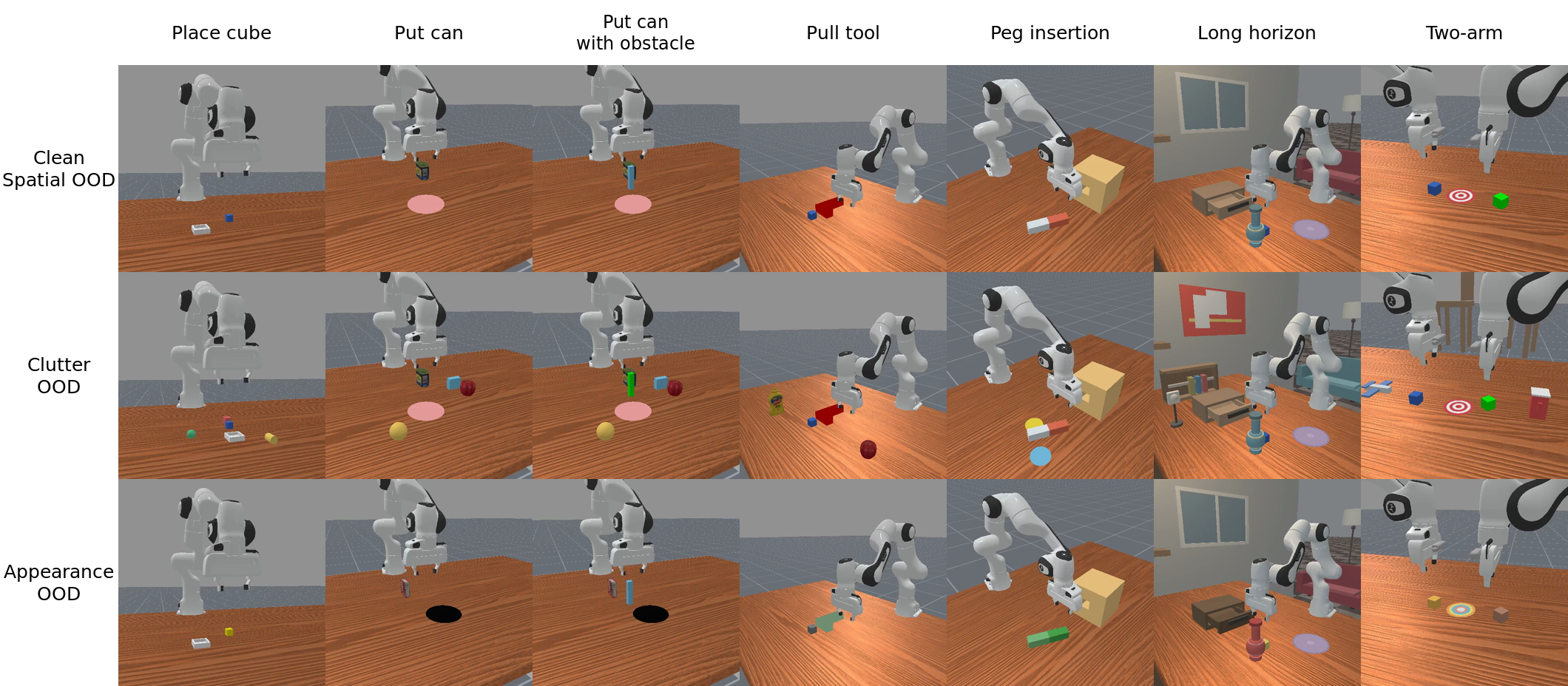
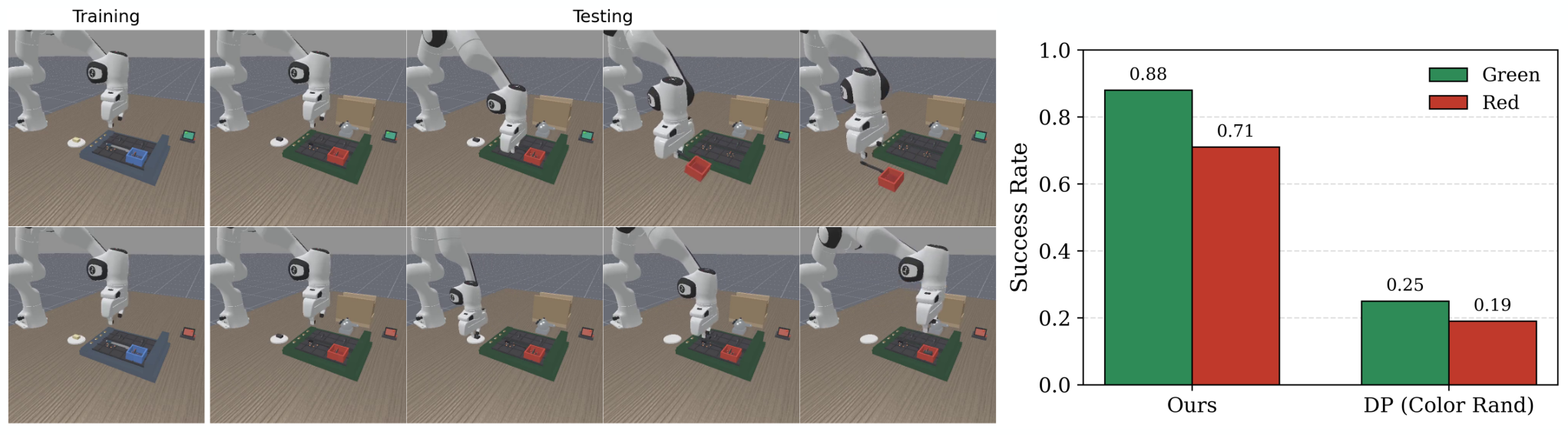
Our experiments evaluate the proposed approach under three forms of visual distribution shift. We first evaluate RoboMP-DINOv2 under held-out spatial configurations and added scene clutter. We then evaluate the RoboMP-DINOv2-MCR training pipeline under unseen task-object appearances.
Finally, we compare RoboMP-DINOv2 with closely matched architectural variants and analyze how strongly the learned representations respond to the evaluated visual perturbations. We consider seven simulated manipulation settings (Fig.
Sources and Demonstrations
Figures are reproduced from Qi et al. See the full paper for experimental details and the project page, when the paper links one, for demonstrations and videos.
Related Papers
A Phenomenology of Neural Geometry in Vision-Language-Action Models
Mozes Jacobs, Aiden Swann, Mathilde Papillon et al.
Robotic manipulation is inherently geometric, but what shape does the world take inside the policy that performs it?

A Sim-to-Real Integration Pipeline for Training and Deployment of Chunk-Based VLA Manipulation Policies
Mathilde Kappel, Clémence Grislain, Mohamed Chetouani et al.
Vision-Language-Action (VLA) models have become a prominent paradigm for mapping multimodal inputs, including semantic instructions, visual observations of the scene, and proprioceptive observations, to robot actions.
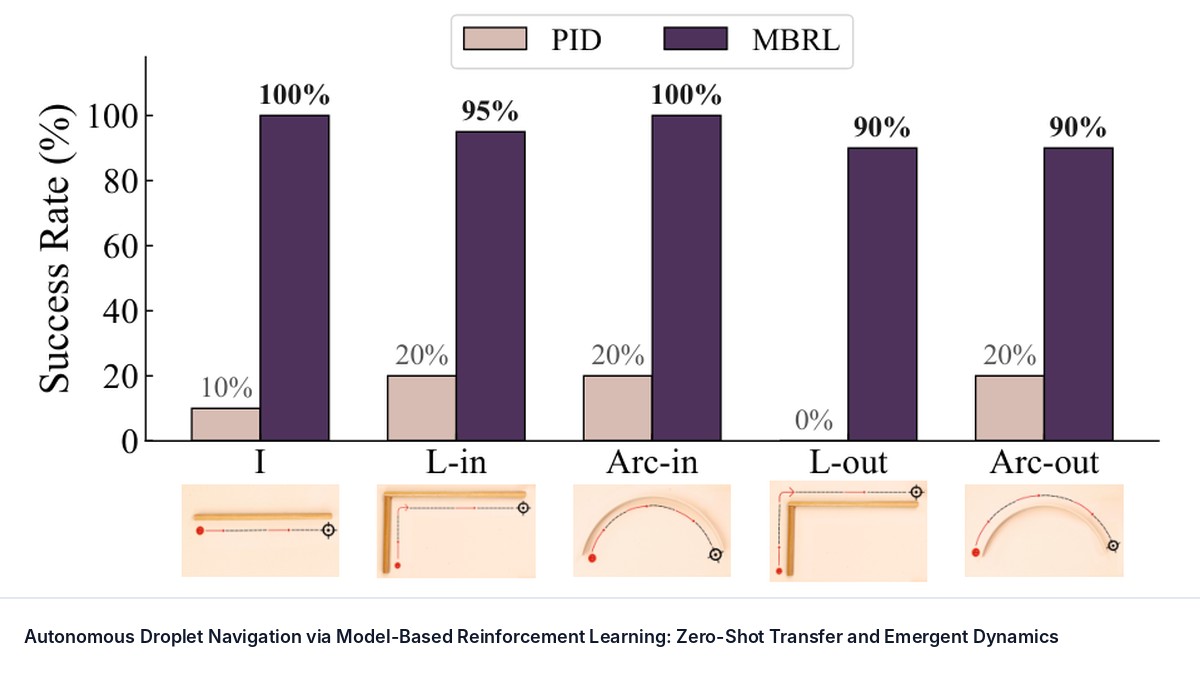
Autonomous Droplet Navigation via Model-Based Reinforcement Learning: Zero-Shot Transfer and Emergent Dynamics
Rajneesh Anand, Mayuresh V. Kothare
Self-driving laboratories (SDLs) are transforming chemical and materials discovery through closed-loop automation, yet automated infrastructure for physical manipulation of soft, deformable matter remains beyond current robotic platforms.
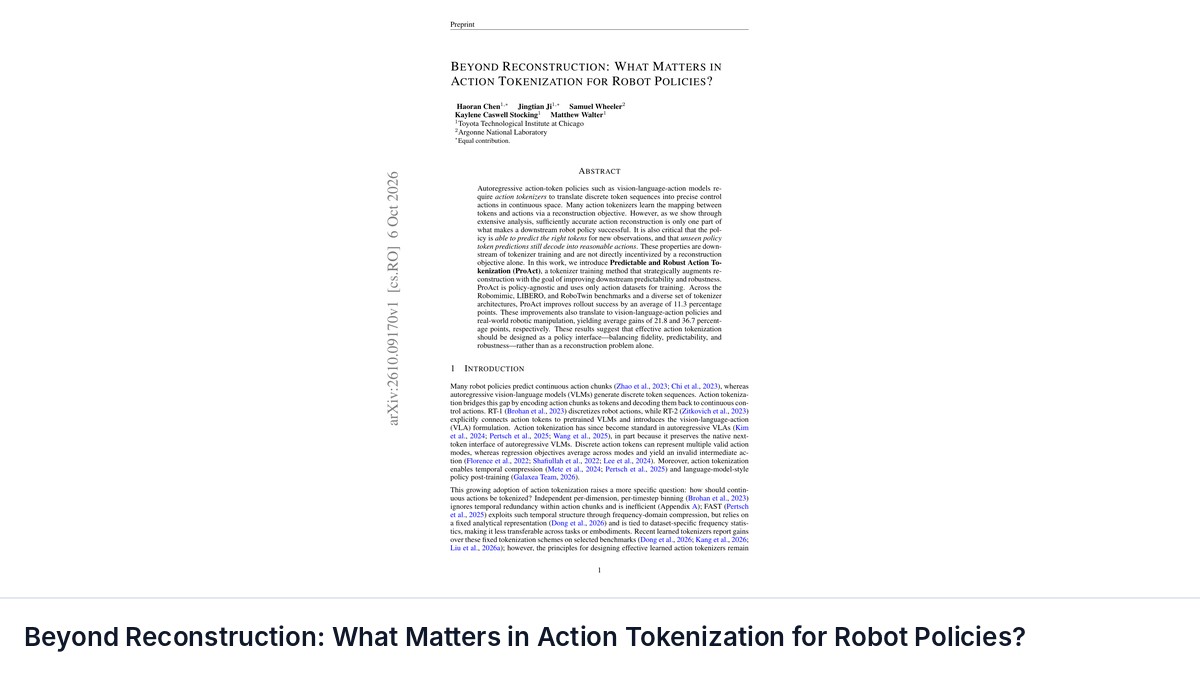
Beyond Reconstruction: What Matters in Action Tokenization for Robot Policies?
Haoran Chen, Jingtian Ji, Samuel Wheeler et al.
Autoregressive action-token policies such as vision-language-action models require action tokenizers to translate discrete token sequences into precise control actions in continuous space. Many action tokenizers learn the mapping between tokens and actions via a reconstruction objective.