
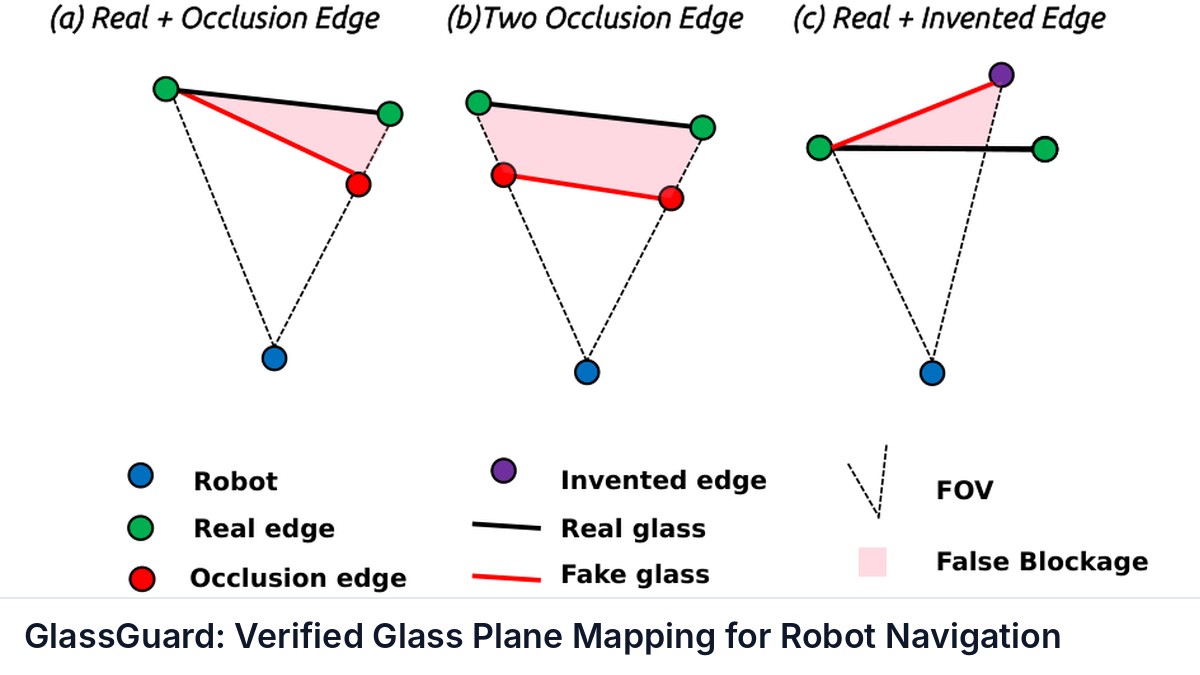
GlassGuard: Verified Glass Plane Mapping for Robot Navigation
Hanwen Guo, Zhengzhi Lin, Yusen Xie, Ji Zhang · N/A · 2026
Framework
N/A
License
N/A
Stars
N/A
Summary
Transparent and specular surfaces pose a serious challenge to LiDAR-based SLAM and navigation because laser returns may pass through glass, leaving collision boundaries absent from the map.
Abstract Summary
Key Points
- Transparent and specular surfaces pose a serious challenge to LiDAR-based SLAM and navigation because laser returns may pass through glass, leaving collision boundaries absent from the map.
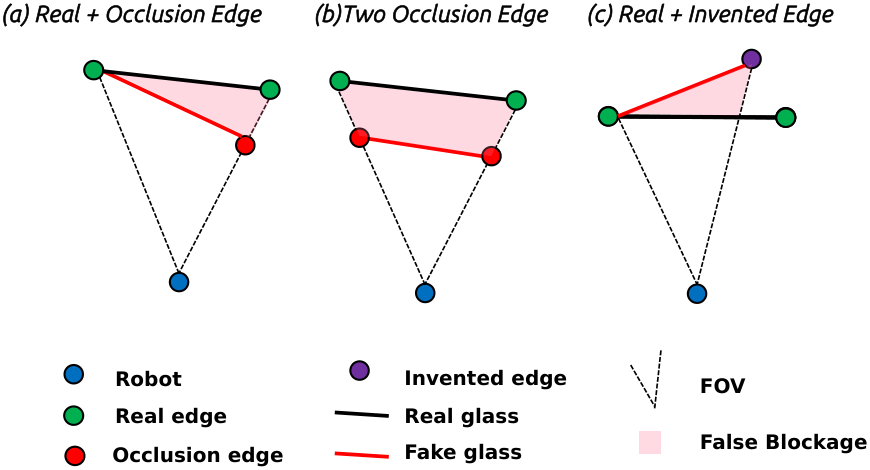
- Prior work attempts to reconstruct the missing surfaces, but inaccurate obstacle placement can create the opposite failure: contamination of traversable free space.
- Recognizing this dual requirement, we present GlassGuard, a navigation-oriented framework for reconstructing planar architectural glass from complementary visual and LiDAR evidence.
- We formulate success in terms of both glass coverage and free-space contamination and apply this principle throughout proposal verification and global map construction.
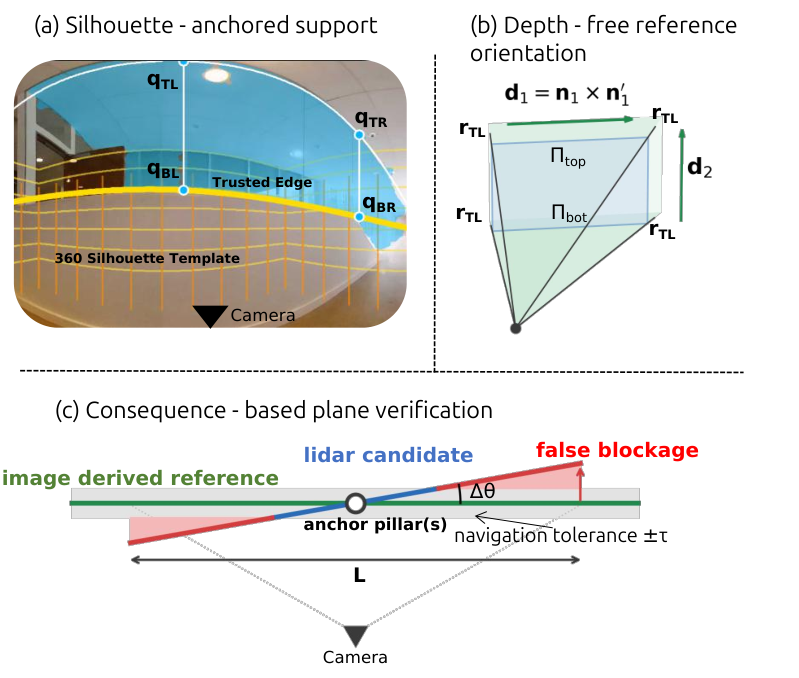
- A foundation vision model provides glass-instance masks, structural 3D cues generate metric plane hypotheses, and depth-free 2D projective geometry checks their orientations before they enter a consolidated global map.
Problem Formulation
For robot navigation, glass reconstruction must satisfy two basic occupancy requirements: physical glass should be represented as occupied, while surrounding traversable space should remain free; these requirements motivate our problem formulation. Let $G_{t}\subset\mathbb{R}^{3}$ denote the true glass surfaces within the region observed by time $t$, and let $S_{t}$ contain all physical surfaces in that region.
Method
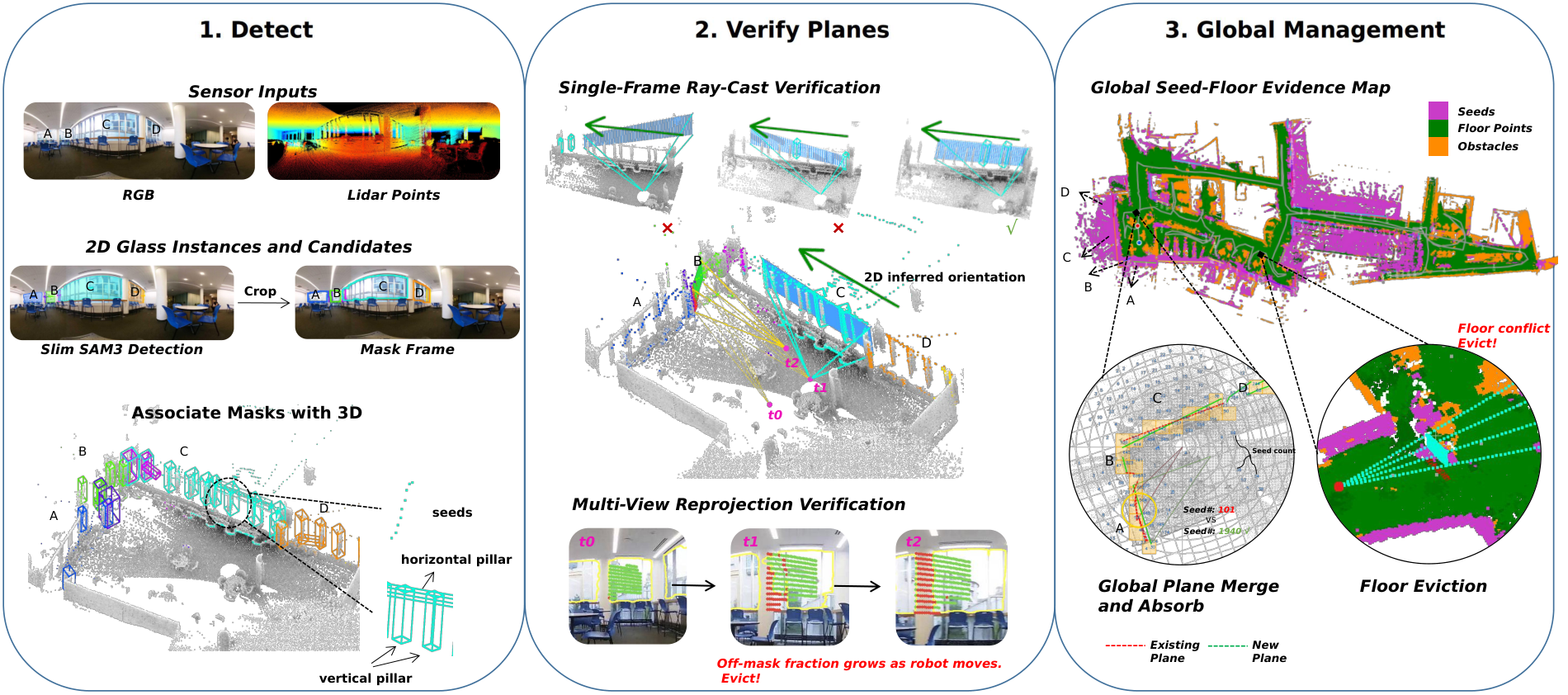
GlassGuard organizes detection as three stages in which each module contributes only what it is reliable for (Fig. 2 ). First , a quantized Slim SAM3 student detects glass-instance masks (Sec. IV-B ); each mask is associated with the surrounding LiDAR geometry to extract seed points (projected 3D points used to localize glass surfaces).
Selected seeds are then grouped into vertical and horizontal pillars, from which bounded 3D plane candidates are constructed (Sec. IV-C ).
Experiments
We evaluate GlassGuard and the baselines using a Mecanum-wheel robot equipped with a Livox Mid-360 LiDAR operating at $10$ Hz [ 1 ] and a $1920\times 640$ Ricoh Theta panoramic camera. At each frame, every LiDAR-using method receives the same $5$ s stack of registered point clouds together with synchronized RGB input.
The pinhole methods receive the same pinhole RGB view, while GG-360 receives the full $360^{\circ}$ panoramic image. GlassGuard runs onboard at a mean of approximately $0.74$ s per frame on an NVIDIA RTX 5070 Ti laptop GPU.
Sources and Demonstrations
Figures are reproduced from Guo et al. See the full paper for experimental details and the project page, when the paper links one, for demonstrations and videos.
Related Papers
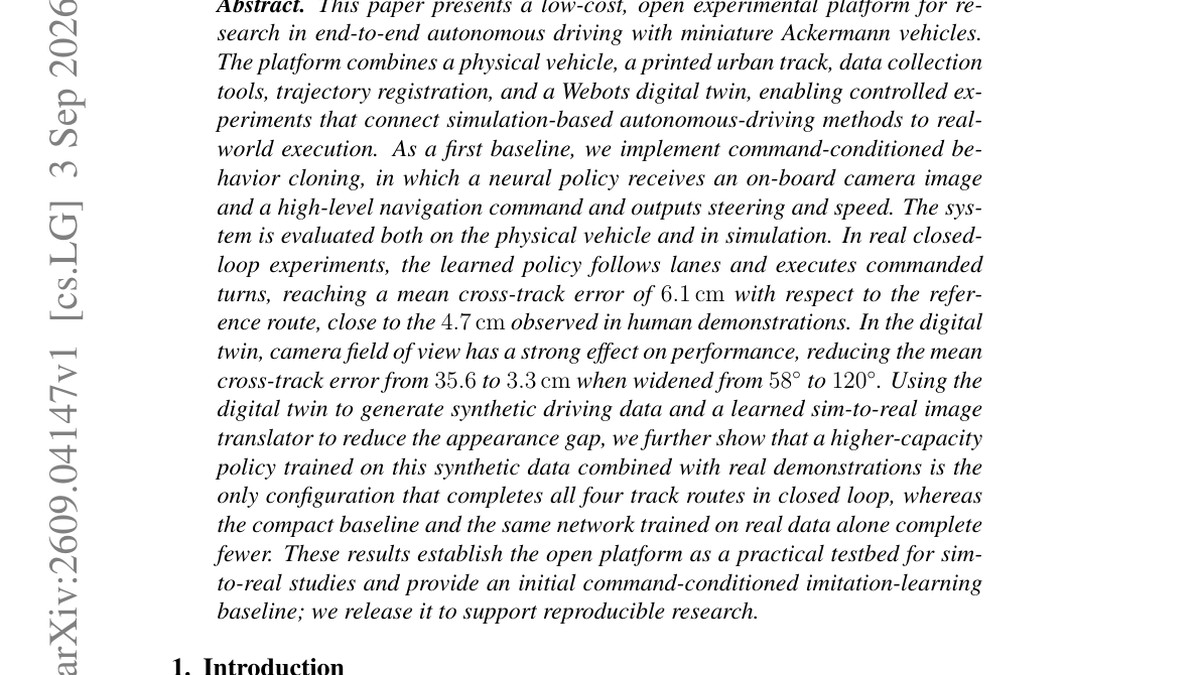
A Low-Cost, Open Platform for End-to-End Autonomous Driving on a Miniature Ackermann Vehicle
Gustavo Claudio Karl Couto, Eric Aislan Antonelo, Gabriel George Zipperer
This paper presents a low-cost, open experimental platform for research in end-to-end autonomous driving with miniature Ackermann vehicles.
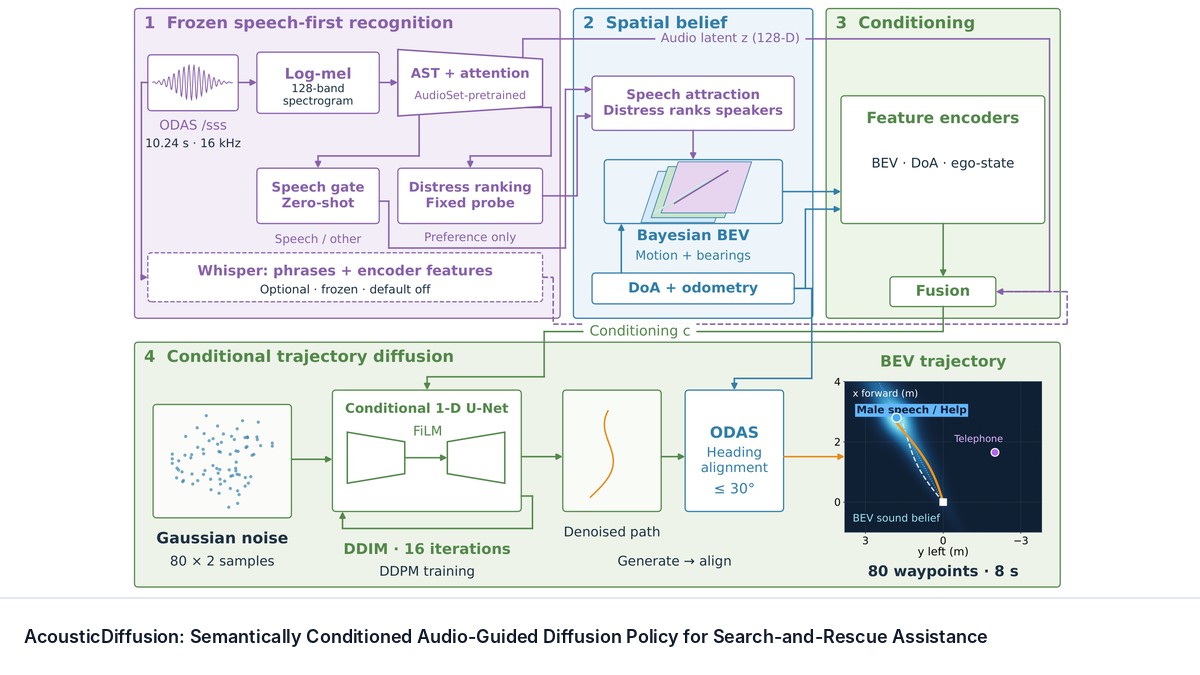
AcousticDiffusion: Semantically Conditioned Audio-Guided Diffusion Policy for Search-and-Rescue Assistance
Iana Zhura, Didar Seyidov, Dmitrii Plotnikov et al.
Navigating toward human callers is an important capability for rescue robots operating where visual contact is degraded or occluded. We present AcousticDiffusion, a semantically conditioned, audio-guided diffusion policy for human-directed navigation.
Aim Short to Reach Far: Your Frozen World Model Can Plan Better Than You Think
Xvyuan Liu, Jianjie Fang, Chen Gao et al.
Planners built on visual world models commonly score each predicted outcome by its distance to the encoded goal image. We show that this target can limit control even with exact dynamics and globally optimal short-horizon search: reaching a goal may require actions that initially move away from it.
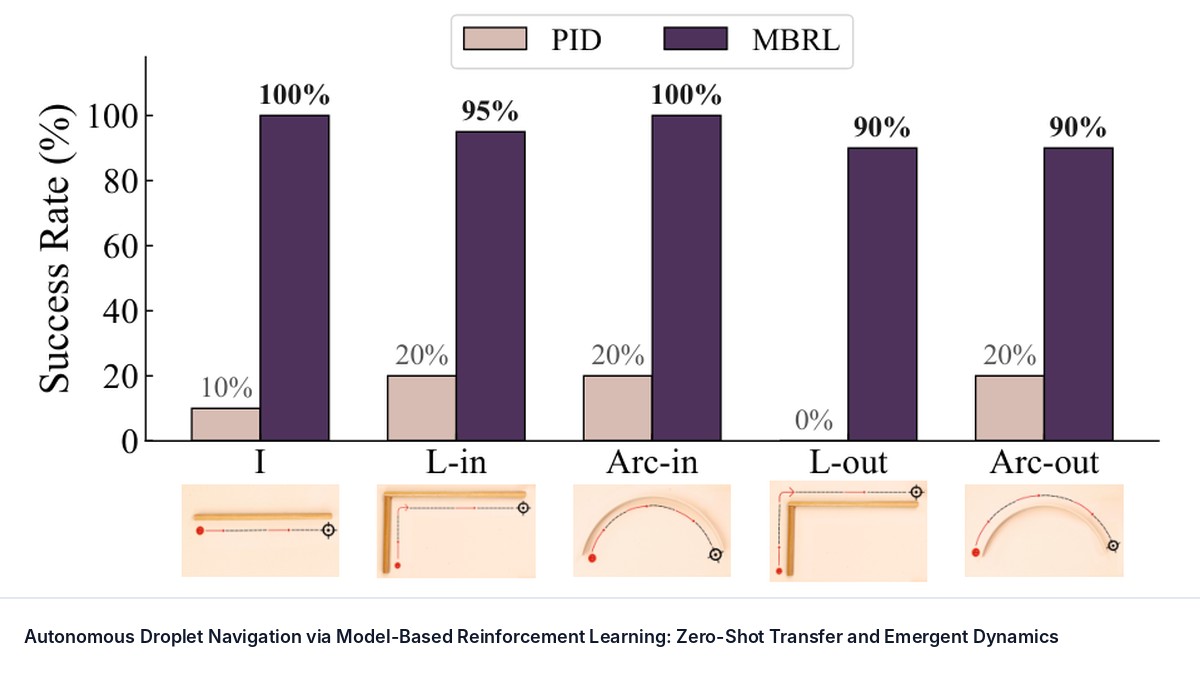
Autonomous Droplet Navigation via Model-Based Reinforcement Learning: Zero-Shot Transfer and Emergent Dynamics
Rajneesh Anand, Mayuresh V. Kothare
Self-driving laboratories (SDLs) are transforming chemical and materials discovery through closed-loop automation, yet automated infrastructure for physical manipulation of soft, deformable matter remains beyond current robotic platforms.