
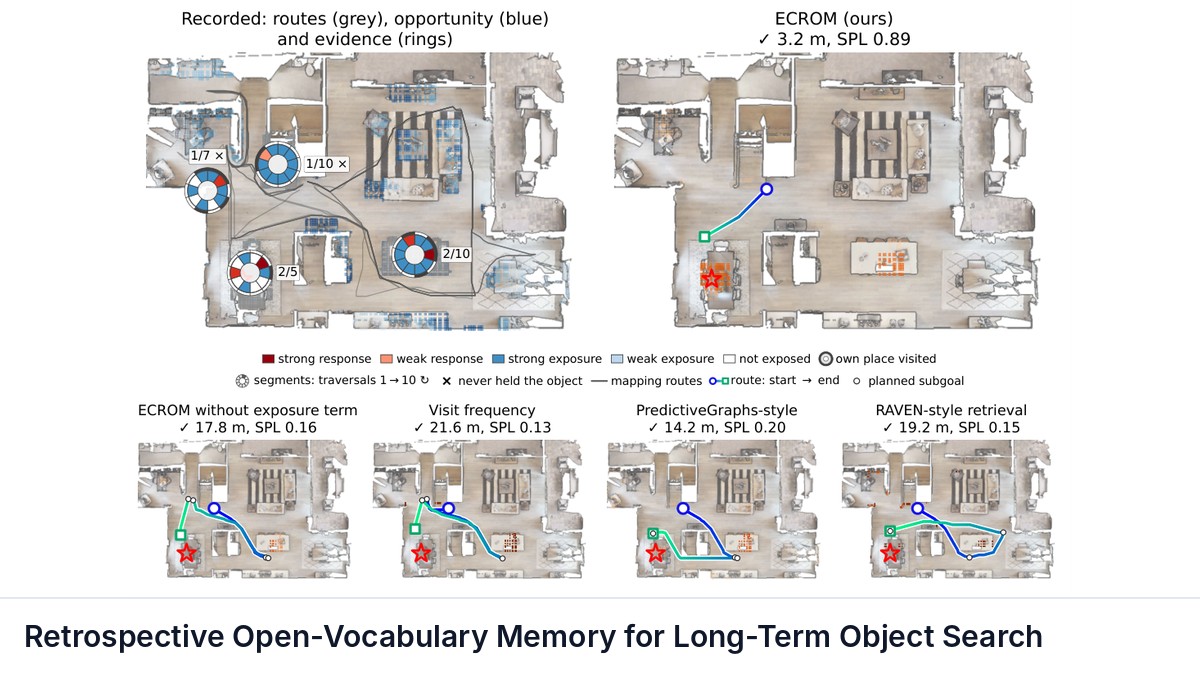
Retrospective Open-Vocabulary Memory for Long-Term Object Search
Jiaming Wang, Zhiwei Xue, Chen Jizhuo, Peng Shiqi, Harold Soh · N/A · 2026
Framework
N/A
License
N/A
Stars
N/A
Summary
Long-term object search requires learning where objects usually appear from repeated but uneven observations of a changing environment.
Abstract Summary
Key Points
- Long-term object search requires learning where objects usually appear from repeated but uneven observations of a changing environment.
- We formulate retrospective open-vocabulary memory as probabilistic inference from censored observations, where the key idea is to reason with evidence per opportunity: a detection or non-detection should influence belief only in proportion to the robot's opportunity to observe the corresponding location.
- We introduce ECROM, which uses this principle to estimate long-term prevalence for concepts specified only at query time and converts the resulting belief directly into an active-search prior.
- To evaluate this problem, we introduce a controlled long-term benchmark in ten HM3D homes that independently varies object placement and observation opportunity across repeated traversals.
- ECROM improves support-level AP on held-out queries by 4.5 points and search SPL by 4.2 points over the strongest competing memory in each metric.
Problem Setup
We record episodes (traversals) $e\in\{1,\ldots,E\}$, each containing a stream of RGB-D frames, odometry, and timestamps. Our goal is to build a query-independent memory $\mathcal{M}$ that can later infer where an arbitrarily specified object is likely to occur and use this prior to search efficiently, rather than exploring the environment from scratch.
We organize this history as a place–view atlas built on the CROSS keyframe graph ( Wang et al., 2026 ) .
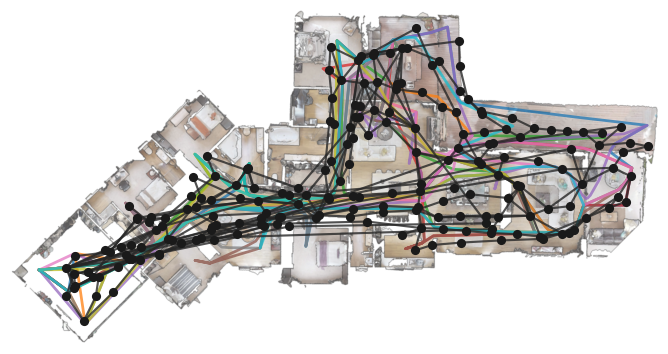
Evidence per Opportunity
(a) Place graph and surface supports $j$ from traversals (b) Opportunity $c_{je}$ of each traversal (c) $p(\theta_{j}\mid\mathcal{H}_{j},q)\propto p(\theta_{j})\,\times$ $\prod_{e}\bigl[1+\theta_{j}c_{je}(\Lambda_{je}-1)\bigr]$ (d) $u^{\star}=\operatorname*{argmax}_{u}$ $\sum_{j}b_{j}c_{j}(u)/(C_{G}(\mathrm{cur},u){+}d_{0})$ 1. Mapping (query independent, once) 2. Query time (any text $q$) 3.

LOOP-Bench: Long-Term Object Occurrence Prediction
We introduce LOOP-Bench ( L ong-Term O bject O ccurrence P rediction), a controlled benchmark that tests whether a robot can infer where an object usually occurs from repeated, uneven observations.
It contains ten HM3D-Semantics homes ( Ramakrishnan et al., 2021 ; Yadav et al., 2023 ) , where objects are repeatedly placed from hidden long-term distributions while routes and viewpoints are sampled independently, separating prevalence from observation opportunity (Figure 4 ).
Simulation Experiments
For each of the 50 LOOP-Bench queries, we build each method’s memory from the 20 mapping traversals of its house and evaluate its predictions on the shared surface supports.
We derive two ground truths from the hidden placement distribution $\pi$: a 15 cm footprint allocates each placement to supports, giving the occurrence probabilities $g_{j}$ used for ranking, and $\theta_{j}^{\ast}=\sum_{k}\pi_{k}m_{jk}$ is the probability that the object rests within 45 cm of support $j$ ($m_{jk}=1$ when placement $k$ does), the prevalence of Eq.
Real-Robot Experiment
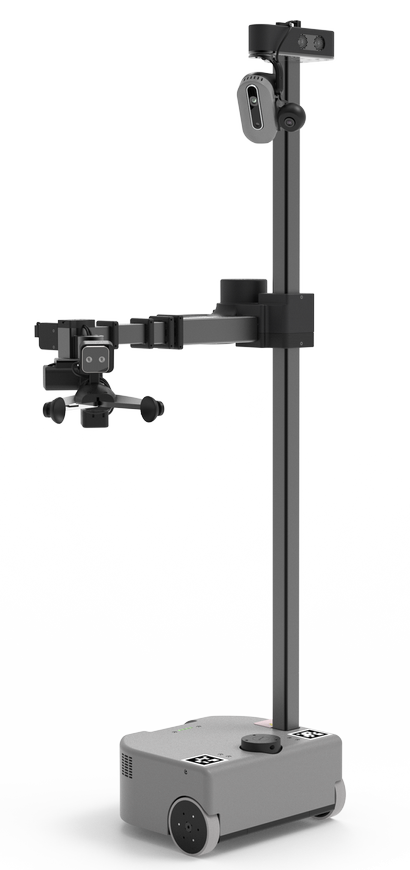
We test whether the prevalence learned by Ecrom transfers to physical robot search. A Hello Robot Stretch 3 operates on an approximately $500\,\mathrm{m}^{2}$ office floor containing desks, tables, shelves, and other candidate supports (Figure 5 ). Each object is assigned a hidden distribution over supports.
Before each of ten mapping traversals, its location is resampled from this distribution; the robot records only RGB-D observations and odometry.
Sources and Demonstrations
Figures are reproduced from Wang et al. See the full paper for experimental details and the project page, when the paper links one, for demonstrations and videos.
Related Papers

A Sim-to-Real Integration Pipeline for Training and Deployment of Chunk-Based VLA Manipulation Policies
Mathilde Kappel, Clémence Grislain, Mohamed Chetouani et al.
Vision-Language-Action (VLA) models have become a prominent paradigm for mapping multimodal inputs, including semantic instructions, visual observations of the scene, and proprioceptive observations, to robot actions.
Aim Short to Reach Far: Your Frozen World Model Can Plan Better Than You Think
Xvyuan Liu, Jianjie Fang, Chen Gao et al.
Planners built on visual world models commonly score each predicted outcome by its distance to the encoded goal image. We show that this target can limit control even with exact dynamics and globally optimal short-horizon search: reaching a goal may require actions that initially move away from it.
Beyond Reconstruction: What Matters in Action Tokenization for Robot Policies?
Haoran Chen, Jingtian Ji, Samuel Wheeler et al.
Autoregressive action-token policies such as vision-language-action models require action tokenizers to translate discrete token sequences into precise control actions in continuous space. Many action tokenizers learn the mapping between tokens and actions via a reconstruction objective.
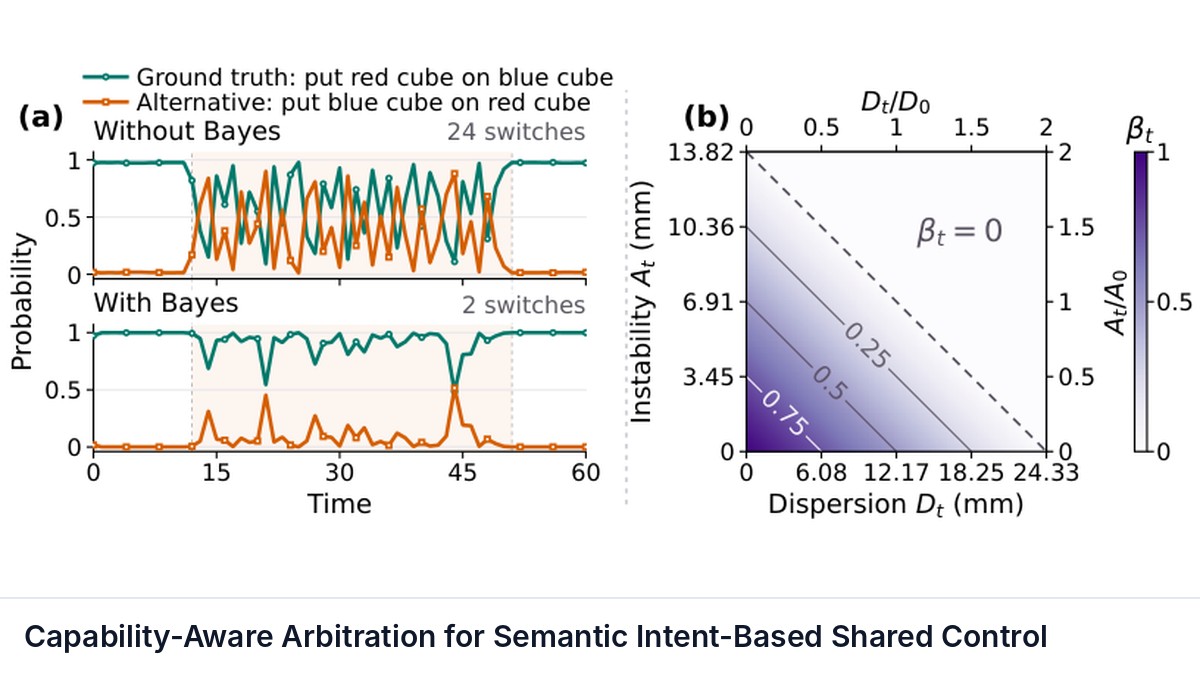
Capability-Aware Arbitration for Semantic Intent-Based Shared Control
Zhaoda Du, Michael Bowman, Xiaoli Zhang
Shared control often allocates robot authority based on confidence in inferred human intent, assuming reliable autonomous execution. When this assumption fails, high intent confidence can cause over-helping.