
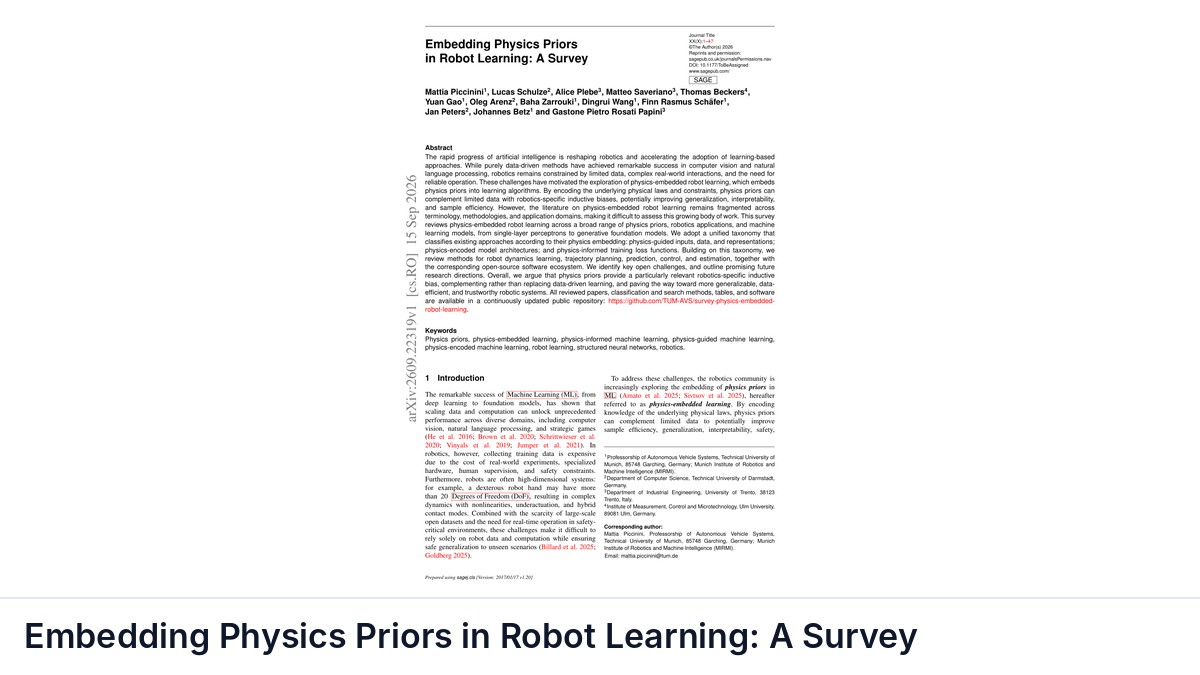
Embedding Physics Priors in Robot Learning: A Survey
Mattia Piccinini, Lucas Schulze, Alice Plebe, Matteo Saveriano, Thomas Beckers, Yuan Gao, Oleg Arenz, Baha Zarrouki, Dingrui Wang, Finn Rasmus Sch\"afer, Jan Peters, Johannes Betz, Gastone Pietro Rosati Papini · N/A · 2026
Framework
N/A
License
N/A
Stars
N/A
Summary
The rapid progress of artificial intelligence is reshaping robotics and accelerating the adoption of learning-based approaches.
Abstract Summary
Key Points
- The rapid progress of artificial intelligence is reshaping robotics and accelerating the adoption of learning-based approaches.
- While purely data-driven methods have achieved remarkable success in computer vision and natural language processing, robotics remains constrained by limited data, complex real-world interactions, and the need for reliable operation.
- These challenges have motivated the exploration of physics-embedded robot learning, which embeds physics priors into learning algorithms.
- By encoding the underlying physical laws and constraints, physics priors can complement limited data with robotics-specific inductive biases, potentially improving generalization, interpretability, and sample efficiency.
- However, the literature on physics-embedded robot learning remains fragmented across terminology, methodologies, and application domains, making it difficult to assess this growing body of work.
Physics-Guided, Physics-Encoded, and Physics-Informed Robot Learning: Overview and Organization
Does the method embed physics priors that express specific physical knowledge of a robotic system, rather than generic mathematical structure? Are any physics priors used to transform, enrich, curate, select, or correct the inputs, data, or representations provided to/by the learning model, either before training or as pre- or post-processing guidance at inference?
Physics-Guided Are any physics priors encoded in learning model architectures, remaining active during inference? Physics-Encoded Are any physics priors incorporated into the trainin...
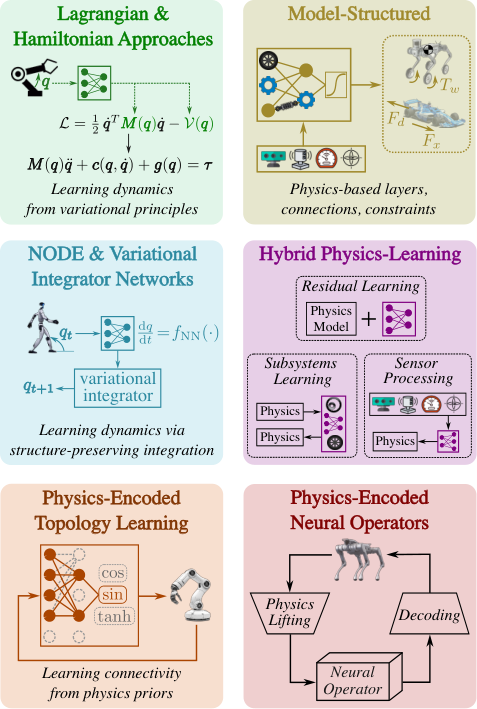
Physics-Encoded Architectures
A first approach to embedding physics priors in robot learning is to design model architectures that explicitly encode physical principles and constraints. This introduces inductive biases aligned with the underlying dynamics, with the potential to improve interpretability, generalization, and sample efficiency. Following Faroughi et al.
(2024) , we refer to physics-encoded NNs as models that “forcibly encode known physics into their core architecture”.
Physics-Informed Loss Functions
Physics-informed approaches provide a flexible and data-efficient framework for solving forward and inverse problems governed by differential equations, by embedding physical laws as soft constraints in the training loss functions. The combination of data-driven and physics-informed loss terms can improve generalization in data-scarce regions, and hence improve the physical consistency of the learned model.
Physics-Guided Inputs, Data, and Representations
Physics-guided learning exploits physics priors to transform, enrich, curate, select, or correct input features, training data, and learned representations.
Rather than modifying the model architecture or training objective, these methods embed physical knowledge into the inputs, data, or representations before training or as pre- or post-processing guidance at inference, while preserving the flexibility of standard ML models.
Software Tools
✓ denotes primary or native support, while $\sim$ denotes partial, indirect, or application-dependent support. Blank cells indicate functionalities that are not objectives of the framework.
In the Optimizers column, Wrapper indicates that the framework relies on optimization algorithms provided by its underlying backend or external libraries, whereas Custom indicates dedicated optimization procedures or training algorithms.
Open Research Questions and Challenges
Despite the rapid progress reviewed in this survey, embedding physics priors in robot learning methods remains an open research field. We organize the main open questions and challenges around the following themes. Challenge 1 – Generality versus Physics-based Inductive Bias: A fundamental trade-off exists between the flexibility of data-driven learning and the inductive bias introduced by physics priors.
The success of foundation models suggests that large-scale pre-training can yield remarkable generalization.
Future Research Directions
To address the open challenges outlined in Sec. 7 , we identify seven research directions that, in our view, represent the most promising paths toward complementing data-driven robot learning with physics priors.
Direction 1 – Combining Multiple Physics-Prior Routes: A promising future direction is the systematic combination of physics-guided inputs and data, physics-encoded architectures, and physics-informed loss functions within unified learning frameworks.
Sources and Demonstrations
Figures are reproduced from Piccinini et al. See the full paper for experimental details and the project page, when the paper links one, for demonstrations and videos.
Related Papers
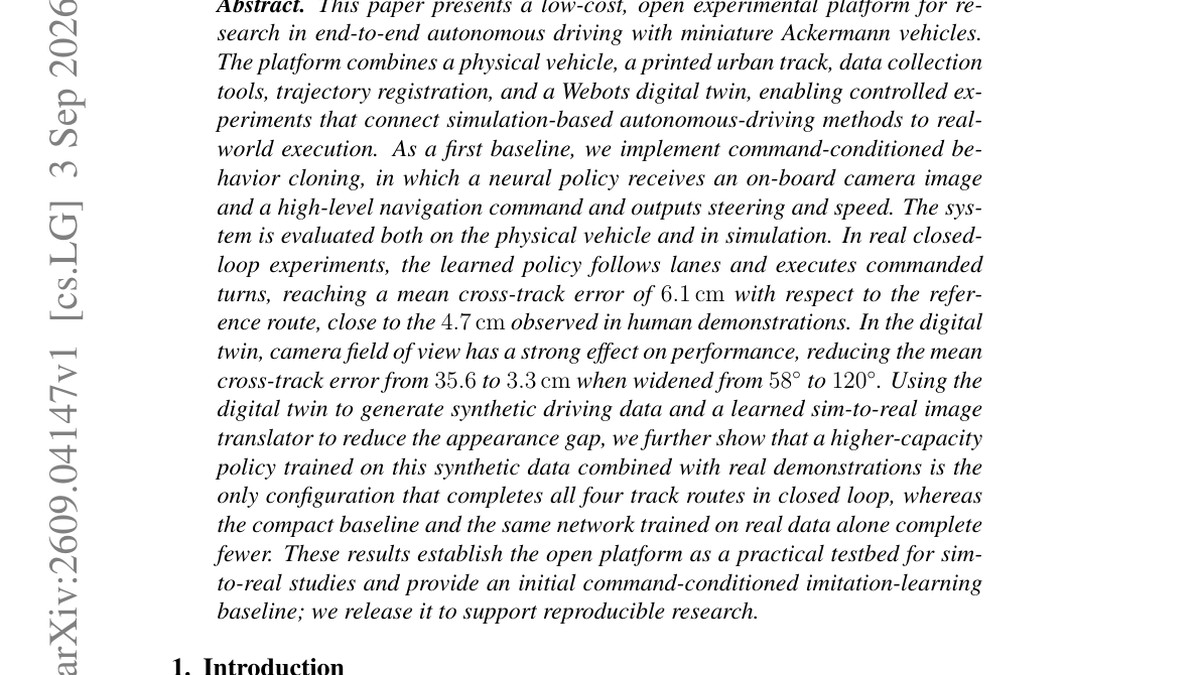
A Low-Cost, Open Platform for End-to-End Autonomous Driving on a Miniature Ackermann Vehicle
Gustavo Claudio Karl Couto, Eric Aislan Antonelo, Gabriel George Zipperer
This paper presents a low-cost, open experimental platform for research in end-to-end autonomous driving with miniature Ackermann vehicles.

Aim Short to Reach Far: Your Frozen World Model Can Plan Better Than You Think
Xvyuan Liu, Jianjie Fang, Chen Gao et al.
Planners built on visual world models commonly score each predicted outcome by its distance to the encoded goal image. We show that this target can limit control even with exact dynamics and globally optimal short-horizon search: reaching a goal may require actions that initially move away from it.
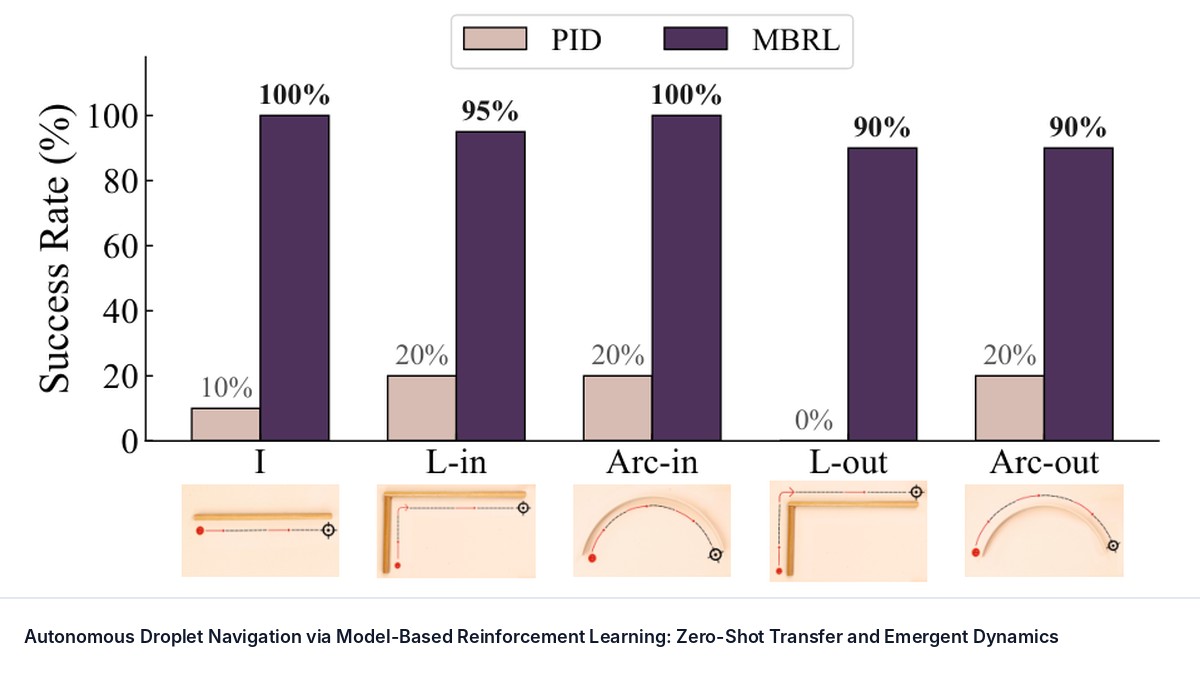
Autonomous Droplet Navigation via Model-Based Reinforcement Learning: Zero-Shot Transfer and Emergent Dynamics
Rajneesh Anand, Mayuresh V. Kothare
Self-driving laboratories (SDLs) are transforming chemical and materials discovery through closed-loop automation, yet automated infrastructure for physical manipulation of soft, deformable matter remains beyond current robotic platforms.
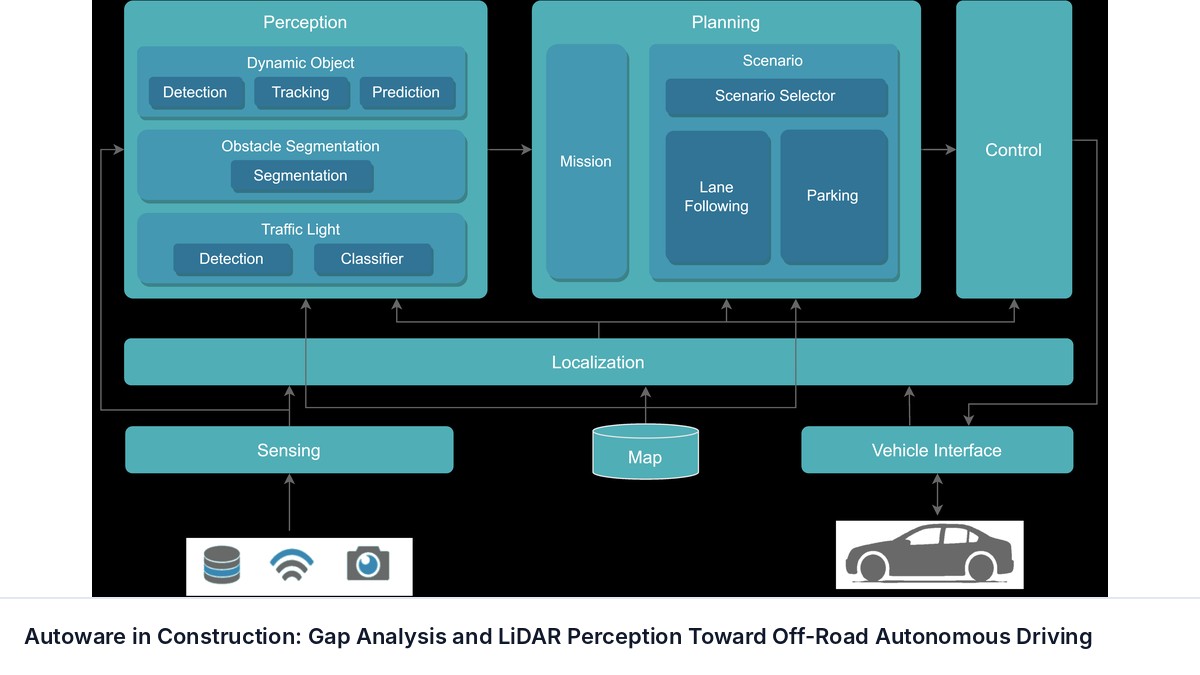
Autoware in Construction: Gap Analysis and LiDAR Perception Toward Off-Road Autonomous Driving
Yu Otsuki, Teja Emmey, Sena Matsushita et al.
Autoware is an open-source autonomous driving software platform widely adopted by researchers and industry developers.