
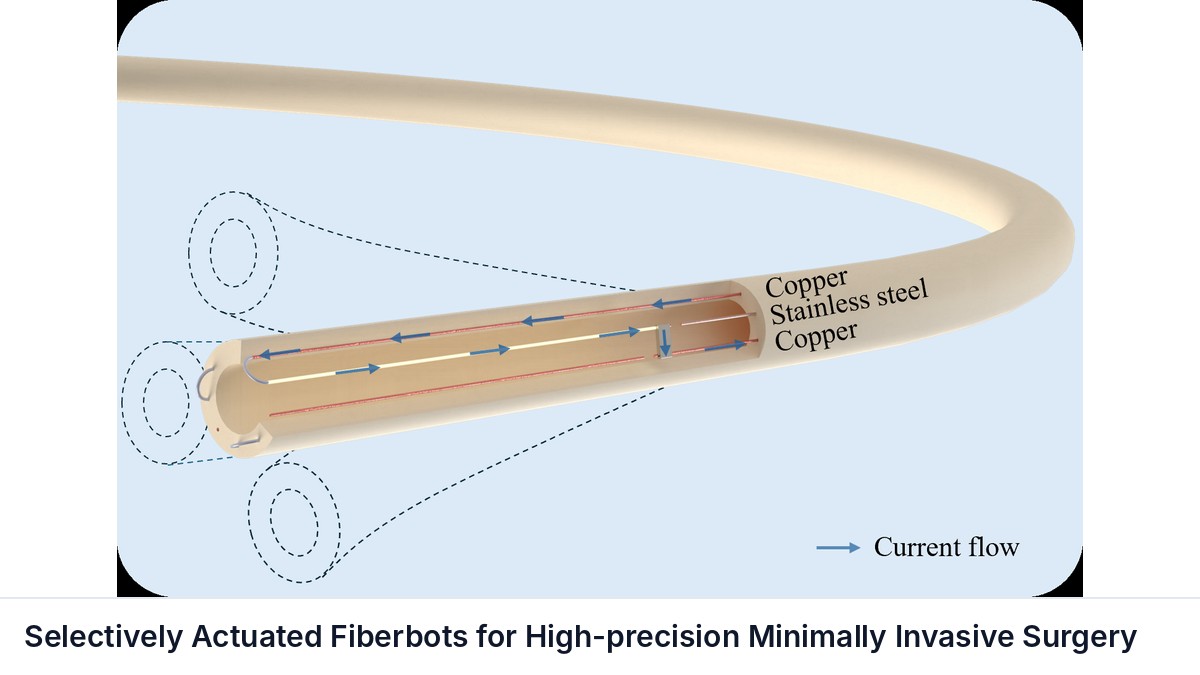
Selectively Actuated Fiberbots for High-precision Minimally Invasive Surgery
Jinshi Zhao, Libaihe Tian, Alex Ranne, Qindong Zheng, Yue Li, Xiaotong Guo, Ziqi Yang, Ali Anil Demircali, Mohamed E. M. K. Abdelaziz, Bruno Gil Rosa, Ferdinando Rodriguez y Baena, Burak Temelkuran · N/A · 2026
Framework
N/A
License
N/A
Stars
N/A
Summary
Long, slender instruments are essential for minimally invasive surgery (MIS), but achieving precise distal manipulation becomes increasingly difficult when actuation extends along the entire instrument.
Abstract Summary
Key Points
- Long, slender instruments are essential for minimally invasive surgery (MIS), but achieving precise distal manipulation becomes increasingly difficult when actuation extends along the entire instrument.
- Here, we present an electrothermally actuated fiber-based robot designed for MIS procedures, in which Joule heating is concentrated in the distal active segment.
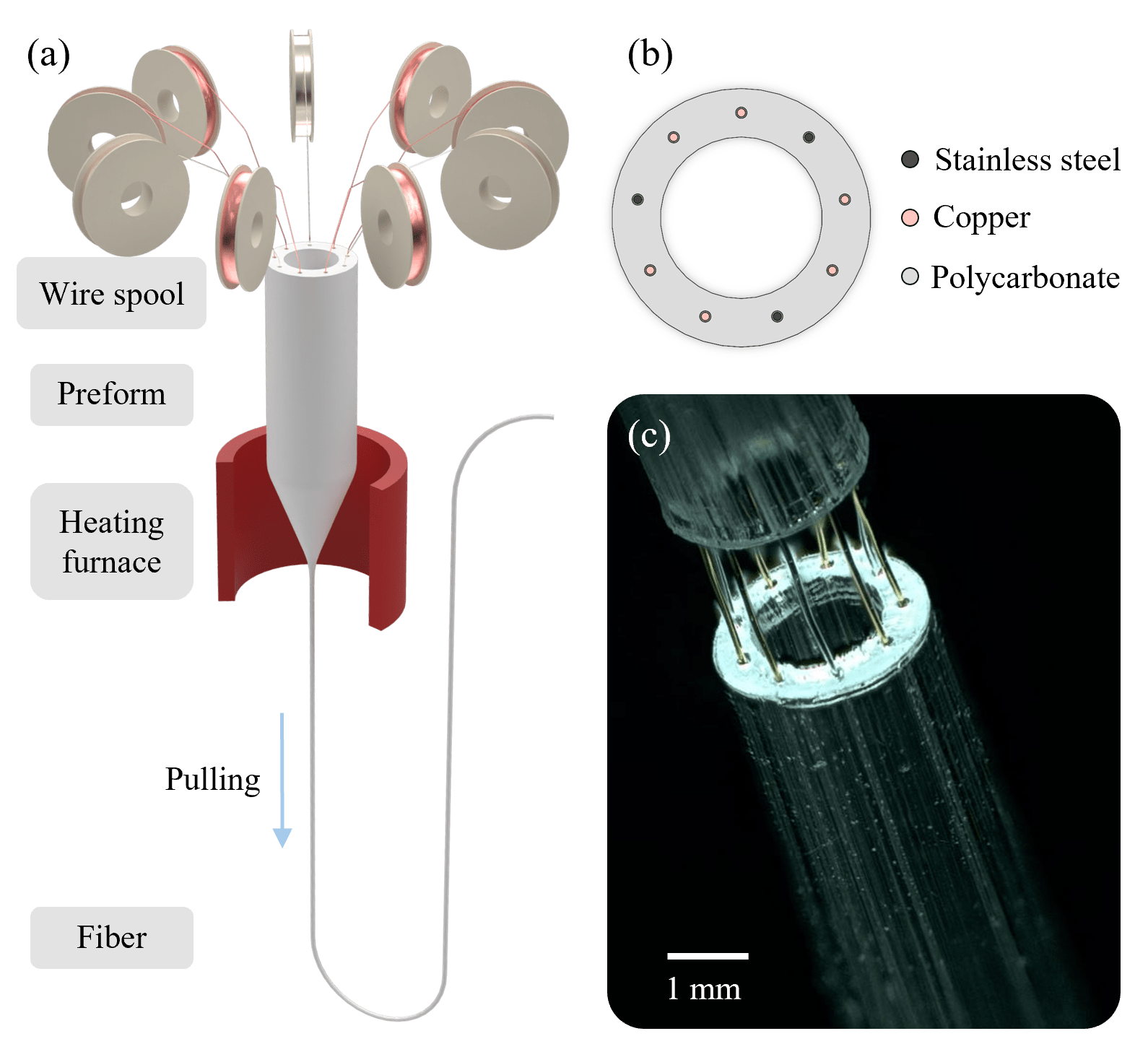
- The fiber is fabricated using a thermal drawing process and uses embedded metallic wires for thermal actuation.
- This robotic fiber, 1.9 mm in diameter and 1.2 m in length, can precisely manipulate surgical laser fibers with positional precision below 100 $\mu$m.
- The compact size of the fiber robot allows it to pass through the working channel of a flexible endoscope, while keeping both devices mechanically uncoupled to allow independent motion.
METHODS
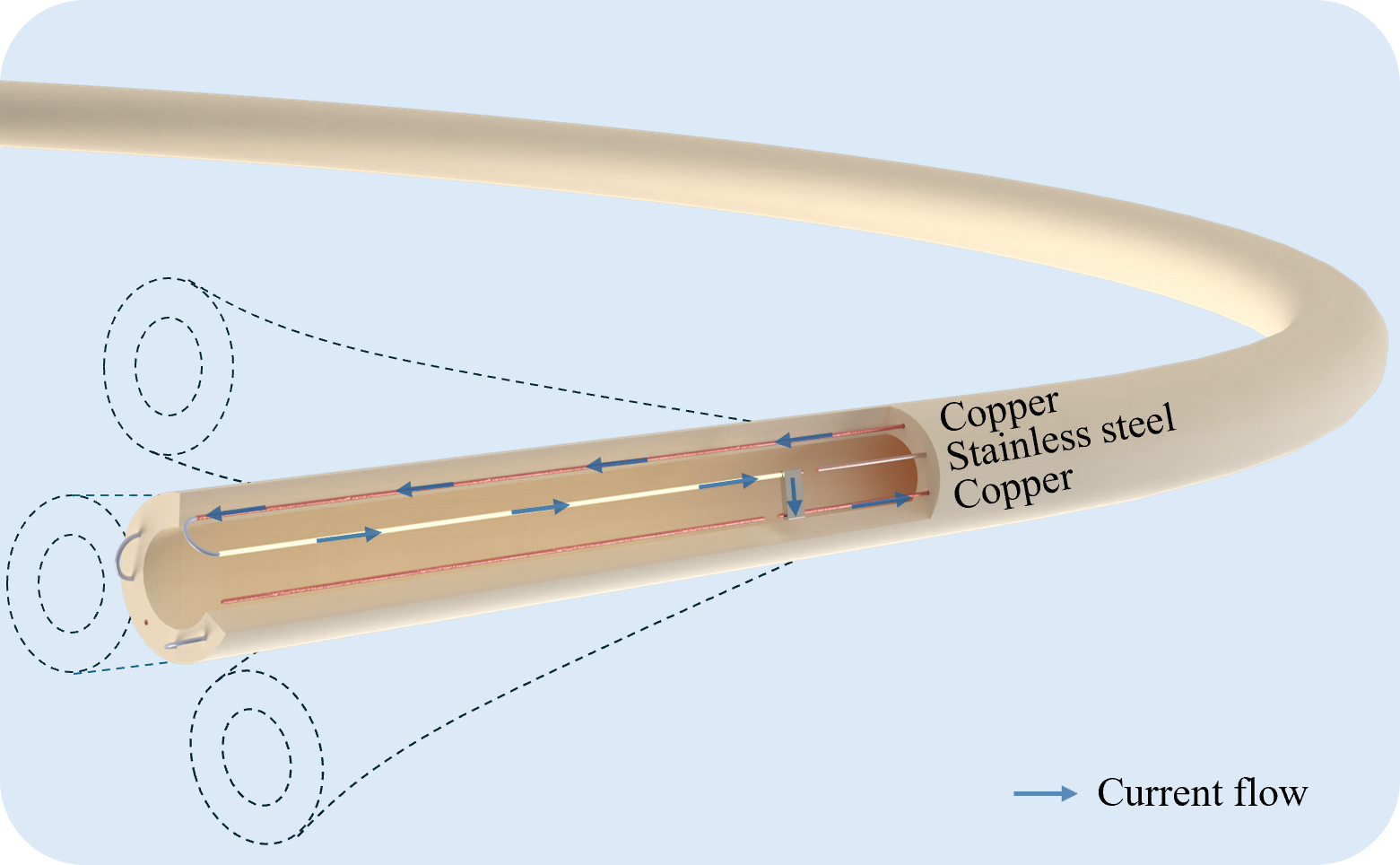
The fiberbot body design consists of a tubular polymeric structure with an outer diameter of 1.9 mm and an inner diameter of 1 mm, adapted to accommodate commercially available fiber-based surgical instruments, such as surgical laser fibers. Nine side lumens are uniformly distributed around a central channel to accommodate metallic wires.
Three triplets of 60 $\mu$m metallic wires, arranged as ’copper–stainless steel–copper’, were embedded within these side channels for actuation and power transmission (Fig. 1 ).
EXPERIMENTAL EVALUATION
To control and actuate the fiberbot, the adapter connected to the fiber was interfaced with a buffer circuit consisting of six operational amplifiers (op-amps). These op-amps provided voltage amplification and impedance matching between the control system and each of the actuation wires.
The input of the buffer circuit was connected via jumper wires to the digital-to-analog converter (DAC) ports of a real-time controller (cRIO-9025, National Instruments, USA). The control system was developed within the LabVIEW environment (Fig. 4 (a)) [ 4 ] .
Sources and Demonstrations
Figures are reproduced from Zhao et al. See the full paper for experimental details and the project page, when the paper links one, for demonstrations and videos.
Related Papers
A Balanced Data Diet: Addressing the Exploration Bottleneck in Mega-Scale RL for Robot Control
Octi Zhang, Mateo Guaman Castro, Patrick Yin et al.
General-purpose robots must perform a wide range of tasks from agile locomotion to dexterous manipulation.

A Sim-to-Real Integration Pipeline for Training and Deployment of Chunk-Based VLA Manipulation Policies
Mathilde Kappel, Clémence Grislain, Mohamed Chetouani et al.
Vision-Language-Action (VLA) models have become a prominent paradigm for mapping multimodal inputs, including semantic instructions, visual observations of the scene, and proprioceptive observations, to robot actions.
AHEAD: Anticipatory Hand-Driven Teleoperation via Human Intent Prediction
Seok Joon Kim, Junho Lee, Federica Spinola et al.
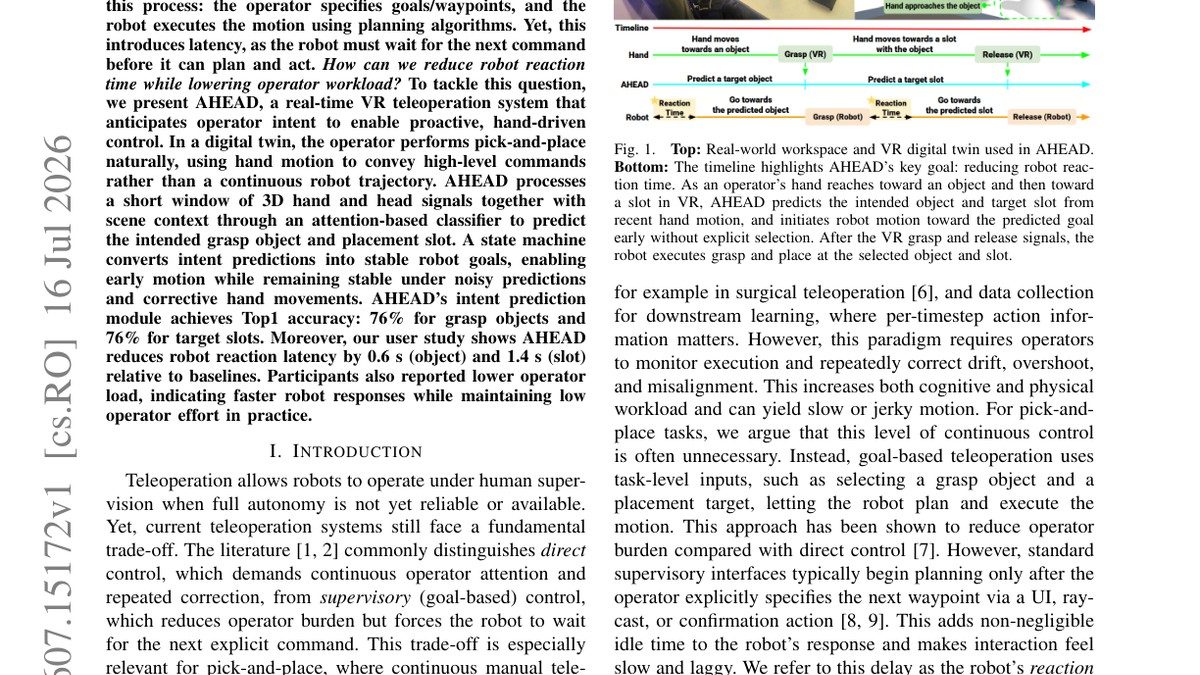
Direct hand-driven teleoperation maps an operator's hand motion to robot end-effector commands at every frame, enabling precise control, but it requires constant monitoring and correction during approach, grasp, and placement, which can be slow and fatiguing.

AXIS: A Growable Community-Driven Data Engine for Scalable Robot Manipulation
Mengfei Zhao, Dihong Huang, Yikai Tang et al.
Learning effective robot manipulation policies requires diverse, high-quality demonstrations, yet existing data pipelines are often difficult to scale because they rely on specialized hardware, centralized operators, or fixed task suites.