
ORCH: Organizational Principles Enable Collective Intelligence in Embodied AI
Zhengran Ji, Jonathan Hyun, Boyuan Chen · N/A · 2026
Framework
N/A
License
N/A
Stars
N/A
Summary
Collective intelligence depends not only on the capabilities of individual members, but also on how those members are organized.
Abstract Summary
Key Points
- Collective intelligence depends not only on the capabilities of individual members, but also on how those members are organized.
- Yet artificial multi-agent systems are typically assembled using fixed organizational structures, even when the physical tasks they perform impose fundamentally different coordination requirements.
- Here we show that principles from human organization theory can be operationalized to organize large, heterogeneous collectives of embodied artificial agents.
- We introduce ORCH (Organizing Roles and Coordination Hierarchies), which constructs task-specific hierarchical organizations by combining pooled interdependence for work that can proceed concurrently with sequential interdependence for work governed by prerequisite relationships.
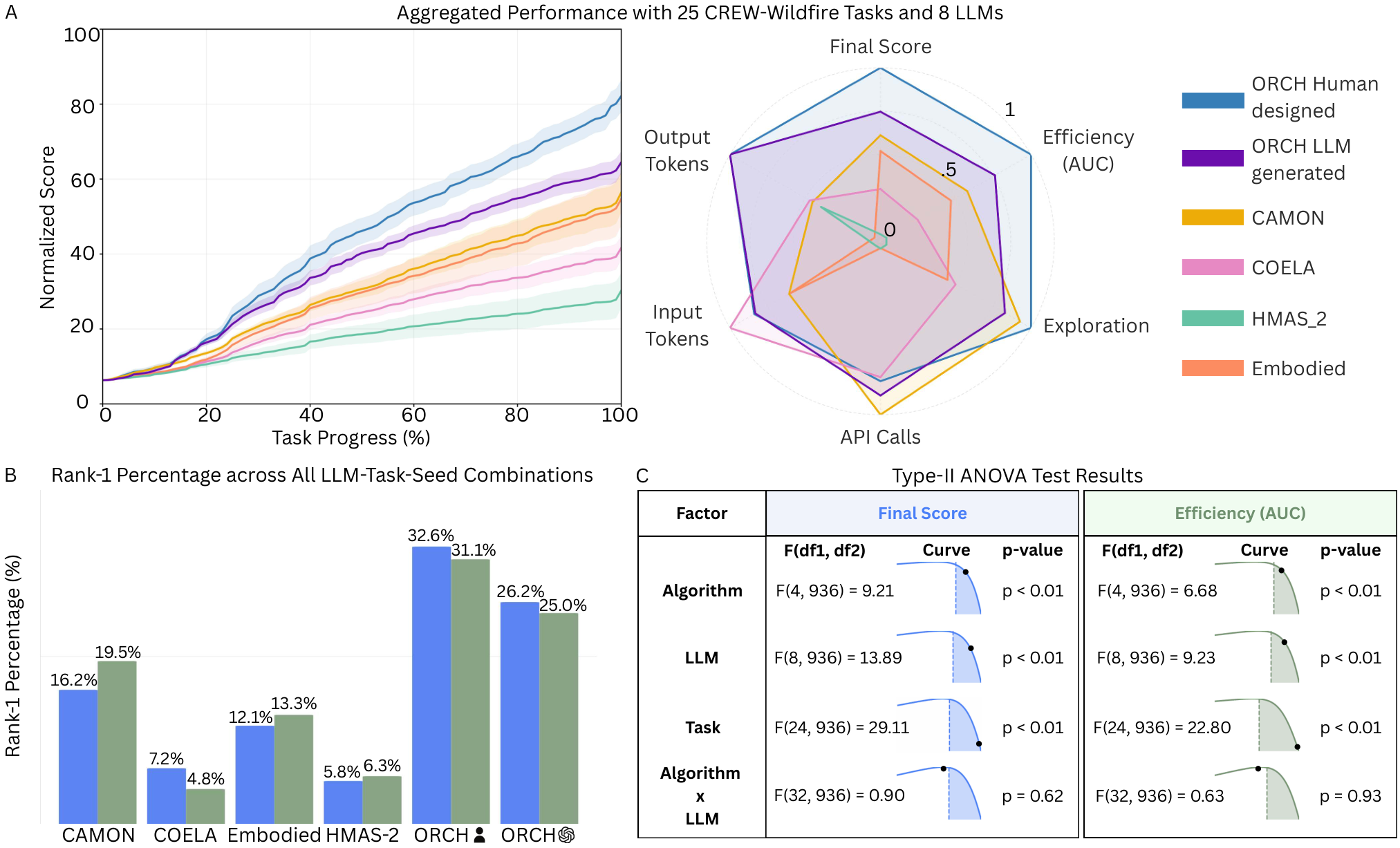
- Across 25 wildfire-response missions spanning reconnaissance, rescue, transportation, resource management, containment and suppression, we evaluated teams of up to 50 heterogeneous agents using eight large language models.
Results
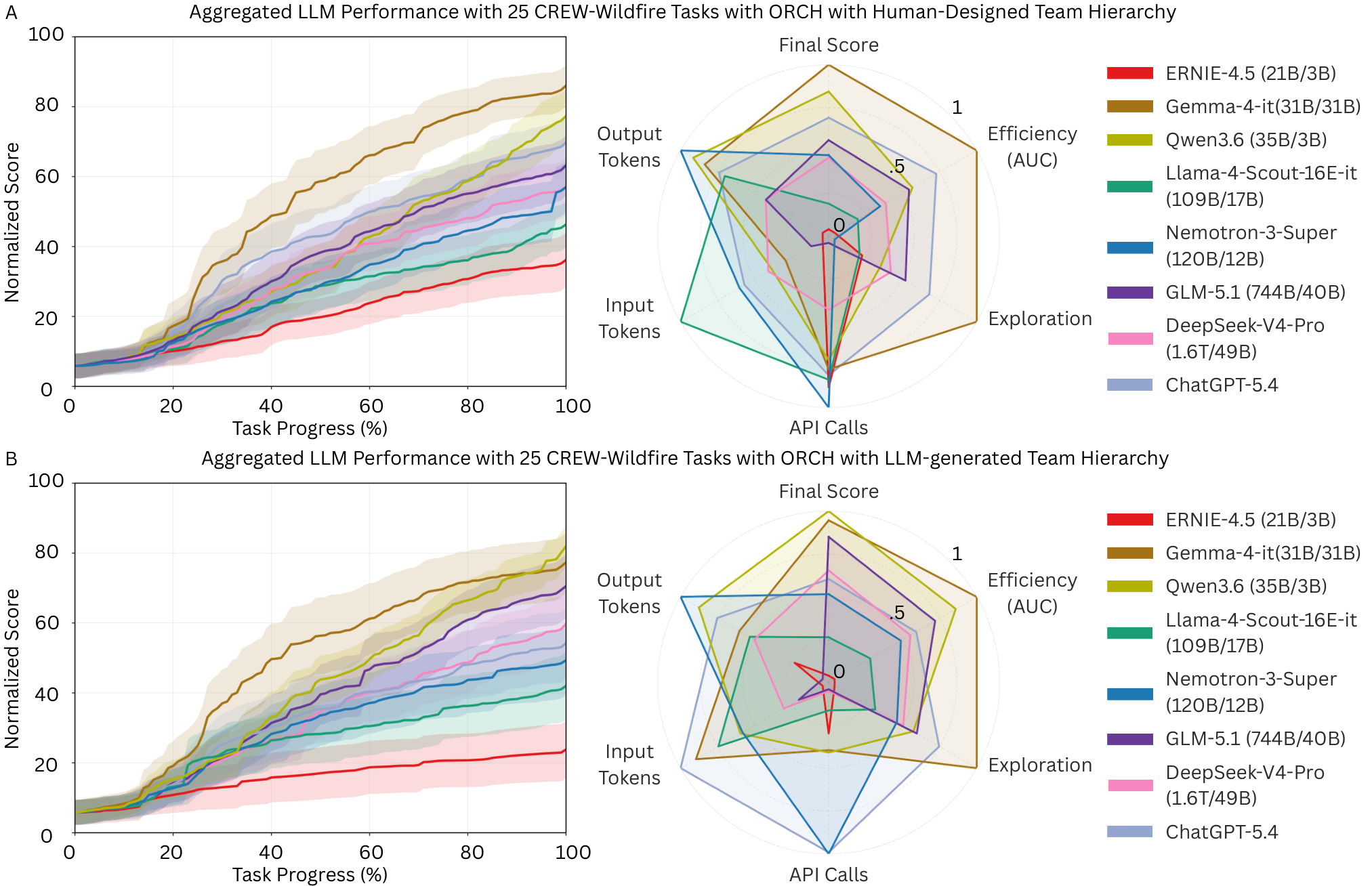
We evaluated ORCH on all 25 CREW-Wildfire missions using five random seeds per task and eight LLMs as the base model for each agent including ChatGPT-5.4 [ 36 ] , Gemma-4-it [ 37 ] , Llama-4-Scout-16E-it [ 5 ] , ERNIE-4.5 [ 2 ] , Qwen-3.6 [ 47 ] , Nemotron-3-Super [ 3 ] , GLM-5.1 [ 15 ] , and DeepSeek-V4-Pro [ 8 ] . These models range in size and capabilities. They also include both proprietary and open-weight models.
Method
Previous embodied LLM-based multi-agent algorithms relied on fixed and naive team hierarchies, typically following an orchestral style in which a single manager supervises all worker agents [ 44 , 51 , 7 , 17 ] . In ORCH , we propose adaptive organizational hierarchies that are tailored to the task difficulty and the capabilities of the available worker agents.
Sources and Demonstrations
Figures are reproduced from Ji et al. See the full paper for experimental details and the project page, when the paper links one, for demonstrations and videos.
Related Papers
3DThinkVLA: Endowing Vision-Language-Action Models with Latent 3D Priors via 3D-Thinking-Guided Co-training
Jiaxin Shi, Xidong Zhang, Fucai Zhu et al.
We propose a 3D-thinking-guided co-training framework that enables vision-language-action (VLA) models to perform 3D spatial reasoning implicitly during action prediction.
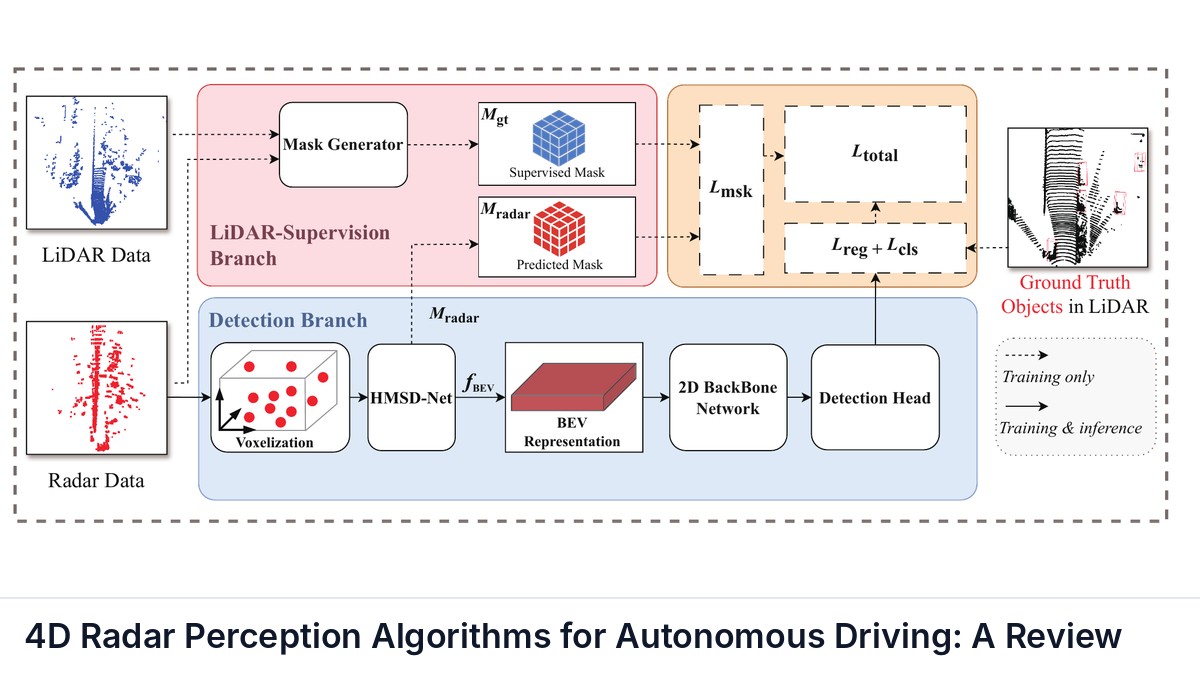
4D Radar Perception Algorithms for Autonomous Driving: A Review
Xumin Wu, Jun Zhou, Jilin Mei et al.
Research on 4D millimeter-wave radar perception algorithms has flourished in recent years, extending from signal processing and object detection to semantic segmentation, motion estimation, occupancy prediction, and dynamic scene reconstruction.
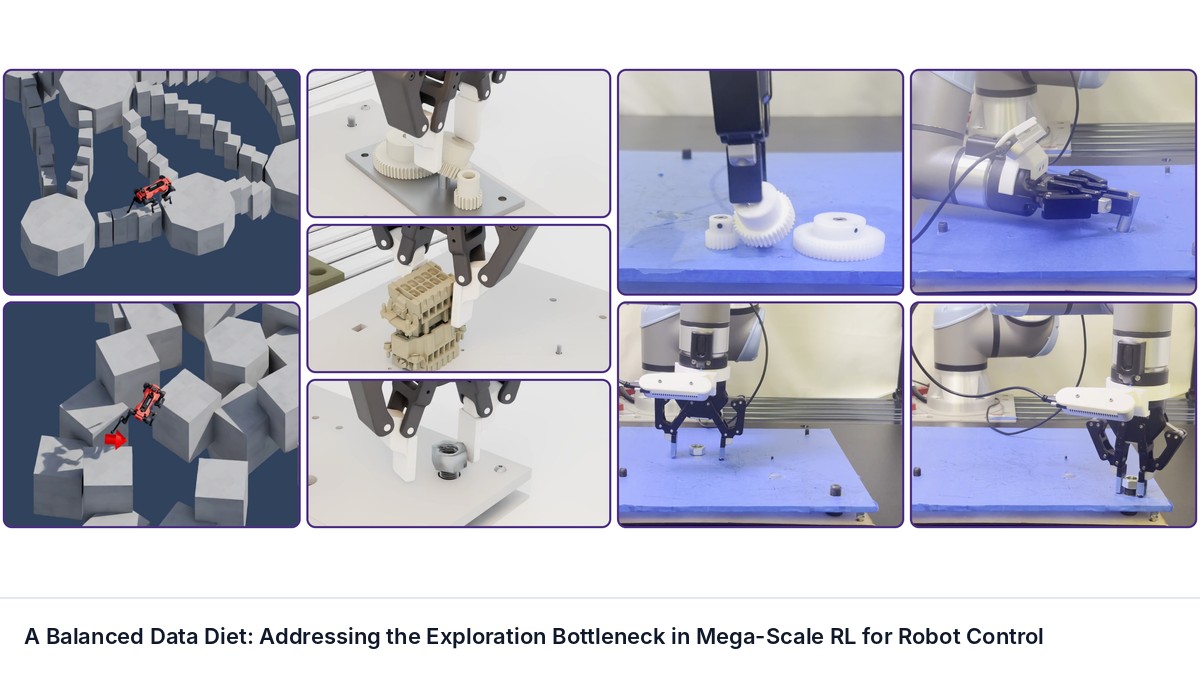
A Balanced Data Diet: Addressing the Exploration Bottleneck in Mega-Scale RL for Robot Control
Octi Zhang, Mateo Guaman Castro, Patrick Yin et al.
General-purpose robots must perform a wide range of tasks from agile locomotion to dexterous manipulation.
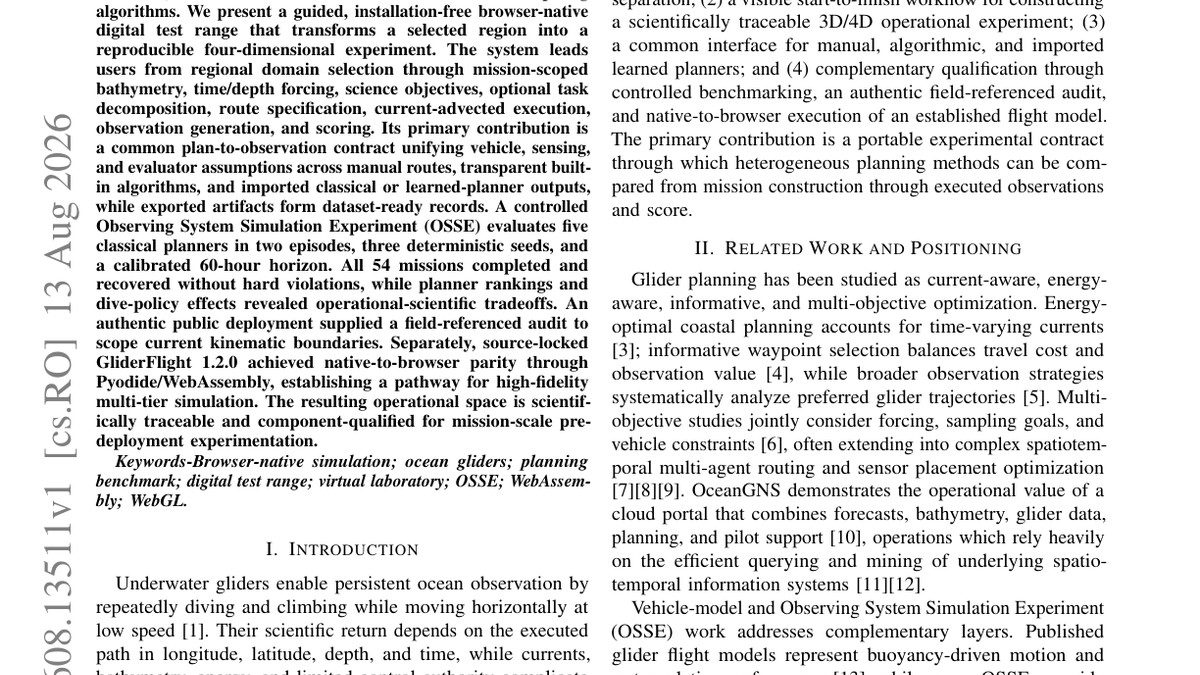
A Browser-Native Digital Test Range for Benchmarking 4D Ocean-Glider Planning Algorithms
Edward Holmberg, Elias Ioup, Mahdi Abdelguerfi
Repeated in-situ evaluation of ocean-glider planners requires scarce vehicles, operators, deployment and recovery resources, and ocean conditions that cannot be reset for competing algorithms.