
Safety-Critical Control for Smoothed Implicit Contact Dynamics
Lee, Haegu, Kim, Yitaek, Sloth, Christoffer · N/A · 2026
Framework
N/A
License
N/A
Stars
N/A
Summary
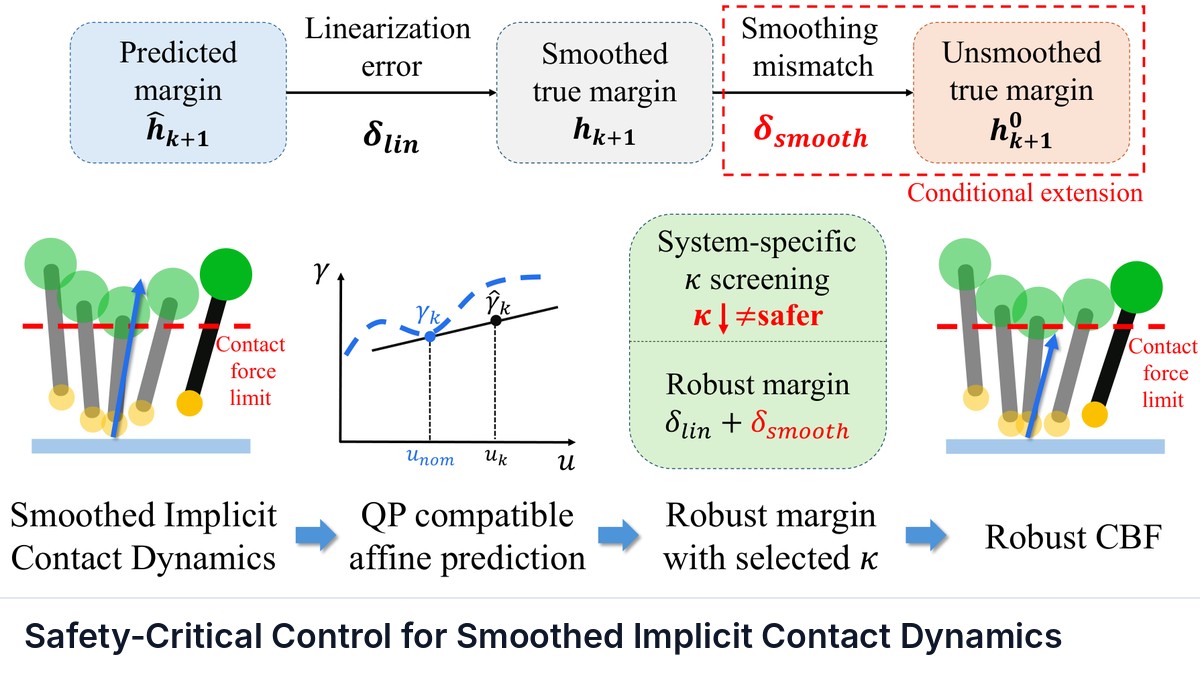
Smoothed implicit contact dynamics enables gradient-based planning and control for contact-rich tasks without predefined mode sequences. However, safety-critical control remains challenging because implicit contact dynamics makes safety-filter design nontrivial.
Abstract Summary
Key Points
- Smoothed implicit contact dynamics enables gradient-based planning and control for contact-rich tasks without predefined mode sequences.
- However, safety-critical control remains challenging because implicit contact dynamics makes safety-filter design nontrivial.
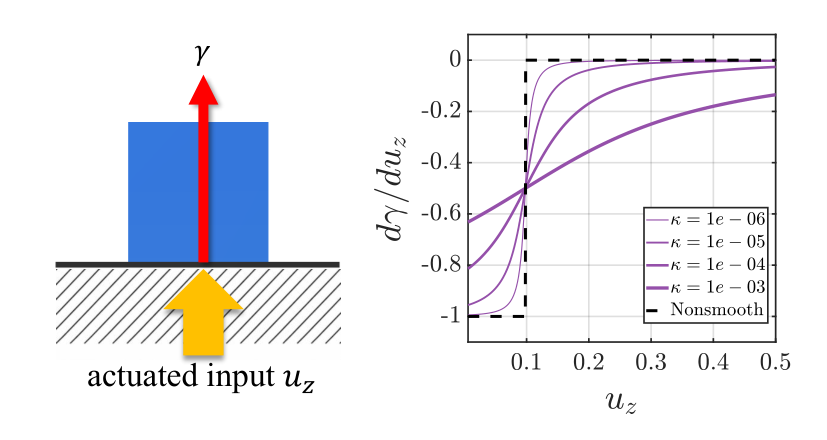
- The smoothing parameter $\kappa$ relaxes contact complementarity constraints, which makes the dynamics smooth but affects the contact force.
- This paper provides a safety-filtering framework for smoothed implicit contact dynamics
- We first derive a discrete-time control barrier function (CBF) constraint using a first-order Taylor approximation of the implicitly defined contact force.
Preliminaries and Problem Formulation
In this section, we briefly review the implicit contact dynamics model and discrete-time control barrier functions used in the proposed safety filter. Accurate modeling of contact forces is important when robots interact with environments. This paper adopts the complementarity-based contact dynamics model of [ 9 ] , in which contact and friction are modeled using a Nonlinear Complementarity Problem (NCP).
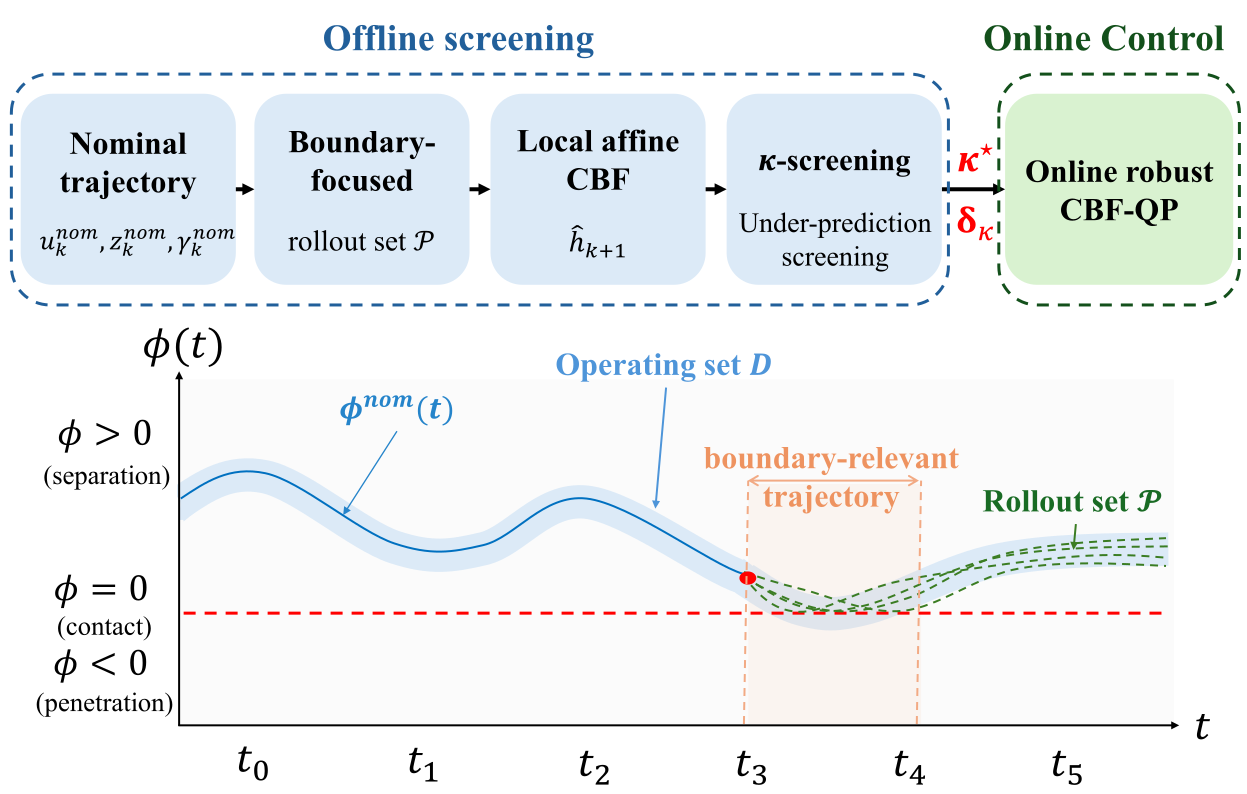
Let $\phi:\mathcal{Z}\to\mathbb{R}$ be the signed-distance function, where $\mathcal{Z}$ denotes the configuration space.
Safety-Critical Control with Implicit Contact Dynamics
CBF frameworks typically rely on explicit control-affine system dynamics, allowing safety constraints to be written as quadratic programs (QPs). In our setting, the contact force is defined implicitly through ( 4 ), so the standard CBF-QP cannot be applied directly. We therefore use a local linear approximation of the solution to derive a QP-compatible constraint.
Experiments and Results
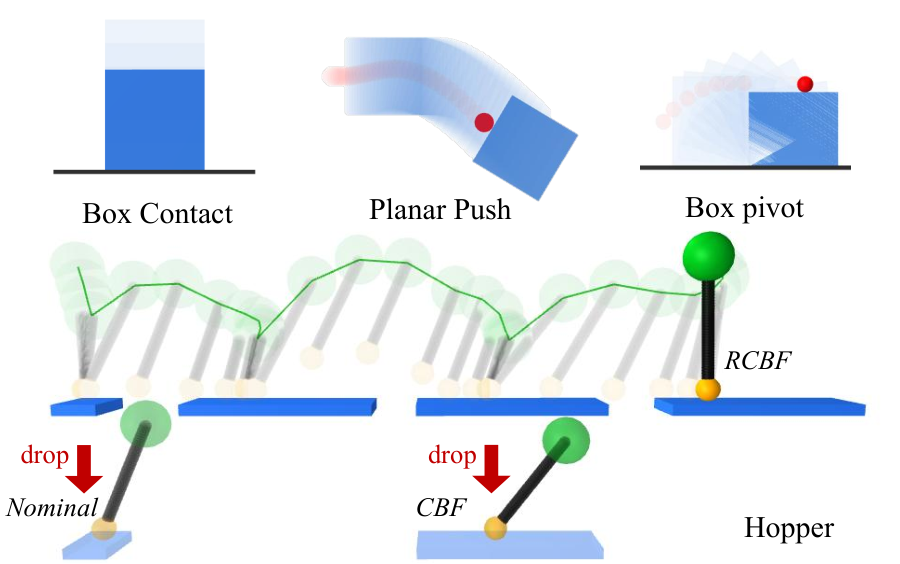
We evaluate the proposed safety filter on the four contact-rich systems shown in Fig. 4 : a 1D box contact, a planar push, a box pivot, and a hopper.
The box-contact input is the vertical force $u_{z}$; the planar-push and box-pivot inputs are $u=[u_{p,x},u_{p,y}]$ and $u=[u_{p,x},u_{p,z}]$, respectively; and the hopper input is $u=[M,\dot{r}]$, where $M$ is the body-pitch torque and $\dot{r}$ is the leg-length rate command. Task-specific $\kappa$ screening follows Sec. III-C .
Sources and Demonstrations
Figures are reproduced from Lee et al. See the full paper for experimental details and the project page, when the paper links one, for demonstrations and videos.
Related Papers
A Browser-Native Digital Test Range for Benchmarking 4D Ocean-Glider Planning Algorithms
Edward Holmberg, Elias Ioup, Mahdi Abdelguerfi
Repeated in-situ evaluation of ocean-glider planners requires scarce vehicles, operators, deployment and recovery resources, and ocean conditions that cannot be reset for competing algorithms.
A Low-Cost, Open Platform for End-to-End Autonomous Driving on a Miniature Ackermann Vehicle
Gustavo Claudio Karl Couto, Eric Aislan Antonelo, Gabriel George Zipperer
This paper presents a low-cost, open experimental platform for research in end-to-end autonomous driving with miniature Ackermann vehicles.
AD-WM: Action-Discriminative World Models for Counterfactual Model Predictive Control
Jiabin Qiu, Zixuan Chen, Hongye Cao et al.
Latent world models are typically trained to predict factual transitions, whereas model predictive control (MPC) must compare alternative actions from the same state. A model can therefore achieve low factual prediction error yet poorly distinguish candidate actions.
AHEAD: Anticipatory Hand-Driven Teleoperation via Human Intent Prediction
Seok Joon Kim, Junho Lee, Federica Spinola et al.
Direct hand-driven teleoperation maps an operator's hand motion to robot end-effector commands at every frame, enabling precise control, but it requires constant monitoring and correction during approach, grasp, and placement, which can be slow and fatiguing.