
Sparse Calibration-Based Personalization of Kernel-Based Gait Phase and Speed Estimation Using Wearable IMUs
Myeongju Cha, Pilwon Hur · N/A · 2026
Framework
N/A
License
N/A
Stars
N/A
Summary
This paper presents sparse calibration-based personalization for kernel-based gait phase and walking speed co-estimation from wearable inertial measurement units (IMUs). A 28-speed reference library was constructed from bilateral thigh and shank trajectories in a 20-subject locomotion dataset.
Abstract Summary
Key Points
- This paper presents sparse calibration-based personalization for kernel-based gait phase and walking speed co-estimation from wearable inertial measurement units (IMUs).
- A 28-speed reference library was constructed from bilateral thigh and shank trajectories in a 20-subject locomotion dataset.
- Rather than directly applying population-average kernels, the method combines a user-specific baseline estimated from three calibration speeds with a principal-component (PC) model of baseline-centered kinematic deviations.
- Offline validation showed that personalized kernels reduced phase error relative to the population kernel.
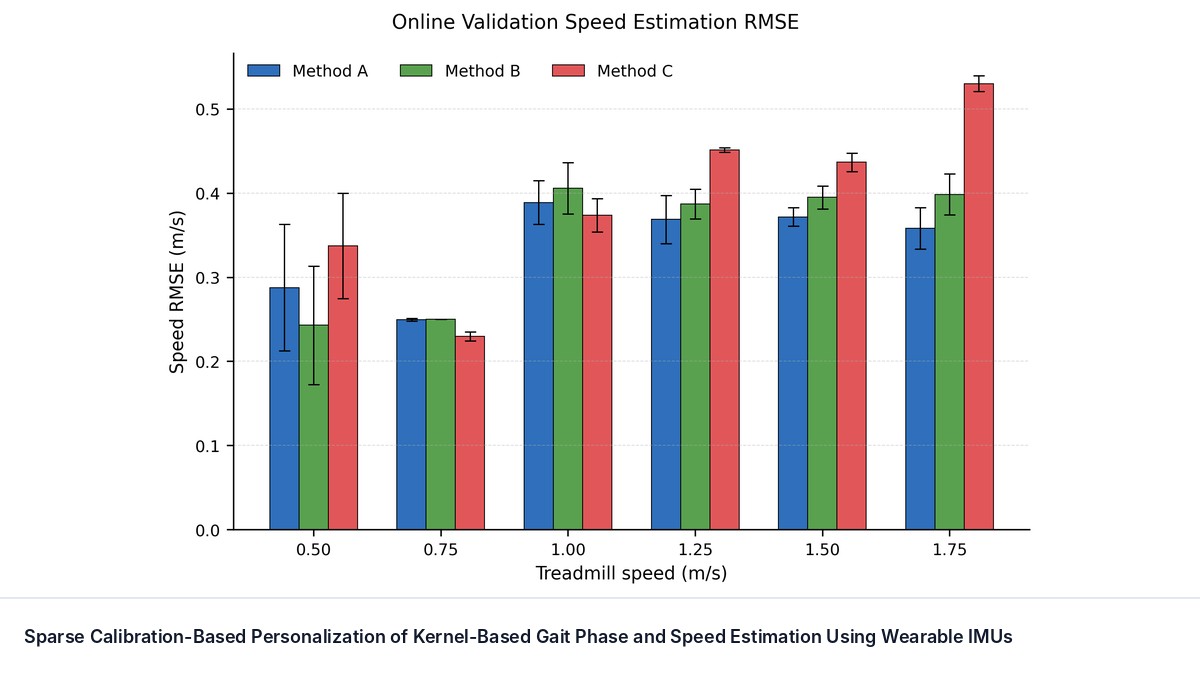
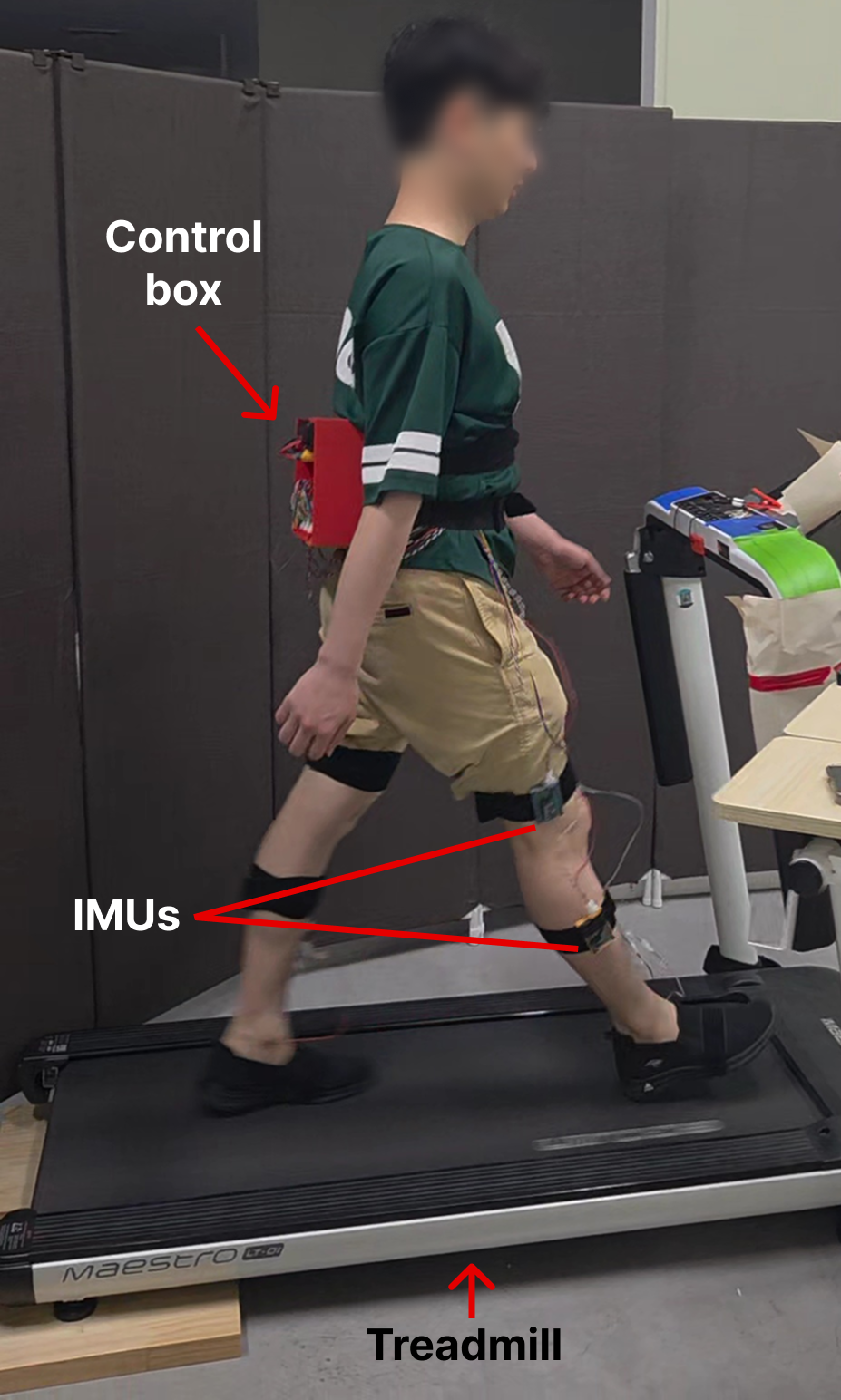
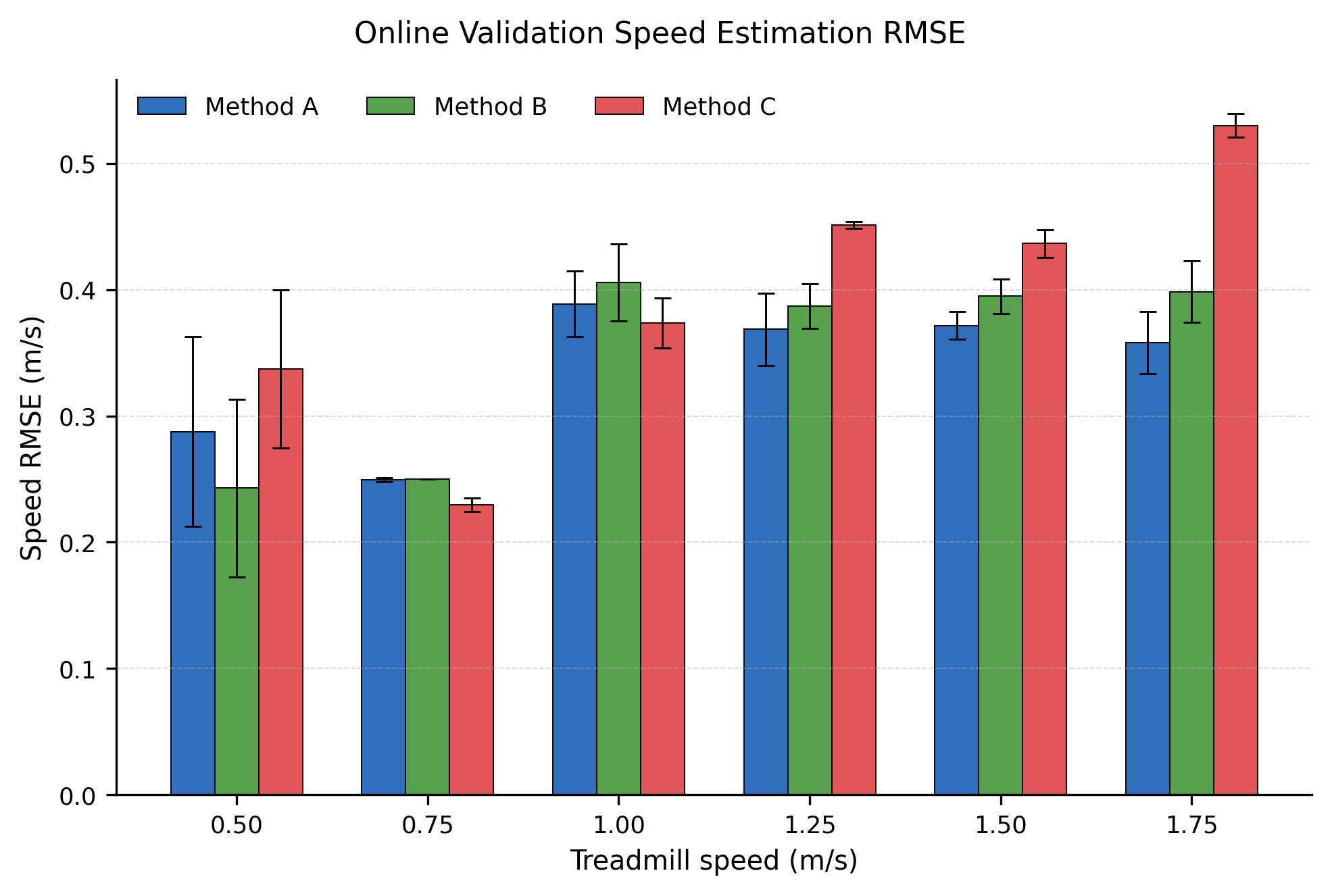
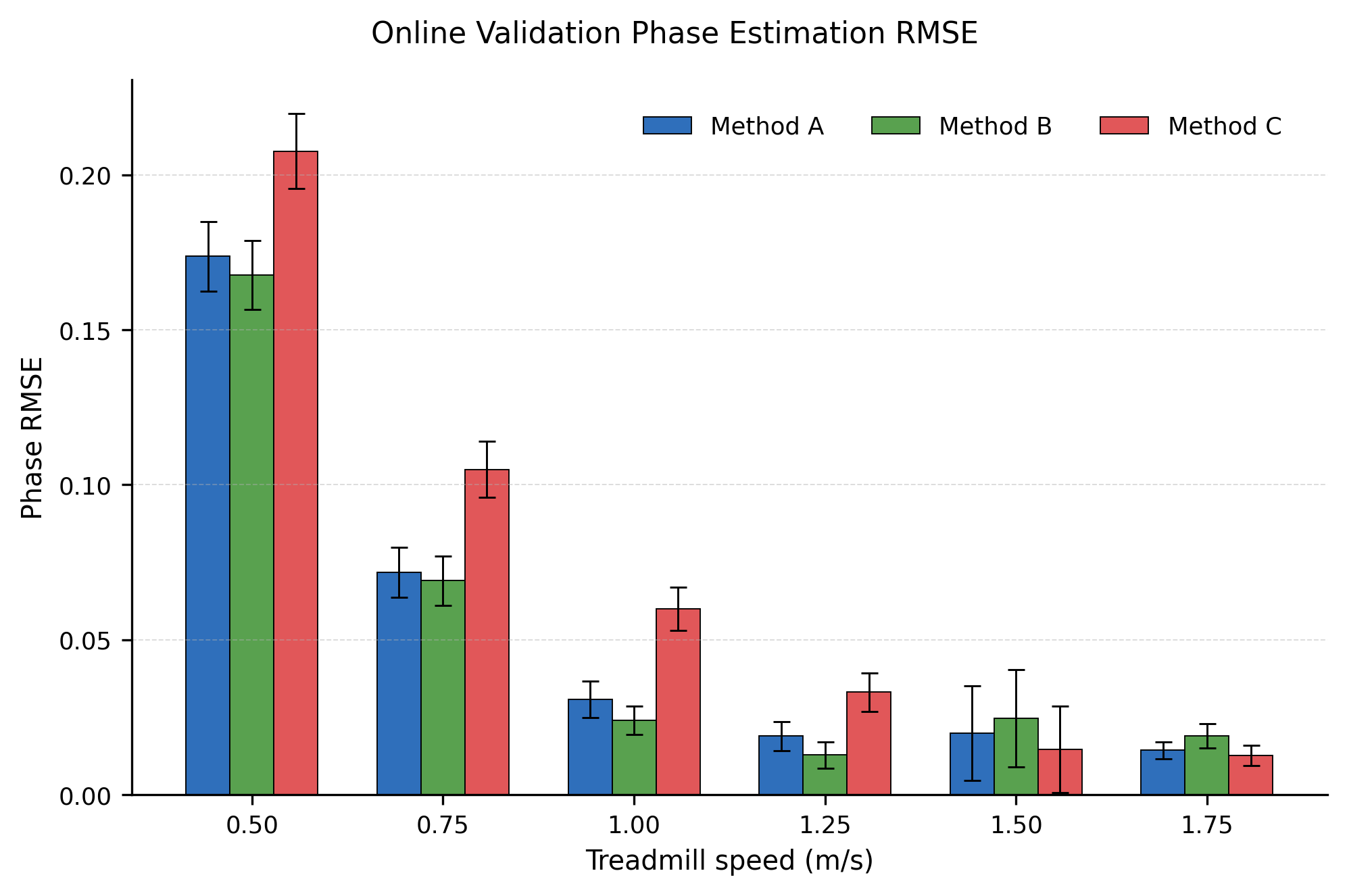
- In a single-participant online pilot evaluation, the personalized kernels produced numerically lower mean phase and speed errors and ran in real time on embedded hardware.
Kernel-Based Phase and Speed Estimation
The sliding-kernel framework of Posh et al. [ 11 ] jointly estimates locomotion mode and gait phase by selecting the best-matching locomotion-mode kernel and its circular alignment. We adapted this framework to level-ground speed estimation by treating each speed in $\mathcal{V}=\{0.50+0.05r\mid r=0,\ldots,27\}$ m/s as a separate kernel candidate.
Let $x_{s,v,c}(\phi)$ denote the subject-level mean stride trajectory for subject $s$, walking speed $v\in\mathcal{V}$, channel $c$, and normalized gait phase $\phi\in(0,1]$.
Sparse Personalized Kernel Generation
The PCA model was constructed from the open-source Camargo locomotion dataset [ 12 ] . Instead of applying PCA to absolute trajectories, each subject’s baseline averaged all available speeds: where $V(s)$ is the set of valid walking speeds for subject $s$.
The baseline-centered deviation was defined as For each subject–speed pair, the four-channel deviation trajectories were concatenated over 101 phase samples into a 404-dimensional vector $\Delta\mathbf{x}_{s,v}$. PCA was applied to these vectors collected from all valid subject–speed pairs.
Experimental Setup
Methods A–C were evaluated on the 20-subject, 0.50–1.85 m/s dataset using LOSO cross-validation and the fixed calibration speeds above. In each fold, the other 19 subjects defined the population kernel and PCA basis. The quadratic form was held fixed, but its coefficients were re-estimated using the same 19 subjects.
The held-out subject provided only the fixed-speed calibration trajectories and the trajectories used for phase and speed evaluation.
Results
Table 2 shows that Method A reduced mean phase RMSE from 0.0178 to 0.0161 compared with the non-personalized population kernel, corresponding to a 9.55% reduction. The Friedman test showed a significant method effect for offline phase RMSE ($\chi^{2}=15.10$, $p=0.0005$).
In the Holm-corrected Wilcoxon comparisons, Method A and Method B both reduced phase RMSE compared with Method C ($p=0.0005$ and $p=0.0017$, respectively), whereas the difference between Method A and Method B was not significant ($p=0.7285$).
Sources and Demonstrations
Figures are reproduced from Cha et al. See the full paper for experimental details and the project page, when the paper links one, for demonstrations and videos.
Related Papers
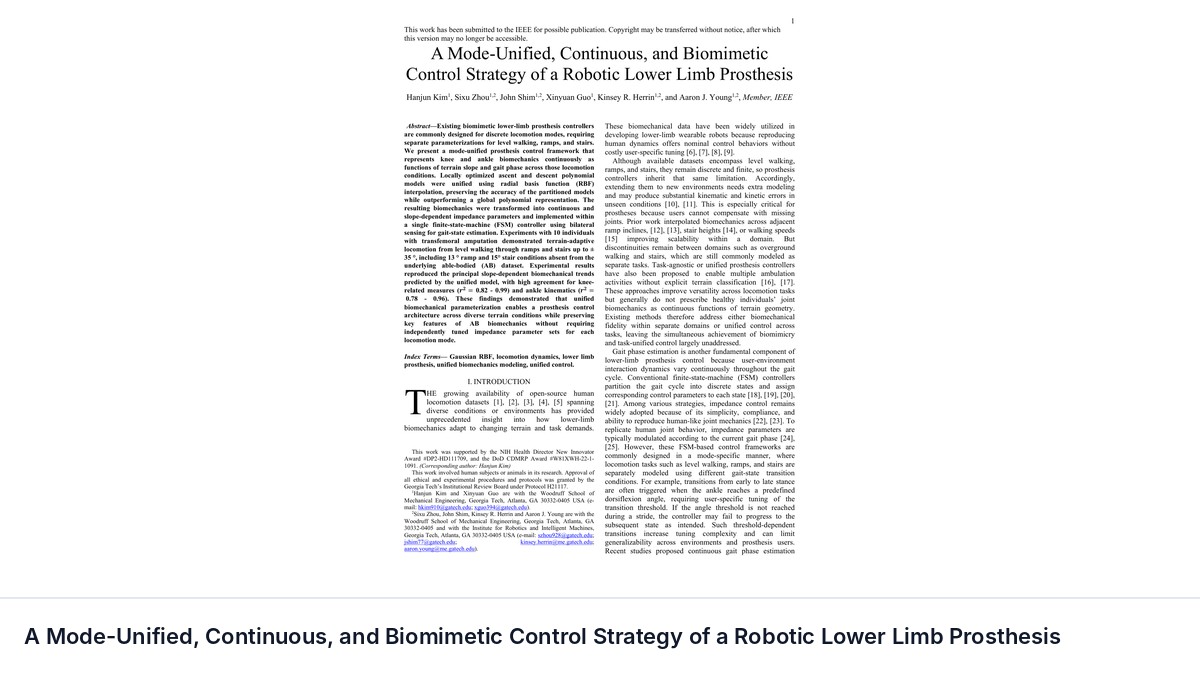
A Mode-Unified, Continuous, and Biomimetic Control Strategy of a Robotic Lower Limb Prosthesis
Hanjun Kim, Sixu Zhou, John Shim et al.
Existing biomimetic lower-limb prosthesis controllers are commonly designed for discrete locomotion modes, requiring separate parameterizations for level walking, ramps, and stairs.
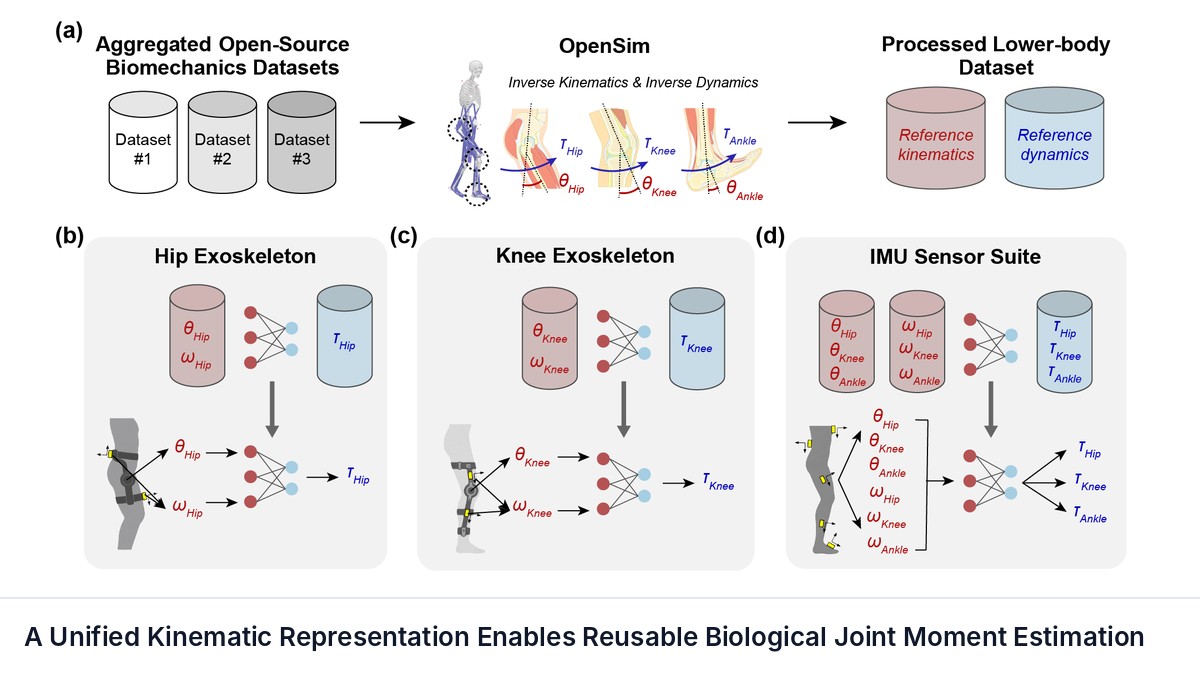
A Unified Kinematic Representation Enables Reusable Biological Joint Moment Estimation
Jinwoo Hwang, Ilseung Park, Changseob Song et al.
Objective: Data-driven models that estimate physiological states, particularly biological joint moments, are widely used in exoskeleton control.
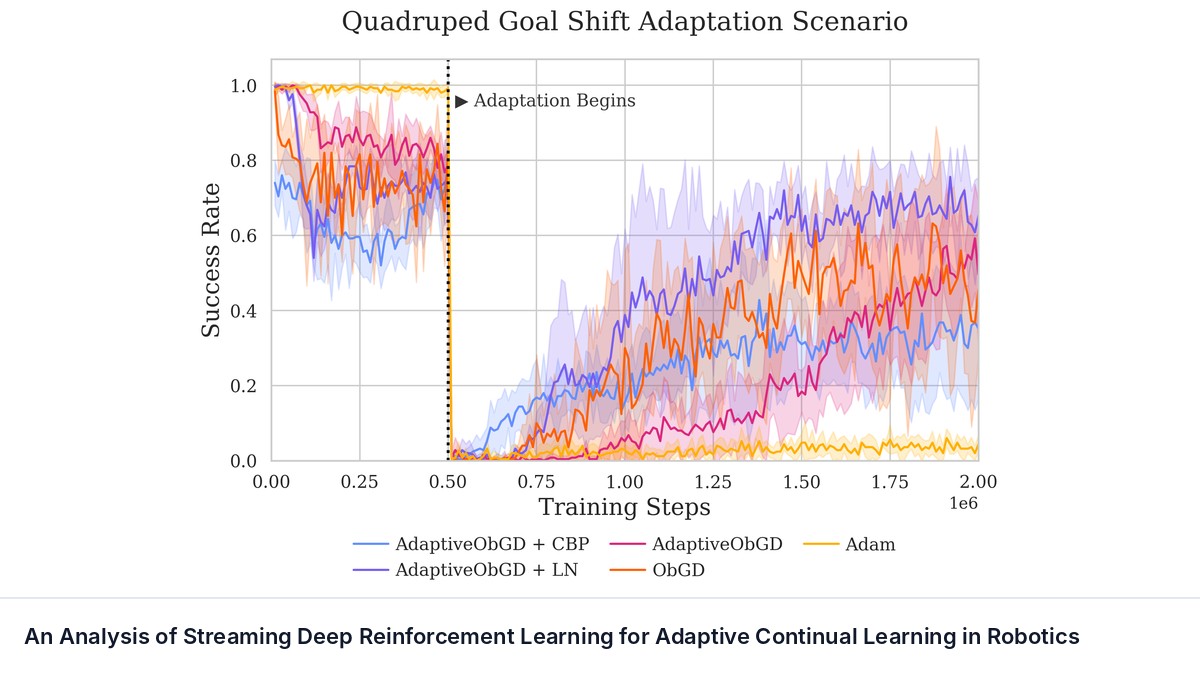
An Analysis of Streaming Deep Reinforcement Learning for Adaptive Continual Learning in Robotics
Teeratham Vitchutripop, Alyssa Quarles, Wenhe Zhang et al.
Over the course of a lifetime, robots may encounter novel scenarios unaccounted for in its original training that result in performance degradation. One common approach to mitigating this issue is to further grow the offline training dataset in hopes of producing a policy robust to these changes.
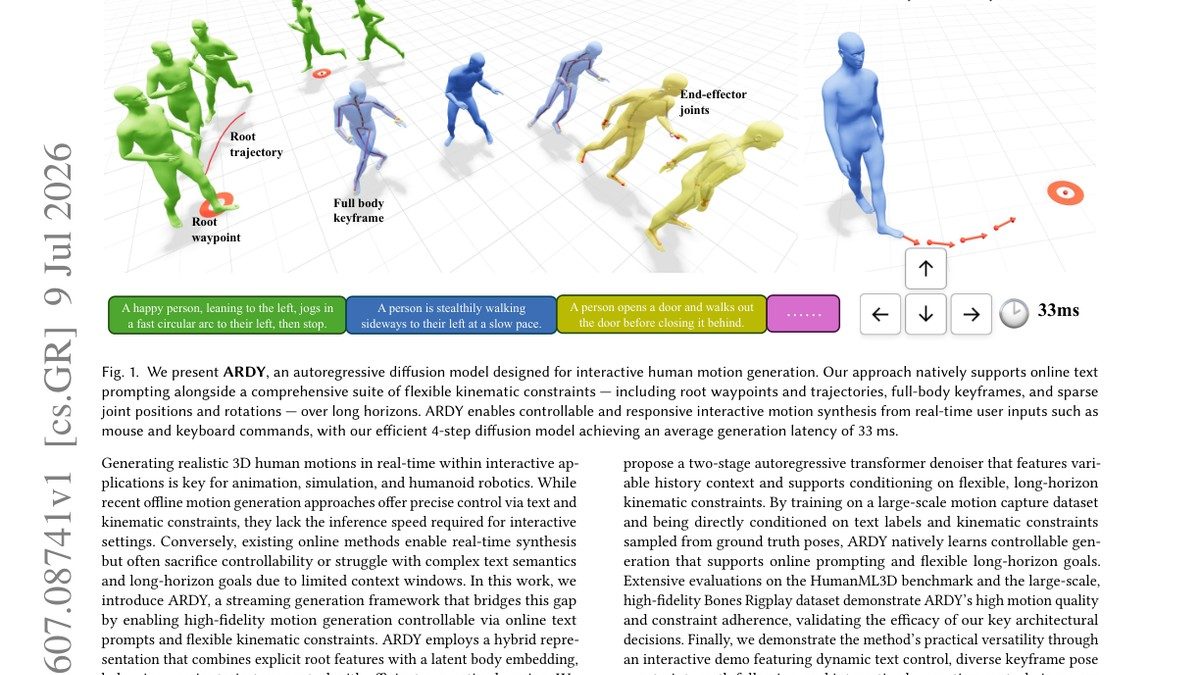
ARDY: Autoregressive Diffusion with Hybrid Representation for Interactive Human Motion Generation
Kaifeng Zhao, Mathis Petrovich, Haotian Zhang et al.
Generating realistic 3D human motions in real-time within interactive applications is key for animation, simulation, and humanoid robotics.