
Modeling and Control of a Rigid-soft Hybrid-link Humanoid Robot
Zewen He, Taiki Ishigaki, Ko Yamamoto · N/A · 2026
Framework
N/A
License
N/A
Stars
N/A
Summary
Physical flexibility plays a significant role not only in human motions but also in robot motions.
Abstract Summary
Key Points
- Physical flexibility plays a significant role not only in human motions but also in robot motions
- For example, a humanoid robot with passive and flexible elements, which can be regarded as a rigid--soft hybrid-link system, has the advantages of storing energy and mitigating impact in a dynamic motion.
- However, the motion design and control of a hybrid-link system are challenging to achieve and have only been discussed in the literature.
- In this study, we propose the framework of inverse kinematics and compliance optimization-based control for a hybrid-link humanoid system that represents the continuous deformation of a flexible structure using the piece-wise constant strain (PCS) model.
- The proposed method was validated using forward dynamics simulations for standing, jumping, and walking motions.
Rigid-soft Hybrid-link System
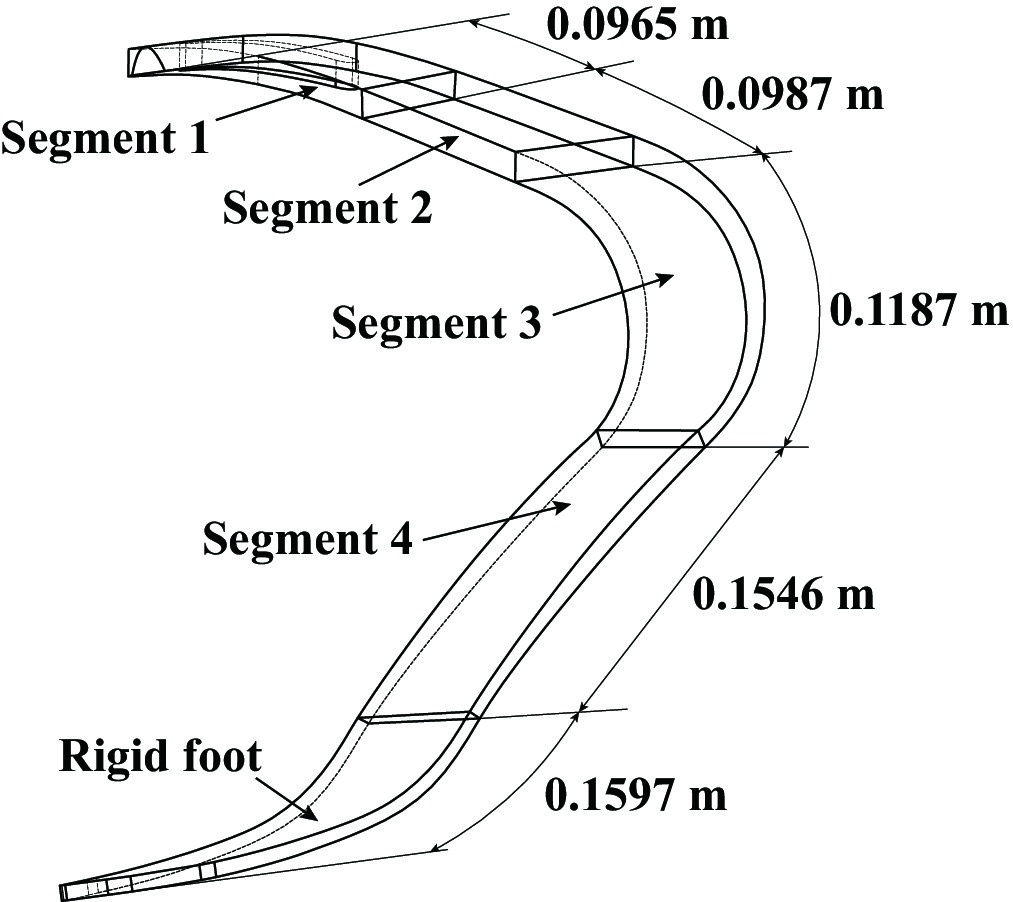
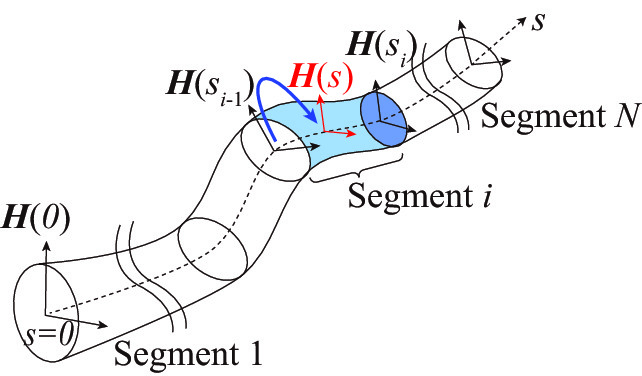
The PCS model discretizes a soft continuum into several constant-strain segments based on the Cosserat rod theory. In this study, we define the $z$-axis to be the direction of the central axis of the continuum. Let $s\in\mathbb{R}$ denote the central axis configuration, as shown in Figure 2 .
Inverse Kinematics for a Hybrid-link Humanoid Robot
Motion generation of a hybrid-link humanoid system must account for the passive deformation due to gravity because such deformation often degrades the balance of a humanoid system. Accordingly, in this section, we present an inverse kinematics (IK) scheme for a hybrid-link system, referred to as hybrid IK .
We started the formulation of hybrid IK by assuming the single-support state of a hybrid-link humanoid, as shown in Figure 3 . In this situation, a leg including a soft-part is in contact with the environment.
Control of Hybrid-link Humanoid based on Compliance Optimization
The outline of the QP-based control for a humanoid robot is summarized as follows Sugihara and Morisawa (2020) : Task-space control calculates the desired acceleration $\ddot{\mbox{\boldmath$p$}}_{\ast}$ assuming a feedback control in the task-space; Inverse dynamics simultaneously calculates the necessary joint actuation force and contact forces.
Validations Through Simulations
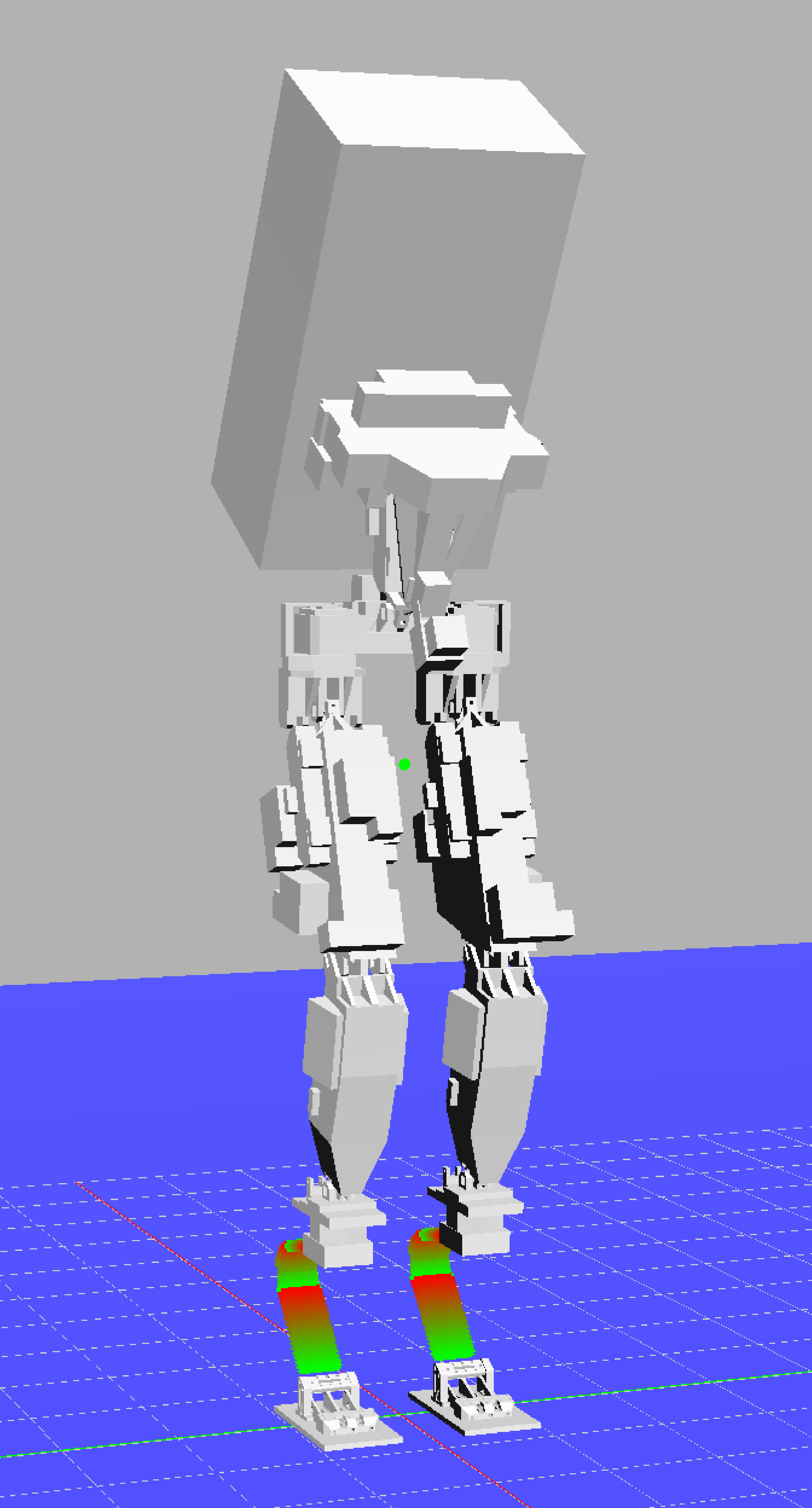
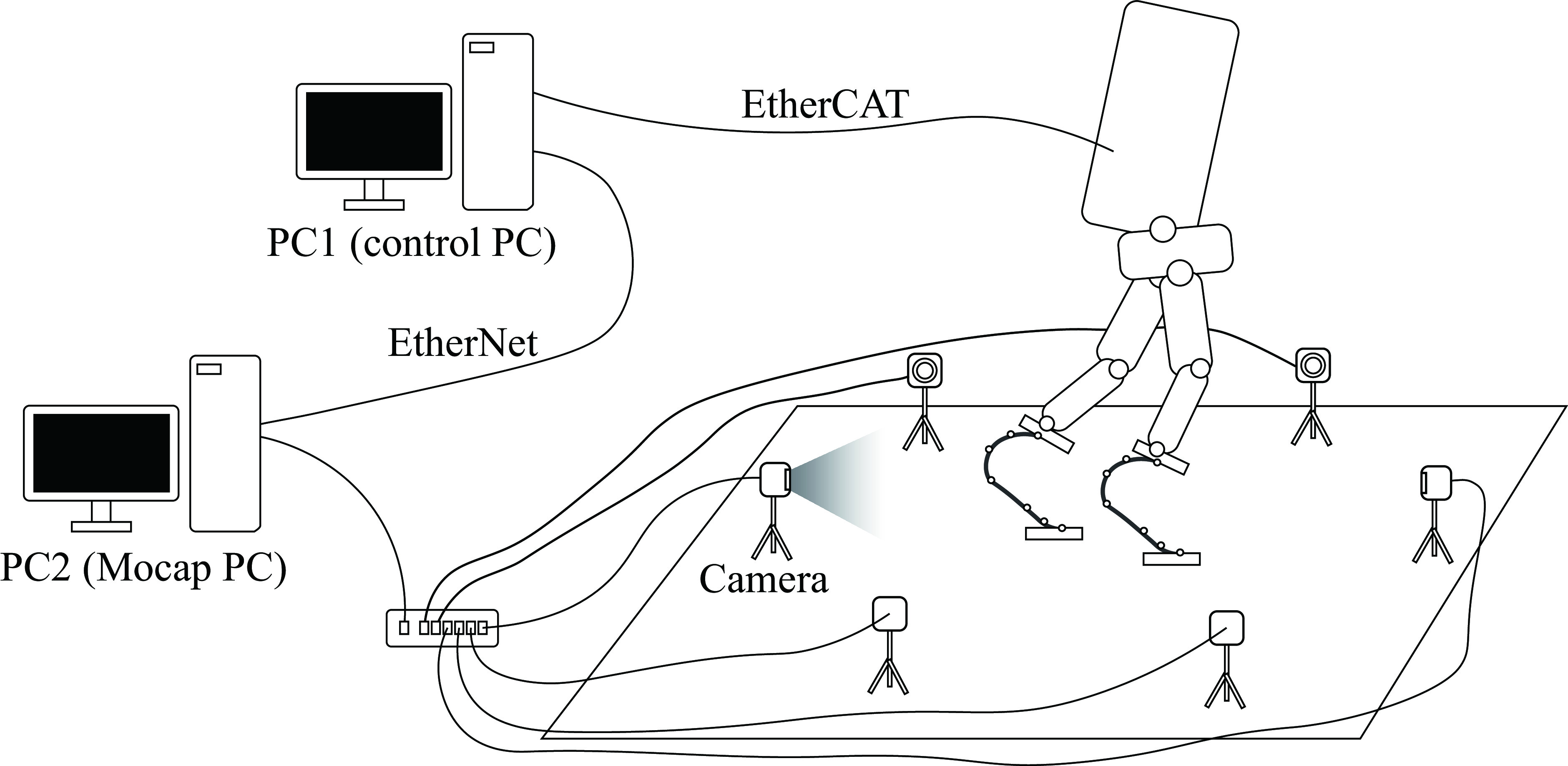
The proposed methods were validated using forward dynamics simulations. The simulation model is shown in Figure 1 . We simulated three scenarios: 1) double-support balancing, 2) vertical hopping, and 3) bipedal walking. In the following subsections, we set the viscoelasticity matrices of each PCS segment as $\mbox{\boldmath$K$}_{S}=50\mbox{\boldmath$E$}$ and $\mbox{\boldmath$D$}_{S}=0.02\mbox{\boldmath$E$}$.
Experimental Validation of Balance Control
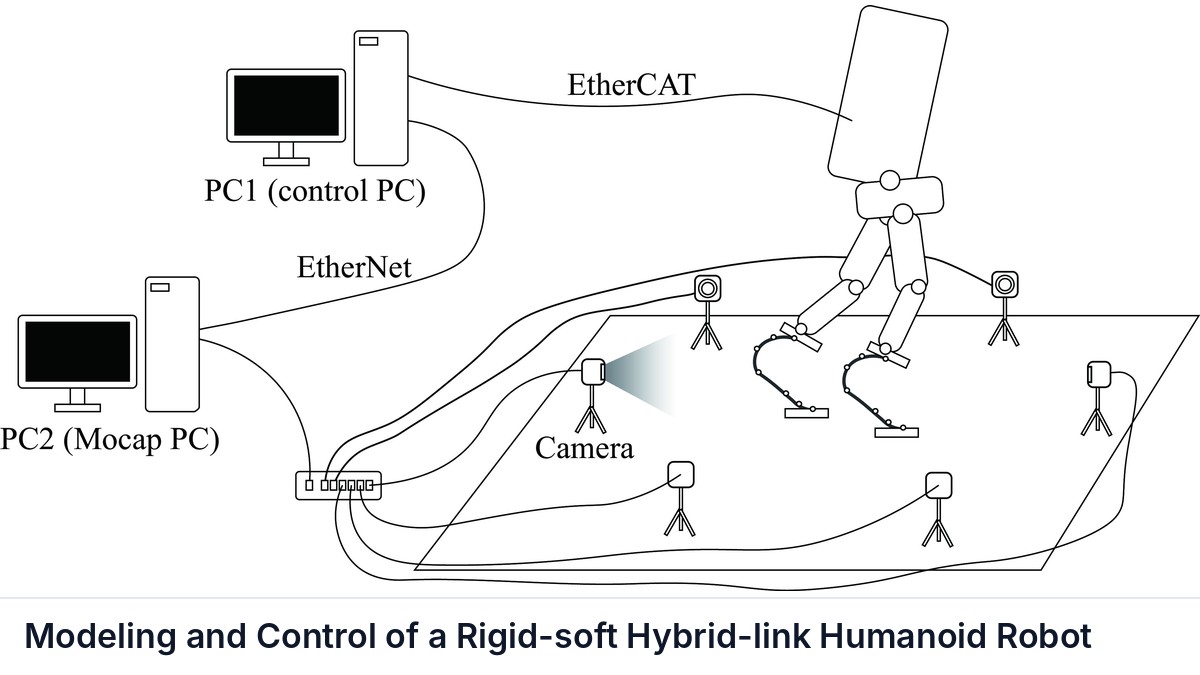
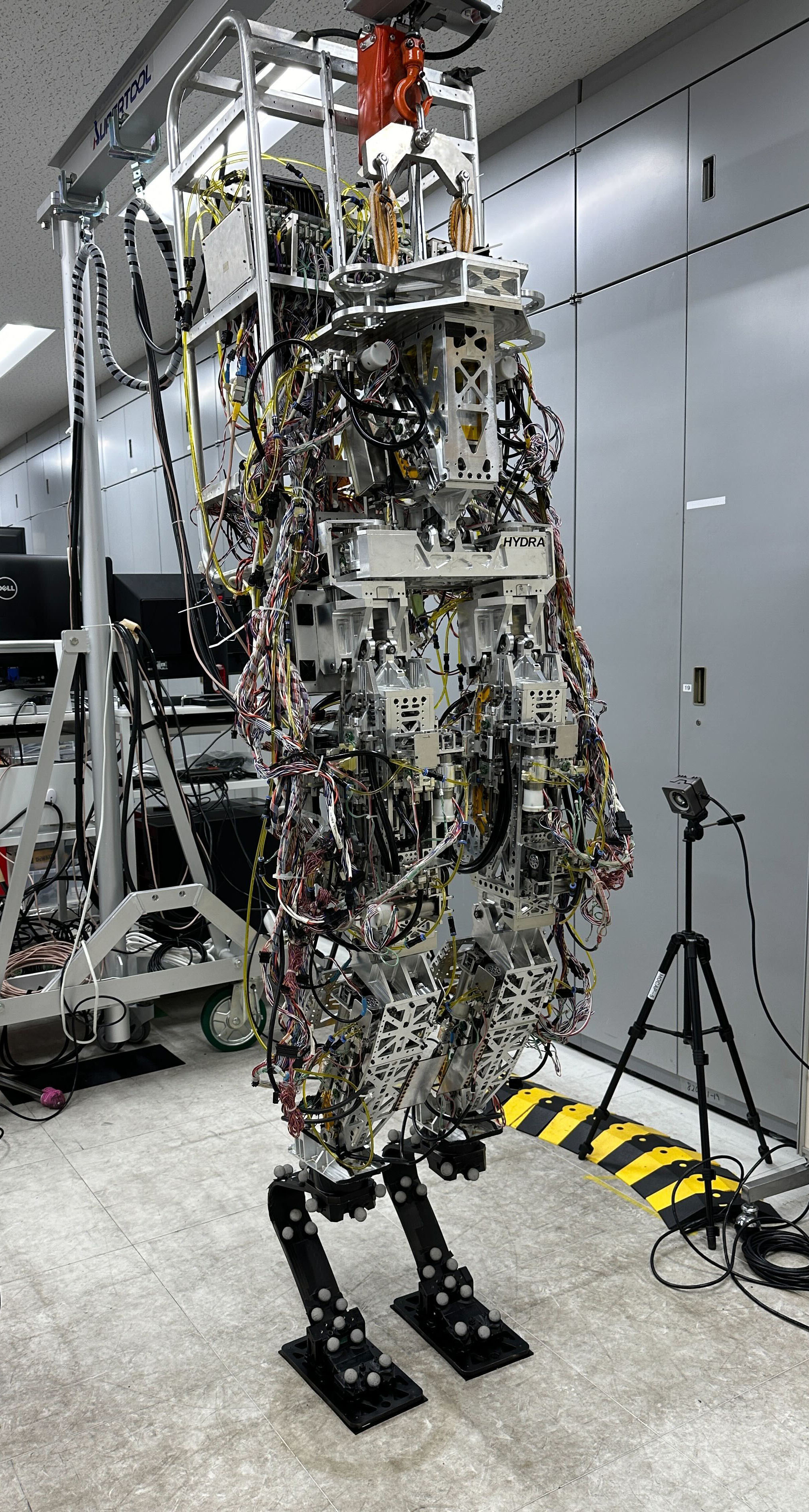
Figure 1 shows an overview of the experimental setup of hybrid Hydra , which consists of a humanoid robot Hydra Ko et al. (2021) wearing a leaf-spring type prosthses (1E91 Runner, Ottobock) at each foot. Hydra is a life-sized hydro-statically driven humanoid robot, with 14 DoFs, in which all joints are driven by the electro-hydrostatic actuators that are force controllable.
The total height and weight of the hybrid Hydra are 220 cm and 77 kg, respectively.
Sources and Demonstrations
Figures are reproduced from He et al. See the full paper for experimental details and the project page, when the paper links one, for demonstrations and videos.
Related Papers
A Balanced Data Diet: Addressing the Exploration Bottleneck in Mega-Scale RL for Robot Control
Octi Zhang, Mateo Guaman Castro, Patrick Yin et al.
General-purpose robots must perform a wide range of tasks from agile locomotion to dexterous manipulation.
A Mode-Unified, Continuous, and Biomimetic Control Strategy of a Robotic Lower Limb Prosthesis
Hanjun Kim, Sixu Zhou, John Shim et al.
Existing biomimetic lower-limb prosthesis controllers are commonly designed for discrete locomotion modes, requiring separate parameterizations for level walking, ramps, and stairs.
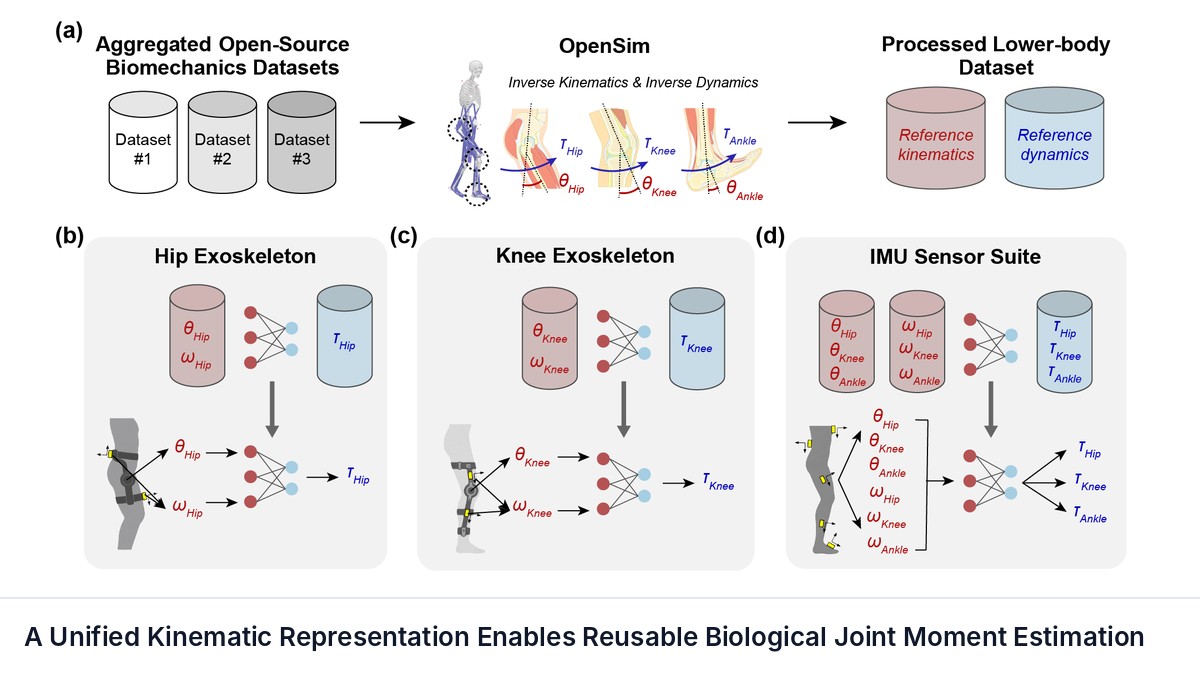
A Unified Kinematic Representation Enables Reusable Biological Joint Moment Estimation
Jinwoo Hwang, Ilseung Park, Changseob Song et al.
Objective: Data-driven models that estimate physiological states, particularly biological joint moments, are widely used in exoskeleton control.
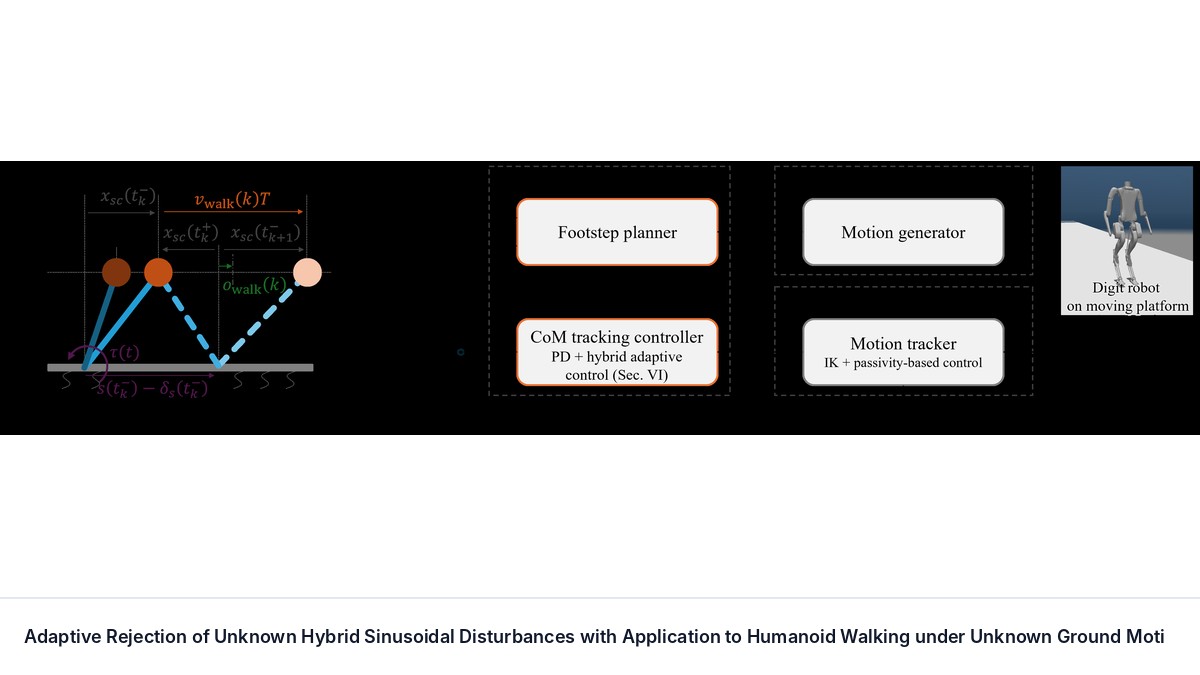
Adaptive Rejection of Unknown Hybrid Sinusoidal Disturbances with Application to Humanoid Walking under Unknown Ground Motion
I-Chia Chang, Jacob Stewart, Petros A. Ioannou et al.
Legged robot control is not yet practical in non-inertial environments, where the ground and surroundings accelerate in the inertial Earth frame, mainly because of the unknown, time-varying, persistent perturbations caused by environmental motion, compounded by the associated hybrid robotic dynamics.