
Passive-Dynamic-Walking-Inspired Dynamics Guidance for Energy-Efficient Humanoid Locomotion
Hyeonjin Choi, Joongheon Kim, Daekyum Kim · N/A · 2026
Framework
N/A
License
N/A
Stars
N/A
Summary
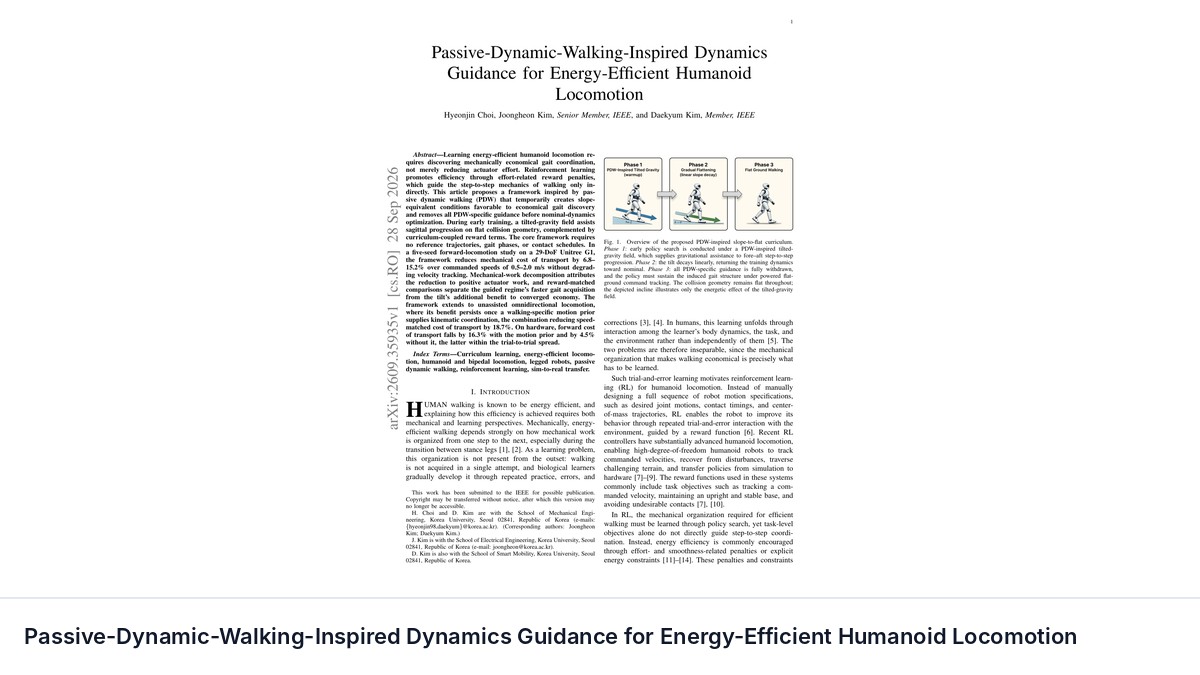
Learning energy-efficient humanoid locomotion requires discovering mechanically economical gait coordination, not merely reducing actuator effort. Reinforcement learning promotes efficiency through effort-related reward penalties, which guide the step-to-step mechanics of walking only indirectly.
Abstract Summary
Key Points
- Learning energy-efficient humanoid locomotion requires discovering mechanically economical gait coordination, not merely reducing actuator effort.
- Reinforcement learning promotes efficiency through effort-related reward penalties, which guide the step-to-step mechanics of walking only indirectly.
- This article proposes a framework inspired by passive dynamic walking (PDW) that temporarily creates slope-equivalent conditions favorable to economical gait discovery and removes all PDW-specific guidance before nominal-dynamics optimization.
- During early training, a tilted-gravity field assists sagittal progression on flat collision geometry, complemented by curriculum-coupled reward terms.
- The core framework requires no reference trajectories, gait phases, or contact schedules
Method
We consider flat-ground omnidirectional velocity tracking on an unmodified 29-DoF humanoid. The deployment task, policy interface, and baseline locomotion objective are identical across all comparisons.
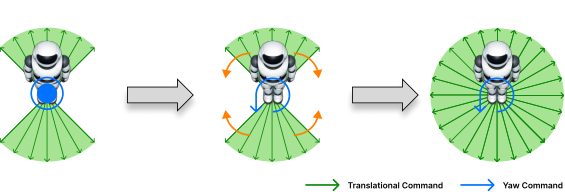
The proposed PDW-inspired curriculum modifies early training through three coupled components: (i) command-conditioned virtual tilted gravity, (ii) curriculum-coupled PDW-inspired rewards, and (iii) a synchronized expansion from sagittally dominant to omnidirectional commands.
Experimental Setup
The robot is a 29-DoF Unitree G1. The nominal robot model has a mass of $m=33.34$ kg, which is used as the mass in all reported cost-of-transport values. Because this mass cancels in every relative comparison, the reported percentage reductions are invariant to its value. Training runs in Isaac Lab on Isaac Sim (PhysX) at a $50$ Hz control rate ($\Delta t=0.02$ s), with 1024 parallel environments and 20 s episodes.
Actions are 29 joint position targets tracked by implicit PD actuators.
Experimental Results
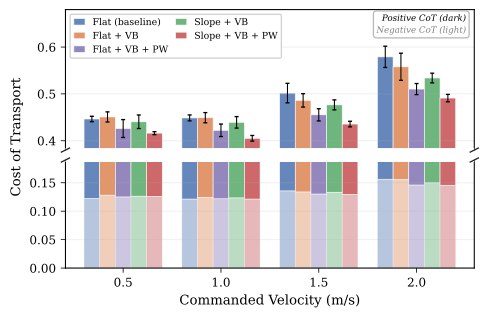
The experiments address four questions. First, does the proposed training scheme reduce mechanical cost of transport during forward locomotion without degrading command tracking? Second, is the reduction explained by lower positive actuator work, as intended by the reward design?
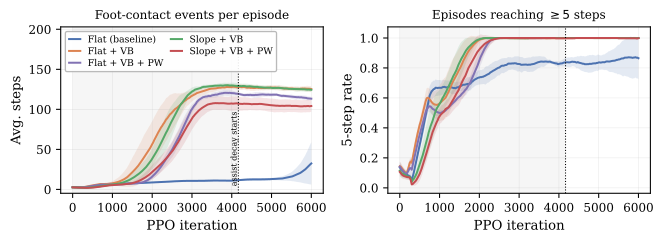
Third, do the VB-guided training regime and tilted-gravity assistance affect when sustained stepping first emerges during training, and is their effect on converged economy separable from that timing? Fourth, does the coordination developed under sagittal assistance ex...
Sources and Demonstrations
Figures are reproduced from Choi et al. See the full paper for experimental details and the project page, when the paper links one, for demonstrations and videos.
Related Papers
A Balanced Data Diet: Addressing the Exploration Bottleneck in Mega-Scale RL for Robot Control
Octi Zhang, Mateo Guaman Castro, Patrick Yin et al.
General-purpose robots must perform a wide range of tasks from agile locomotion to dexterous manipulation.
A Heterogeneous Architecture for Robot RL Beyond GPU-Dominant Paradigms
Yufei Jia, Zhanxiang Cao, Mingrui Yu et al.
Simulation-based RL for contemporary robot control is increasingly organized around GPU-resident simulation: physics, rollout collection, and learning are placed on a single GPU-centric execution path
A Mode-Unified, Continuous, and Biomimetic Control Strategy of a Robotic Lower Limb Prosthesis
Hanjun Kim, Sixu Zhou, John Shim et al.
Existing biomimetic lower-limb prosthesis controllers are commonly designed for discrete locomotion modes, requiring separate parameterizations for level walking, ramps, and stairs.
A Unified Kinematic Representation Enables Reusable Biological Joint Moment Estimation
Jinwoo Hwang, Ilseung Park, Changseob Song et al.
Objective: Data-driven models that estimate physiological states, particularly biological joint moments, are widely used in exoskeleton control.