
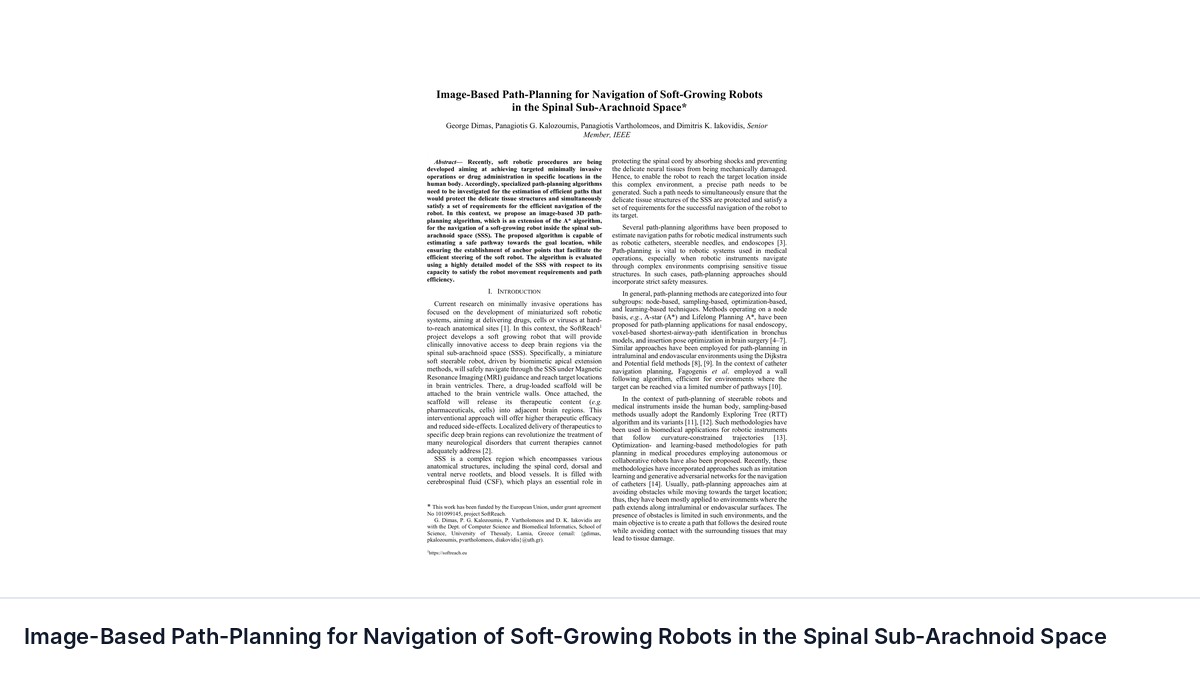
Image-Based Path-Planning for Navigation of Soft-Growing Robots in the Spinal Sub-Arachnoid Space
George Dimas, Panagiotis G. Kalozoumis, Panagiotis Vartholomeos, Dimitris K. Iakovidis · N/A · 2026
Framework
N/A
License
N/A
Stars
N/A
Summary
Recently, soft robotic procedures are being developed aiming at achieving targeted minimally invasive operations or drug administration in specific locations in the human body.
Abstract Summary
Key Points
- Recently, soft robotic procedures are being developed aiming at achieving targeted minimally invasive operations or drug administration in specific locations in the human body.
- Accordingly, specialized path-planning algorithms need to be investigated for the estimation of efficient paths that would protect the delicate tissue structures and simultaneously satisfy a set of requirements for the efficient navigation of the robot.
- In this context, we propose an image-based 3D pathplanning algorithm, which is an extension of the A* algorithm, for the navigation of a soft-growing robot inside the spinal subarachnoid space (SSS).
- The proposed algorithm is capable of estimating a safe pathway towards the goal location, while ensuring the establishment of anchor points that facilitate the efficient steering of the soft robot.
- The algorithm is evaluated using a highly detailed model of the SSS with respect to its capacity to satisfy the robot movement requirements and path efficiency.
Image-Based Path-Planning for Navigation of Soft-Growing Robots in the Spinal Sub-Arachnoid Space
|Authors: George Dimas, Panagiotis G. Kalozoumis, Panagiotis Vartholomeos, Dimitris K. Iakovidis
|Venue: arXiv preprint | Year: 2026
|arXiv: 2610.12631
Abstract
Recently, soft robotic procedures are being developed aiming at achieving targeted minimally invasive operations or drug administration in specific locations in the human body. Accordingly, specialized path-planning algorithms need to be investigated for the estimation of efficient paths that would protect the delicate tissue structures and simultaneously satisfy a set of requirements for the efficient navigation of the robot. In this context, we propose an image-based 3D pathplanning algorithm, which is an extension of the A* algorithm, for the navigation of a soft-growing robot inside the spinal subarachnoid space (SSS). The proposed algorithm is capable of estimating a safe pathway towards the goal location, while ensuring the establishment of anchor points that facilitate the efficient steering of the soft robot. The algorithm is evaluated using a highly detailed model of the SSS with respect to its capacity to satisfy the robot movement requirements and path efficiency.
Key Contributions
- Recently, soft robotic procedures are being developed aiming at achieving targeted minimally inva…
- Accordingly, specialized path-planning algorithms need to be investigated for the estimation of e…
- In this context, we propose an image-based 3D pathplanning algorithm, which is an extension of th…
- The proposed algorithm is capable of estimating a safe pathway towards the goal location, while e…
- The algorithm is evaluated using a highly detailed model of the SSS with respect to its capacity …
Topics
- vision
- planning
Code & Data
No code repository linked in paper metadata.
BibTeX
@article{Dimas2026_261012631,
  title     = {Image-Based Path-Planning for Navigation of Soft-Growing Robots in the Spinal Sub-Arachnoid Space},
  author    = {George Dimas and Panagiotis G. Kalozoumis and Panagiotis Vartholomeos and Dimitris K. Iakovidis},
  year      = {2026},
  eprint    = {2610.12631},
  archivePrefix = {arXiv},
  primaryClass  = {cs.RO},
  url       = {https://arxiv.org/abs/2610.12631}
}
Related Papers
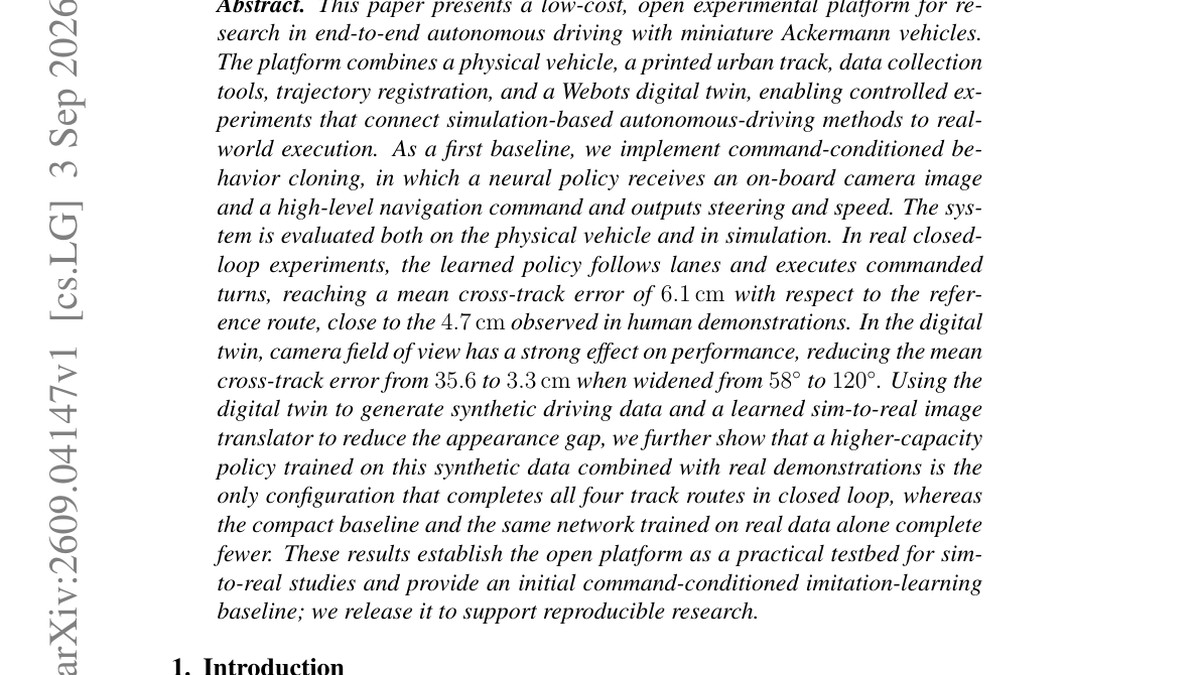
A Low-Cost, Open Platform for End-to-End Autonomous Driving on a Miniature Ackermann Vehicle
Gustavo Claudio Karl Couto, Eric Aislan Antonelo, Gabriel George Zipperer
This paper presents a low-cost, open experimental platform for research in end-to-end autonomous driving with miniature Ackermann vehicles.
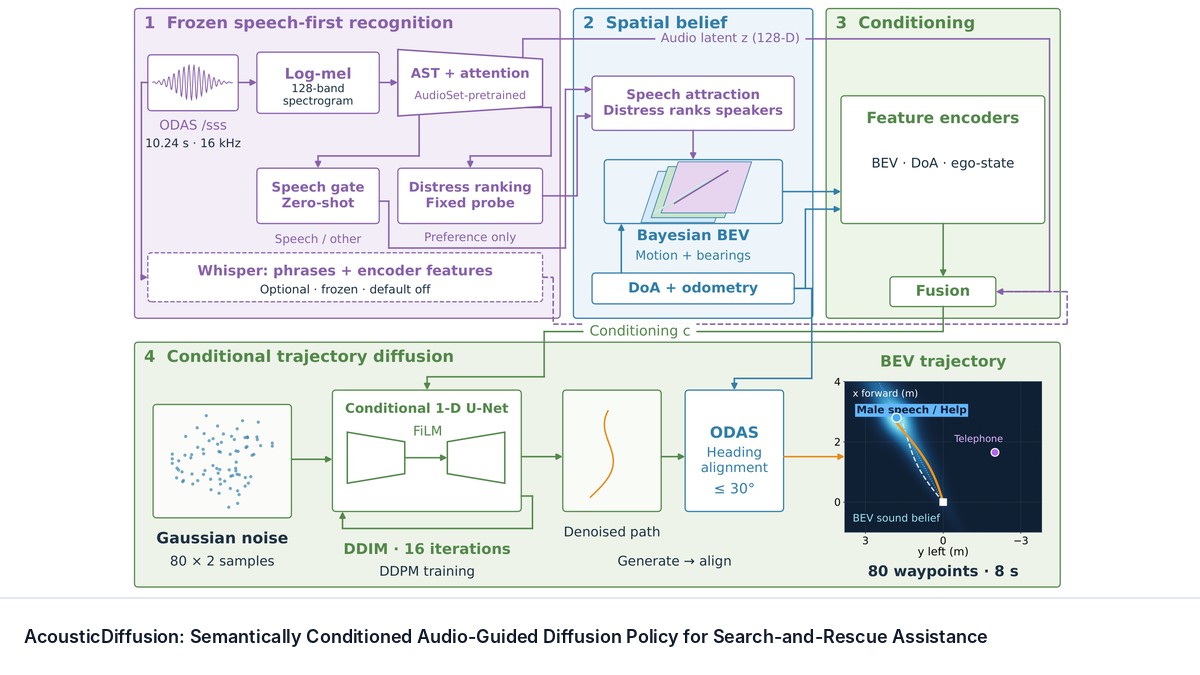
AcousticDiffusion: Semantically Conditioned Audio-Guided Diffusion Policy for Search-and-Rescue Assistance
Iana Zhura, Didar Seyidov, Dmitrii Plotnikov et al.
Navigating toward human callers is an important capability for rescue robots operating where visual contact is degraded or occluded. We present AcousticDiffusion, a semantically conditioned, audio-guided diffusion policy for human-directed navigation.
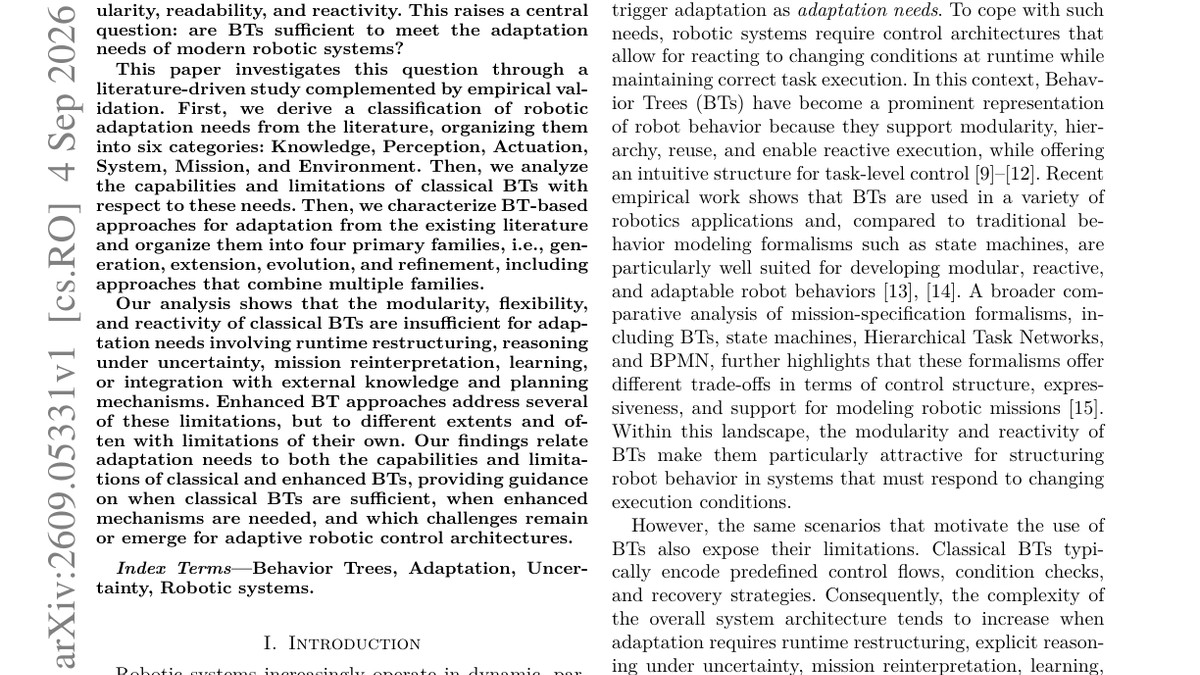
Adaptation Needs in Robotic Systems: Assessing Behavior Trees and Their Enhancement
Mehran Rostamnia, Gianluca Filippone, Ricardo Caldas et al.
Robotic systems increasingly operate in dynamic, uncertain, and open-ended environments, where design-time assumptions may no longer hold, and adaptation becomes necessary to maintain effective and safe operation.
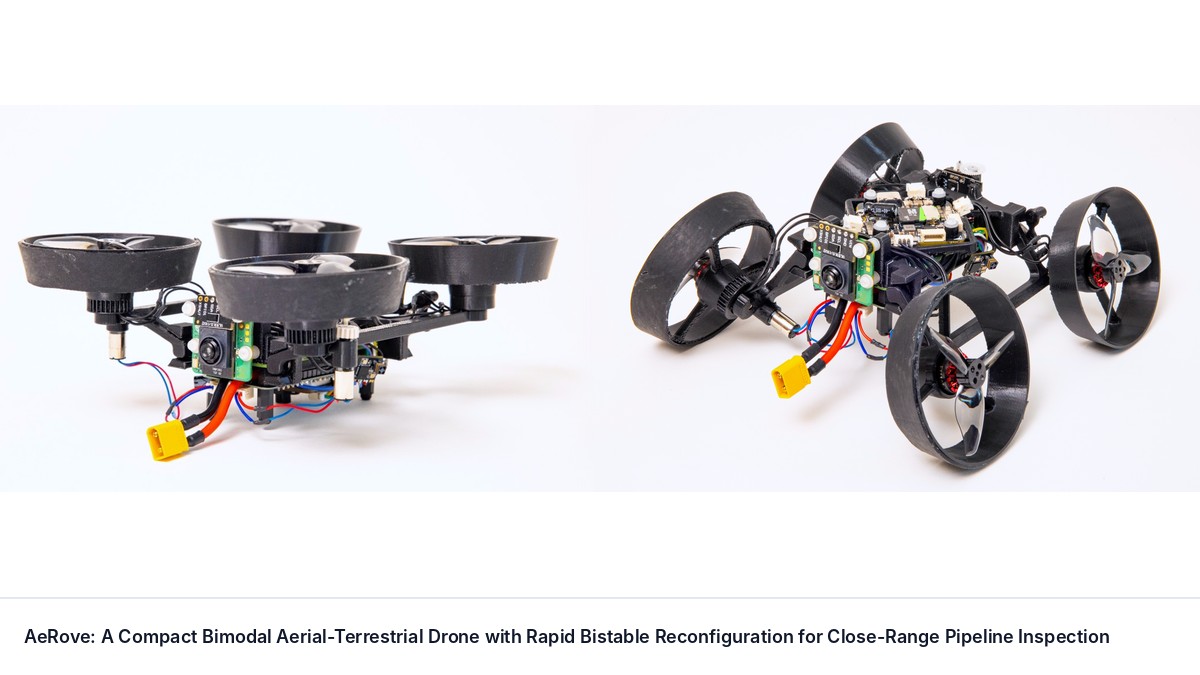
AeRove: A Compact Bimodal Aerial-Terrestrial Drone with Rapid Bistable Reconfiguration for Close-Range Pipeline Inspection
Caleb Polillio, Petras Swissler
Close-proximity pipeline inspection is challenging for standard drones due to high hovering power consumption, airflow sensitivity, and propeller wash interference with gas sensing. To address this, we present AeRove, a compact bimodal aerial-terrestrial robot.