
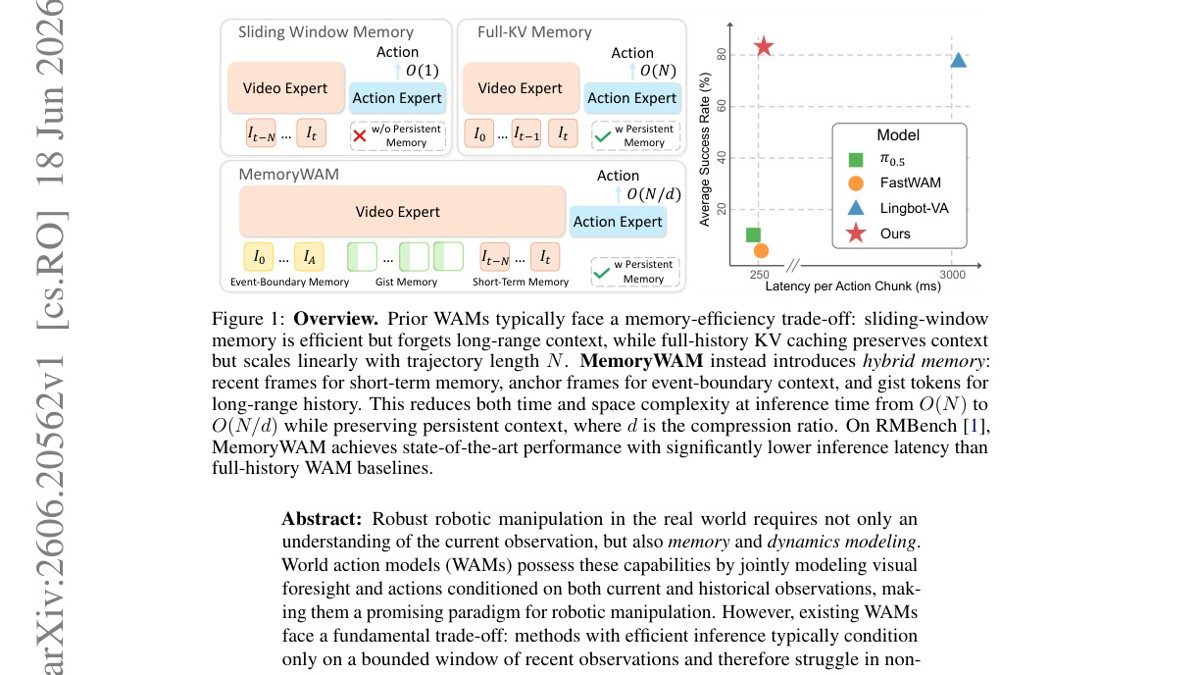
MemoryWAM: Efficient World Action Modeling with Persistent Memory
Sizhe Yang, Juncheng Mu, Tianming Wei, Chenhao Lu, Xiaofan Li, Linning Xu, Zhengrong Xue, Zhecheng Yuan, Dahua Lin, Jiangmiao Pang, Huazhe Xu · · 2026
Framework
N/A
License
N/A
Stars
N/A
Summary
Robust robotic manipulation in the real world requires not only an understanding of the current observation, but also memory and dynamics modeling.
Abstract Summary
Key Points
- Proposes MemoryWAM for robotics.
- Evaluated on real or simulated robotic tasks.
- Primary contribution in ar-vr.
Method
Prior approaches in vision-language-action models (VLAs) [ 7 , 6 ] and world action models (WAMs) [ 39 , 62 ] typically map recent observations to actions, relying on a bounded temporal window $o_{t-N:t}$ and task instruction $l$: While effective for short-horizon tasks, they struggle in non-Markovian environments where decisions depend on long-range history.
A straightforward approach to retain long-term history is to preserve the full KV cache of all past observations within an autoregressive Transformer [ 33 , 60 , 50 ] .
Experiments
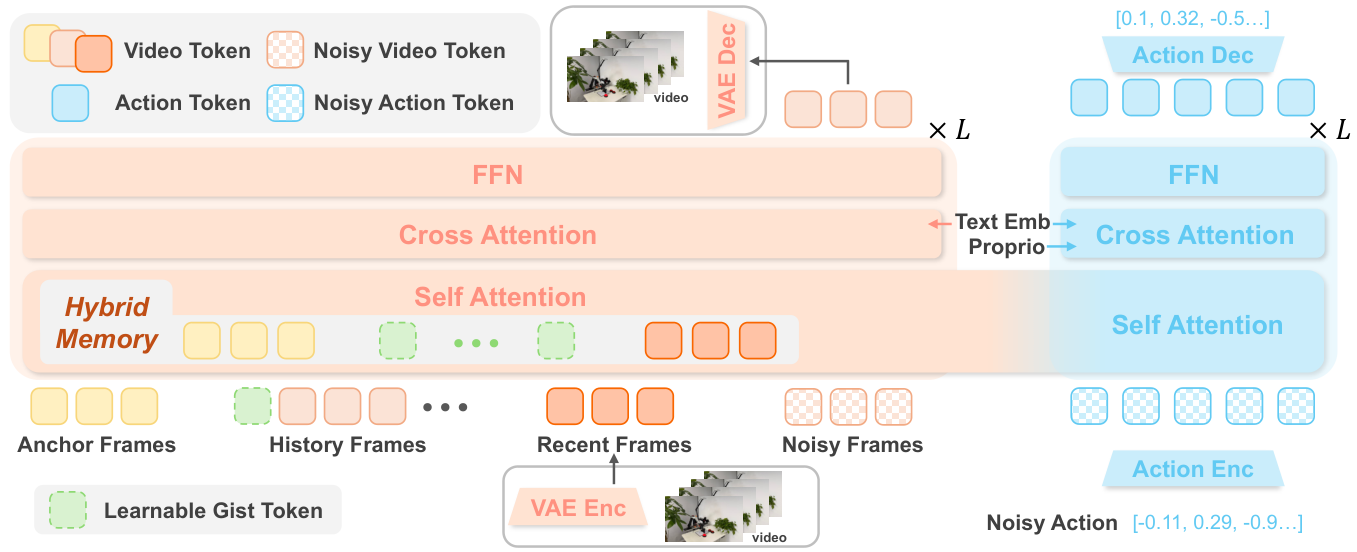
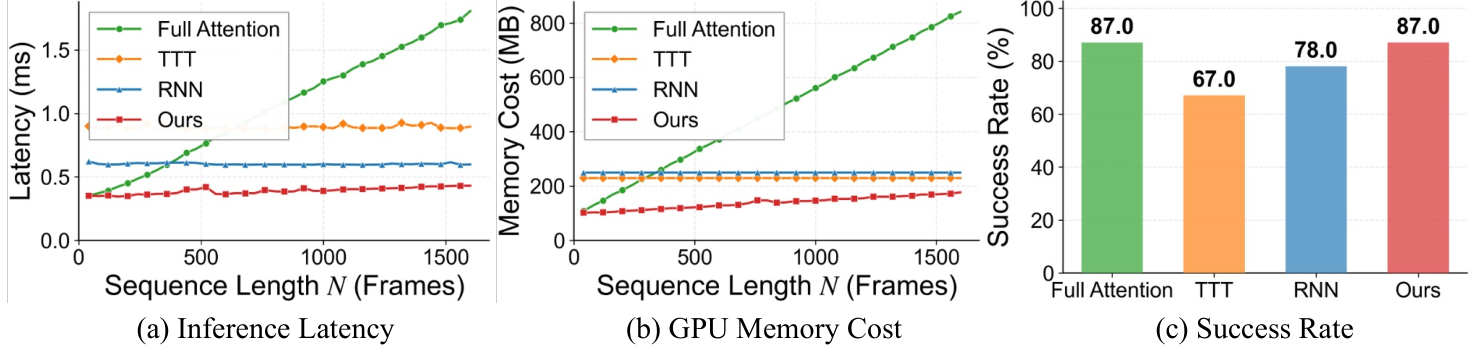
MemoryWAM aims to equip world action models with efficient persistent memory, enabling end-to-end execution of long-horizon manipulation tasks with low inference cost. In this section, we evaluate MemoryWAM from three complementary perspectives: efficiency, policy performance, and design effectiveness.
We first describe the implementation details of MemoryWAM, including model architecture, training setup, and inference protocol in Sec. 4.1 . We then conduct a systematic study of memory mechanisms in Sec.
Sources and Demonstrations
Figures are reproduced from Yang et al. See the full paper for experimental details and the project page, when the paper links one, for demonstrations and videos.
Related Papers
MemoryWAM: Efficient World Action Modeling with Persistent Memory
Sizhe Yang, Juncheng Mu, Tianming Wei et al.
Robust robotic manipulation in the real world requires not only an understanding of the current observation, but also memory and dynamics modeling.
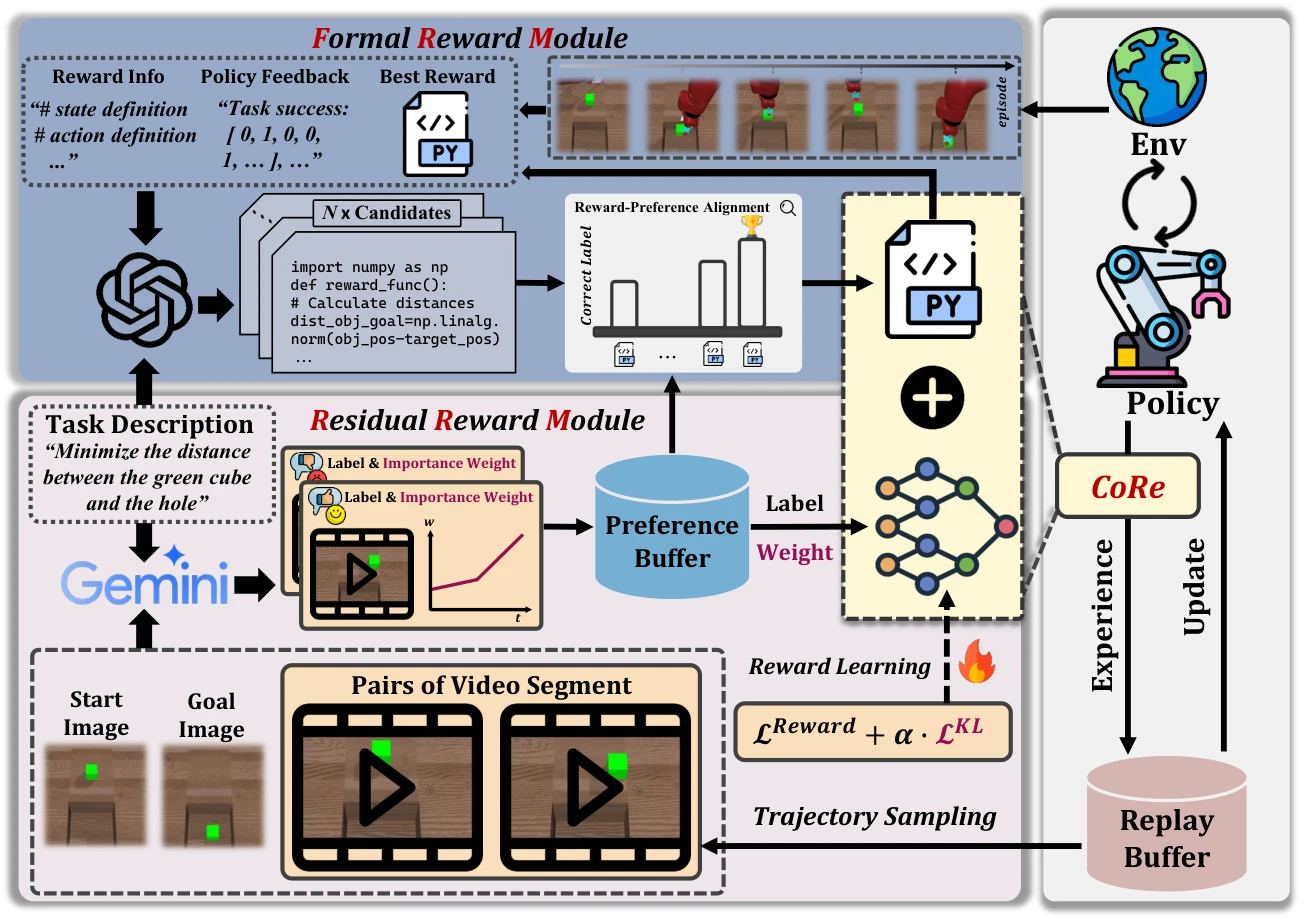
CoRe: Combined Rewards with Vision-Language Model Feedback for Preference-Aligned Reinforcement Learning
Hexian Ni, Tao Lu, Yinghao Cai
CoRe combines code-based rewards with learned visual preferences so that neither reward source has to capture the entire task alone.
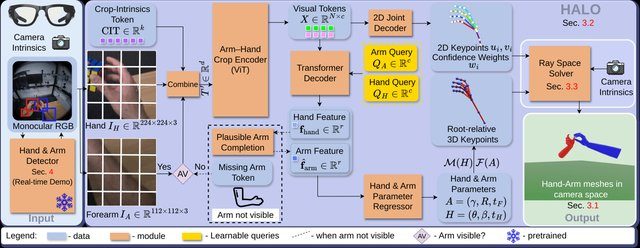
EgoForce: Forearm-Guided Camera-Space 3D Hand Pose from a Monocular Egocentric Camera
Christen Millerdurai, Shaoxiang Wang, Yaxu Xie et al.
Reconstructing the absolute 3D pose and shape of the hands from the user's viewpoint using a single head-mounted camera is crucial for practical egocentric interaction in AR/VR, telepresence, and hand-centric manipulation tasks, where sensing must remain compact and unobtrusive.
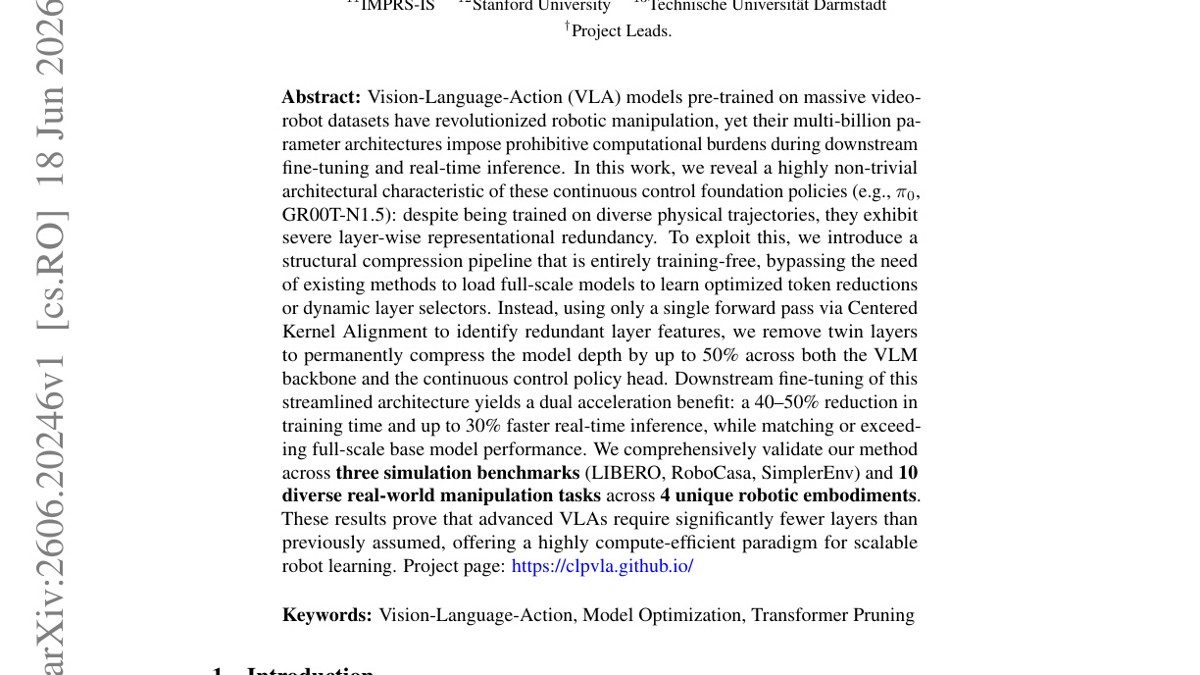
Finetuning Vision-Language-Action Models Requires Fewer Layers Than You Think
Gia-Binh Nguyen, Trong-Bao Ho, Thien-Loc Ha et al.
Vision-Language-Action (VLA) models pre-trained on massive video-robot datasets have revolutionized robotic manipulation, yet their multi-billion parameter architectures impose prohibitive computational burdens during downstream fine-tuning and real-time inference.