
Fast Planning for Multi-object Multi-target Throwing
Zhengming Zhu, Yang Liu, Xiao Gao, Aude Billard · N/A · 2026
Framework
N/A
License
N/A
Stars
N/A
Summary
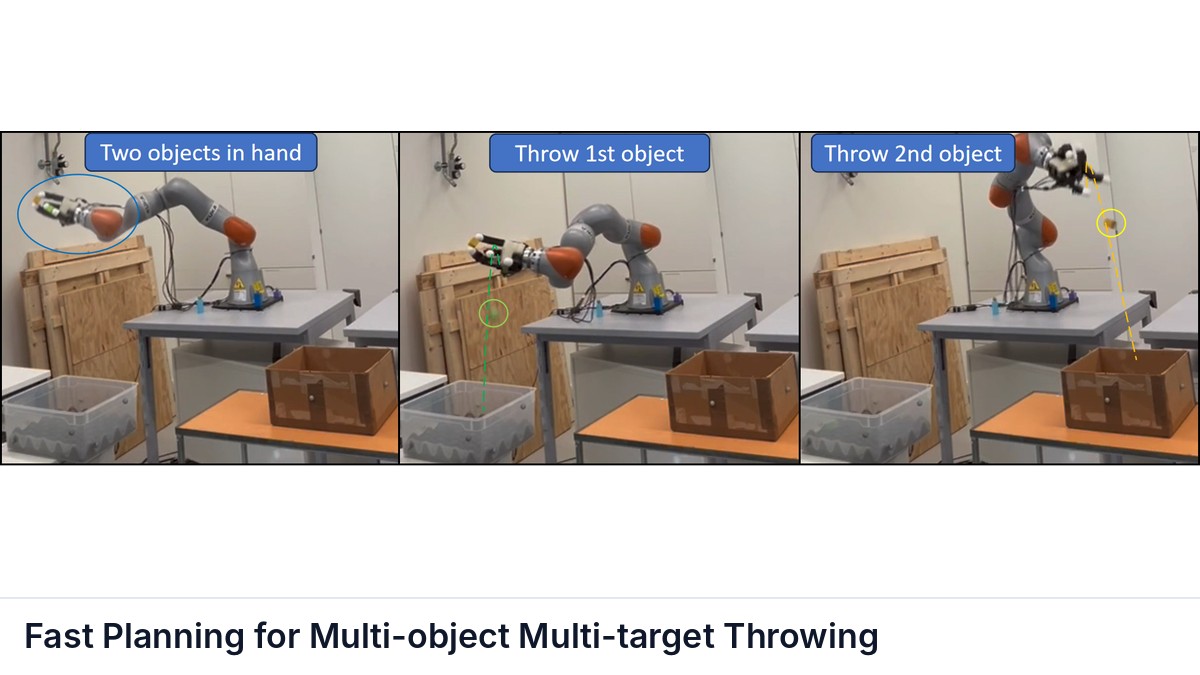
Robot throwing has emerged as a promising technique for improving efficiency in logistics and warehouse automation, by enlarging the workspace and speeding up the process. To significantly increase the throwing system's throughput, we develop strategies for throwing multiple objects in one swipe.
Abstract Summary
Key Points
- Robot throwing has emerged as a promising technique for improving efficiency in logistics and warehouse automation, by enlarging the workspace and speeding up the process.
- To significantly increase the throwing system's throughput, we develop strategies for throwing multiple objects in one swipe.
- Such multi-object multi-target throwing (MOMT) leverages the large degrees of freedom of anthropomorphic hands.
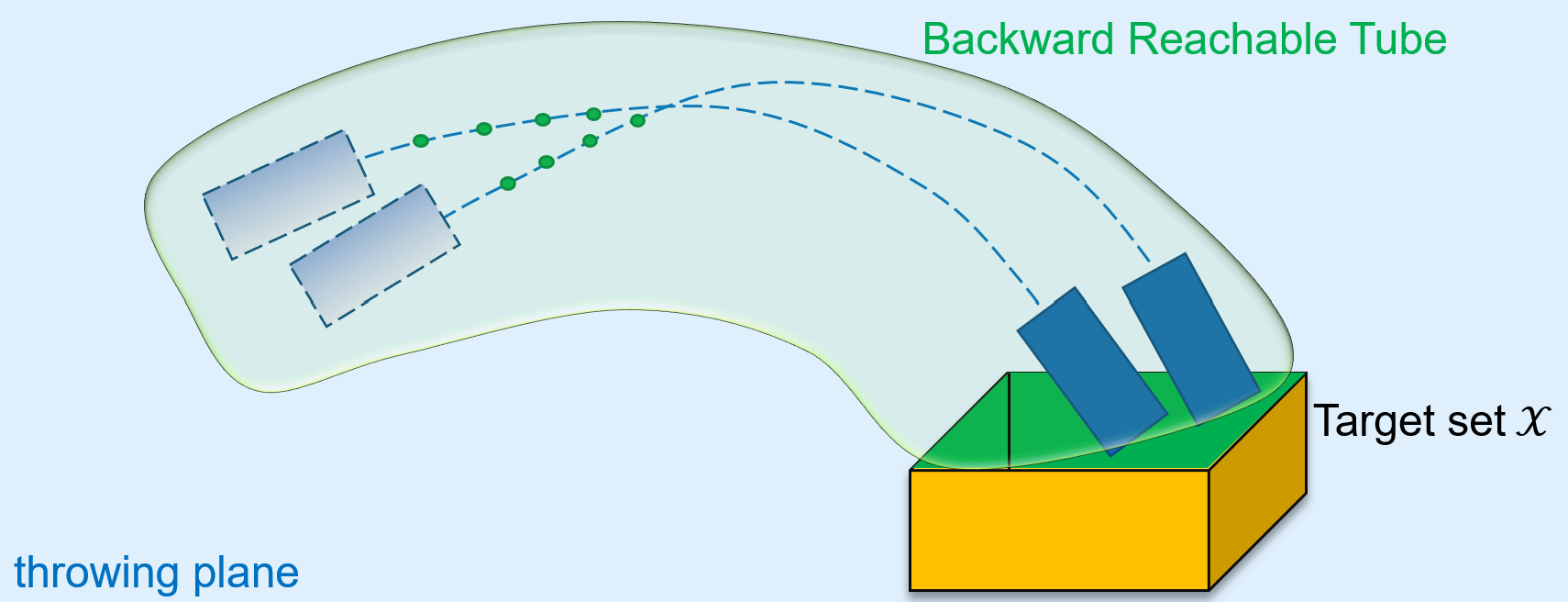
- The key is to quickly generate fast and feasible throwing motions, which involves a complex trade-off between short trajectory duration and short planning time.
- We solve this problem in two stages
Method
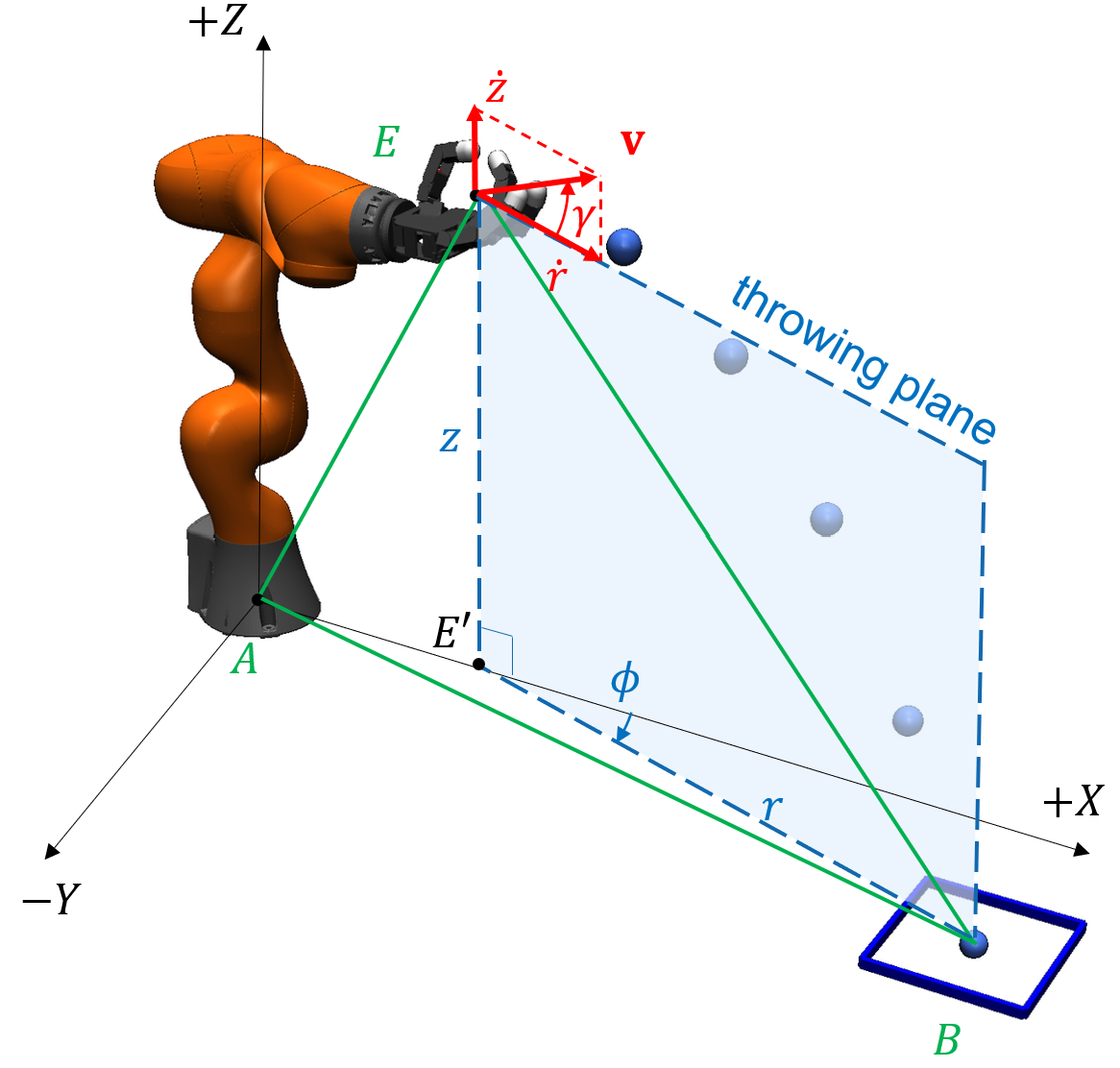
Our framework consists of two components: (1) a single-target throwing planner that generates diverse feasible throwing configurations for a fixed-base manipulator in under 5 ms, and (2) a multi-target coordinator that coordinates multiple throws to minimize total task time. We describe each in turn.
We make the following assumptions throughout this work: The manipulator is fixed-base, with the first joint rotating about the vertical axis (common in industrial arms). Objects are point masses during flight (no aerodynamic effects or spin).
Experiment
In this section, we evaluate the proposed MOMT throwing framework through simulation studies and real-world experiments. Our evaluation investigates three key questions: Planning-execution trade-off : How does the pruning parameter $K$ in Greedy search affect the balance between computation time and execution optimality? Scalability : How does the framework perform as the number of objects increases?
Real-world validity : Is the planning framework effective on physical hardware, and can the computational efficiency enable reactive re-planning?...
Sources and Demonstrations
Figures are reproduced from Zhu et al. See the full paper for experimental details and the project page, when the paper links one, for demonstrations and videos.
Related Papers
AD-WM: Action-Discriminative World Models for Counterfactual Model Predictive Control
Jiabin Qiu, Zixuan Chen, Hongye Cao et al.
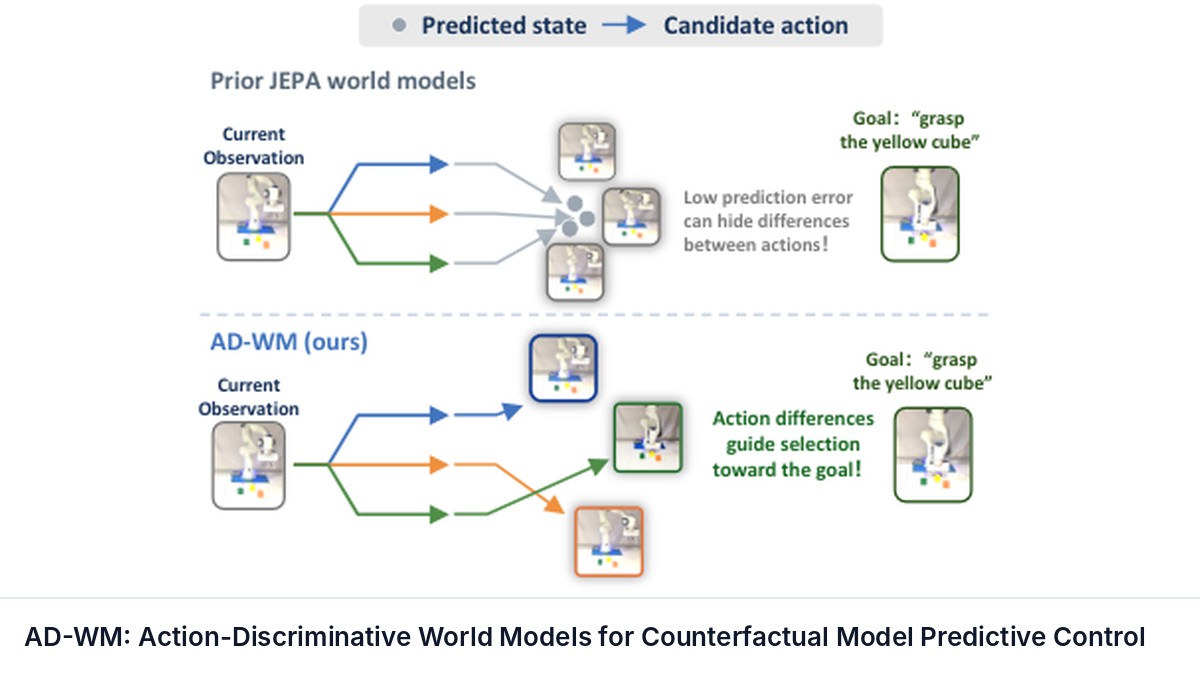
Latent world models are typically trained to predict factual transitions, whereas model predictive control (MPC) must compare alternative actions from the same state. A model can therefore achieve low factual prediction error yet poorly distinguish candidate actions.
AHEAD: Anticipatory Hand-Driven Teleoperation via Human Intent Prediction
Seok Joon Kim, Junho Lee, Federica Spinola et al.
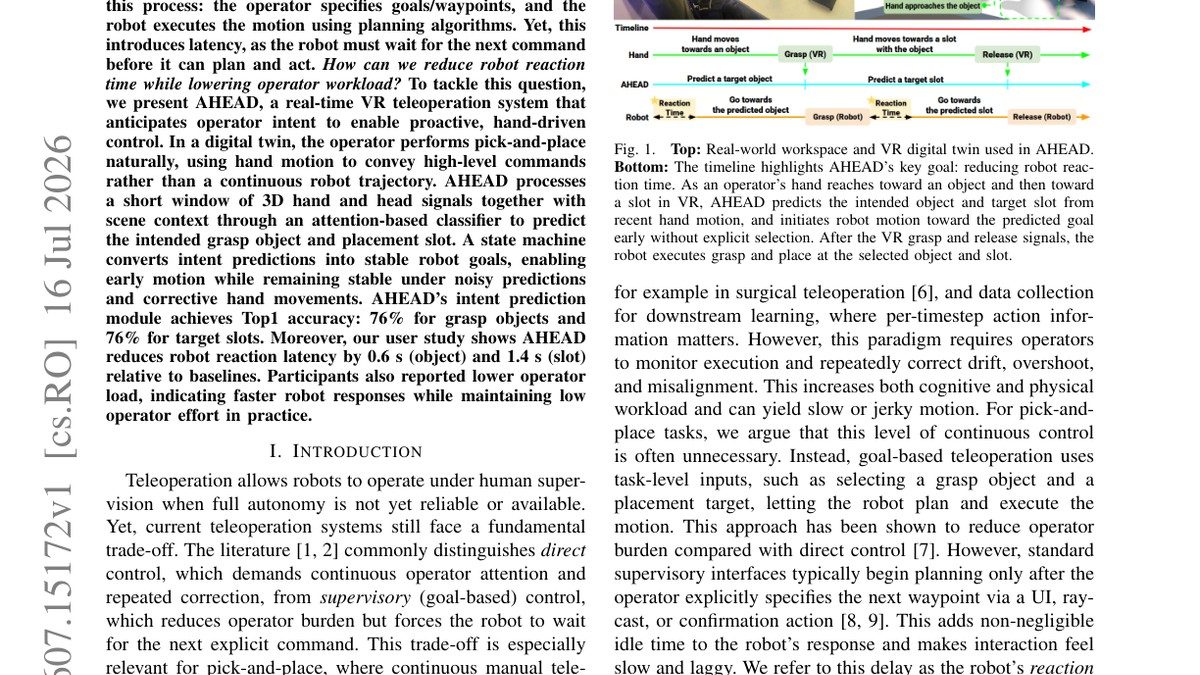
Direct hand-driven teleoperation maps an operator's hand motion to robot end-effector commands at every frame, enabling precise control, but it requires constant monitoring and correction during approach, grasp, and placement, which can be slow and fatiguing.
Autonomous Droplet Navigation via Model-Based Reinforcement Learning: Zero-Shot Transfer and Emergent Dynamics
Rajneesh Anand, Mayuresh V. Kothare
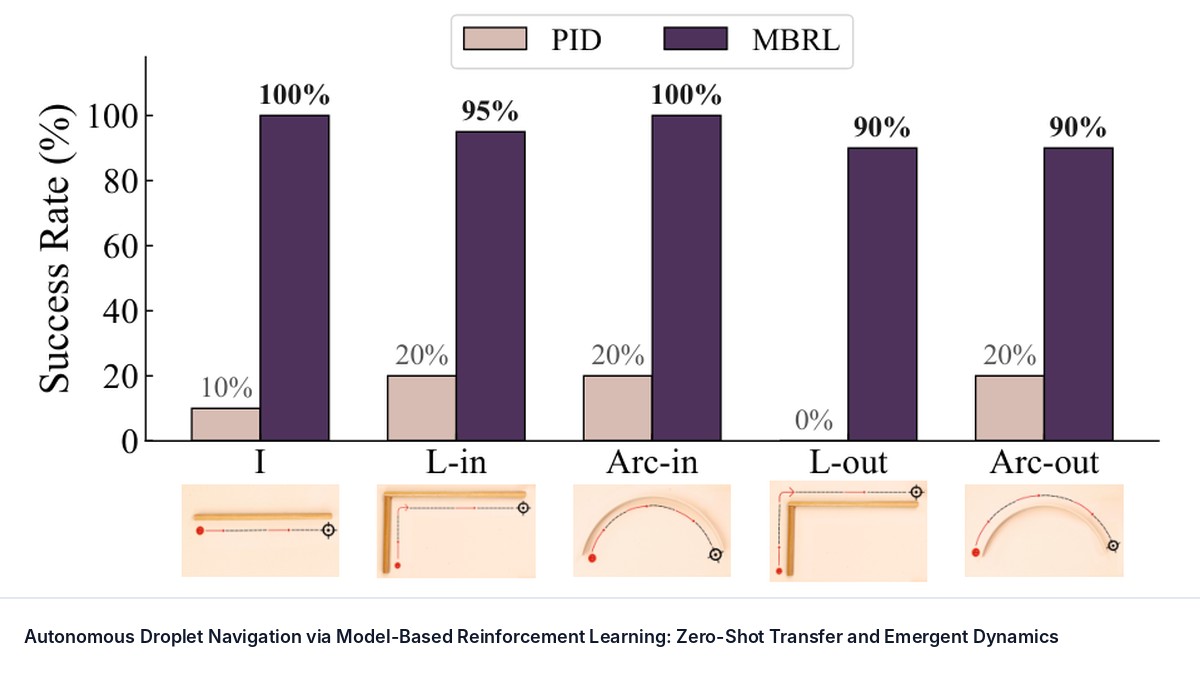
Self-driving laboratories (SDLs) are transforming chemical and materials discovery through closed-loop automation, yet automated infrastructure for physical manipulation of soft, deformable matter remains beyond current robotic platforms.
Body-Grounded Replanning for Physically Adaptive Manipulation
Namiko Saito, Hiroshi Kera
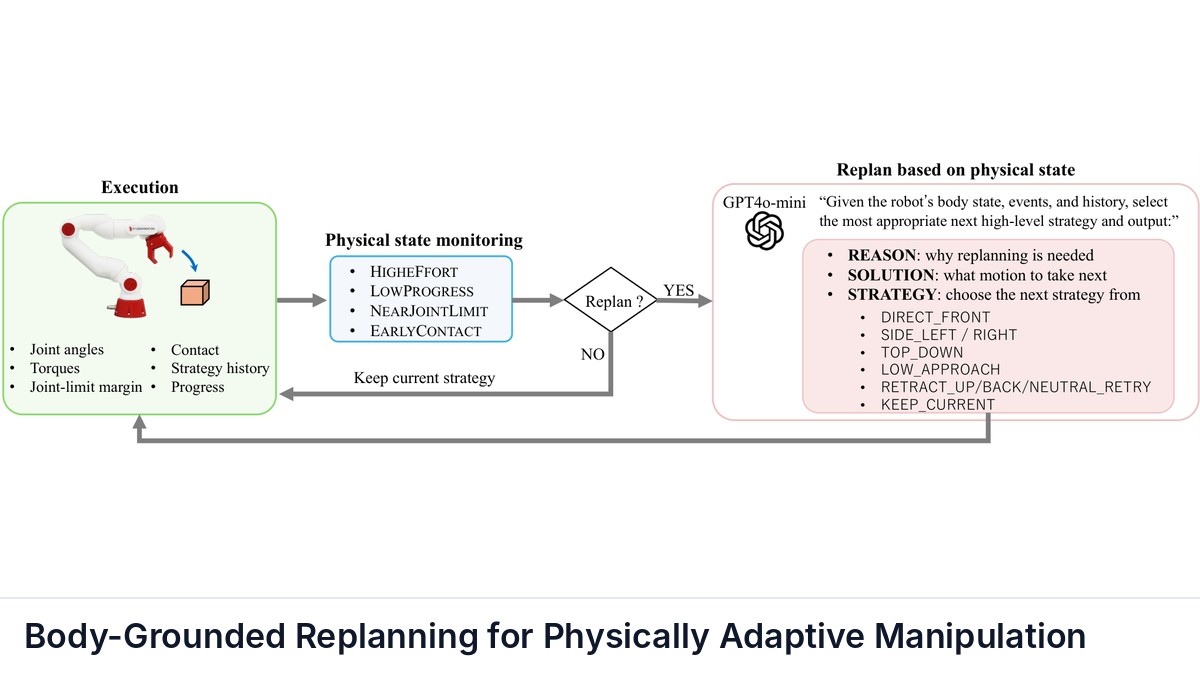
Manipulation requires not only reasoning about the external environment, but also about the robot's physical condition.