
Real-Time Whole-Body Safe Motion Generation for Multi-Segment Tendon-Driven Continuum Robots
Fangju Yang, Siyi Ma, Tonghao Guan, Tingcong Liu, Hang Yang, Zhengqiang Zhang, Jian S. Dai, Ke Wu · N/A · 2026
Framework
N/A
License
N/A
Stars
N/A
Summary
Real-time motion generation for tendon-driven continuum robots requires accurate modeling of nonuniform bending and whole-body collision avoidance. This paper presents a unified actuation-space framework for planar multi-segment tendon-driven continuum robots.
Abstract Summary
Key Points
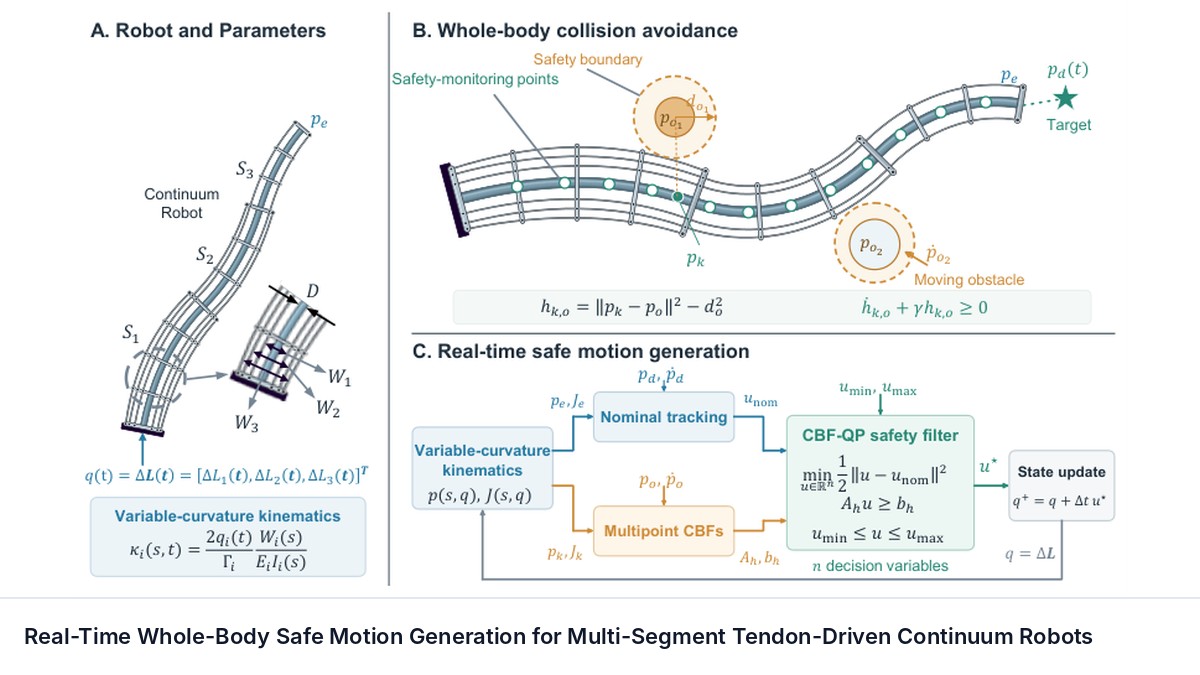
- Real-time motion generation for tendon-driven continuum robots requires accurate modeling of nonuniform bending and whole-body collision avoidance.
- This paper presents a unified actuation-space framework for planar multi-segment tendon-driven continuum robots.
- An energy-based variable-curvature model captures spatially varying tendon spacing and bending stiffness and provides analytical Jacobians for differential inverse kinematics and safety monitoring.
- A multipoint CBF-QP enforces backbone clearance under obstacle motion and actuation-velocity bounds, while its decision dimension depends only on the number of independently actuated segments.
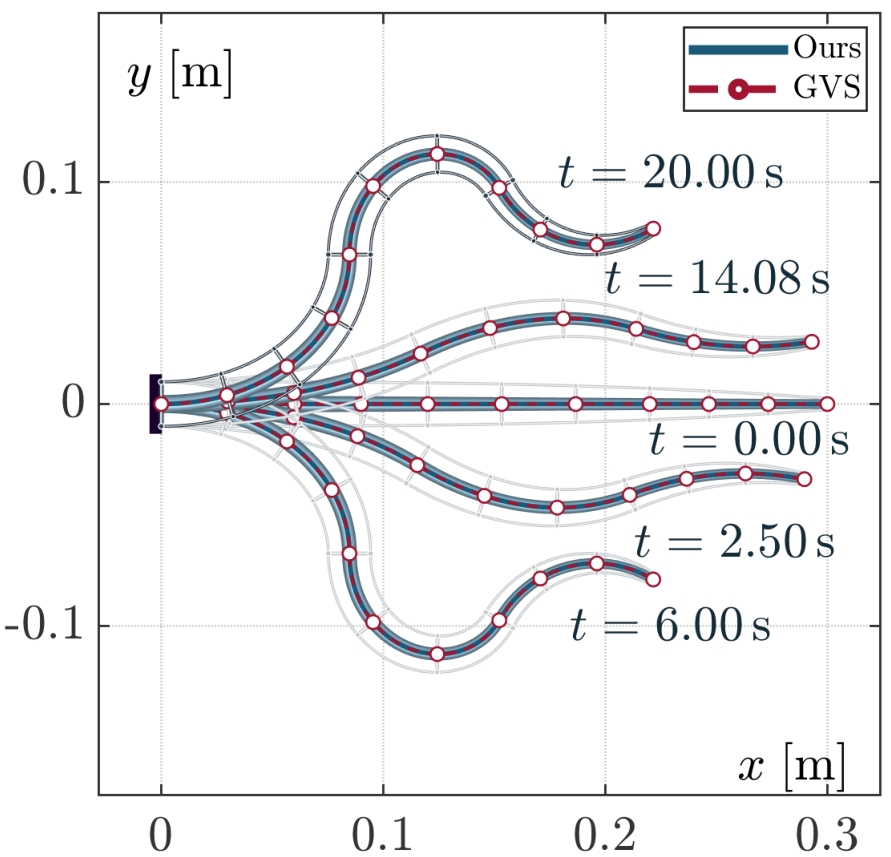
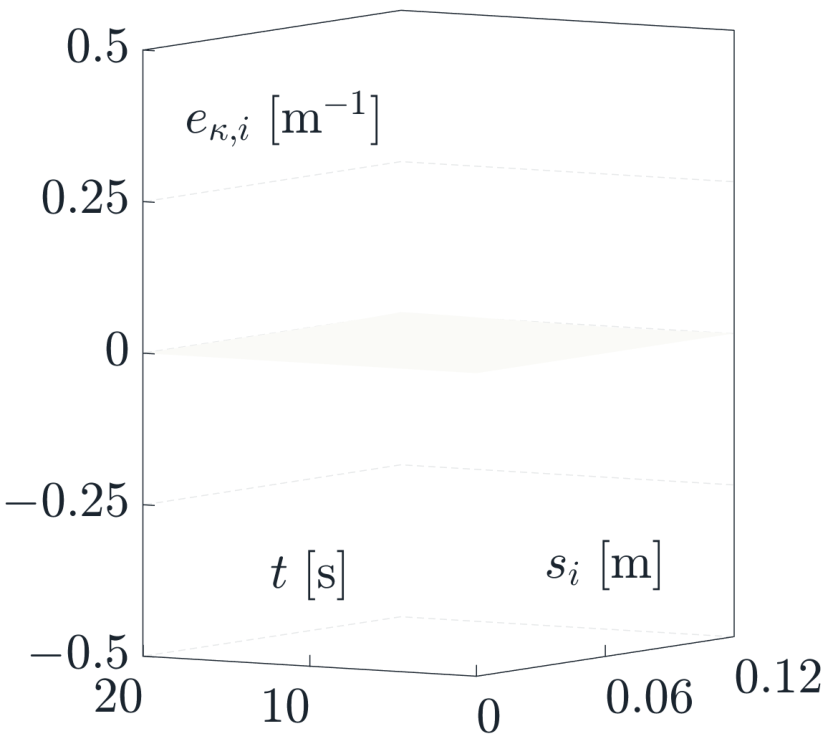
- The model closely agrees with GVS references, with a maximum curvature error of $5.223 \times 10^{-2}\,\mathrm{m}^{-1}$.
Variable-Curvature Kinematic Modeling in Actuation Space
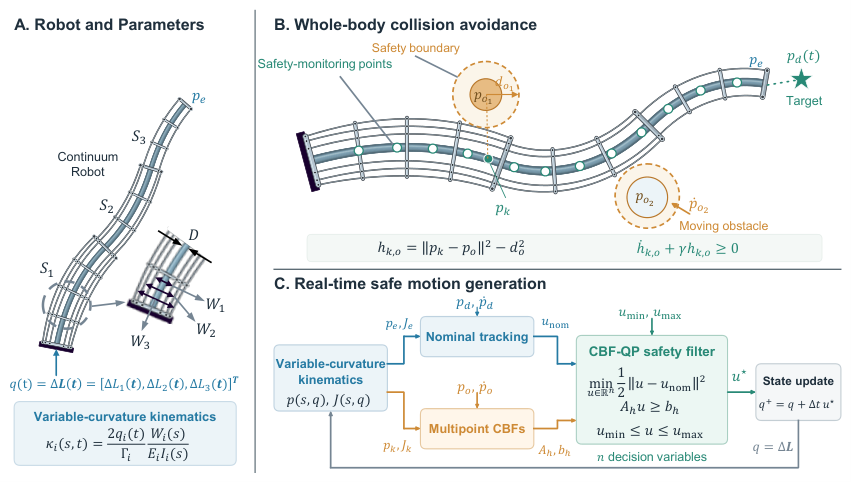
This paper considers the $n$-segment planar tendon-driven continuum robot (TDCR) shown in Fig. 1 and develops a general variable-curvature kinematic model in actuation space. The robot comprises $n$ serially connected flexible segments, where the $i$-th segment is denoted by $\mathcal{S}_{i}$ and has length $L_{i}$, yielding the total robot length $L=\sum_{i=1}^{n}L_{i}$.
The arc-length coordinate $s\in[0,L]$ specifies a material point along the backbone.
Real-Time Whole-Body Collision-Avoidance Framework
Building on the multi-segmen continuum-robot kinematics, this section develops a real-time whole-body safety-control framework. Unlike methods that impose collision-avoidance constraints only at the robot tip, the proposed framework selects multiple safety-monitoring positions along the flexible backbone and constructs control barrier function constraints using their actuation-space point Jacobians.
Tip trajectory tracking and whole-body collision avoidance are thereby unified in an actuation-space quadratic program.
Numerical Validation
Numerical simulations evaluate the kinematic accuracy, whole-body collision avoidance, and computational efficiency of the proposed framework. Kinematic predictions are compared with GVS results [ 22 ] . Whole-body collision avoidance is then evaluated with static obstacles and during trajectory tracking with moving obstacles. Table I summarizes the parameters used for the kinematic validation in Fig. 2 .
The proposed model and GVS use identical geometric and material properties and tendon-length inputs.
Sources and Demonstrations
Figures are reproduced from Yang et al. See the full paper for experimental details and the project page, when the paper links one, for demonstrations and videos.
Related Papers

3D Euler-Angle Orientation Control for Two-Ray Fading Mitigation in Maritime Air-to-Sea Communications
Mohammed Bajja, Abdoul Karim A. H. Saliah, Hajar El Hammouti et al.
Maritime Air-to-Sea links are dominated by a line-of-sight ray and a sea-surface reflected ray whose destructive combination produces deep fades. Existing mitigation strategies optimize Unmanned Aerial Vehicle position or trajectory but leave attitude unexploited.
A Balanced Data Diet: Addressing the Exploration Bottleneck in Mega-Scale RL for Robot Control
Octi Zhang, Mateo Guaman Castro, Patrick Yin et al.
General-purpose robots must perform a wide range of tasks from agile locomotion to dexterous manipulation.
A bioinspired internal model-based online estimator for planar pursuit
Tengyue Liu, Xincheng Li, Sofia Morales Ferreira et al.
Bioinspired feedback controls for pursuit, tracking, and collective motion are often expressed in terms of the relative configuration between interacting agents.
A Biomimetic Gaze Control to Restore Head-Neck Movements
Colin Rubow, Haohan Zhang
Powered neck exoskeletons are developed to restore head-neck motions for those with neck muscle weakness. Current methods using hand-held input devices to control these robotic systems are unintuitive or non-viable for these populations.