
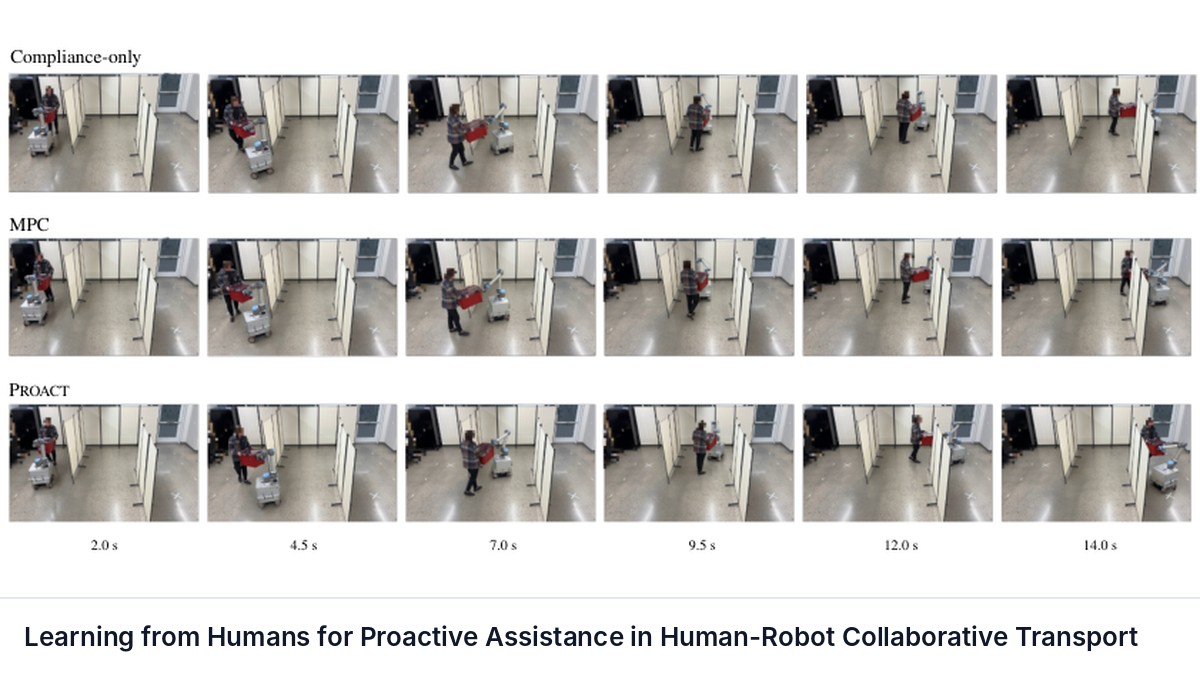
Learning from Humans for Proactive Assistance in Human-Robot Collaborative Transport
Elvin Yang, Christoforos Mavrogiannis · N/A · 2026
Framework
N/A
License
N/A
Stars
N/A
Summary
We focus on human-robot collaborative transport, a challenging task of broad relevance spanning logistics, manufacturing, and the home, in which a user and a robot work together to relocate a large or heavy object.
Abstract Summary
Key Points
- We focus on human-robot collaborative transport, a challenging task of broad relevance spanning logistics, manufacturing, and the home, in which a user and a robot work together to relocate a large or heavy object.
- To act as an effective partner, the robot should reduce the user's effort by contributing to efficient relocation of the object while remaining physically responsive to them.
- Prior work often addresses these capabilities separately, producing robots that may move the object efficiently but resist user input, or accommodate the user but depend on continuous guidance.
- Our key insight is that obstacle-constrained collaborative transport requires integrating predictions of human collaborative behavior with compliant robot control.
- To this end, we introduce PROACT, a framework for human-robot collaborative transport that incorporates anticipation into compliant whole-body control through a learned model of human collaborative behavior.
Problem Statement
We consider a user and a robot collaborating to transport a rigid object in a workspace $\mathcal{W}\subseteq SE(3)$ containing obstacle-occupied regions $\mathcal{O}\subset\mathcal{W}$. We represent the object state as $(x^{\mathrm{obj}},\dot{x}^{\mathrm{obj}})\in\mathcal{W}\times\mathbb{R}^{6}$, where $x^{\mathrm{obj}}$ is its pose and $\dot{x}^{\mathrm{obj}}$ is its twist.
The user and robot maintain fixed grasps on opposite sides of the object throughout the task. The robot is a mobile manipulator with a holonomic base and an $N$-DoF arm.
Proact: A Framework for Proactive Assistance in Collaborative Transport
We propose a framework that combines human collaborative behavior modeling in the form of object motion prediction with compliant whole-body robot control for physical human-robot collaborative transport.
The model, learned from demonstrations of dyadic human collaborative transport, predicts a future horizon of object twists describing how a collaborative team would realize a route, conditioned on recent object state history.
Evaluation
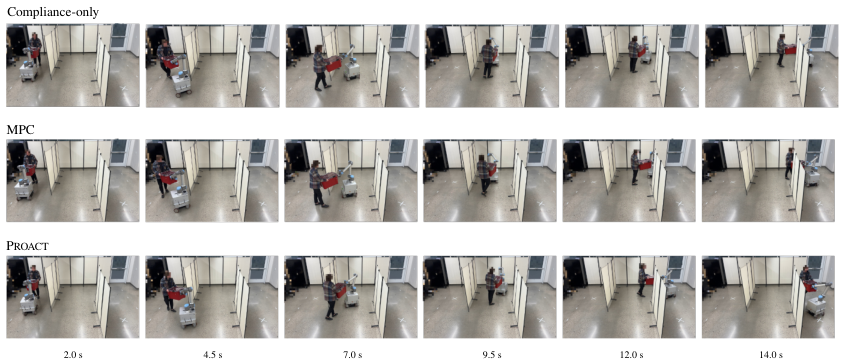
We conduct two complementary evaluations of our method: a component-level evaluation of model prediction performance and a pilot study assessing the full system via real-world human-robot collaborative transport trials.
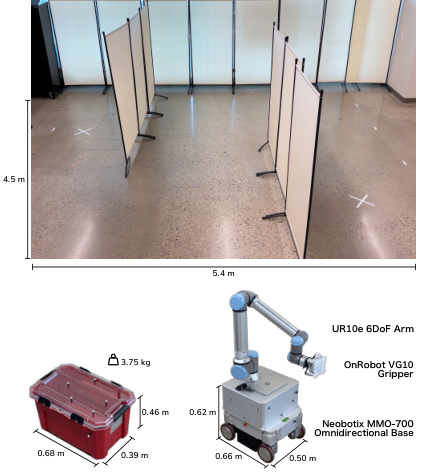
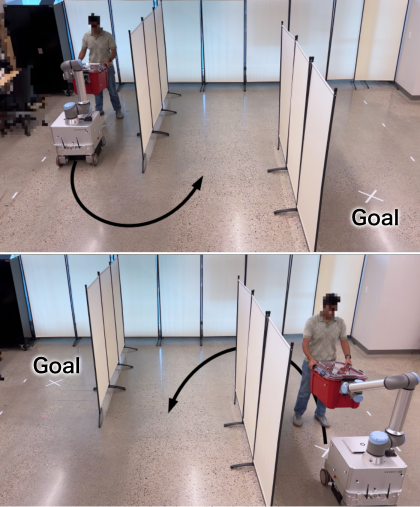
Motivated by practical transport challenges such as maneuvering around corners and through constrained spaces, we design a new $4.5\text{\times}5.4\text{\,}\mathrm{m}$ workspace that requires successive turns between start and goal locations (Fig. 3 ).
Sources and Demonstrations
Figures are reproduced from Yang et al. See the full paper for experimental details and the project page, when the paper links one, for demonstrations and videos.
Related Papers

A Sim-to-Real Integration Pipeline for Training and Deployment of Chunk-Based VLA Manipulation Policies
Mathilde Kappel, Clémence Grislain, Mohamed Chetouani et al.
Vision-Language-Action (VLA) models have become a prominent paradigm for mapping multimodal inputs, including semantic instructions, visual observations of the scene, and proprioceptive observations, to robot actions.
Behavioral Cloning Mystery
Seohong Park, Sergey Levine
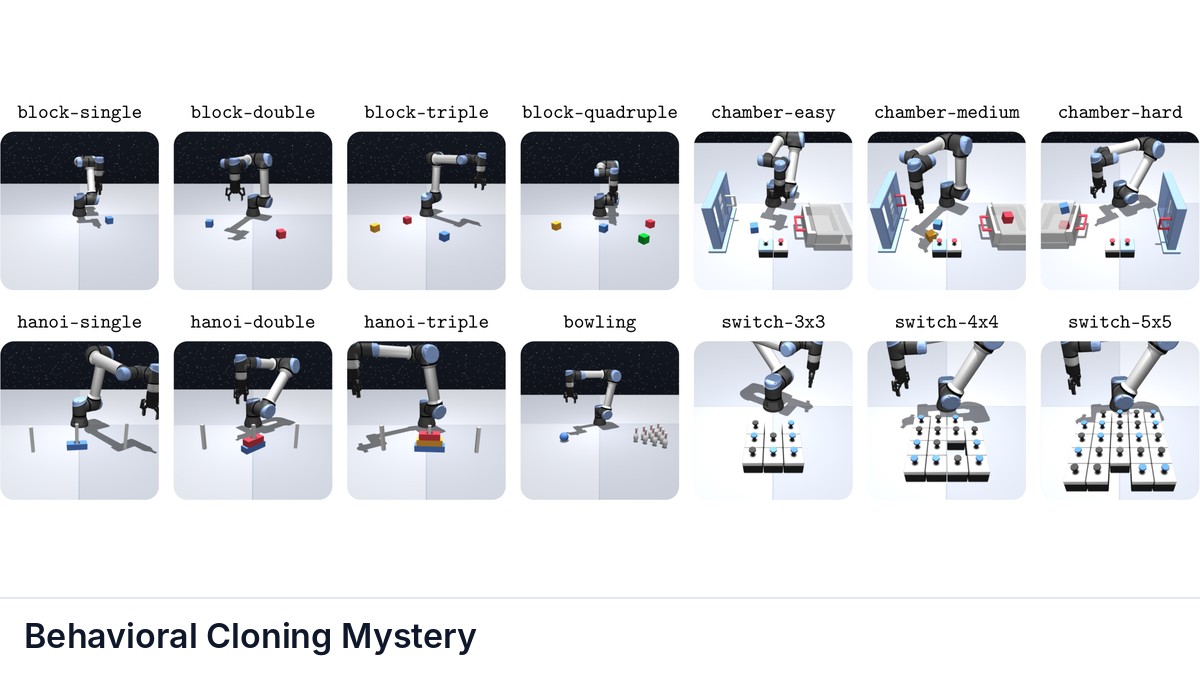
Behavioral cloning (BC), despite its simplicity, exhibits many counterintuitive phenomena in the real world. For example, the performance of BC often keeps increasing as the model overfits more to the dataset, and fully closed-loop policies often completely fail without action chunking.

Capability-Aware Arbitration for Semantic Intent-Based Shared Control
Zhaoda Du, Michael Bowman, Xiaoli Zhang
Shared control often allocates robot authority based on confidence in inferred human intent, assuming reliable autonomous execution. When this assumption fails, high intent confidence can cause over-helping.
Design and Evaluation of a Collaborative Teleoperation Interface for Multi-Operator Multi-Robot Systems in Challenging Environments
Alperen Kenan, Juan José García Cárdenas, Adriana Tapus et al.
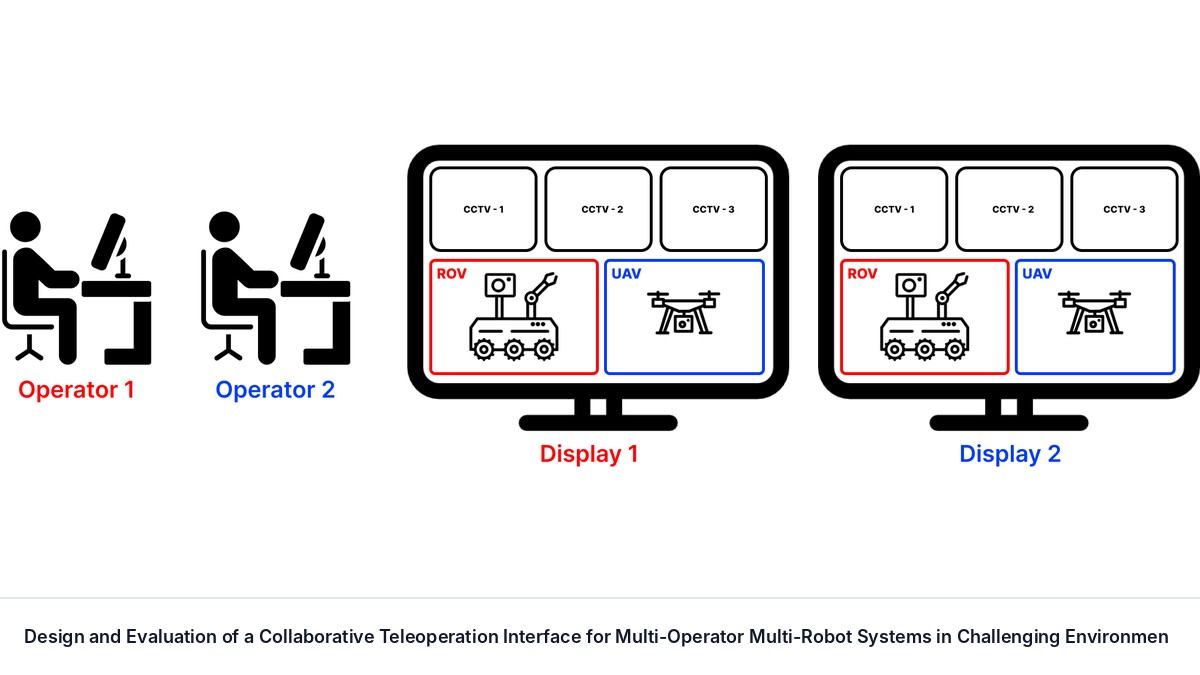
Multi-robot systems that combine the complementary capabilities of specialised platforms are critical for complex missions in challenging, inaccessible environments.