
RynnUnify: Towards Unified Embodied Brain
Minghao Zhu, Bohan Hou, Kun Xiang, Zixuan Wang, Yinzhou Tang, Yifei Yang, Zhikai Wang, Tianyi Zhang, Kehan Li, Haoyu Zhao, Siteng Huang, Leigang Qu, Sicong Leng, Dongchi Huang, Mingxiu Chen, Shijian Lu, Yue Wang, Xiaodan Liang, Zhenyu Zeng, Deli Zhao, Chengju Liu, Jianfei Yang, Xin Li · N/A · 2026
Framework
N/A
License
N/A
Stars
N/A
Summary
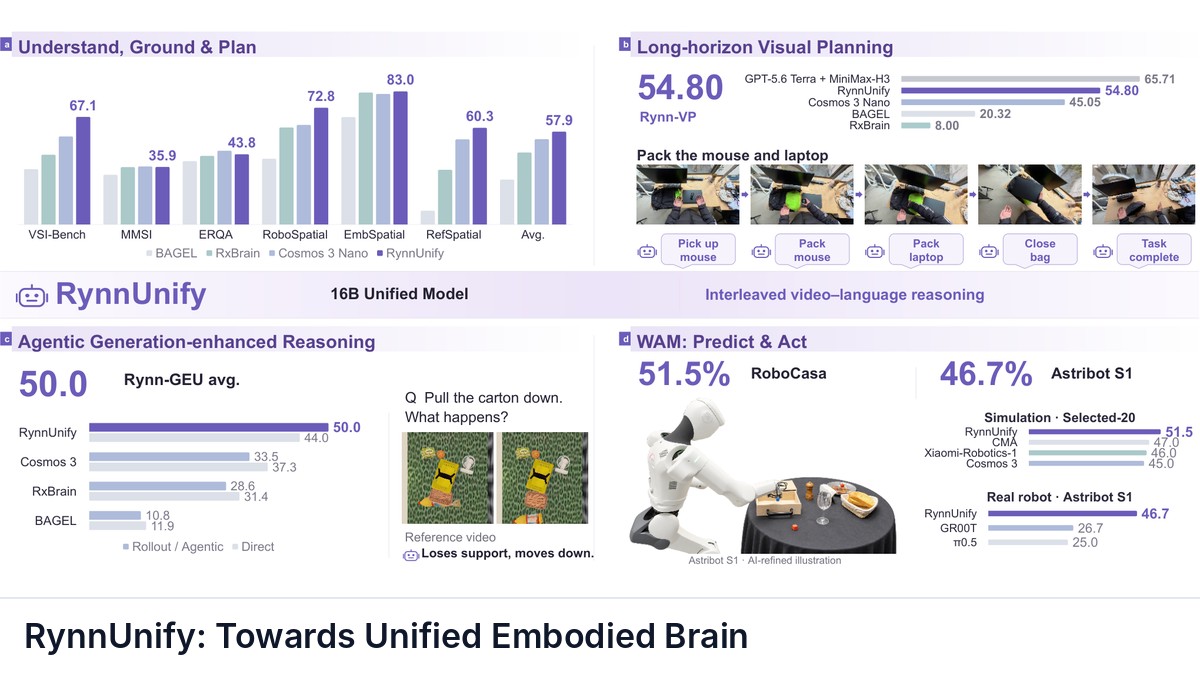
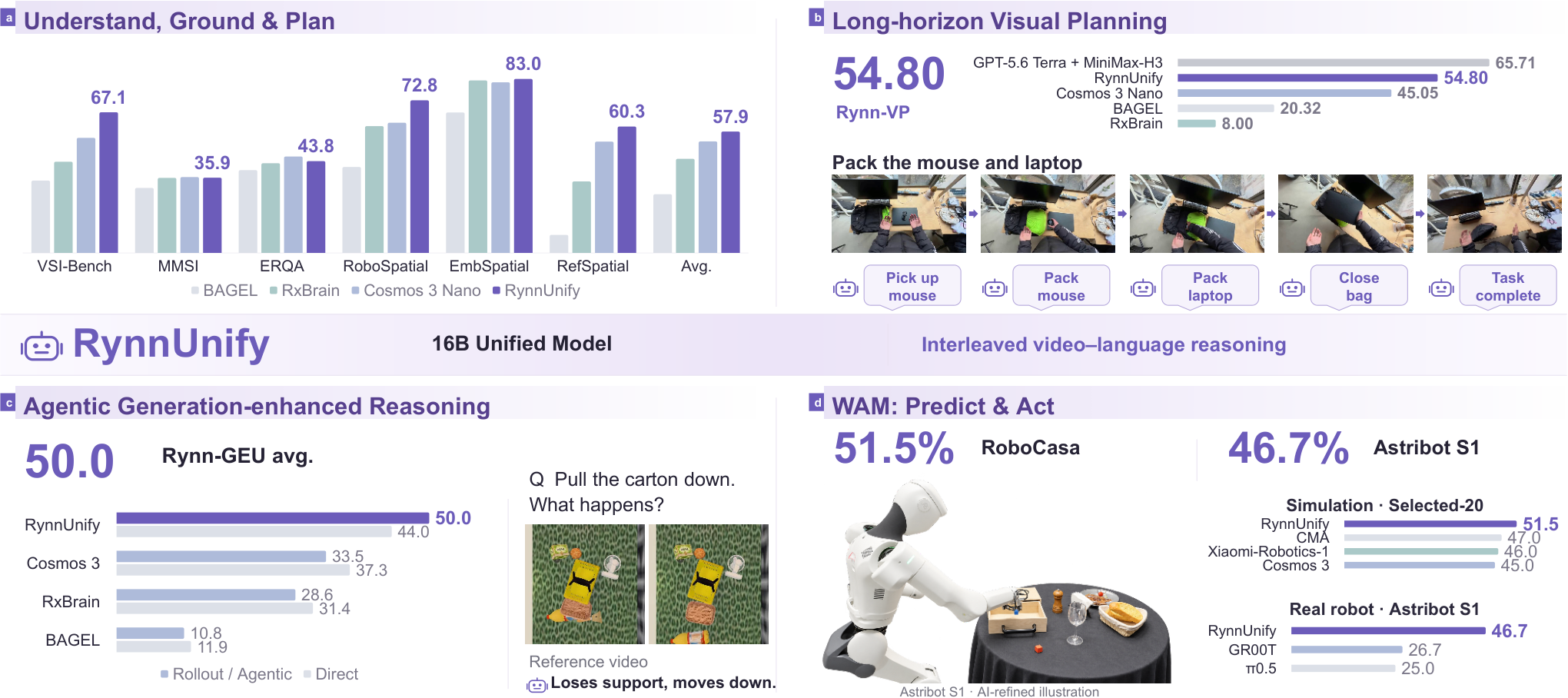
We introduce RynnUnify, a 16B unified embodied model that combines strong embodied understanding with long-horizon visual planning through interleaved video--language reasoning.
Abstract Summary
Key Points
- We introduce RynnUnify, a 16B unified embodied model that combines strong embodied understanding with long-horizon visual planning through interleaved video--language reasoning.
- With capabilities spanning spatial reasoning, physical prediction, and grounding, RynnUnify connects an understanding of the physical world with visual anticipation of how it evolves across successive subtasks.
- Building on these capabilities, we further develop an agentic extension through reinforcement learning to selectively use video predictions for reasoning about unobserved states and interaction outcomes.
- We also develop a world-action extension of the full RynnUnify model, translating its understanding and prediction capabilities into robot control.
- To evaluate these capabilities, we introduce Rynn-VP and Rynn-GEU for long-horizon visual planning and anticipatory reasoning.
Model Architecture
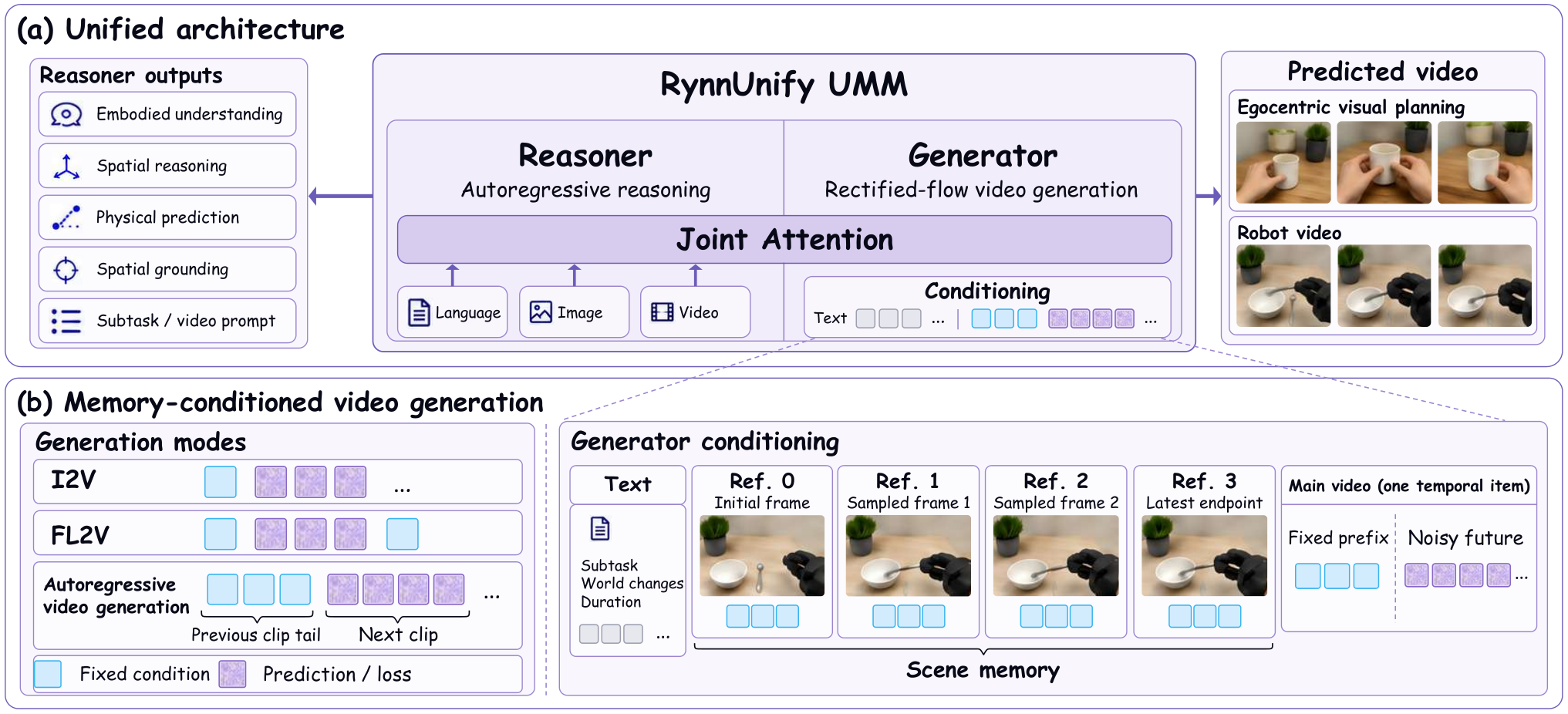
As shown in Figure 2 , RynnUnify adopts the Mixture-of-Transformers (MoT) liang2025mixtureoftransformers architecture of Cosmos3 cosmos3 . The model comprises an autoregressive reasoner for multimodal understanding and language generation, and a diffusion generator for predicting continuous visual latents through rectified flow liu2022flow .
The two branches use separate Transformer parameters and interact through joint attention, allowing the generator to attend to representations produced by the reasoner.
Data
Table 3.1 summarizes the data used to fine-tune the reasoner and generator. To maintain broad embodied understanding and reasoning capabilities, we use a 10% subset of the RynnBrain pretraining corpus li2026rynnbrain11capablegeneralizable as the foundation of our understanding data.
Reasoning about embodied tasks requires the model to interpret task intentions, recognize objects and their properties, understand spatial relationships, and track changes across successive observations.
Sources and Demonstrations
Figures are reproduced from Zhu et al. See the full paper for experimental details and the project page, when the paper links one, for demonstrations and videos.
Related Papers
A Low-Cost, Open Platform for End-to-End Autonomous Driving on a Miniature Ackermann Vehicle
Gustavo Claudio Karl Couto, Eric Aislan Antonelo, Gabriel George Zipperer
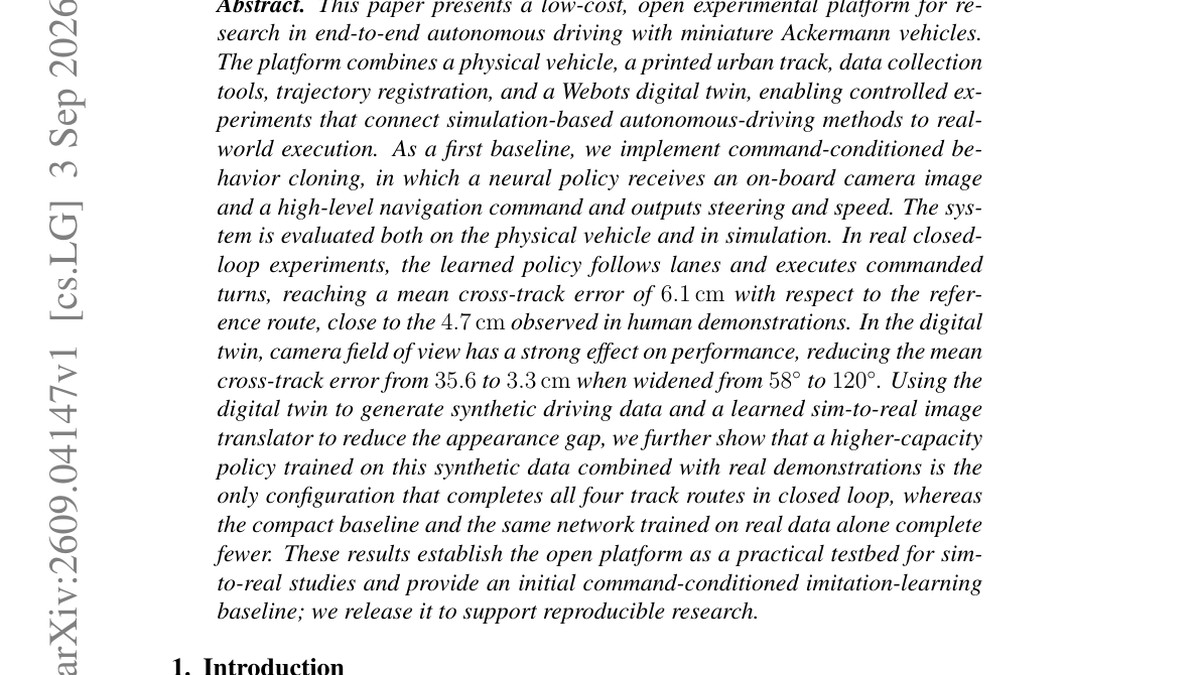
This paper presents a low-cost, open experimental platform for research in end-to-end autonomous driving with miniature Ackermann vehicles.
Aim Short to Reach Far: Your Frozen World Model Can Plan Better Than You Think
Xvyuan Liu, Jianjie Fang, Chen Gao et al.
Planners built on visual world models commonly score each predicted outcome by its distance to the encoded goal image. We show that this target can limit control even with exact dynamics and globally optimal short-horizon search: reaching a goal may require actions that initially move away from it.
Autonomous Droplet Navigation via Model-Based Reinforcement Learning: Zero-Shot Transfer and Emergent Dynamics
Rajneesh Anand, Mayuresh V. Kothare
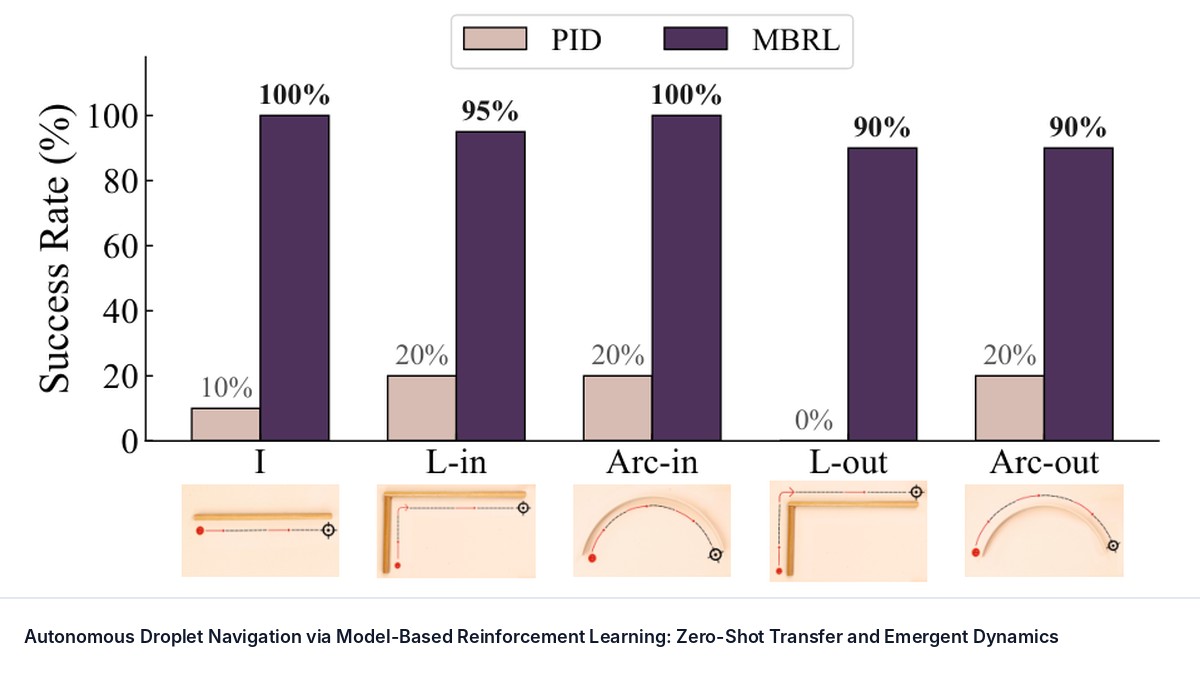
Self-driving laboratories (SDLs) are transforming chemical and materials discovery through closed-loop automation, yet automated infrastructure for physical manipulation of soft, deformable matter remains beyond current robotic platforms.
Autoware in Construction: Gap Analysis and LiDAR Perception Toward Off-Road Autonomous Driving
Yu Otsuki, Teja Emmey, Sena Matsushita et al.
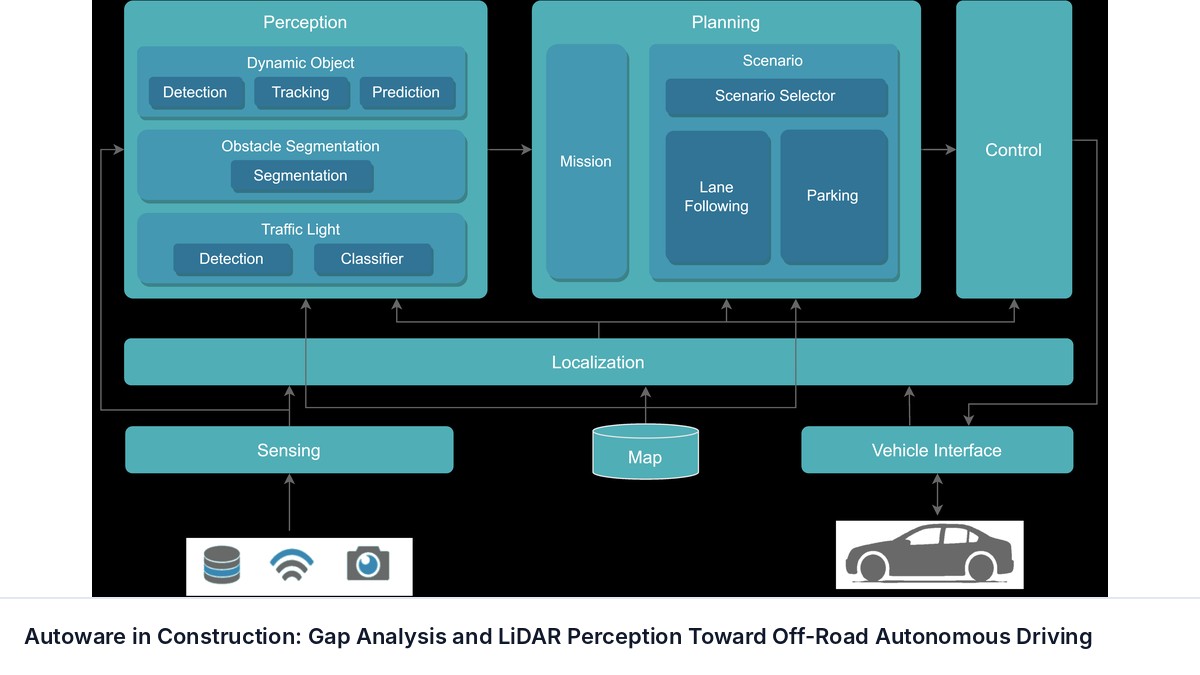
Autoware is an open-source autonomous driving software platform widely adopted by researchers and industry developers.