
GOTT: Object-centric Dexterous Manipulation with a Reusable Cross-Embodiment Primitive
Yulin Liu, Lai Wei, Yen-Jen Wang, Akash Sharma, Pieter Abbeel, Henrik I. Christensen, Haozhi Qi · N/A · 2026
Framework
N/A
License
N/A
Stars
N/A
Summary
Foundation models and large-scale human data provide rich sources of manipulation intent, but translating this intent into multi-fingered robot behavior remains difficult. Dexterous hands still lack a reusable low-level primitive that reliably establishes contact across tasks and embodiments.
Abstract Summary
Key Points
- Foundation models and large-scale human data provide rich sources of manipulation intent, but translating this intent into multi-fingered robot behavior remains difficult.
- Dexterous hands still lack a reusable low-level primitive that reliably establishes contact across tasks and embodiments.
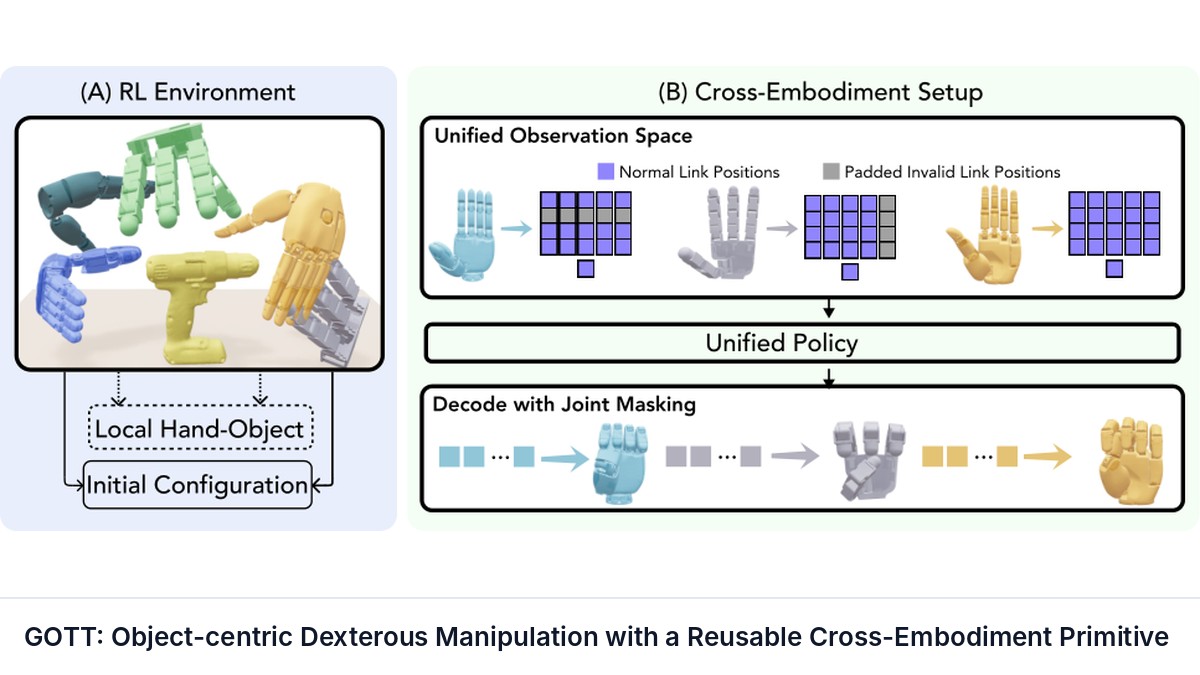
- We propose GOTT, a reach-acquire-move framework built around a single cross-embodiment contact-acquisition primitive.
- Given a robot-agnostic object trajectory and a reach specification, GOTT first brings the hand near a task-relevant contact region.
- The shared closed-loop primitive then establishes stable contact from this approximate initialization, and a pose-conditioned controller tracks the desired object motion.
Dexterous Manipulation via General Object Trajectory Tracking
We propose GOTT , a reach-acquire-move framework (Section 3.1 ) for executing rigid-object motions with dexterous hands. Its high-level interface consists of a desired object trajectory $\tau_{o}$ and a reach specification $\rho$ that brings the hand near a task-relevant contact region.
At its core, a reusable cross-embodiment contact-acquisition primitive grounds this interface by turning an approximate reach into stable contact (Section 3.2 ).
Experiments
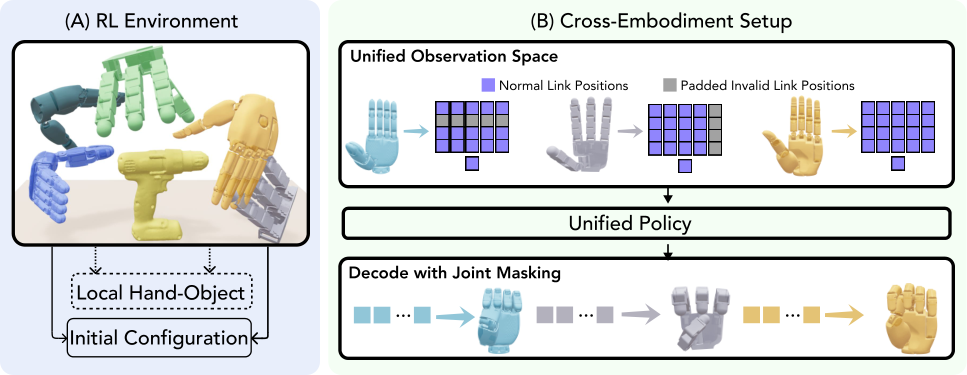
We evaluate the contact-acquisition primitive’s robustness, cross-embodiment transfer, and contribution to end-to-end task success. We further examine its reuse across workspaces and with different high-level sources, and evaluate key design choices through ablations. Hardware setup.
We evaluate GOTT on multiple arm-hand platforms, including Franka Research 3 (7-DoF) and Tianji (7-DoF) arms paired with XHand (12-DoF) and Sharpa Wave (22-DoF) hands, as shown in Figure 4 . Object assets and perception stack.
Sources and Demonstrations
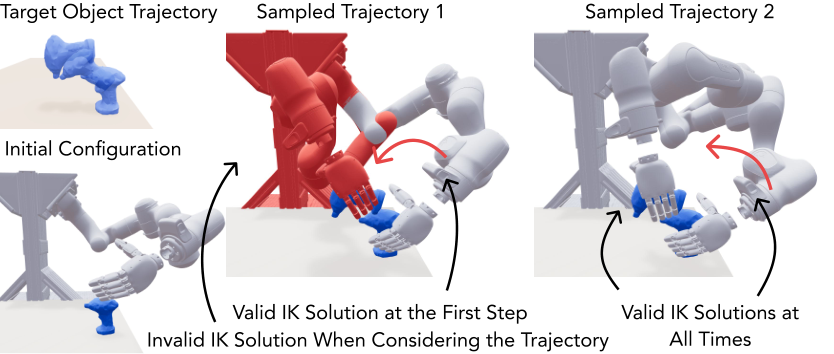
Figures are reproduced from Liu et al. See the full paper for experimental details and the project page, when the paper links one, for demonstrations and videos.
Related Papers
AHEAD: Anticipatory Hand-Driven Teleoperation via Human Intent Prediction
Seok Joon Kim, Junho Lee, Federica Spinola et al.
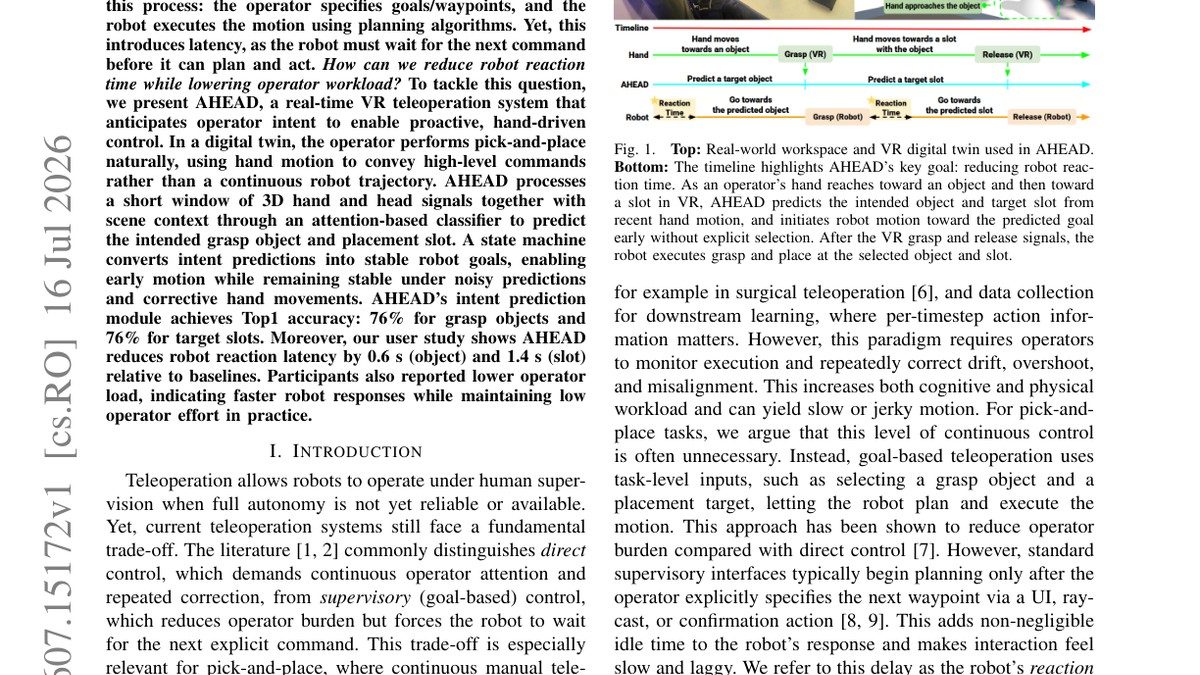
Direct hand-driven teleoperation maps an operator's hand motion to robot end-effector commands at every frame, enabling precise control, but it requires constant monitoring and correction during approach, grasp, and placement, which can be slow and fatiguing.
Dexterity from Supervised Play
Botao He, Yiming Dou, Yiannis Aloimonos et al.
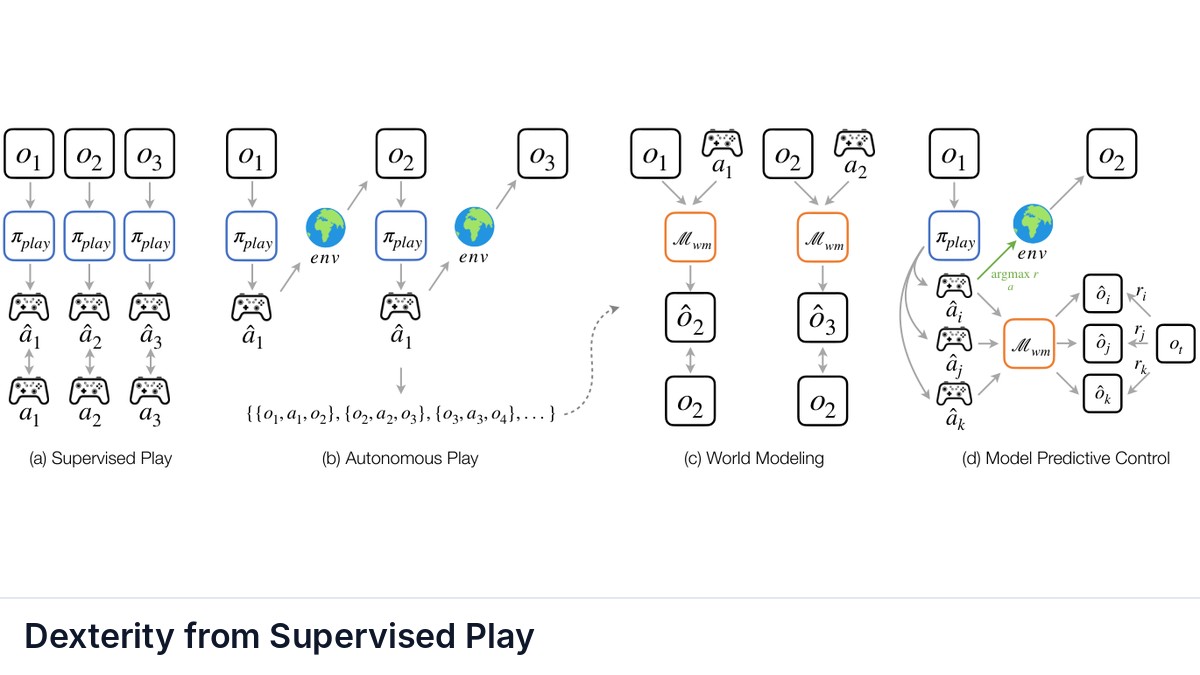
How can robots autonomously collect the contact-rich experience needed to learn dexterous manipulation?
Has GPT-6-Astra Achieved Embodied Intelligence?
SenseNova, Joint Research Team, : et al.
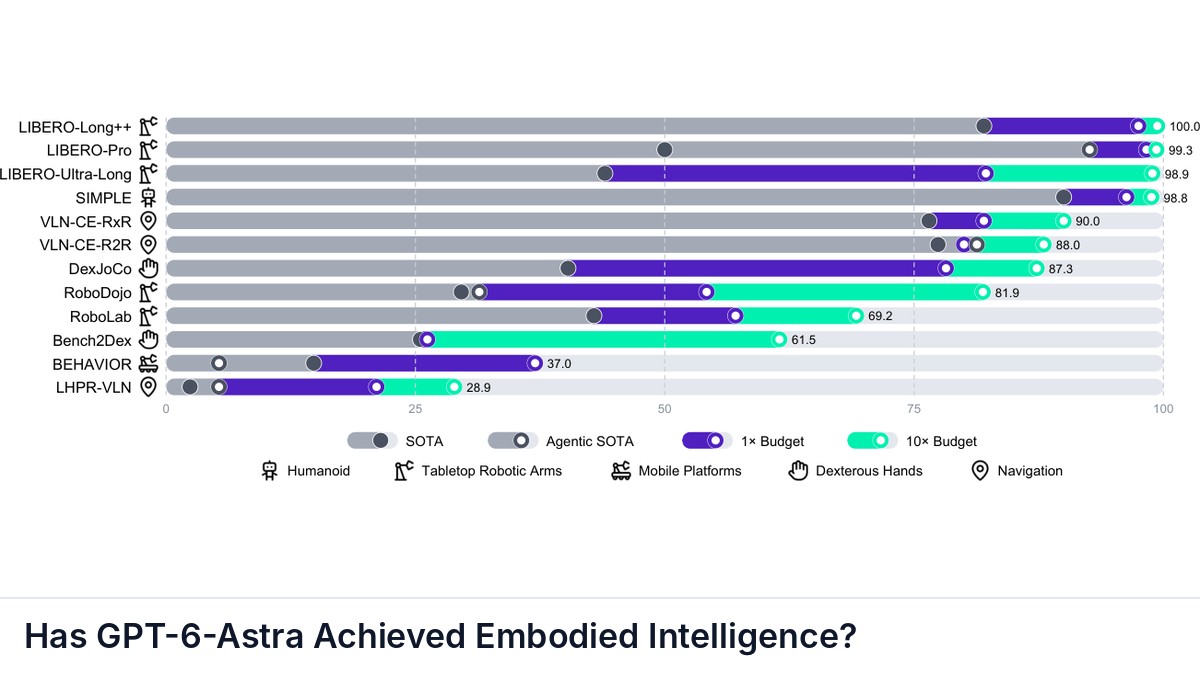
GPT-6-Astra demonstrates a level of competence in robotic manipulation and navigation that challenges the conventional paradigm of building specialized models for individual tasks and embodiments.
In-Context Learning for Robots: Methods and Applications
Haojian Huang, Zexi Li, Junhao Guo et al.
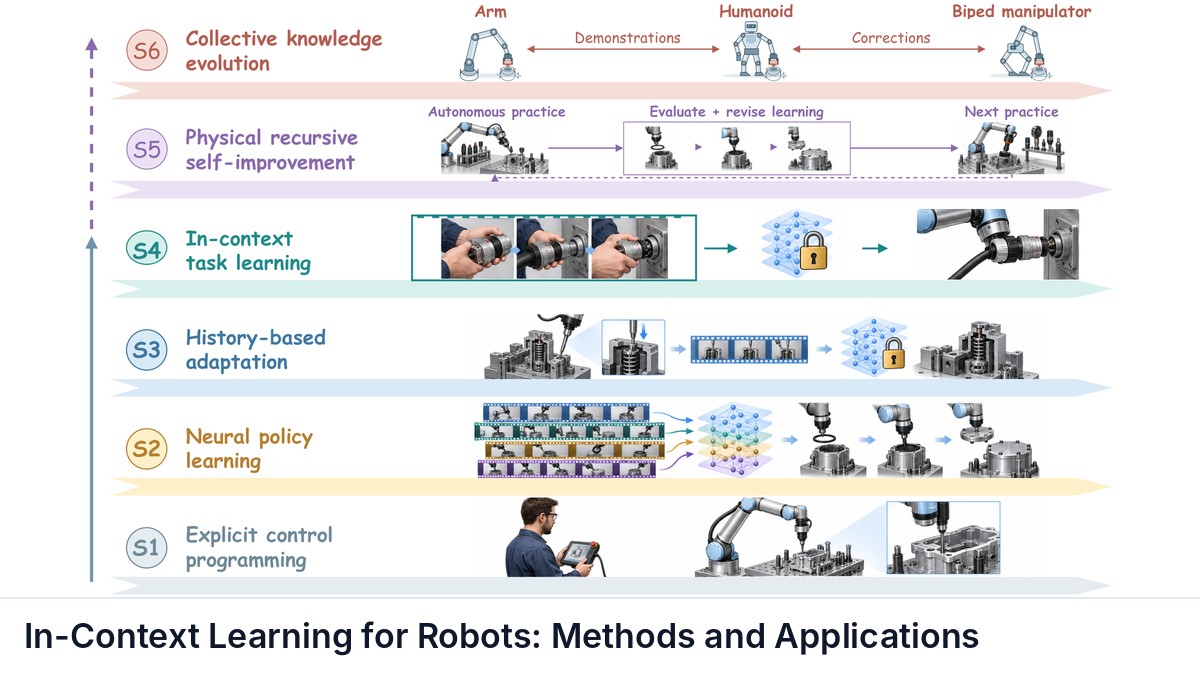
General-purpose robots must infer what a new task requires and translate that understanding into appropriate physical action.