
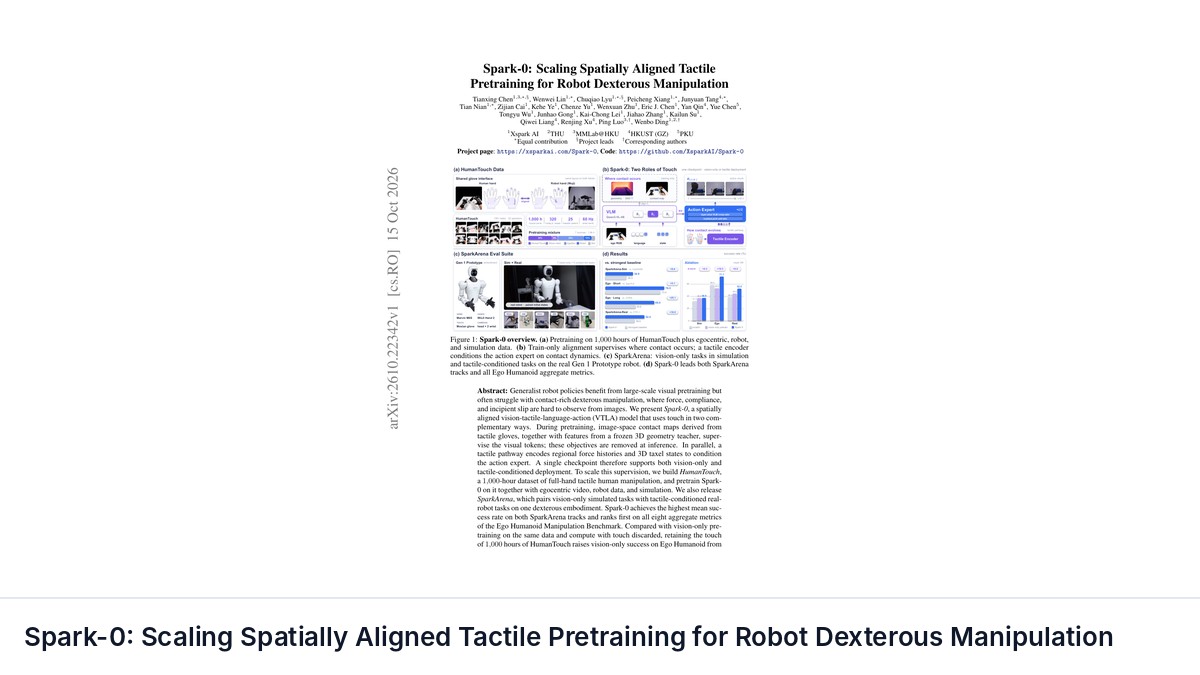
Spark-0: Scaling Spatially Aligned Tactile Pretraining for Robot Dexterous Manipulation
Tianxing Chen, Wenwei Lin, Chuqiao Lyu, Peicheng Xiang, Junyuan Tang, Tian Nian, Zijian Cai, Kehe Ye, Chenze Yu, Wenxuan Zhu, Eric J. Chen, Yan Qin, Yue Chen, Tongyu Wu, Junhao Gong, Kai-Chong Lei, Jiahao Zhang, Kailun Su, Qiwei Liang, Renjing Xu, Ping Luo, Wenbo Ding · N/A · 2026
Framework
N/A
License
N/A
Stars
N/A
Summary
Generalist robot policies benefit from large-scale visual pretraining but often struggle with contact-rich dexterous manipulation, where force, compliance, and incipient slip are hard to observe from images.
Abstract Summary
Key Points
- Generalist robot policies benefit from large-scale visual pretraining but often struggle with contact-rich dexterous manipulation, where force, compliance, and incipient slip are hard to observe from images.
- We present Spark-0, a spatially aligned vision-tactile-language-action (VTLA) model that uses touch in two complementary ways.
- During pretraining, image-space contact maps derived from tactile gloves, together with features from a frozen 3D geometry teacher, supervise the visual tokens; these objectives are removed at inference.
- In parallel, a tactile pathway encodes regional force histories and 3D taxel states to condition the action expert.
- A single checkpoint therefore supports both vision-only and tactile-conditioned deployment
Spark-0: Scaling Spatially Aligned Tactile Pretraining for Robot Dexterous Manipulation
|Authors: Tianxing Chen, Wenwei Lin, Chuqiao Lyu, Peicheng Xiang, Junyuan Tang, Tian Nian, Zijian Cai, Kehe Ye, Chenze Yu, Wenxuan Zhu, Eric J. Chen, Yan Qin, Yue Chen, Tongyu Wu, Junhao Gong, Kai-Chong Lei, Jiahao Zhang, Kailun Su, Qiwei Liang, Renjing Xu, Ping Luo, Wenbo Ding
|Venue: arXiv preprint | Year: 2026
|arXiv: 2610.22342v1
Abstract
Generalist robot policies benefit from large-scale visual pretraining but often struggle with contact-rich dexterous manipulation, where force, compliance, and incipient slip are hard to observe from images. We present Spark-0, a spatially aligned vision-tactile-language-action (VTLA) model that uses touch in two complementary ways. During pretraining, image-space contact maps derived from tactile gloves, together with features from a frozen 3D geometry teacher, supervise the visual tokens; these objectives are removed at inference. In parallel, a tactile pathway encodes regional force histories and 3D taxel states to condition the action expert. A single checkpoint therefore supports both vision-only and tactile-conditioned deployment. To scale this supervision, we build HumanTouch, a 1,000-hour dataset of full-hand tactile human manipulation, and pretrain Spark-0 on it together with egocentric video, robot data, and simulation. We also release SparkArena, which pairs vision-only simulated tasks with tactile-conditioned real-robot tasks on one dexterous embodiment. Spark-0 achieves the highest mean success rate on both SparkArena tracks and ranks first on all eight aggregate metrics of the Ego Humanoid Manipulation Benchmark. Compared with vision-only pretraining on the same data and compute with touch discarded, retaining the touch of 1,000 hours of HumanTouch raises vision-only success on Ego Humanoid from 52.5% to 71.7%, and success on SparkArena-Real, where touch is also used at deployment, from 44.0% to 52.0%, indicating that touch serves not only as a policy input but also as scalable supervision for dexterous visuomotor pretraining. The Website is available at: https://xsparkai.com/Spark-0.
Key Contributions
- Generalist robot policies benefit from large-scale visual pretraining but often struggle with con…
- We present Spark-0, a spatially aligned vision-tactile-language-action (VTLA) model that uses tou…
- During pretraining, image-space contact maps derived from tactile gloves, together with features …
- In parallel, a tactile pathway encodes regional force histories and 3D taxel states to condition …
- A single checkpoint therefore supports both vision-only and tactile-conditioned deployment
Topics
- manipulation
- vision
- reinforcement-learning
- tactile
- benchmark
Code & Data
- GitHub repository: https://github.com/XsparkAI/Spark-0
BibTeX
@article{Chen2026_261022342v1,
  title     = {Spark-0: Scaling Spatially Aligned Tactile Pretraining for Robot Dexterous Manipulation},
  author    = {Tianxing Chen and Wenwei Lin and Chuqiao Lyu and Peicheng Xiang and Junyuan Tang and Tian Nian and Zijian Cai and Kehe Ye and Chenze Yu and Wenxuan Zhu and Eric J. Chen and Yan Qin and Yue Chen and Tongyu Wu and Junhao Gong and Kai-Chong Lei and Jiahao Zhang and Kailun Su and Qiwei Liang and Renjing Xu and Ping Luo and Wenbo Ding},
  year      = {2026},
  eprint    = {2610.22342v1},
  archivePrefix = {arXiv},
  primaryClass  = {cs.RO},
  url       = {https://arxiv.org/abs/2610.22342v1}
}
Related Papers
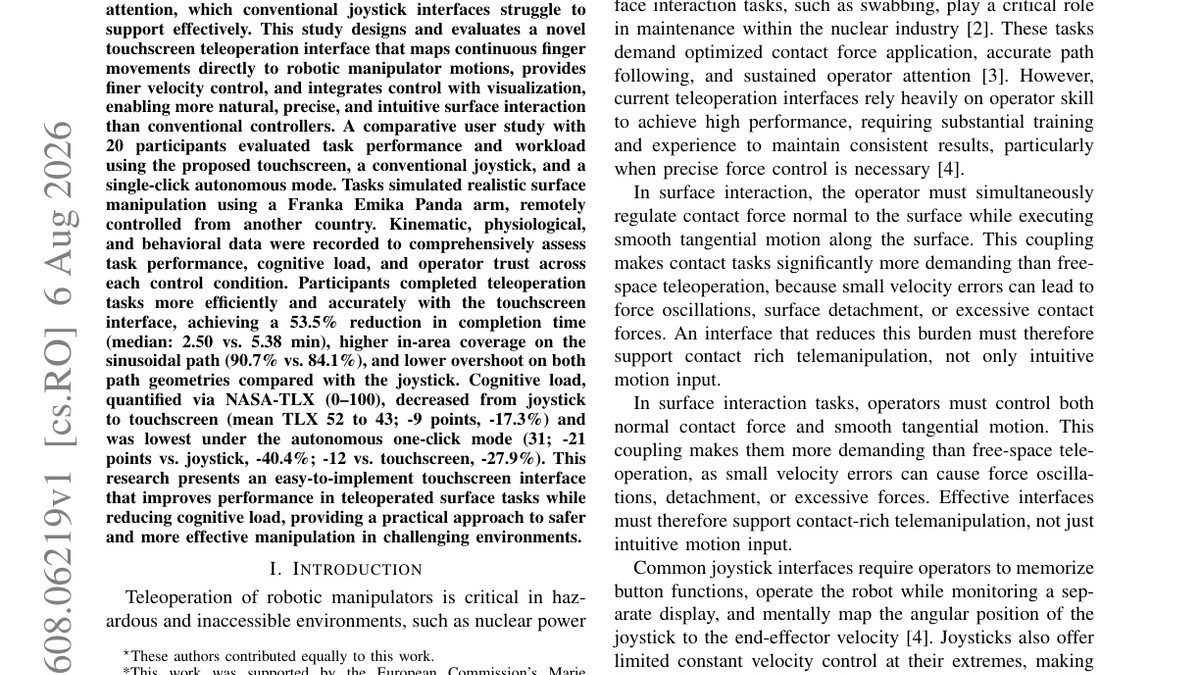
Design and Evaluation of a Touchscreen-Based Teleoperation Interface for Robotic Manipulators
Juan José García Cárdenas, Alperen Kenan, Hamidreza Raei et al.
Intuitive teleoperation interfaces are crucial for the safe and effective operation of robotic manipulators in challenging environments.
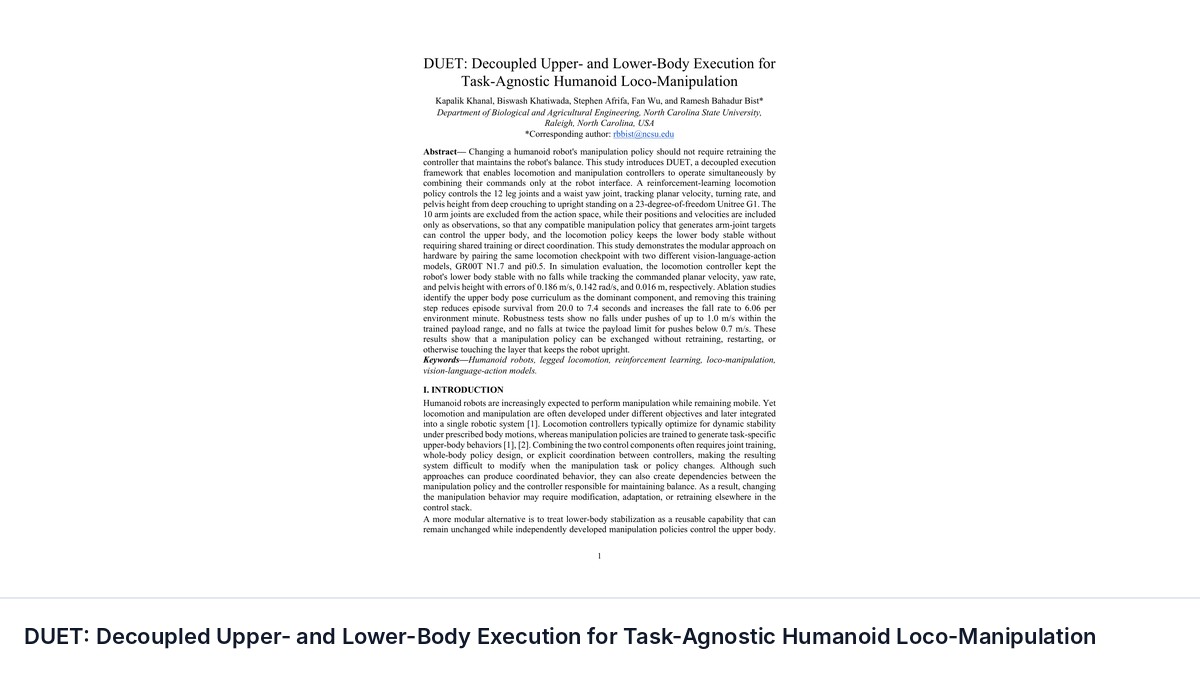
DUET: Decoupled Upper- and Lower-Body Execution for Task-Agnostic Humanoid Loco-Manipulation
Kapalik Khanal, Biswash Khatiwada, Stephen Afrifa et al.
Changing a humanoid robot's manipulation policy should not require retraining the controller that maintains the robot's balance.
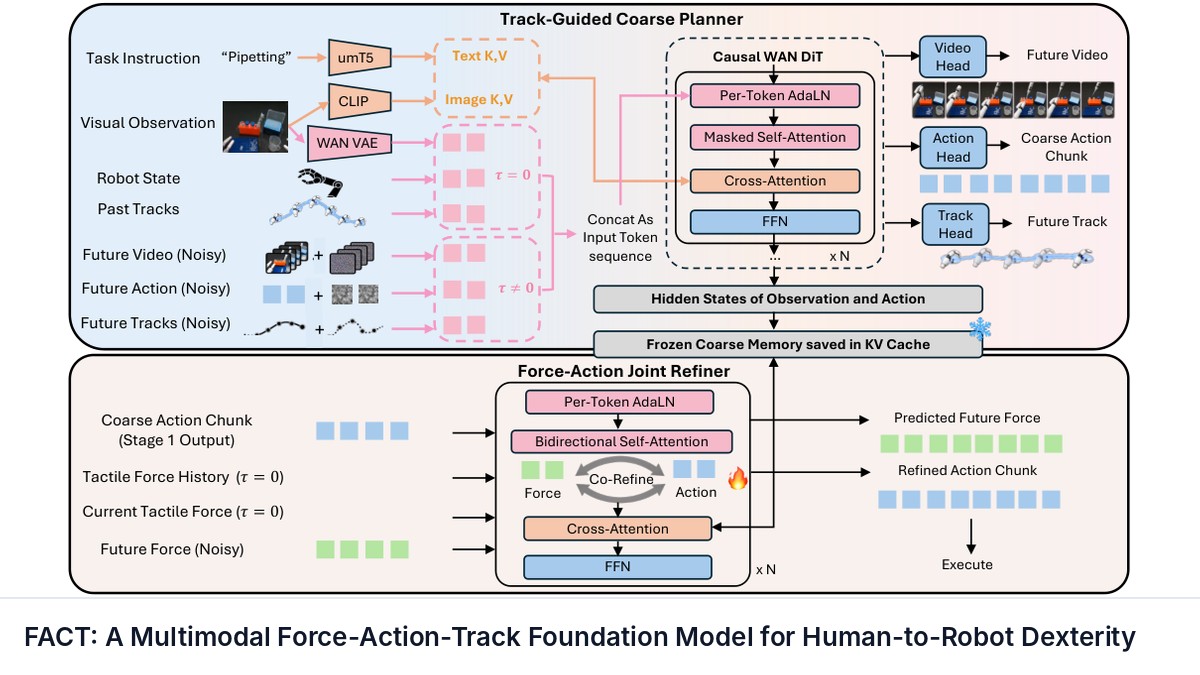
FACT: A Multimodal Force-Action-Track Foundation Model for Human-to-Robot Dexterity
Zhi Cao, Yining Hong, Jiaolong Yang et al.
Human demonstrations offer a scalable alternative to costly robot data collection for dexterous manipulation, but most human datasets lack force measurements.
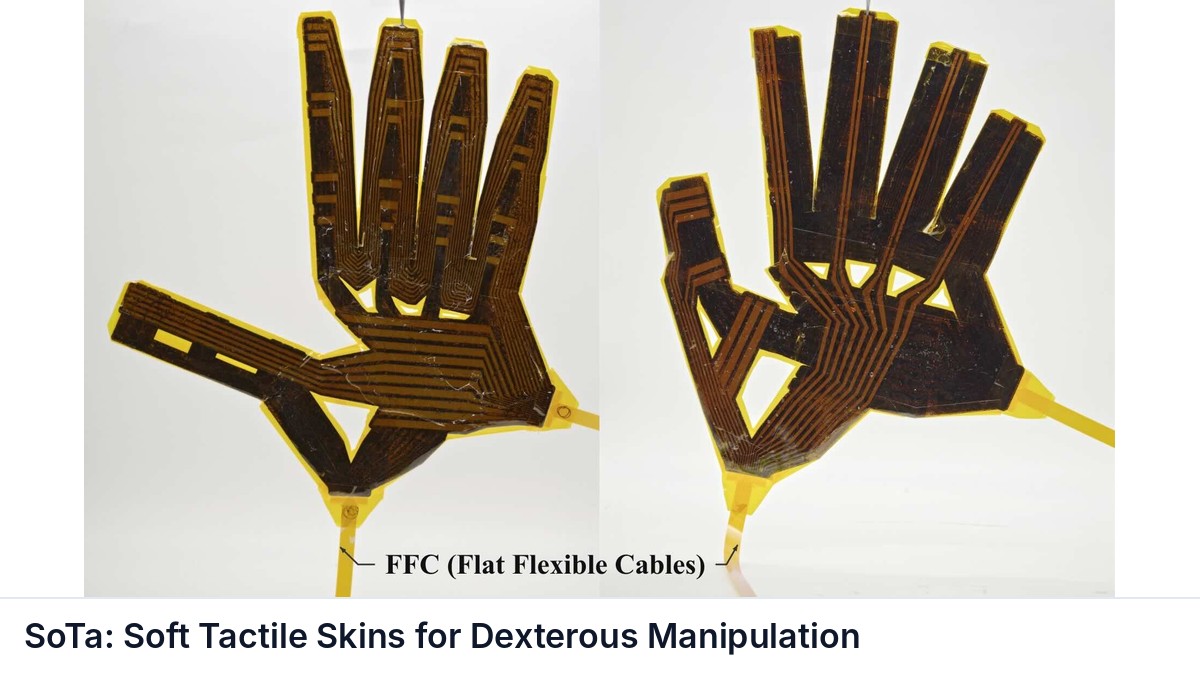
SoTa: Soft Tactile Skins for Dexterous Manipulation
Jingyun Yang, Baiyu Shi, Timothy Yu et al.
A growing body of work suggests that tactile sensing gives robot policies contact information that complements vision in dexterous manipulation. However, visuo-tactile robot data remains scarce: dexterous demonstrations require teleoperating robots, which limits dataset scale.