

CAP: Continuously Adaptive Perception-Blind Humanoid Locomotion via Learned Denoising
Hongjin Chen, Zijun Xu, Shihao Ma, Yi Zhao, Xilai Liu, Ke Ma, Wei Zhang, Chunyang Xie, Pengfei Li, Jieru Zhao, Wenchao Ding · N/A · 2026
Framework
N/A
License
N/A
Stars
N/A
Summary
Humanoid locomotion across complex terrain demands forward-looking exteroception to anticipate obstacles, yet this signal is unreliable in real-world deployment, failing partially and intermittently.
Abstract Summary
Key Points
- Humanoid locomotion across complex terrain demands forward-looking exteroception to anticipate obstacles, yet this signal is unreliable in real-world deployment, failing partially and intermittently.
- Existing perceptive policies often assume that depth observations remain clean and in-distribution, while recent attempts to unify perceptive and blind control typically route or switch between separate sub-policies, leaving recoverable information in partially corrupted depth unexploited.
- We instead propose CAP, a single-stage humanoid locomotion policy that recovers this signal with a perceptive world-model encoder trained as a learned denoiser to reconstruct clean depth from a corrupted input, together with a co-active proprioceptive variational encoder that supplies depth-free body-state information.
- A coupled training recipe pairs a depth-noise curriculum on the world-model input with world-model feature dropout on the policy-facing latent, exposing the policy to failures across the entire perception-quality spectrum.
- In simulation, CAP matches or improves upon perceptive baselines when depth remains informative, and degrades more smoothly than a binary-switching baseline as perception worsens.
Method
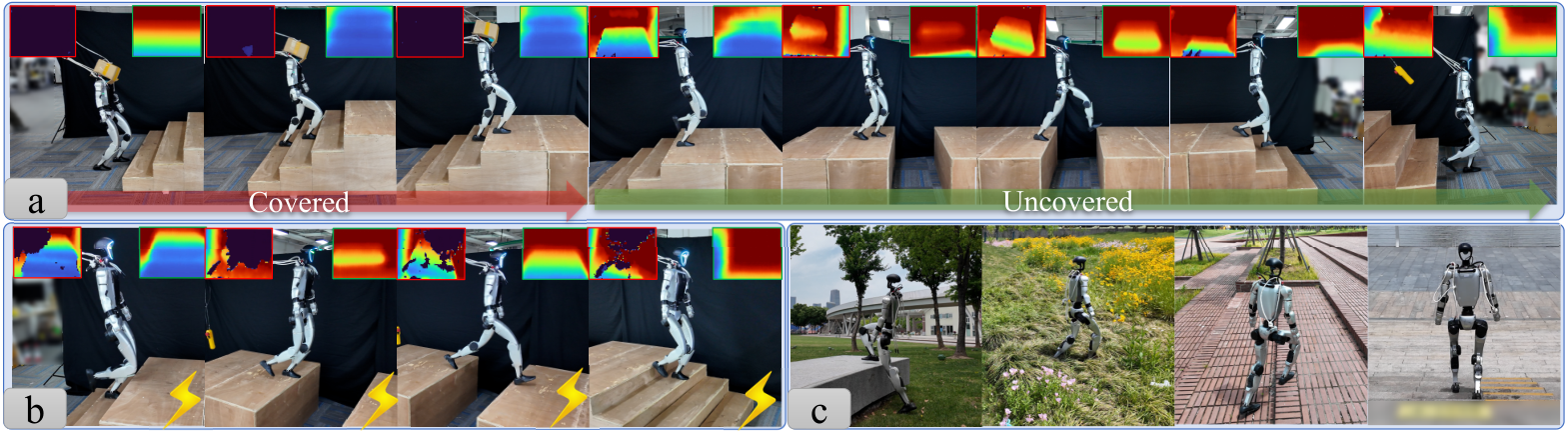
Fig. summarizes CAP ’s architecture and training recipe. Architecturally, CAP couples an asymmetric actor–critic with two co-trained encoders: a perceptive world-model encoder and a proprioceptive variational encoder. The asymmetric design [ 23 ] lets us collapse training into a single stage: the actor receives only signals available on the deployed robot, whereas the critic additionally accesses privileged signals.
Experiments
All simulation experiments use the Unitree G1 humanoid in Isaac Gym [ 21 ] with a common reward design on Stair, Platform, Gap, and Hurdle. We evaluate two anchor cells, Clean and Noisy , and an eight-stage perception-quality sweep from nominal depth to severe failure, with the severe endpoint tested only on Stair.
Each Noisy or degraded stage fixes the severity level, but its depth corruptions remain time-structured within a rollout through per-frame noise, occlusion, and intermittent full-frame failure.
Sources and Demonstrations
Figures are reproduced from Chen et al. See the full paper for experimental details and the project page, when the paper links one, for demonstrations and videos.
Related Papers
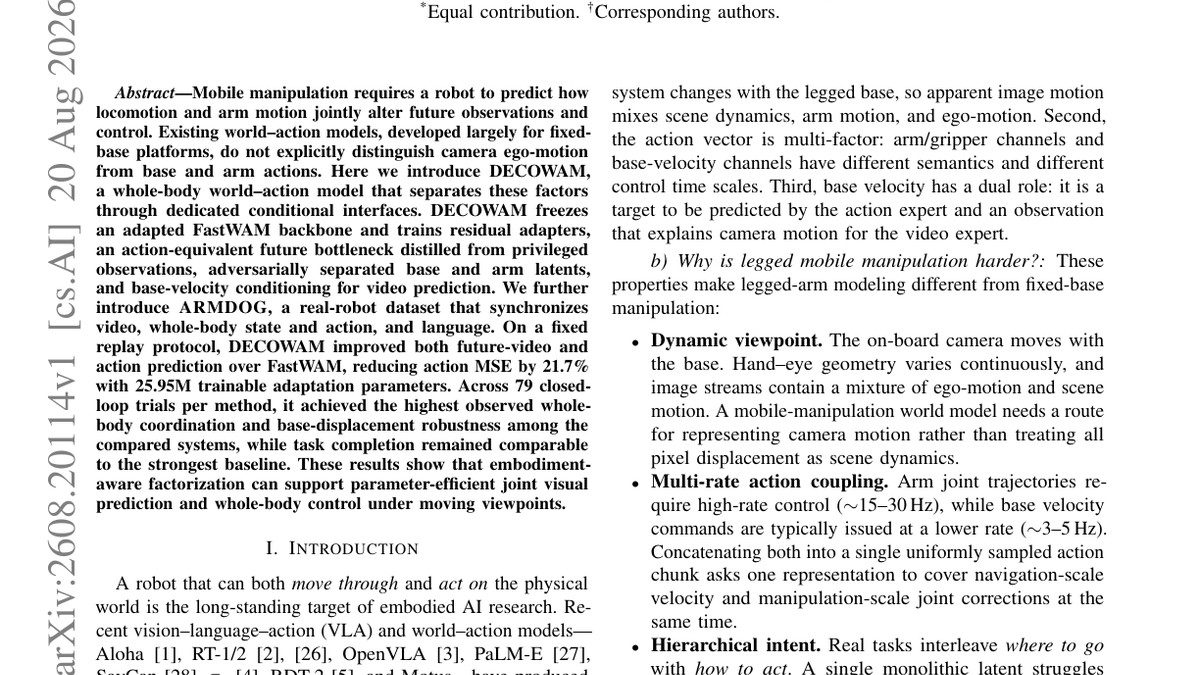
DECOWAM: Decoupled Whole-Body World-Action Model for Legged Mobile Manipulation
Siyuan Ma, Boshi Zhang, Yutian Zhang et al.
Mobile manipulation requires a robot to predict how locomotion and arm motion jointly alter future observations and control. Existing world-action models, developed largely for fixed-base platforms, do not explicitly distinguish camera ego-motion from base and arm actions.
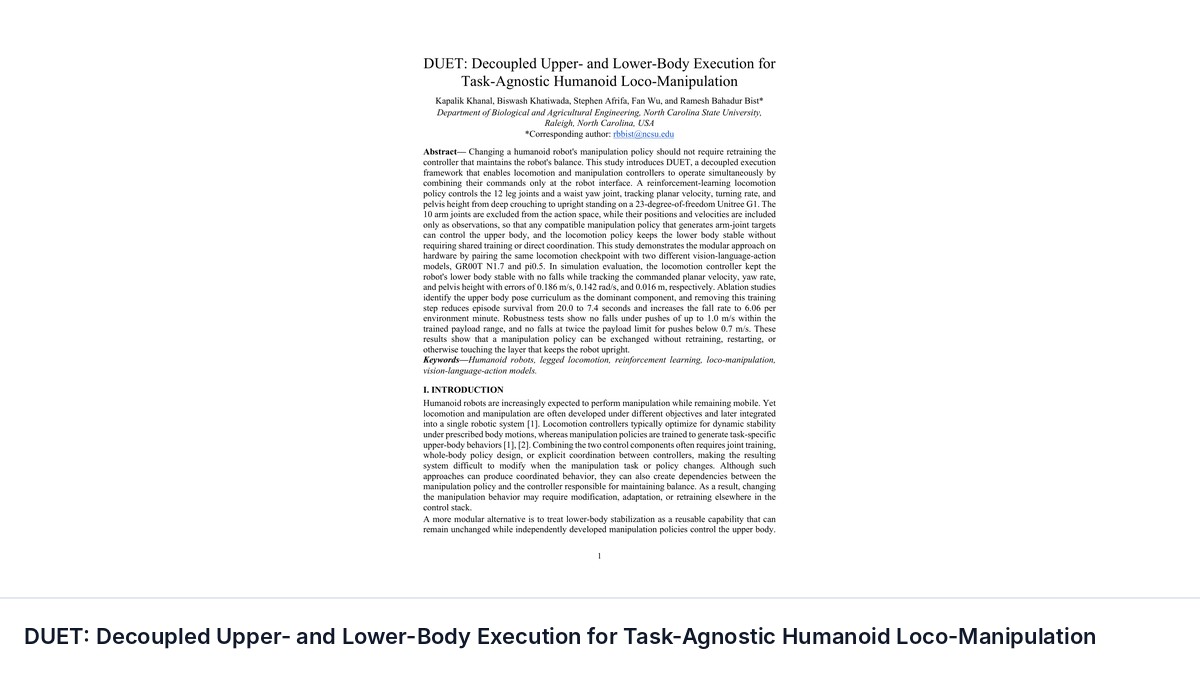
DUET: Decoupled Upper- and Lower-Body Execution for Task-Agnostic Humanoid Loco-Manipulation
Kapalik Khanal, Biswash Khatiwada, Stephen Afrifa et al.
Changing a humanoid robot's manipulation policy should not require retraining the controller that maintains the robot's balance.
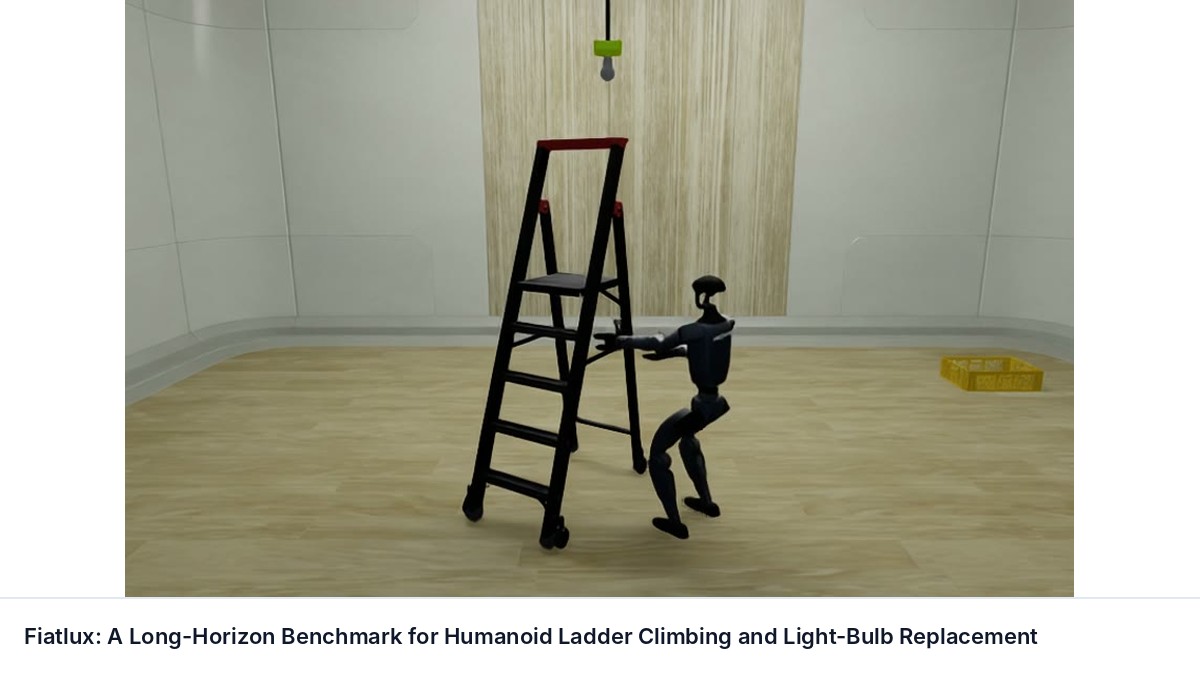
Fiatlux: A Long-Horizon Benchmark for Humanoid Ladder Climbing and Light-Bulb Replacement
Pavel Bushuyeu, Yujin Chen, Anton Nikolaev et al.
Existing benchmarks evaluate tabletop manipulation, flat-floor household activity, or humanoid locomotion and manipulation as separate task groups; none scores vertical mobility and dexterous work on a fragile payload in one long-horizon episode.
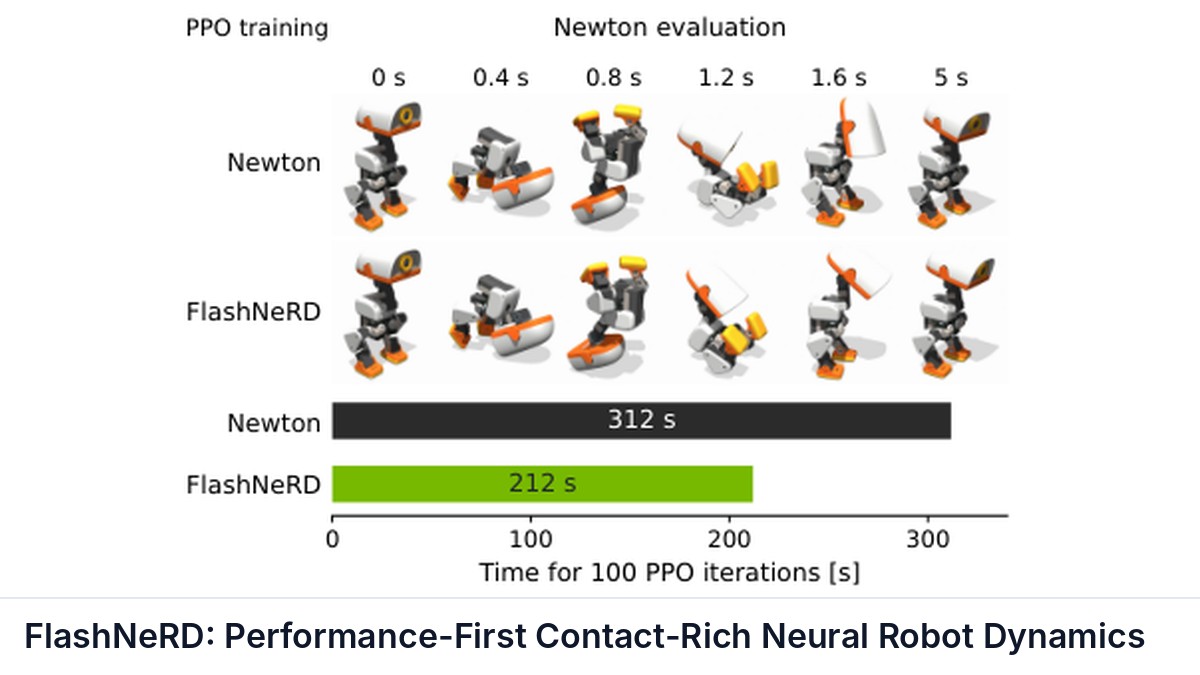
FlashNeRD: Performance-First Contact-Rich Neural Robot Dynamics
Mohammadmehdi Ataei, Mohammad Amin Nabian, Jie Xu et al.
Compared with analytical physics, learned dynamics models promise robot simulation that is faster, inherently differentiable, and easily adaptable to real data.