
HumanoidTTT: Test-Time Capability Reuse for Efficient Humanoid Control
Jingtai Yang, Yining Wu, Yanjun Li, Zeyu Zhang, Hao Tang · N/A · 2026
Framework
N/A
License
N/A
Stars
N/A
Summary
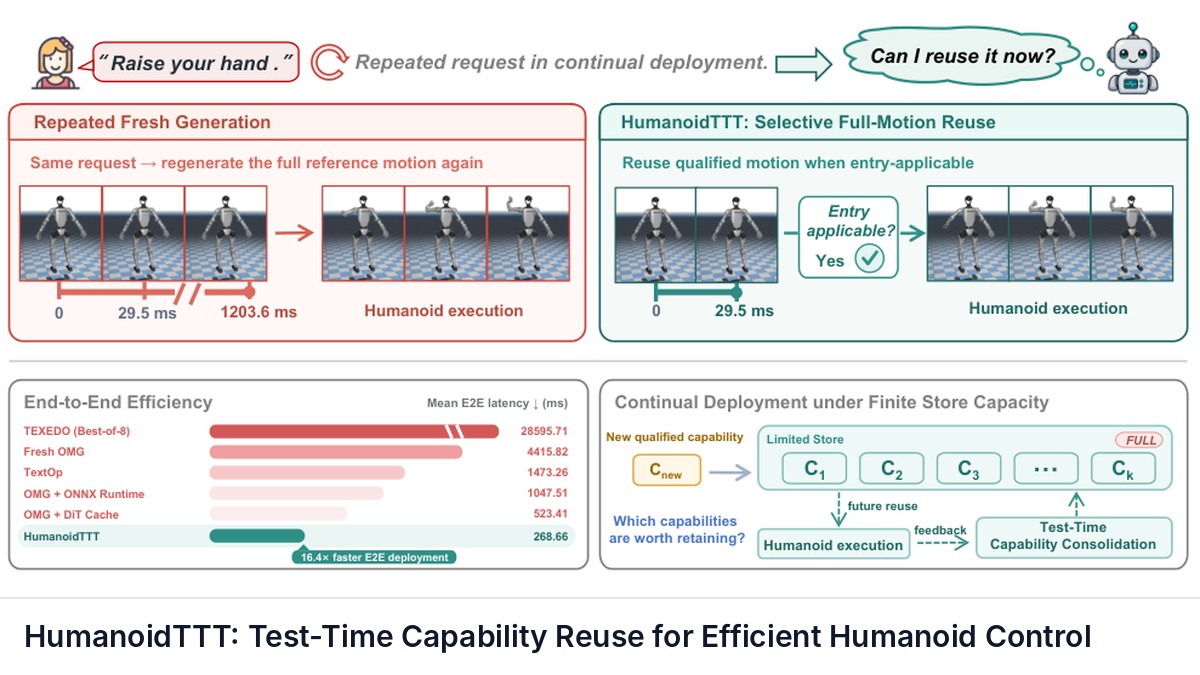
Recent advances in motion generation and whole-body tracking have enabled humanoid robots to execute increasingly diverse motions, yet the same motion capabilities may be requested repeatedly during continual deployment.
Abstract Summary
Key Points
- Recent advances in motion generation and whole-body tracking have enabled humanoid robots to execute increasingly diverse motions, yet the same motion capabilities may be requested repeatedly during continual deployment.
- Reliable reuse is challenging because intervening motions can change the robot's entry state, making previously successful motions unsafe to replay blindly.
- Meanwhile, validated capabilities accumulate during deployment, while bounded storage requires deciding which ones are worth retaining.
- To address these challenges, we present HumanoidTTT, a framework for test-time capability reuse in continual humanoid control.
- Specifically, we introduce Selective Full-Motion Reuse, which authorizes direct reuse of validated complete motions only from certified applicable entry states, allowing accepted reuse to bypass fresh generation.
METHOD: HUMANOIDTTT
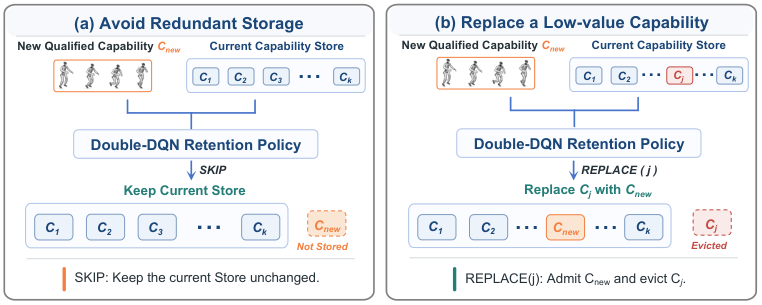
HumanoidTTT instantiates Test-Time Capability Learning by maintaining a persistent Full-Motion Store during continual deployment. Fig. 2 summarizes its read, acquisition, and consolidation paths. Entry Applicability selects validated complete motions for direct execution from changed robot states. Reuse misses invoke a Frozen Motion Generator followed by fixed execution-based qualification.
Experiments
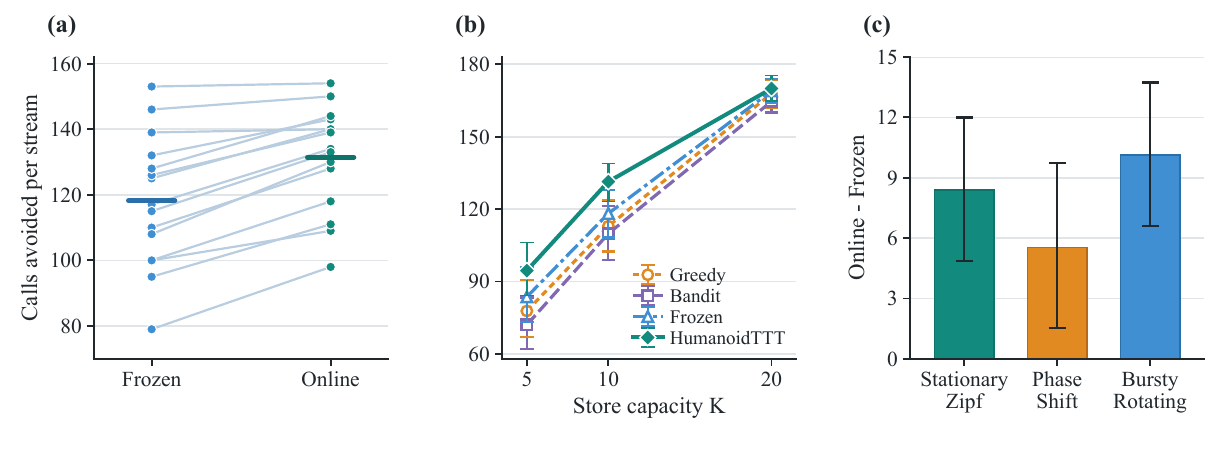
We evaluate HumanoidTTT along four dimensions: selective full-motion reuse reliability, accepted-reuse preparation efficiency, end-to-end inference efficiency, and finite-capacity capability consolidation. We use a frozen motion generator and a fixed execution stack.
A stored capability consists of a validated complete G1 motion together with the entry information used to determine whether that motion remains executable from the current state.
Sources and Demonstrations
Figures are reproduced from Yang et al. See the full paper for experimental details and the project page, when the paper links one, for demonstrations and videos.
Related Papers

3D Euler-Angle Orientation Control for Two-Ray Fading Mitigation in Maritime Air-to-Sea Communications
Mohammed Bajja, Abdoul Karim A. H. Saliah, Hajar El Hammouti et al.
Maritime Air-to-Sea links are dominated by a line-of-sight ray and a sea-surface reflected ray whose destructive combination produces deep fades. Existing mitigation strategies optimize Unmanned Aerial Vehicle position or trajectory but leave attitude unexploited.
A Balanced Data Diet: Addressing the Exploration Bottleneck in Mega-Scale RL for Robot Control
Octi Zhang, Mateo Guaman Castro, Patrick Yin et al.
General-purpose robots must perform a wide range of tasks from agile locomotion to dexterous manipulation.
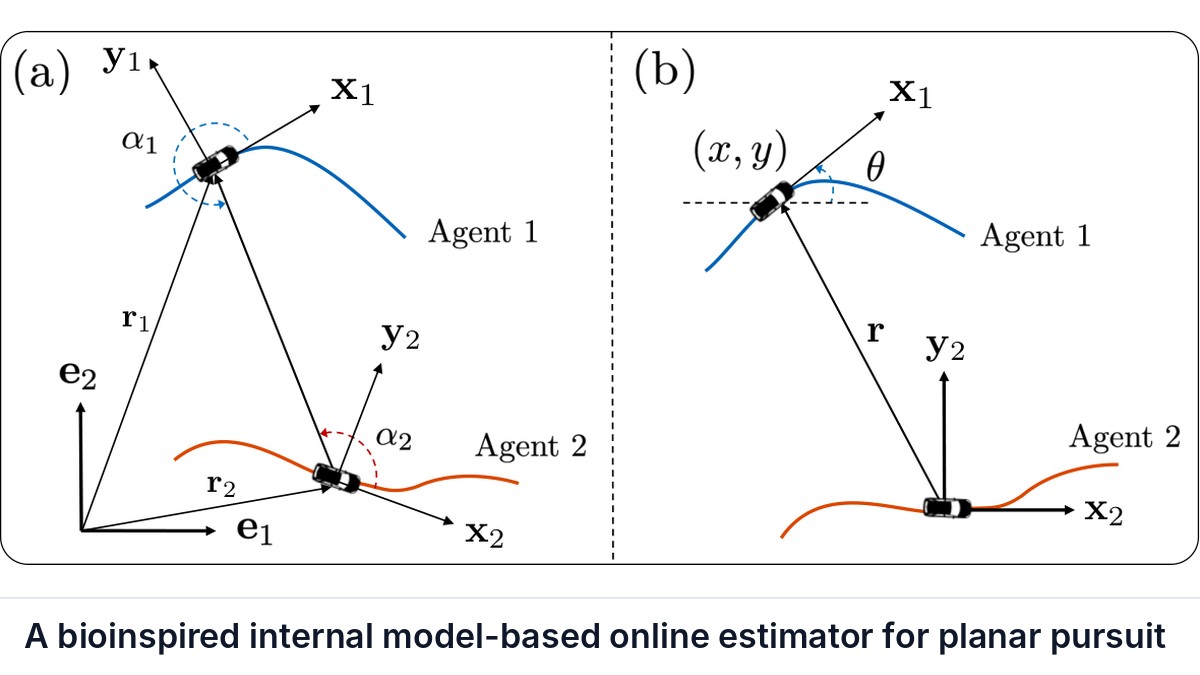
A bioinspired internal model-based online estimator for planar pursuit
Tengyue Liu, Xincheng Li, Sofia Morales Ferreira et al.
Bioinspired feedback controls for pursuit, tracking, and collective motion are often expressed in terms of the relative configuration between interacting agents.
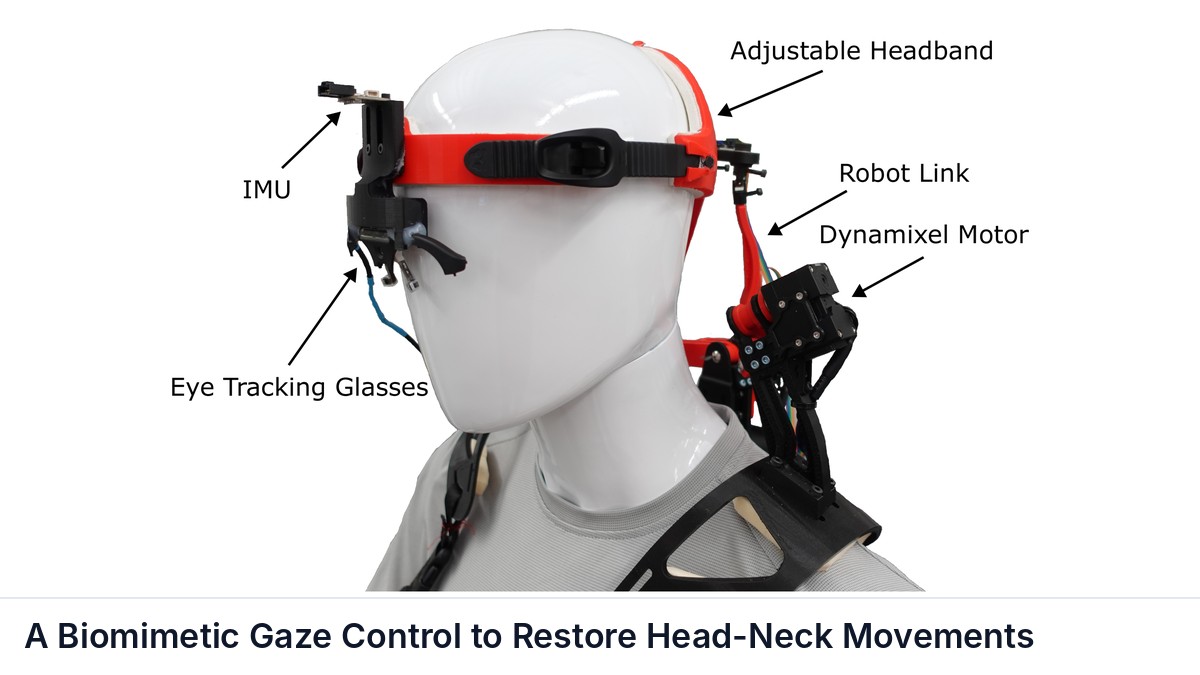
A Biomimetic Gaze Control to Restore Head-Neck Movements
Colin Rubow, Haohan Zhang
Powered neck exoskeletons are developed to restore head-neck motions for those with neck muscle weakness. Current methods using hand-held input devices to control these robotic systems are unintuitive or non-viable for these populations.