

SwingBot: Learning Whole-Body Brachiation for Humanoid Robots
Yujie Xiong, Peng Zhai, Taixian Hou, Quancheng Qian, Cunwang Liu, Kangmai Hu, Long Yang, Zhiyan Dong, Lihua Zhang · N/A · 2026
Framework
N/A
License
N/A
Stars
N/A
Summary
Brachiation enables primates to move across overhead supports when ground paths are blocked, suggesting a complementary locomotion mode for robots operating in cluttered or hazardous environments.
Abstract Summary
Key Points
- Brachiation enables primates to move across overhead supports when ground paths are blocked, suggesting a complementary locomotion mode for robots operating in cluttered or hazardous environments.
- Bringing this capabil?ity to high-DoF humanoid robots is difficult because the controller must discover a long-horizon release-swing-capture sequence, coordinate alternating contacts with whole-body momentum, and act without reliable measurements of segment?relative displacement or hook-contact state.
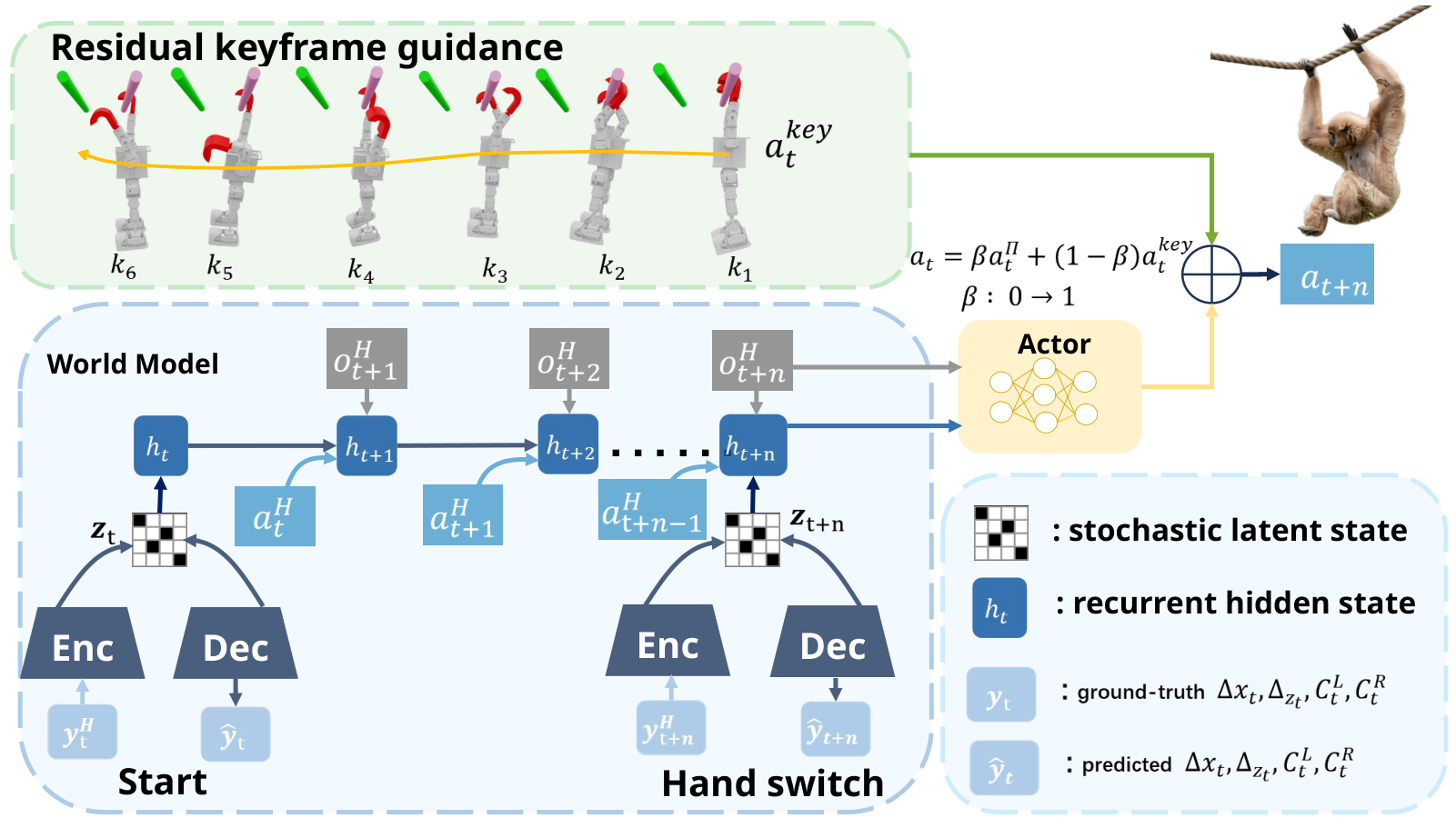
- We present SwingBot, a learning framework for continuous humanoid brachiation with passive wrist hooks.
- Swing?Bot makes the task trainable by organizing learning around the structure of brachi?ation: biomimetic keyframes make rare release-swing-capture transitions reach?able during early exploration, and recurrent privileged-state estimation provides compact position and contact latents for deployment.
- Hardware experiments demonstrate continuous bar traversal and robustness to payload, external distur?bances and different bar spacings, showing that this formulation offers a practical route to whole-body robotic brachiation.
Method
We formulate whole-body brachiation as command-conditioned partially observable reinforcement learning. The robot is controlled through a 20-DoF policy interface, including 12 leg DoFs and 8 arm DoFs. At each timestep, the policy outputs a residual joint-position action $\mathbf{a}_{t}\in\mathbb{R}^{20}$, which is converted to a joint target and tracked by low-level PD control.
The policy is optimized with PPO to maximize $J(\pi_{\theta})=\mathbb{E}_{\pi_{\theta}}[\sum_{t=0}^{T-1}\gamma^{t}r(\mathbf{s}_{t},\mathbf{a}_{t})]$ [ 38 , 29 ] .
Experiments
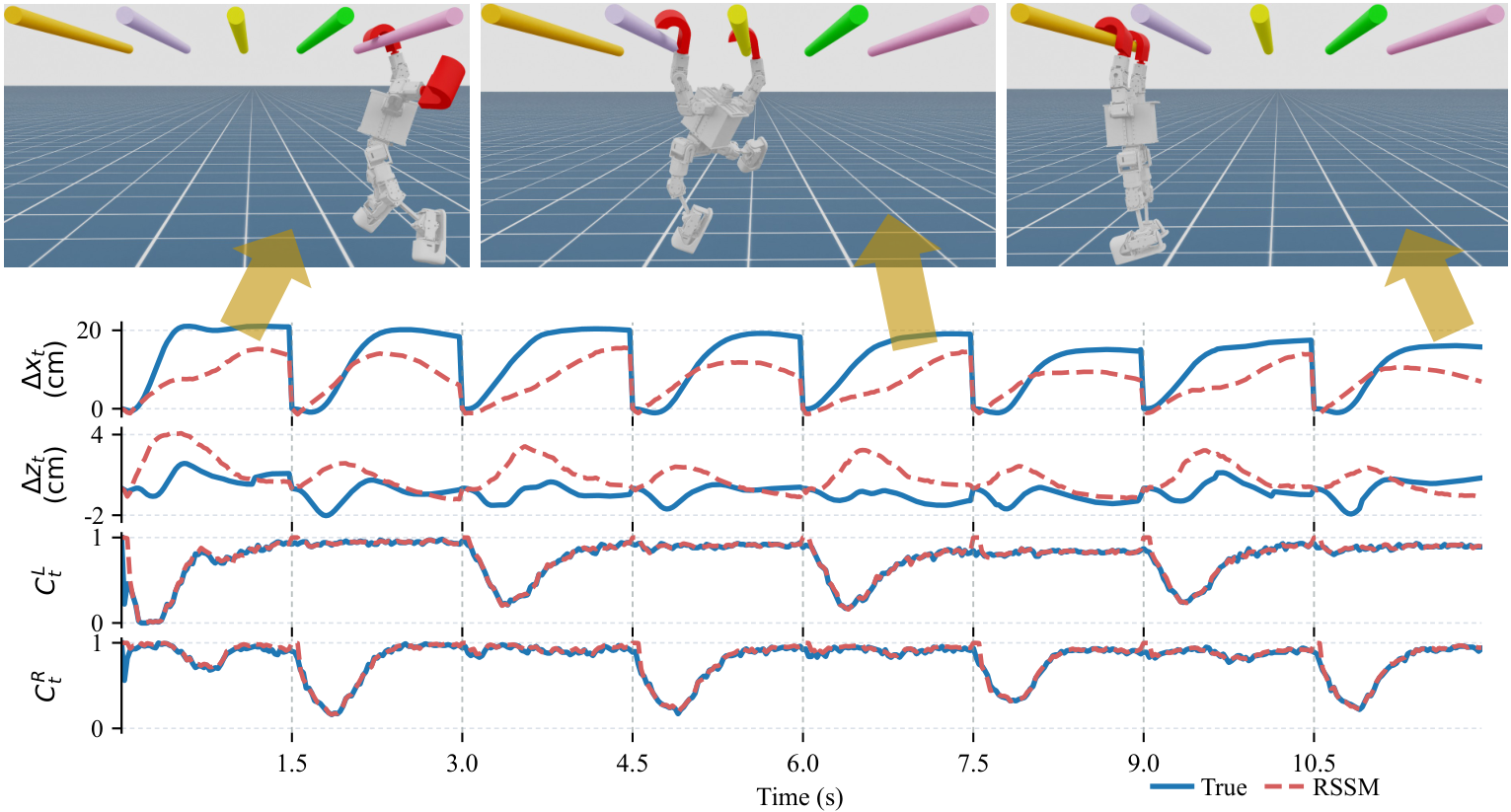
We evaluate SwingBot through simulation ablations, RSSM reconstruction analysis, and hardware tests for continuous traversal, payload carrying, disturbance recovery and different bar spacings. Experimental setup. Each rollout contains eight scripted command segments, and the command alternates between left and right hooks every $1.5$ seconds unless otherwise specified.
Sources and Demonstrations
Figures are reproduced from Xiong et al. See the full paper for experimental details and the project page, when the paper links one, for demonstrations and videos.
Related Papers
A Balanced Data Diet: Addressing the Exploration Bottleneck in Mega-Scale RL for Robot Control
Octi Zhang, Mateo Guaman Castro, Patrick Yin et al.
General-purpose robots must perform a wide range of tasks from agile locomotion to dexterous manipulation.
A Mode-Unified, Continuous, and Biomimetic Control Strategy of a Robotic Lower Limb Prosthesis
Hanjun Kim, Sixu Zhou, John Shim et al.
Existing biomimetic lower-limb prosthesis controllers are commonly designed for discrete locomotion modes, requiring separate parameterizations for level walking, ramps, and stairs.
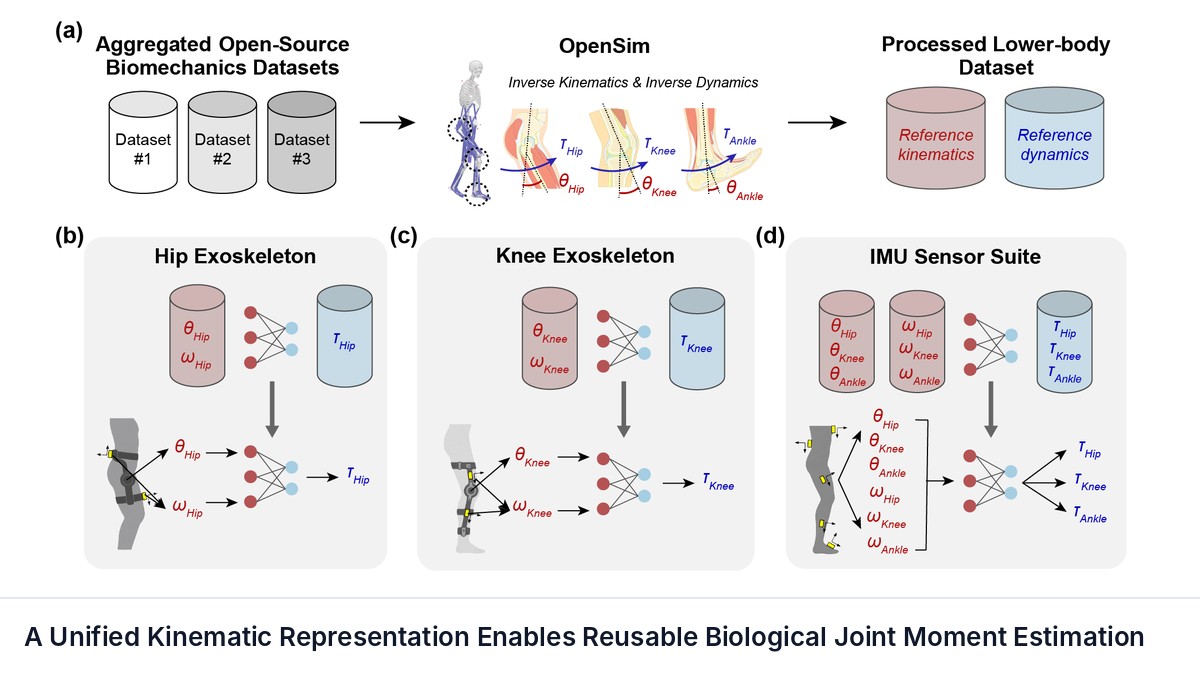
A Unified Kinematic Representation Enables Reusable Biological Joint Moment Estimation
Jinwoo Hwang, Ilseung Park, Changseob Song et al.
Objective: Data-driven models that estimate physiological states, particularly biological joint moments, are widely used in exoskeleton control.
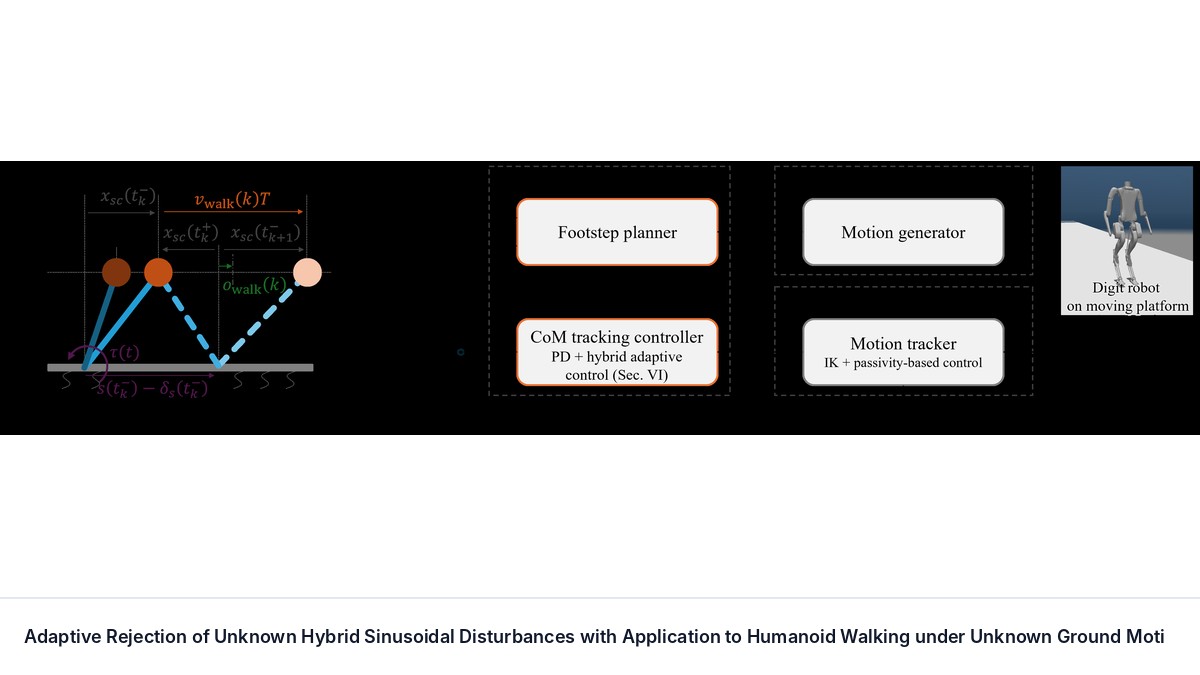
Adaptive Rejection of Unknown Hybrid Sinusoidal Disturbances with Application to Humanoid Walking under Unknown Ground Motion
I-Chia Chang, Jacob Stewart, Petros A. Ioannou et al.
Legged robot control is not yet practical in non-inertial environments, where the ground and surroundings accelerate in the inertial Earth frame, mainly because of the unknown, time-varying, persistent perturbations caused by environmental motion, compounded by the associated hybrid robotic dynamics.