
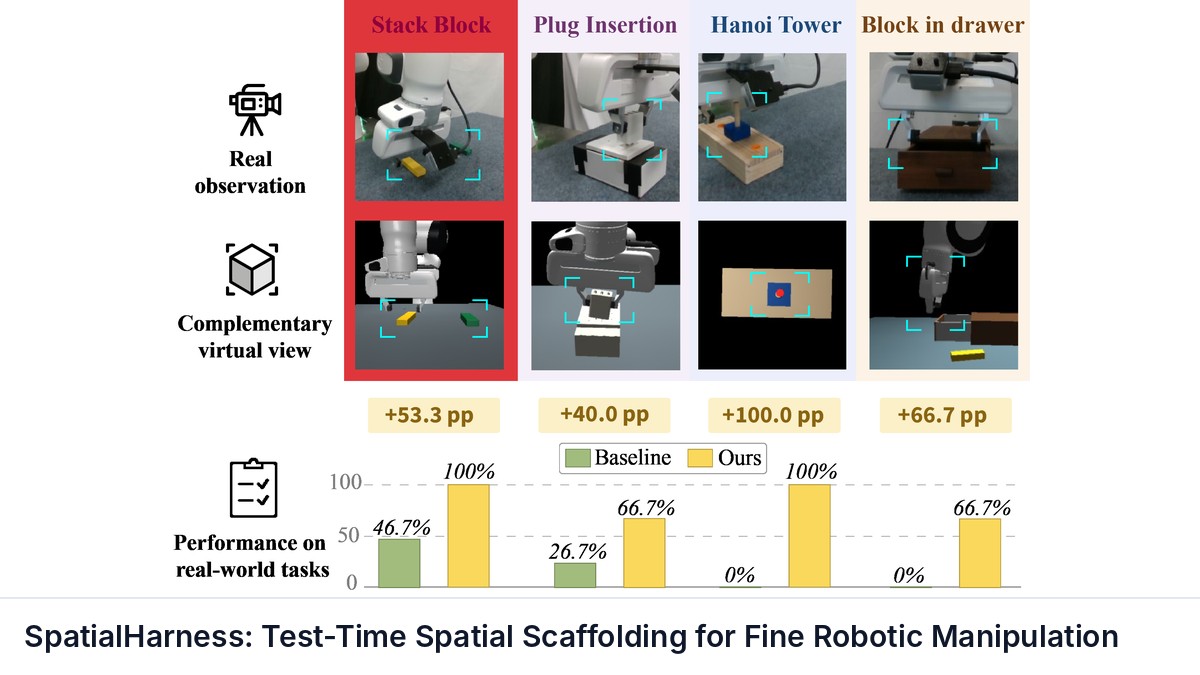
SpatialHarness: Test-Time Spatial Scaffolding for Fine Robotic Manipulation
Jiayu Wang, Yue Yu, Bin Zhu, Zhiyao Yang, Jingjing Chen · N/A · 2026
Framework
N/A
License
N/A
Stars
N/A
Summary
Frontier multimodal foundation models (e.g., GPT-6 Astra) have recently shown strong potential for direct robotic control, yet their performance on fine manipulation remains limited.
Abstract Summary
Key Points
- Frontier multimodal foundation models (e.g., GPT-6 Astra) have recently shown strong potential for direct robotic control, yet their performance on fine manipulation remains limited.
- We argue that an important source of failure is not necessarily insufficient policy capability, but insufficient spatial observability, where task-critical spatial relationships may be poorly revealed by the existing physical camera setup.
- We introduce SpatialHarness, a test-time embodied harness that provides test-time spatial scaffolding for fine robotic manipulation without policy fine-tuning or changes to the physical sensing setup.
- SpatialHarness maintains an online simulated scene synchronized with real-world execution, identifies task-critical spatial relationships, and renders complementary virtual views that expose them to a frozen multimodal policy.
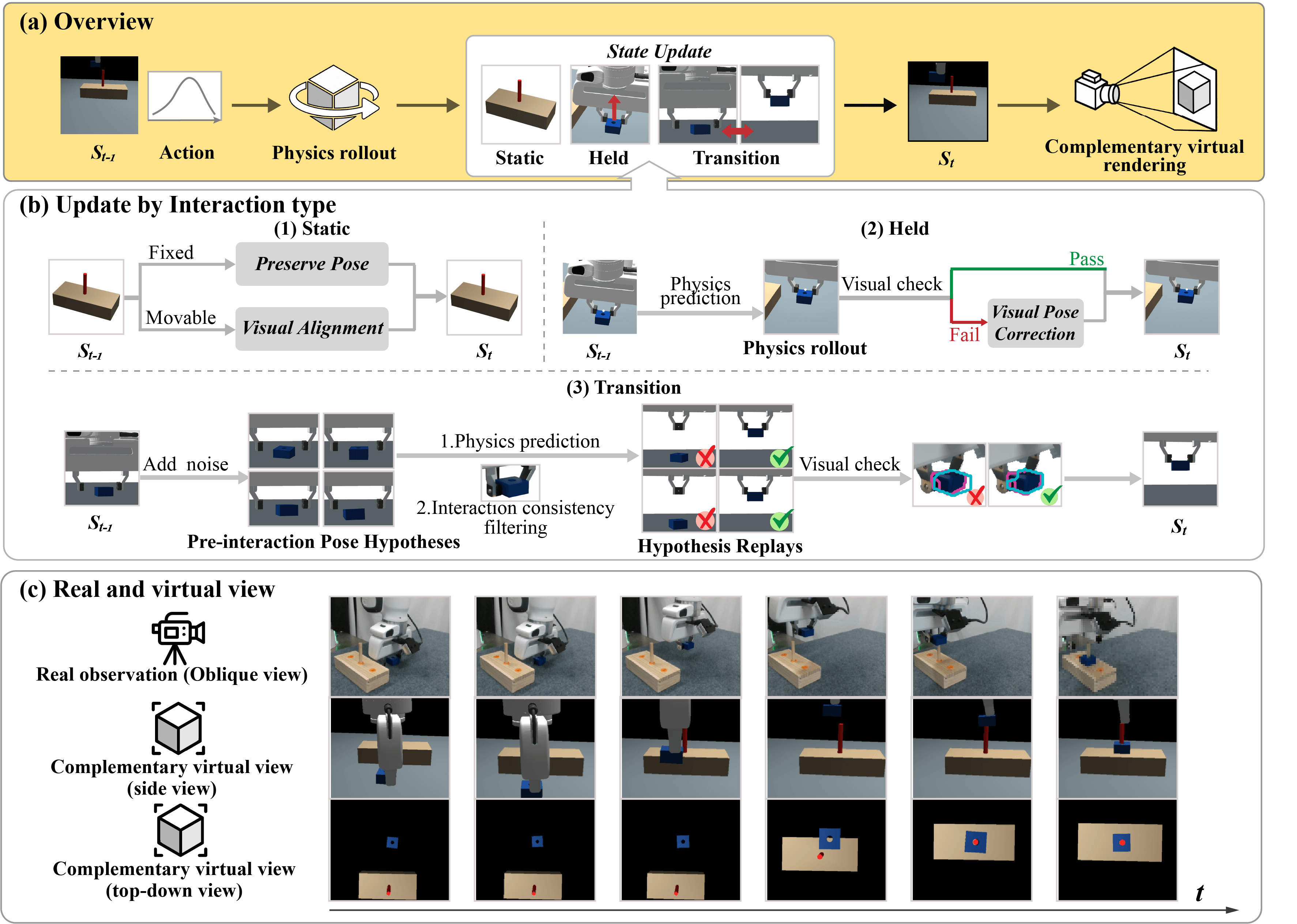
- To keep the simulated scene aligned during interaction, we develop interaction-aware scene synchronization that distinguishes static, held, and transition modes.
Method
SpatialHarness is a test-time embodied harness that provides test-time spatial scaffolding for a frozen multimodal policy. Its spatial context comprises complementary virtual views and structured spatial information. At each decision step, the policy receives this spatial context together with the task instruction, real observations, robot states.
The policy integrates these inputs to assess the current scene and generate robot actions through tool calls.
Experiments
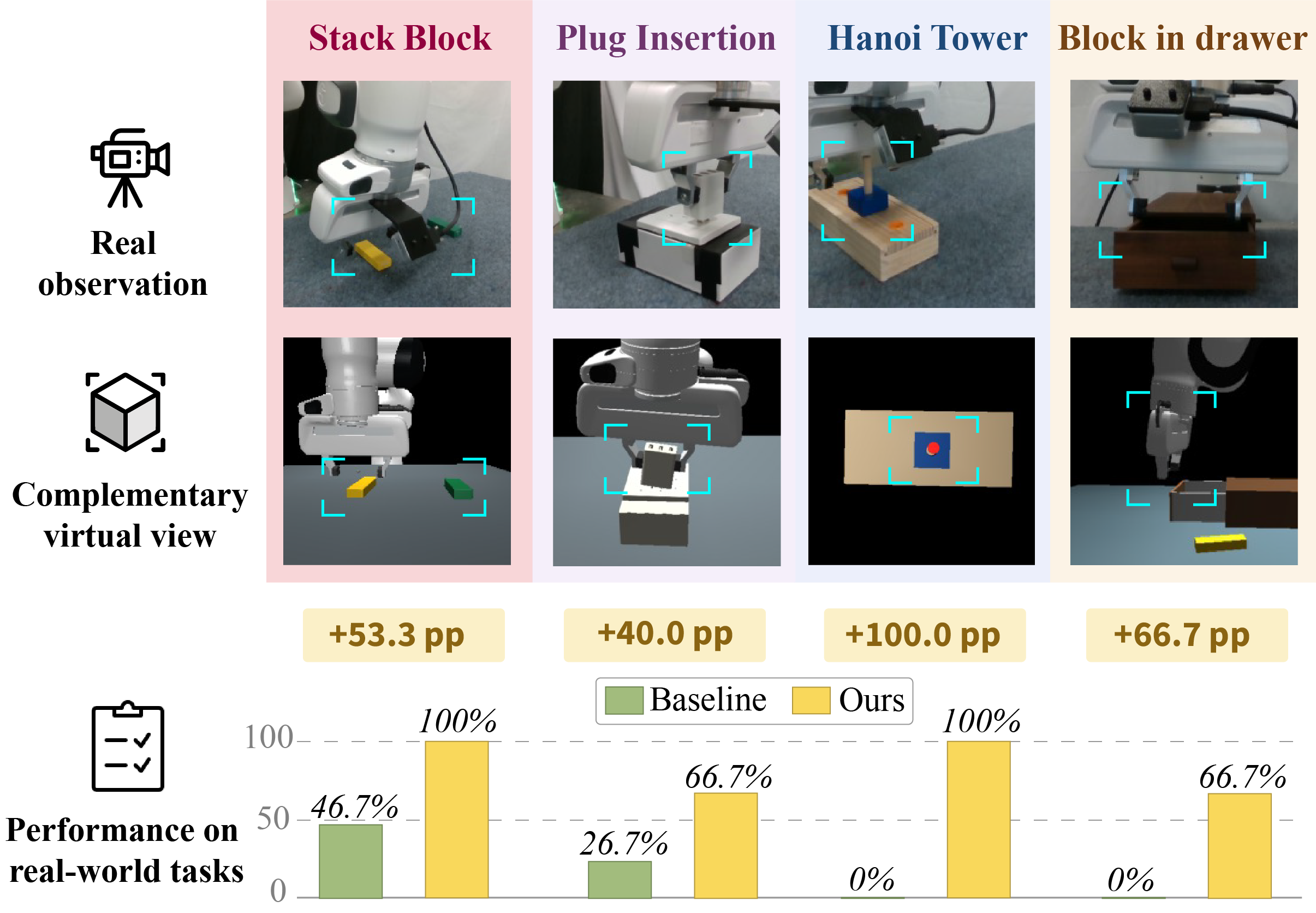
We evaluate SpatialHarness on four real robot tasks to assess its benefits for fine manipulation. With the manipulation model and real camera configuration held fixed, we compare task success rates and model query overhead with and without supplementary spatial observations. We use a Franka Research 3 arm and two Intel RealSense RGB-D cameras, one mounted on the wrist and one providing a fixed third-person view.
Sources and Demonstrations
Figures are reproduced from Wang et al. See the full paper for experimental details and the project page, when the paper links one, for demonstrations and videos.
Related Papers
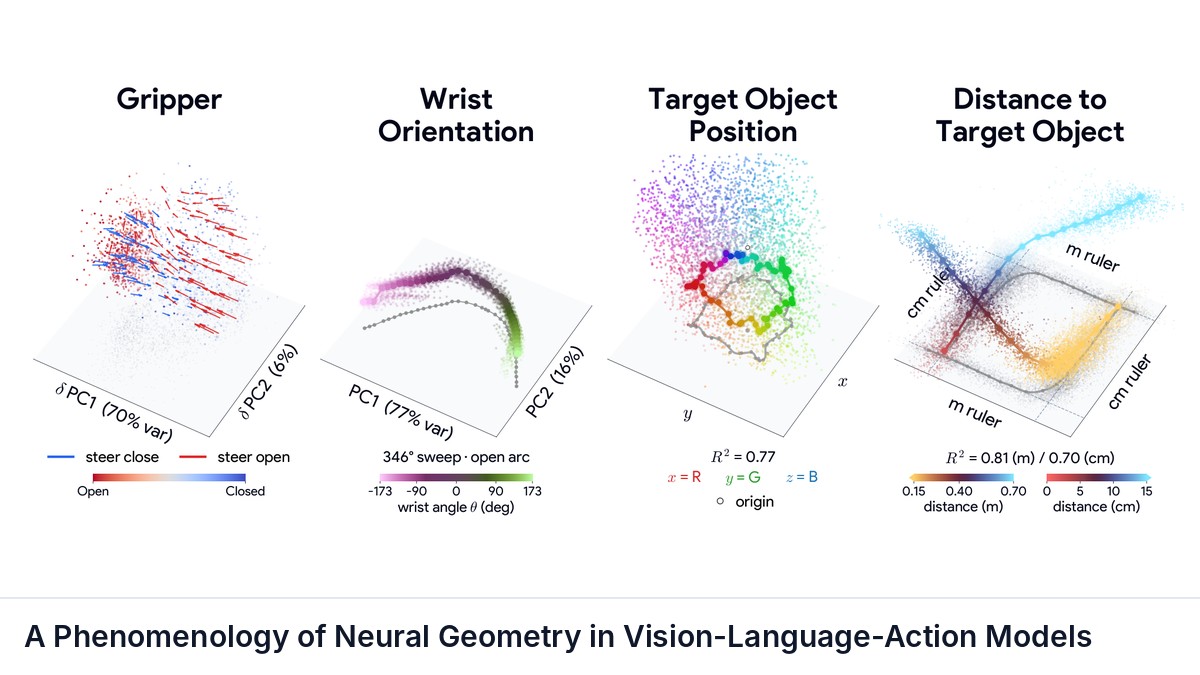
A Phenomenology of Neural Geometry in Vision-Language-Action Models
Mozes Jacobs, Aiden Swann, Mathilde Papillon et al.
Robotic manipulation is inherently geometric, but what shape does the world take inside the policy that performs it?

A Sim-to-Real Integration Pipeline for Training and Deployment of Chunk-Based VLA Manipulation Policies
Mathilde Kappel, Clémence Grislain, Mohamed Chetouani et al.
Vision-Language-Action (VLA) models have become a prominent paradigm for mapping multimodal inputs, including semantic instructions, visual observations of the scene, and proprioceptive observations, to robot actions.
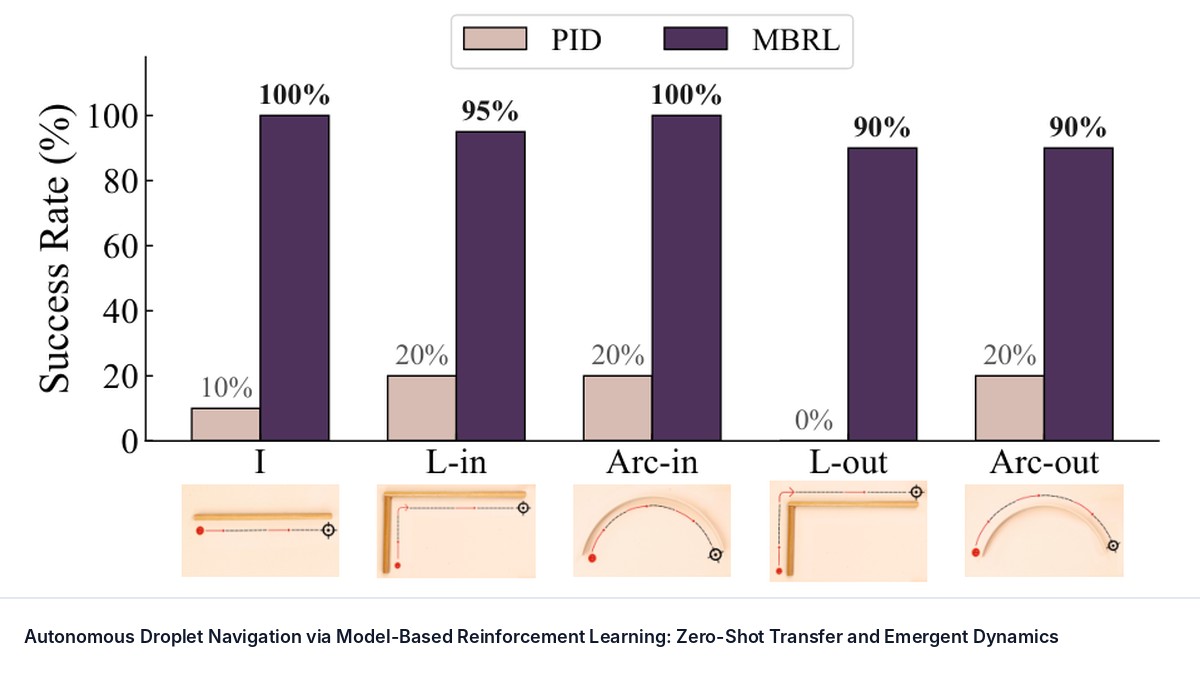
Autonomous Droplet Navigation via Model-Based Reinforcement Learning: Zero-Shot Transfer and Emergent Dynamics
Rajneesh Anand, Mayuresh V. Kothare
Self-driving laboratories (SDLs) are transforming chemical and materials discovery through closed-loop automation, yet automated infrastructure for physical manipulation of soft, deformable matter remains beyond current robotic platforms.
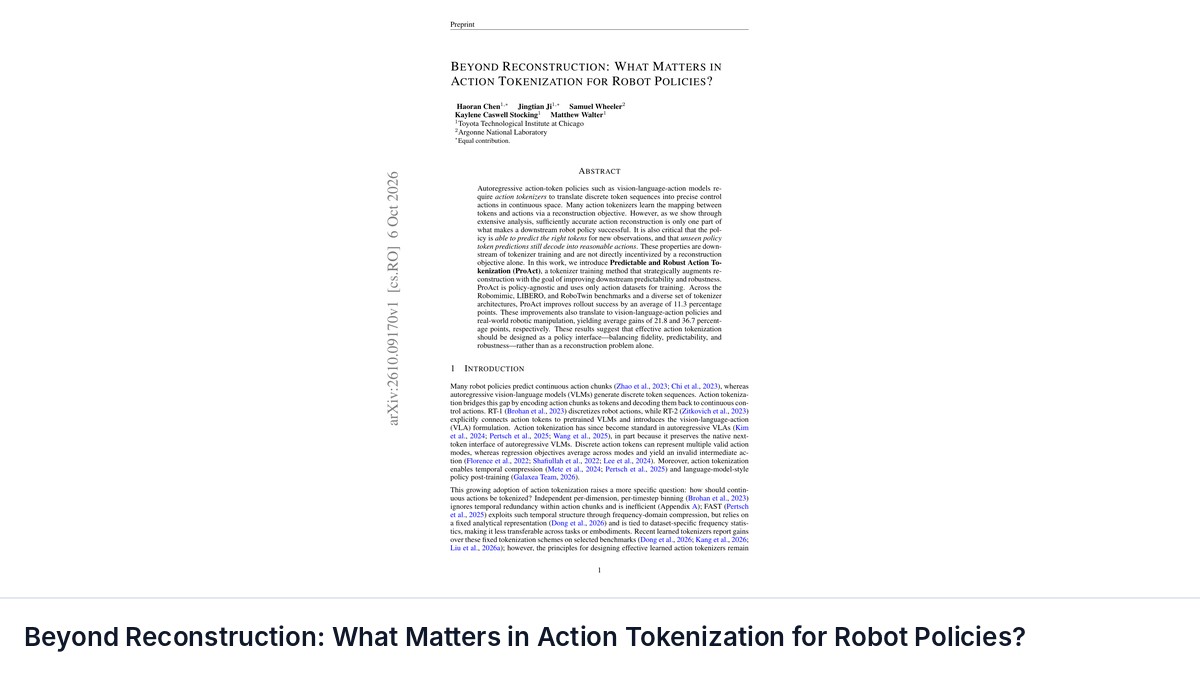
Beyond Reconstruction: What Matters in Action Tokenization for Robot Policies?
Haoran Chen, Jingtian Ji, Samuel Wheeler et al.
Autoregressive action-token policies such as vision-language-action models require action tokenizers to translate discrete token sequences into precise control actions in continuous space. Many action tokenizers learn the mapping between tokens and actions via a reconstruction objective.