
DreamX-Phi 1.0: Action-Conditioned Video World Model for Robotic Manipulation
DreamX Team, Rui Chen, Xiangxiang Chu, Geng Li, Jifan Li, Qingfeng Shi, Datao Tang, Jing Tang, Jun Wang, Pengfei Zhang · N/A · 2026
Framework
N/A
License
N/A
Stars
N/A
Summary
We present \textbf{DreamX-Phi 1.0}, an action-conditioned video world model for robotic manipulation that, given an observed frame, a language instruction, and a prescribed action sequence comprising end-effector poses and gripper states, predicts the resulting future observations.
Abstract Summary
Key Points
- We present \textbf{DreamX-Phi 1.0}, an action-conditioned video world model for robotic manipulation that, given an observed frame, a language instruction, and a prescribed action sequence comprising end-effector poses and gripper states, predicts the resulting future observations.
- Yet realism alone does not guarantee faithfulness: a convincing rollout can still move the wrong arm or lose the manipulated object.
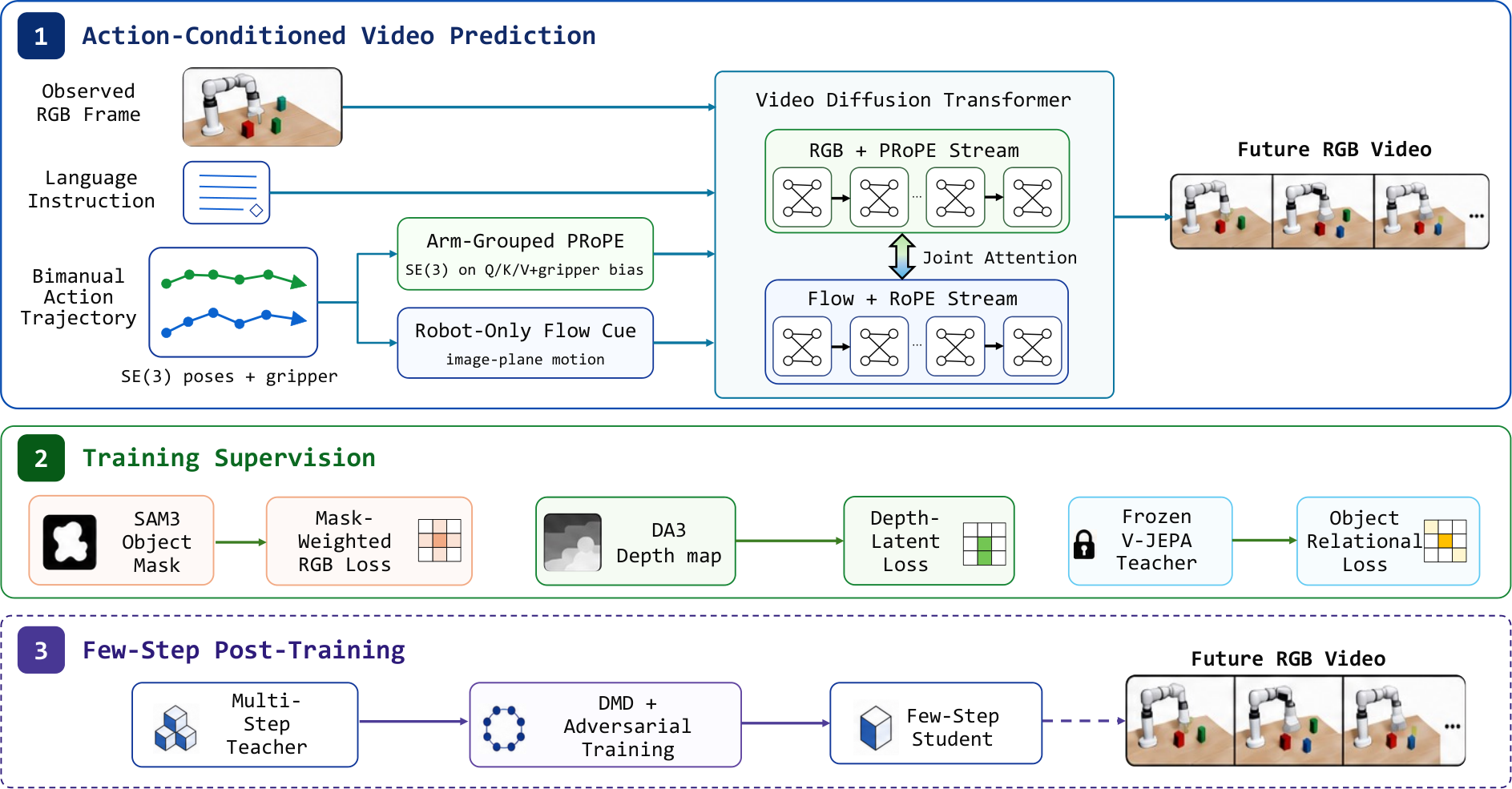
- To ensure the prediction respects each arm's commanded path, we inject per-arm $\mathrm{SE}(3)$ transformations into attention via \textbf{PRoPE-style geometric encoding}, preserving arm identity and rigid-motion structure.
- Action control alone does not fully constrain scene geometry or the evolution of small manipulated objects.
- We therefore add a lightweight \textbf{depth branch} for scene-level geometry and use \textbf{SAM3 masks} with a frozen \textbf{V-JEPA teacher} to maintain object consistency throughout grasping.
Data Curation
Reliable action-conditioned prediction depends not only on the diversity of robot motions, but also on broad visual coverage and consistent alignment between observations and control signals. We therefore construct the corpus from three complementary sources: action-free egocentric video, real-robot demonstrations, and simulated robot trajectories.
Together, these sources span everyday visual dynamics, physically executed manipulation, and controlled variation in task and scene configuration. Table 1 summarizes their scale.
Method
Given an observed RGB frame $\mathbf{x}_{0}$, a language instruction $\mathbf{c}$, and a prescribed bimanual action trajectory $\mathbf{a}_{1:T}$ containing end-effector poses and gripper states, our goal is to model the conditional distribution using a Wan2.2-TI2V-5B video diffusion transformer.
The latent of the first frame provides the visual context, and the future-frame latents are learned under a flow-matching objective ( Lipman et al., 2023 ) .
Evaluation
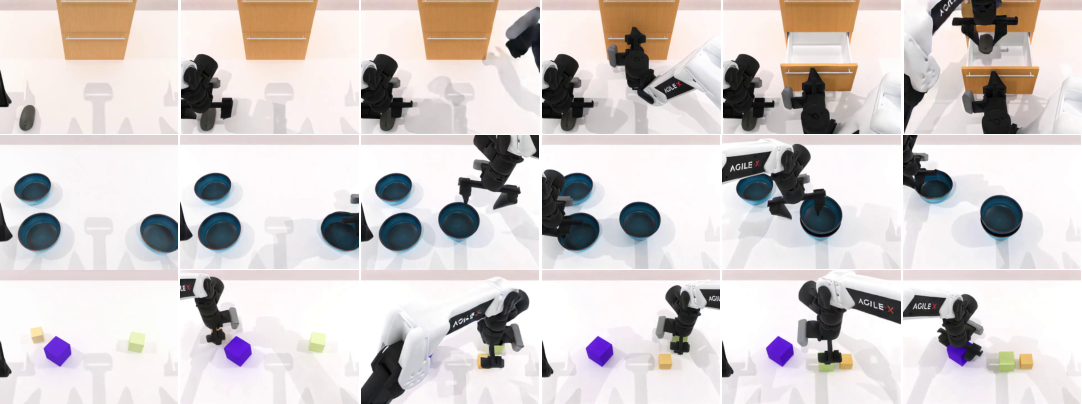
We evaluate DreamX-Phi 1.0 along two complementary axes: the fidelity of its predicted visual rollouts and its utility as a learned environment for policy training.
WorldArena 2.0 is our primary benchmark: Track 1 evaluates video prediction conditioned on language instructions or robot actions, while Track 2 measures whether a policy optimized through interaction with the submitted world model succeeds in held-out simulator episodes.
Future Work
The current DreamX-Phi 1.0 is formulated as a Forward Dynamics Model (FDM), which predicts future observations from an externally provided action sequence and does not generate actions itself. We will extend this framework to other model formulations. In particular, we plan to develop a joint World Action Model that generates future video and robot action trajectories together.
Training these outputs jointly should help align each proposed action with its predicted visual consequences.
Sources and Demonstrations
Figures are reproduced from Team et al. See the full paper for experimental details and the project page, when the paper links one, for demonstrations and videos.
Related Papers
A Balanced Data Diet: Addressing the Exploration Bottleneck in Mega-Scale RL for Robot Control
Octi Zhang, Mateo Guaman Castro, Patrick Yin et al.
General-purpose robots must perform a wide range of tasks from agile locomotion to dexterous manipulation.
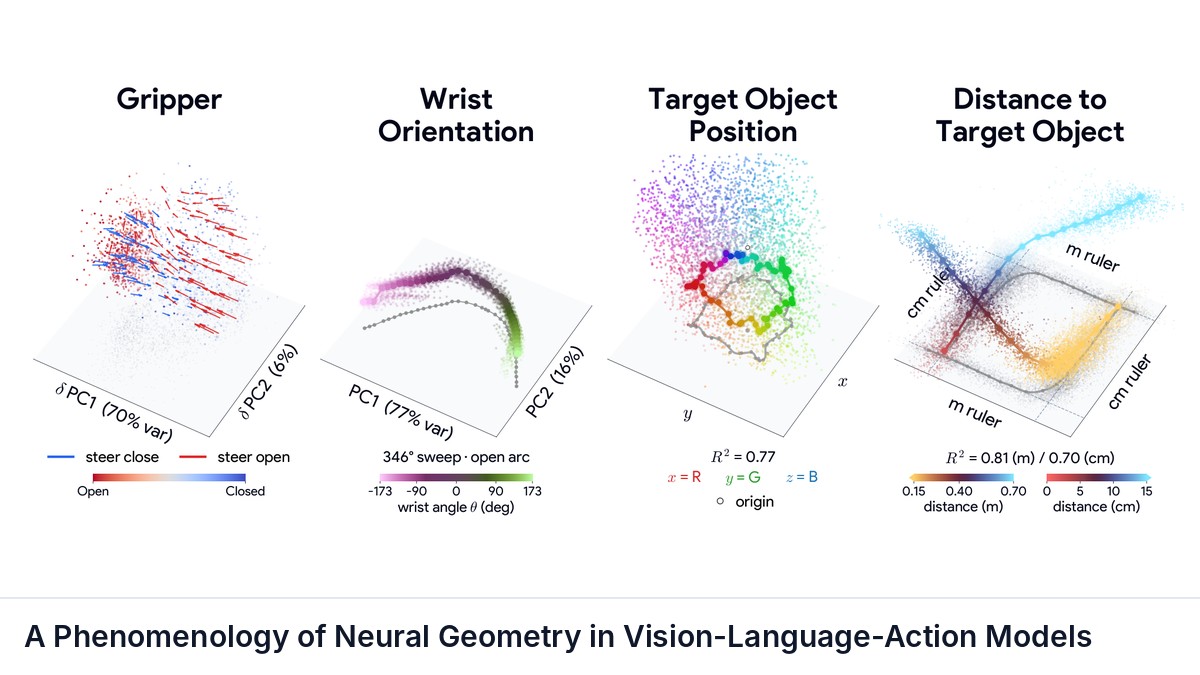
A Phenomenology of Neural Geometry in Vision-Language-Action Models
Mozes Jacobs, Aiden Swann, Mathilde Papillon et al.
Robotic manipulation is inherently geometric, but what shape does the world take inside the policy that performs it?

A Sim-to-Real Integration Pipeline for Training and Deployment of Chunk-Based VLA Manipulation Policies
Mathilde Kappel, Clémence Grislain, Mohamed Chetouani et al.
Vision-Language-Action (VLA) models have become a prominent paradigm for mapping multimodal inputs, including semantic instructions, visual observations of the scene, and proprioceptive observations, to robot actions.
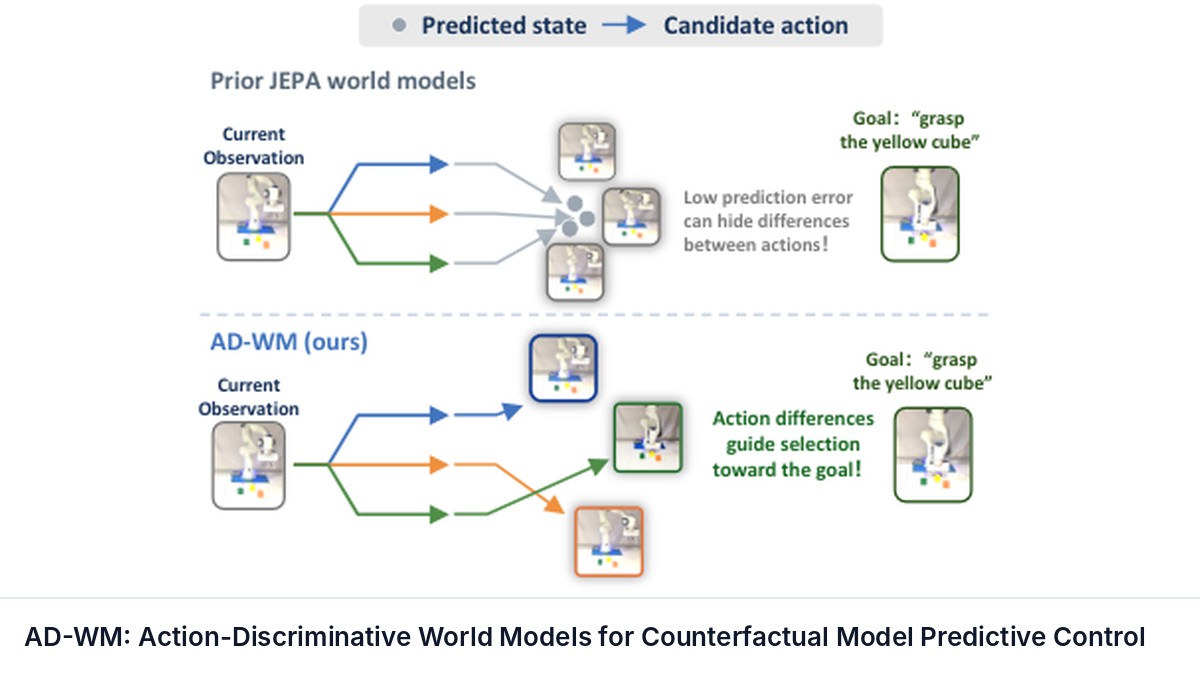
AD-WM: Action-Discriminative World Models for Counterfactual Model Predictive Control
Jiabin Qiu, Zixuan Chen, Hongye Cao et al.
Latent world models are typically trained to predict factual transitions, whereas model predictive control (MPC) must compare alternative actions from the same state. A model can therefore achieve low factual prediction error yet poorly distinguish candidate actions.