
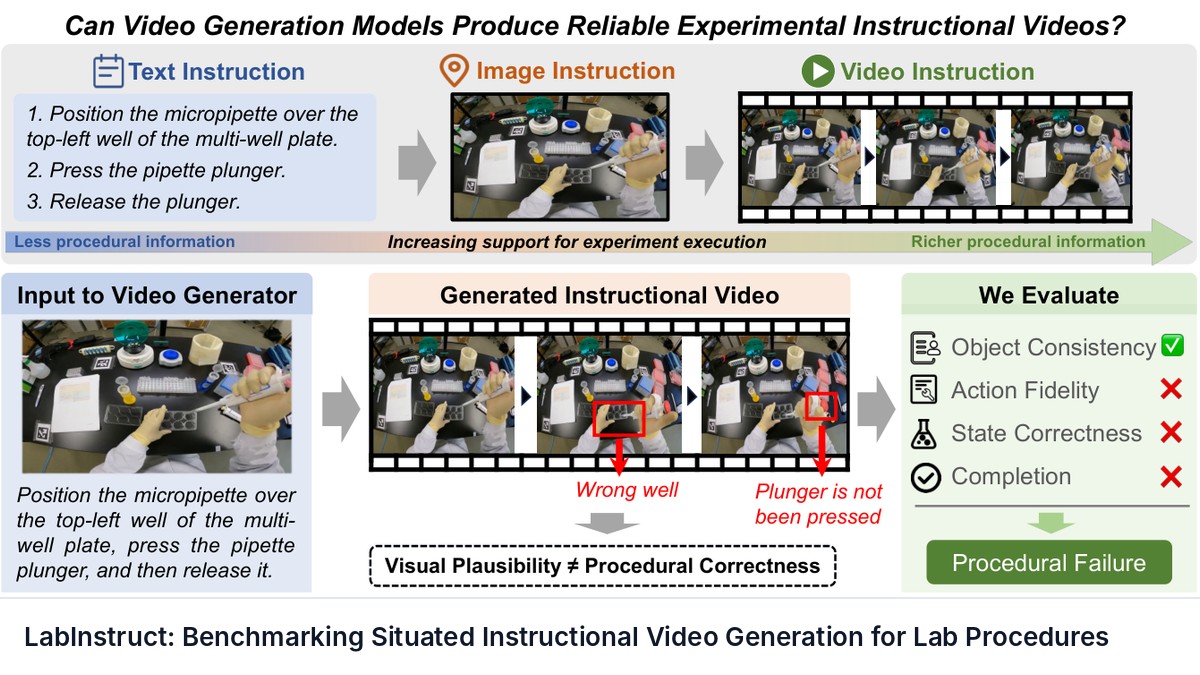
LabInstruct: Benchmarking Situated Instructional Video Generation for Lab Procedures
Yuming Fu, Weijia Wu, Jing Chen, Jiahao Tang, Feifei Chen, Hongyu Zhu, Xin Jin, Alex Jinpeng Wang · N/A · 2026
Framework
N/A
License
N/A
Stars
N/A
Summary
Self-driving laboratories (SDLs) aim to automate the full experimental loop, from scientific decision-making to physical execution.
Abstract Summary
Key Points
- Self-driving laboratories (SDLs) aim to automate the full experimental loop, from scientific decision-making to physical execution.
- Ideally, AI-generated plans could be carried out directly by robotic systems, but reliable automation remains difficult in complex, open-world laboratory environments, where experiments often involve fine-grained manipulation, long-horizon procedures, and substantial variation across tasks and setups.
- Humans therefore remain an important execution interface between AI-generated plans and physical experiments, creating a need for clear and effective human-facing experimental guidance.
- Because laboratory procedures are inherently visual, spatial, and dynamic, video is particularly well suited to communicating apparatus configurations, manipulation actions, temporal dependencies, and state changes.
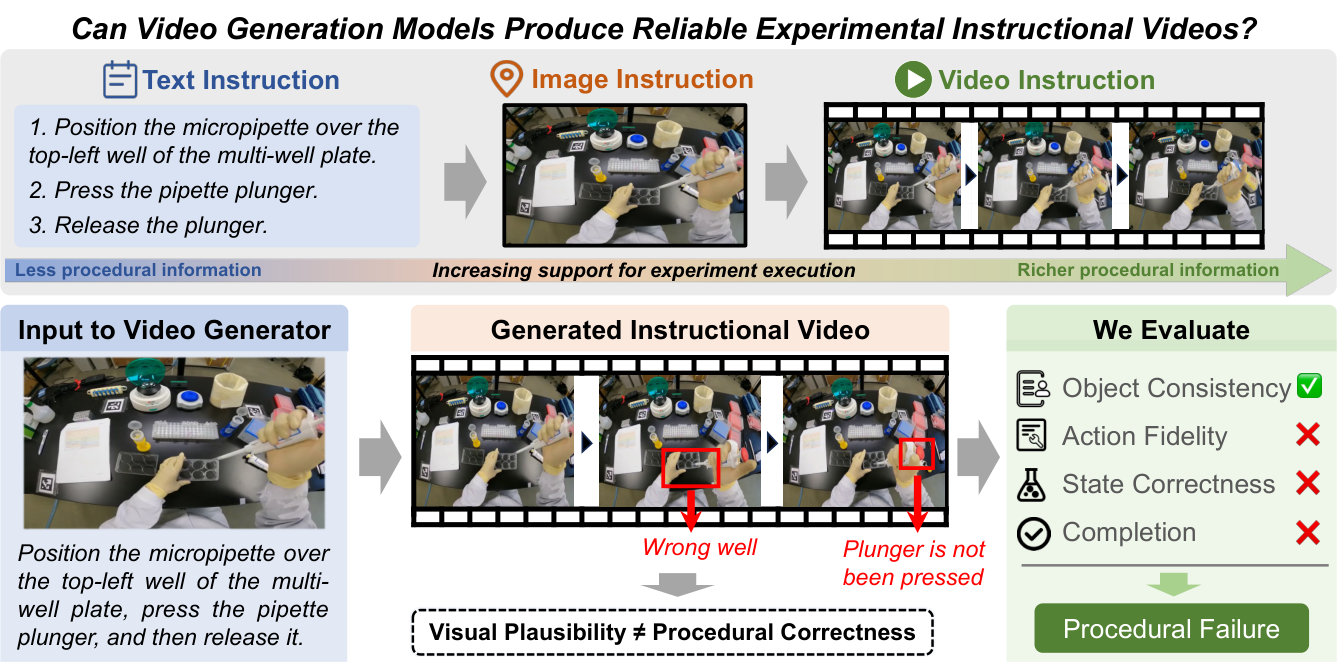
- Recent advances in video generation now make it possible to synthesize experimental demonstrations directly from an initial workspace image and a natural-language instruction.
The LabInstruct Benchmark
For each task, we have the initial workspace observation $\textit{f}_{0}$, including relevant objects, spatial relationship, and scene context.
Given $\textit{f}_{0}$ and a natural-language instruction $T$, the generator synthesizes $\textit{f}_{1:N}=\mathcal{G}(\textit{f}_{0},T;\theta)$ while preserving workspace identity and continuity, executing the instructed actions in the correct order, and reaching the expected intermediate and final states.
Experiments
Wan 2.2 I2V A14B [ 36 ] (simplified as Wan 2.2), LTX 2.3 [ 37 ] , Cosmos3 Nano , Cosmos3 Super [ 40 ] , LingBot Video [ 41 ] , and MiniMax H3 [ 38 ] , as well as 2 commercial models: Seedance 2.0 [ 44 ] and Wan 3.0 [ 48 ] . All models are provided with the same initial frame and a verified natural-language instruction to ensure a controlled comparison across models for each task.
To prioritize broad coverage across both tasks and generators, we evaluate one generated sample per model–task pair under fixed model-specific generation settings.
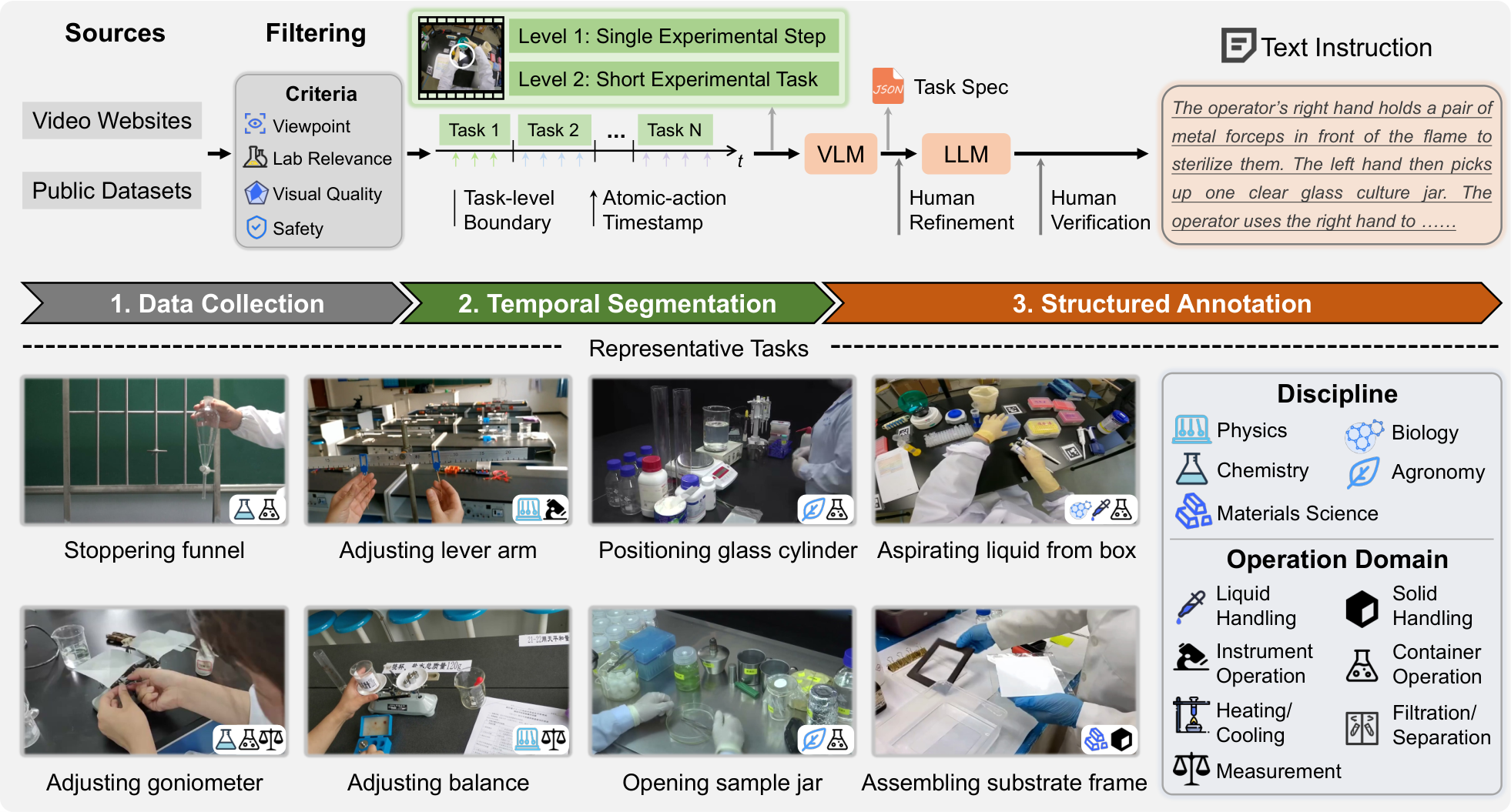
Sources and Demonstrations
Figures are reproduced from Fu et al. See the full paper for experimental details and the project page, when the paper links one, for demonstrations and videos.
Related Papers

A Sim-to-Real Integration Pipeline for Training and Deployment of Chunk-Based VLA Manipulation Policies
Mathilde Kappel, Clémence Grislain, Mohamed Chetouani et al.
Vision-Language-Action (VLA) models have become a prominent paradigm for mapping multimodal inputs, including semantic instructions, visual observations of the scene, and proprioceptive observations, to robot actions.
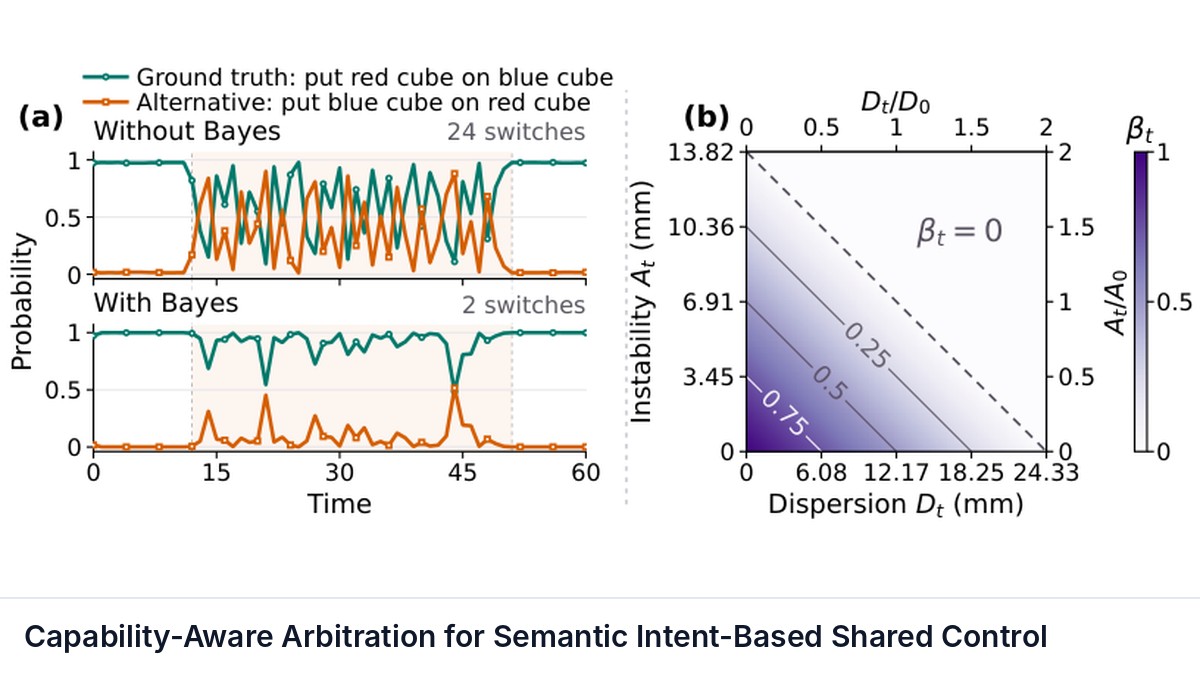
Capability-Aware Arbitration for Semantic Intent-Based Shared Control
Zhaoda Du, Michael Bowman, Xiaoli Zhang
Shared control often allocates robot authority based on confidence in inferred human intent, assuming reliable autonomous execution. When this assumption fails, high intent confidence can cause over-helping.
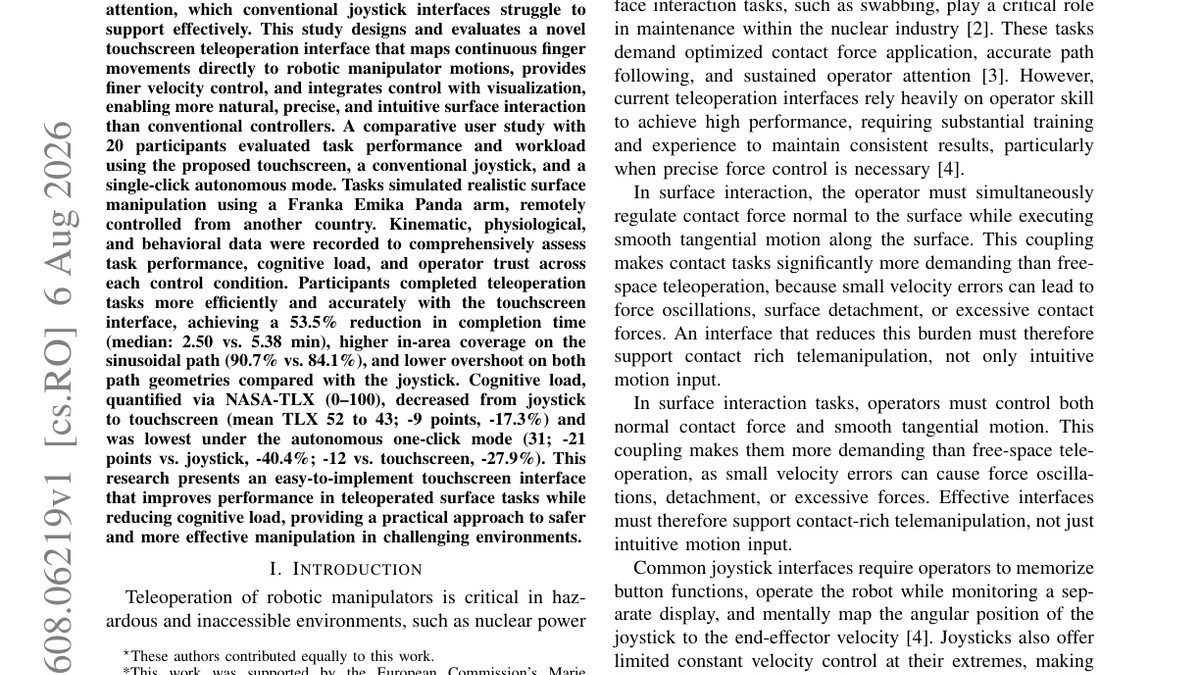
Design and Evaluation of a Touchscreen-Based Teleoperation Interface for Robotic Manipulators
Juan José García Cárdenas, Alperen Kenan, Hamidreza Raei et al.
Intuitive teleoperation interfaces are crucial for the safe and effective operation of robotic manipulators in challenging environments.
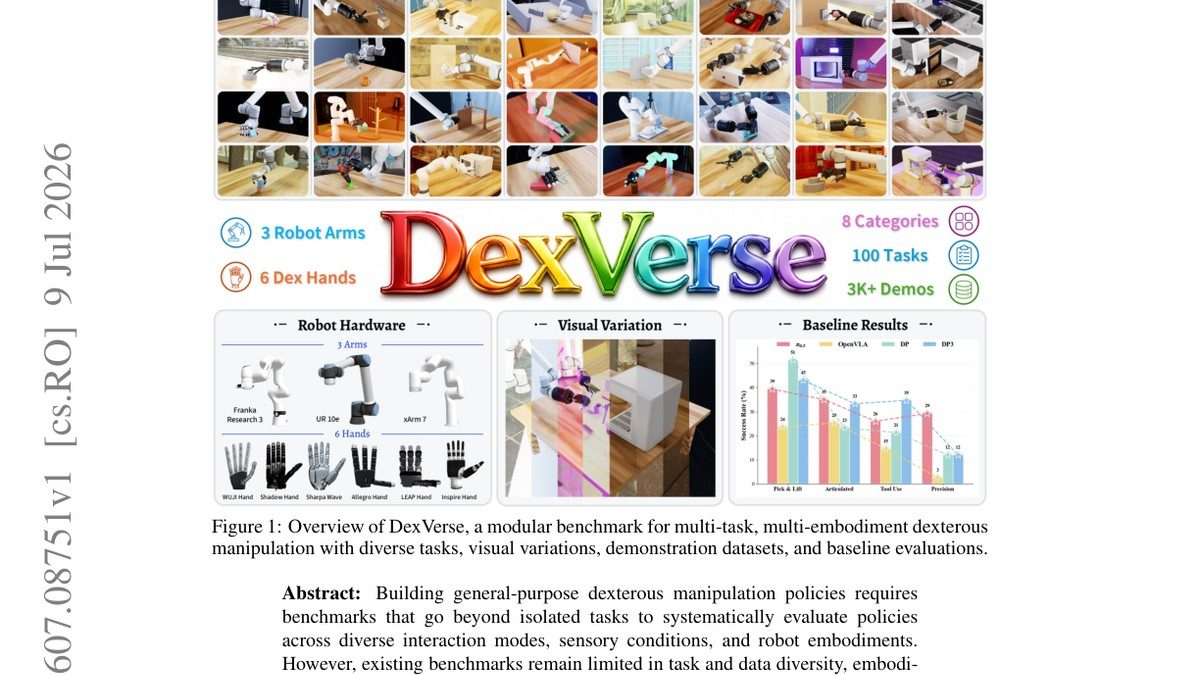
DexVerse: A Modular Benchmark for Multi-Task, Multi-Embodiment Dexterous Manipulation
Yunchao Yao, Zhuxiu Xu, Tianqi Zhang et al.
Building general-purpose dexterous manipulation policies requires benchmarks that go beyond isolated tasks to systematically evaluate policies across diverse interaction modes, sensory conditions, and robot embodiments.