
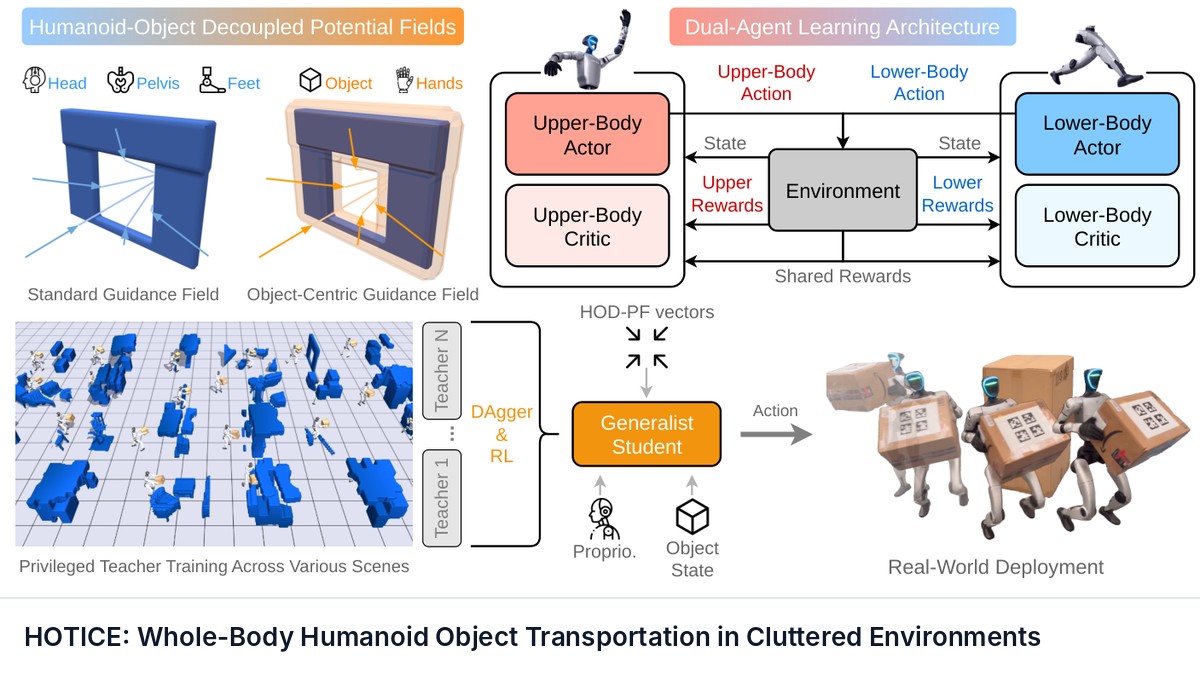
HOTICE: Whole-Body Humanoid Object Transportation in Cluttered Environments
Toan Nguyen, Weiduo Yuan, Siheng Zhao, Yue Wang, Daniel Seita · N/A · 2026
Framework
N/A
License
N/A
Stars
N/A
Summary
Object transportation is a fundamental capability for humanoid robots operating in real-world, human-centric environments, yet existing methods struggle when clutter constrains free space around both the robot and its carried payload.
Abstract Summary
Key Points
- Object transportation is a fundamental capability for humanoid robots operating in real-world, human-centric environments, yet existing methods struggle when clutter constrains free space around both the robot and its carried payload.
- We present HOTICE, a whole-body humanoid learning framework for transporting objects through such cluttered environments.
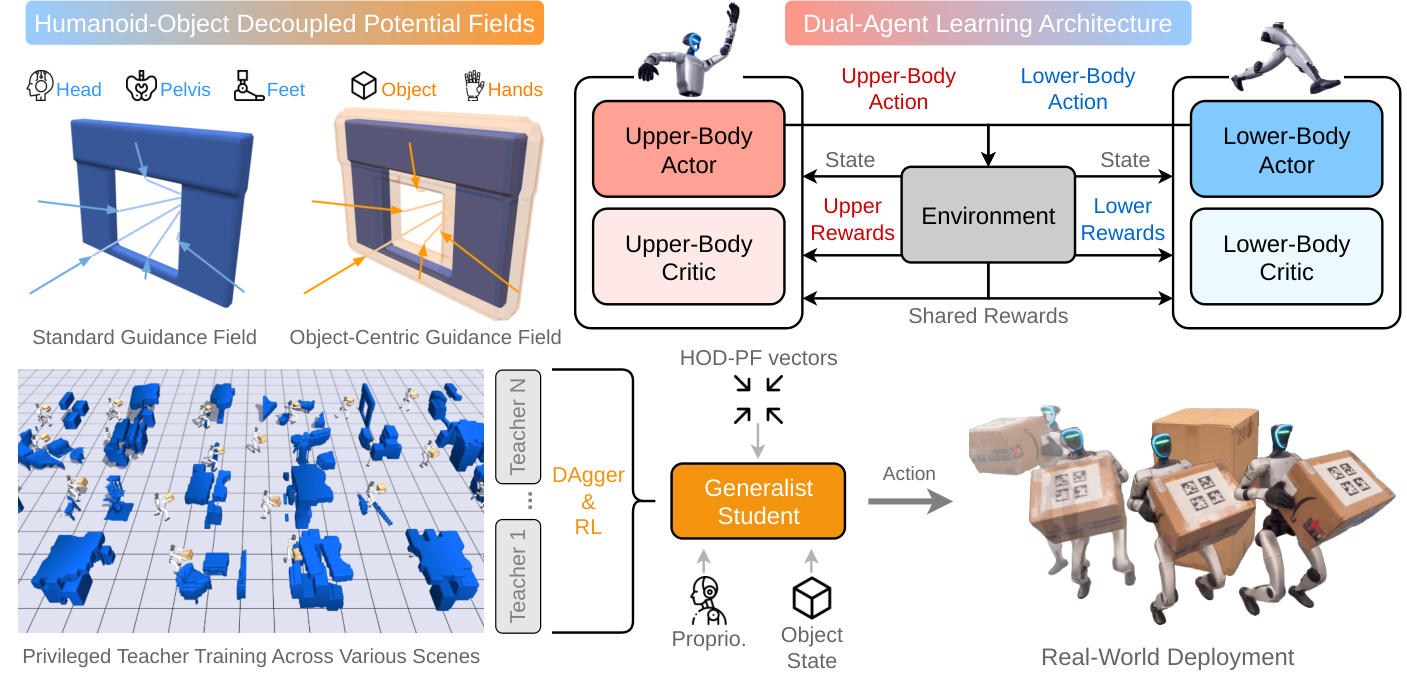
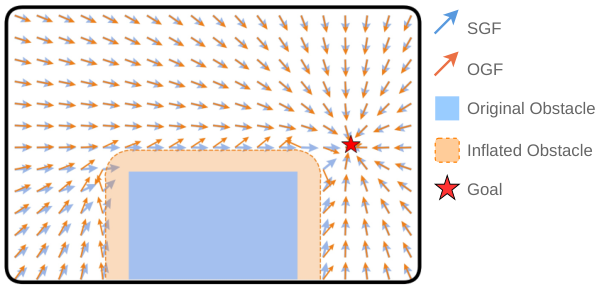
- First, we introduce Humanoid-Object Decoupled Potential Fields, which jointly encode collision-avoidance guidance for the robot and the carried object, enabling coordinated, obstacle-aware motion for both.
- Second, to address the large action space inherent to whole-body loco-manipulation, we design a dual-agent reinforcement learning architecture that decouples upper- and lower-body control while preserving whole-body coordination via shared state observations and rewards.
- To train a policy that generalizes across diverse cluttered scenes, we further employ a specialist-to-generalist distillation strategy, in which privileged teacher policies are distilled into a single deployable student policy.
PROBLEM STATEMENT
We investigate a humanoid loco-manipulation object transportation setting.
Given a cluttered environment populated by obstacles of different types (side, ground, and overhead obstacles), the robot starts at a starting position $\mathbf{s}\in\mathbb{R}^{3}$ holding an object $\mathscr{O}$ and is required to transport $\mathscr{O}$ to a target position $\mathbf{g}\in\mathbb{R}^{3}$ without colliding with the obstacles $\mathscr{C}$. The object $\mathscr{O}$ can be of different shapes.
Method
We present H umanoid O bject T ransportation I n C luttered E nvironments ( HOTICE ), an RL whole-body humanoid learning framework for transporting objects while avoiding collisions with diverse obstacles.
Experiments
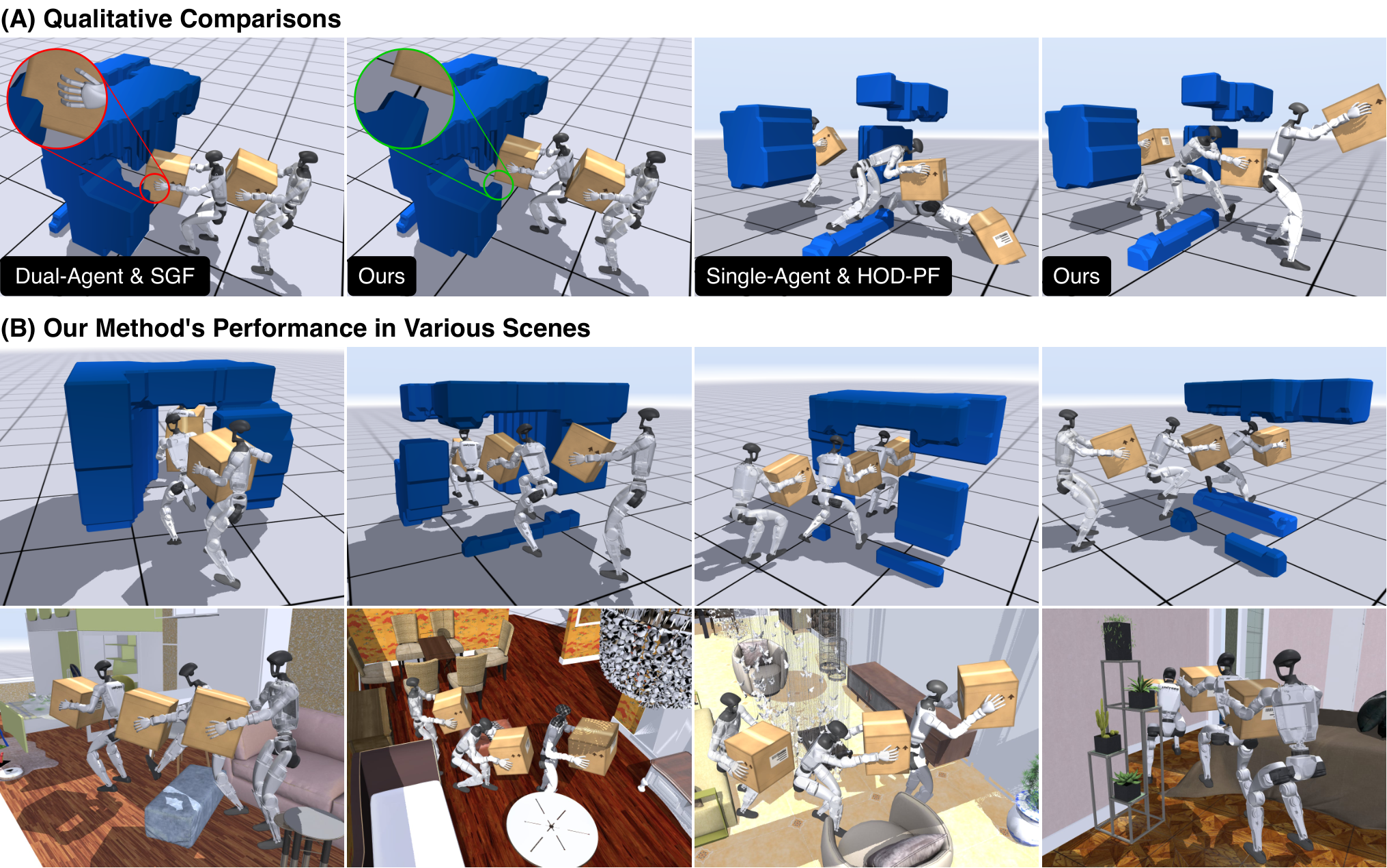
We conduct extensive experiments in both simulation (Section V-A ) and the real world (Section V-B ) to validate the performance and generalizability of our proposed HOTICE . Main Experiments. We first investigate the effectiveness of our method in enabling humanoid robots to transport objects in cluttered scenes while avoiding collisions with complex obstacles.
Since no prior method directly addresses our problem setting, we assess the significance of our key contributions through ablations of HOTICE .
Sources and Demonstrations
Figures are reproduced from Nguyen et al. See the full paper for experimental details and the project page, when the paper links one, for demonstrations and videos.
Related Papers
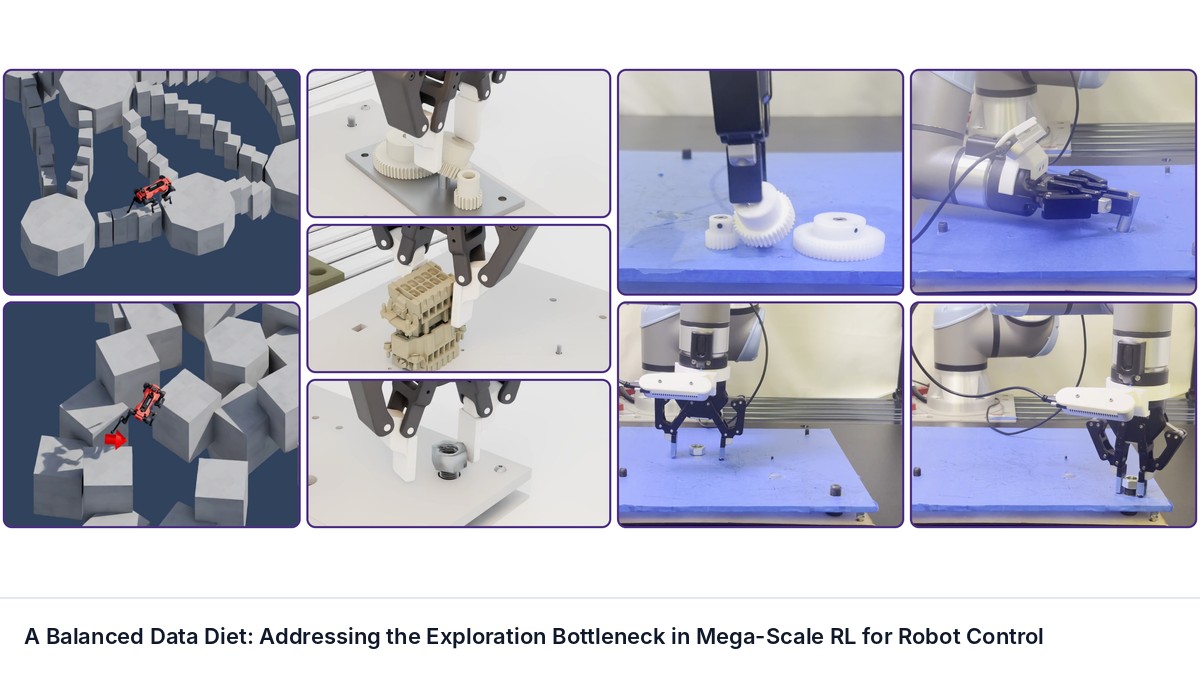
A Balanced Data Diet: Addressing the Exploration Bottleneck in Mega-Scale RL for Robot Control
Octi Zhang, Mateo Guaman Castro, Patrick Yin et al.
General-purpose robots must perform a wide range of tasks from agile locomotion to dexterous manipulation.
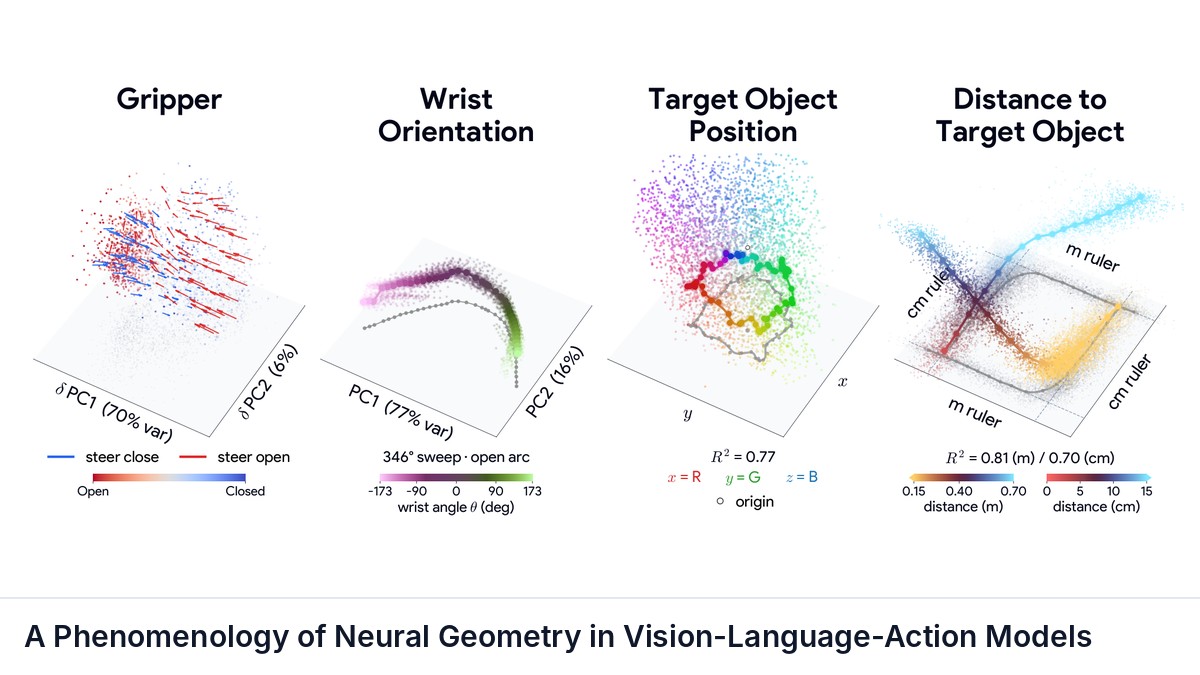
A Phenomenology of Neural Geometry in Vision-Language-Action Models
Mozes Jacobs, Aiden Swann, Mathilde Papillon et al.
Robotic manipulation is inherently geometric, but what shape does the world take inside the policy that performs it?

A Sim-to-Real Integration Pipeline for Training and Deployment of Chunk-Based VLA Manipulation Policies
Mathilde Kappel, Clémence Grislain, Mohamed Chetouani et al.
Vision-Language-Action (VLA) models have become a prominent paradigm for mapping multimodal inputs, including semantic instructions, visual observations of the scene, and proprioceptive observations, to robot actions.
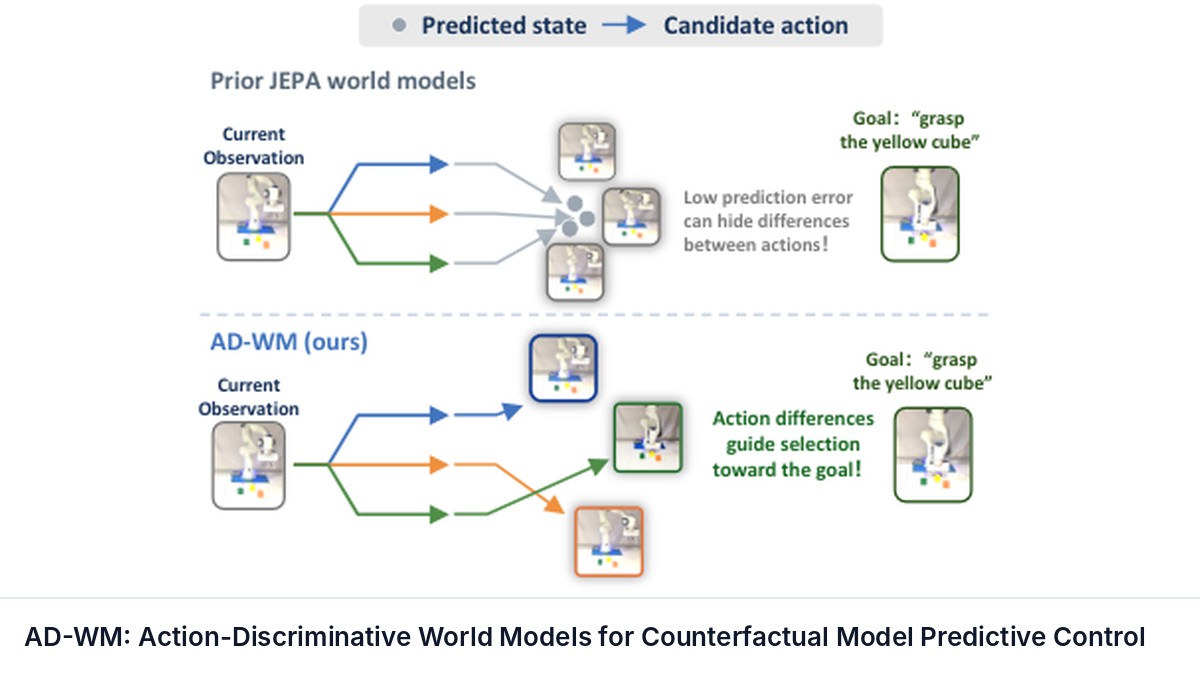
AD-WM: Action-Discriminative World Models for Counterfactual Model Predictive Control
Jiabin Qiu, Zixuan Chen, Hongye Cao et al.
Latent world models are typically trained to predict factual transitions, whereas model predictive control (MPC) must compare alternative actions from the same state. A model can therefore achieve low factual prediction error yet poorly distinguish candidate actions.