
Dissecting Motion-Prior Regularization for Data-Scarce Robotic Insertion
Ning Hu, Shuai Li, Jindong Tan · N/A · 2026
Framework
N/A
License
N/A
Stars
N/A
Summary
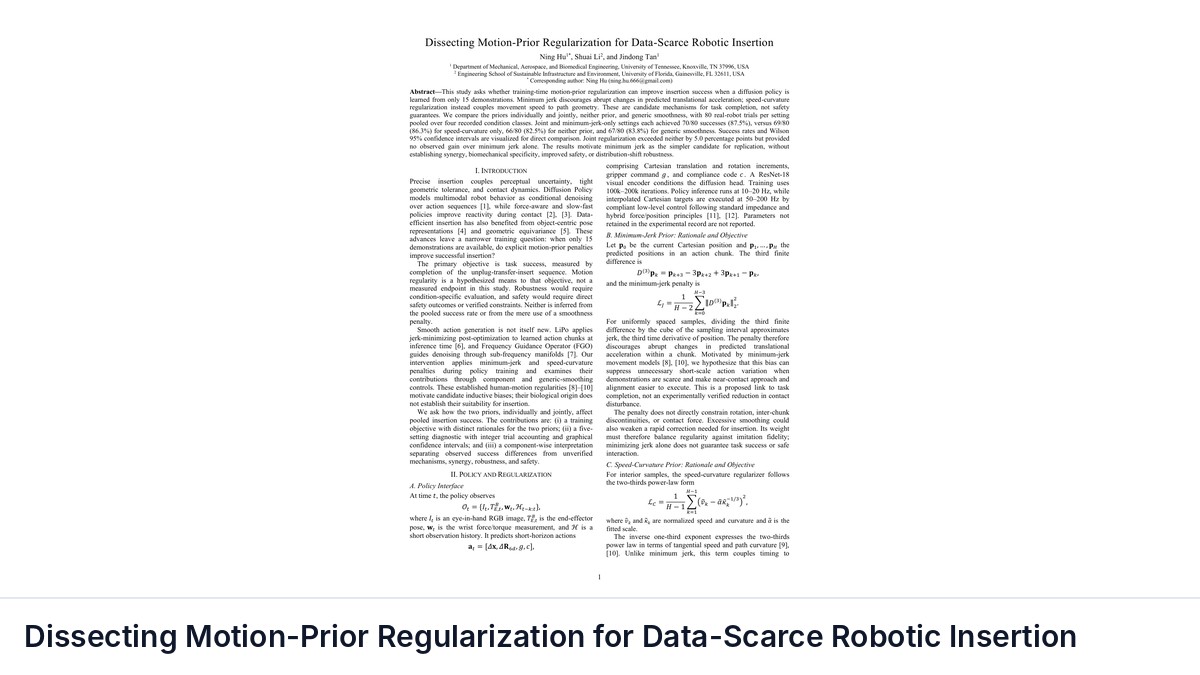
This study asks whether training-time motion-prior regularization can improve insertion success when a diffusion policy is learned from only 15 demonstrations.
Abstract Summary
Key Points
- This study asks whether training-time motion-prior regularization can improve insertion success when a diffusion policy is learned from only 15 demonstrations.
- Minimum jerk discourages abrupt changes in predicted translational acceleration; speed-curvature regularization instead couples movement speed to path geometry.
- These are candidate mechanisms for task completion, not safety guarantees
- We compare the priors individually and jointly, neither prior, and generic smoothness, with 80 real-robot trials per setting pooled over four recorded condition classes.
- Joint and minimum-jerk-only settings each achieved 70/80 successes (87.5%), versus 69/80 (86.3%) for speed-curvature only, 66/80 (82.5%) for neither prior, and 67/80 (83.8%) for generic smoothness.
Dissecting Motion-Prior Regularization for Data-Scarce Robotic Insertion
|Authors: Ning Hu, Shuai Li, Jindong Tan
|Venue: arXiv preprint | Year: 2026
|arXiv: 2609.17484v1
Abstract
This study asks whether training-time motion-prior regularization can improve insertion success when a diffusion policy is learned from only 15 demonstrations. Minimum jerk discourages abrupt changes in predicted translational acceleration; speed-curvature regularization instead couples movement speed to path geometry. These are candidate mechanisms for task completion, not safety guarantees. We compare the priors individually and jointly, neither prior, and generic smoothness, with 80 real-robot trials per setting pooled over four recorded condition classes. Joint and minimum-jerk-only settings each achieved 70/80 successes (87.5%), versus 69/80 (86.3%) for speed-curvature only, 66/80 (82.5%) for neither prior, and 67/80 (83.8%) for generic smoothness. Success rates and Wilson 95% confidence intervals are visualized for direct comparison. Joint regularization exceeded neither by 5.0 percentage points but provided no observed gain over minimum jerk alone. The results motivate minimum jerk as the simpler candidate for replication, without establishing synergy, biomechanical specificity, improved safety, or distribution-shift robustness.
Key Contributions
- This study asks whether training-time motion-prior regularization can improve insertion success w…
- Minimum jerk discourages abrupt changes in predicted translational acceleration; speed-curvature …
- These are candidate mechanisms for task completion, not safety guarantees
- We compare the priors individually and jointly, neither prior, and generic smoothness, with 80 re…
- Joint and minimum-jerk-only settings each achieved 70/80 successes (87.5%), versus 69/80 (86.3%) …
Topics
- vision
- reinforcement-learning
- learning-from-demonstration
Code & Data
No code repository linked in paper metadata.
BibTeX
@article{Hu2026_260917484v1,
  title     = {Dissecting Motion-Prior Regularization for Data-Scarce Robotic Insertion},
  author    = {Ning Hu and Shuai Li and Jindong Tan},
  year      = {2026},
  eprint    = {2609.17484v1},
  archivePrefix = {arXiv},
  primaryClass  = {cs.RO},
  url       = {https://arxiv.org/abs/2609.17484v1}
}
Related Papers
A Low-Cost, Open Platform for End-to-End Autonomous Driving on a Miniature Ackermann Vehicle
Gustavo Claudio Karl Couto, Eric Aislan Antonelo, Gabriel George Zipperer
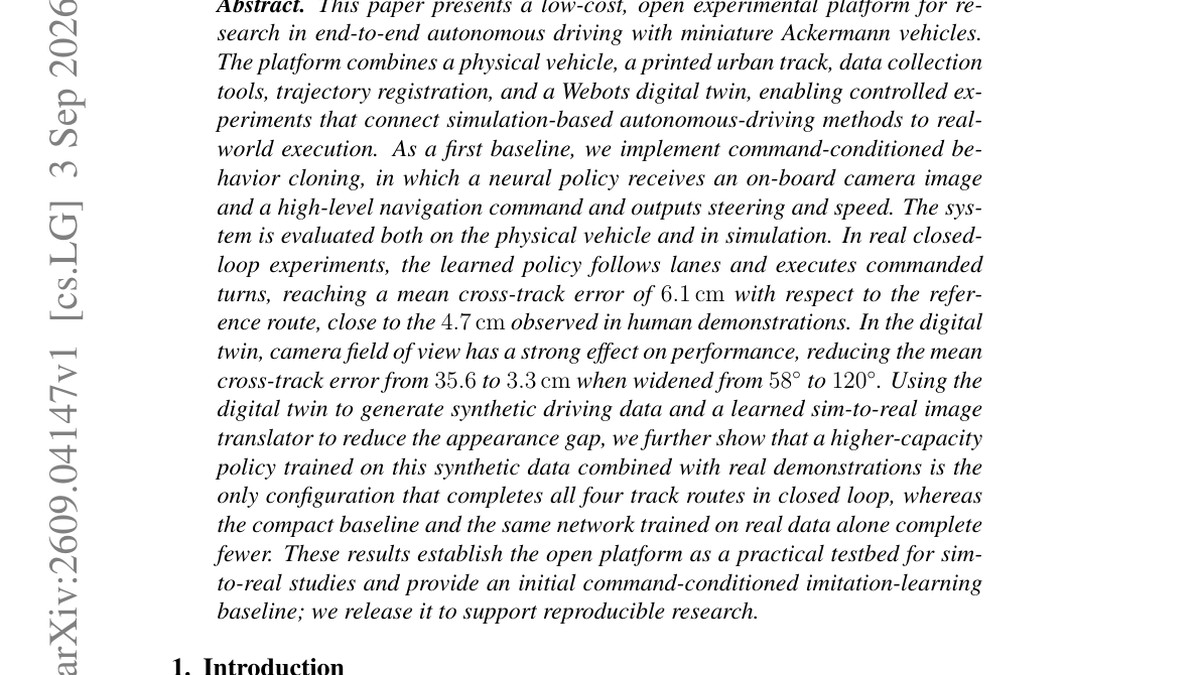
This paper presents a low-cost, open experimental platform for research in end-to-end autonomous driving with miniature Ackermann vehicles.

A Sim-to-Real Integration Pipeline for Training and Deployment of Chunk-Based VLA Manipulation Policies
Mathilde Kappel, Clémence Grislain, Mohamed Chetouani et al.
Vision-Language-Action (VLA) models have become a prominent paradigm for mapping multimodal inputs, including semantic instructions, visual observations of the scene, and proprioceptive observations, to robot actions.
Awomo-SimDataEngine: Agentic Simulation-ReadyWorld Generation
PhysicalRSI Team, Danjiao Ma, Enhui Ma et al.
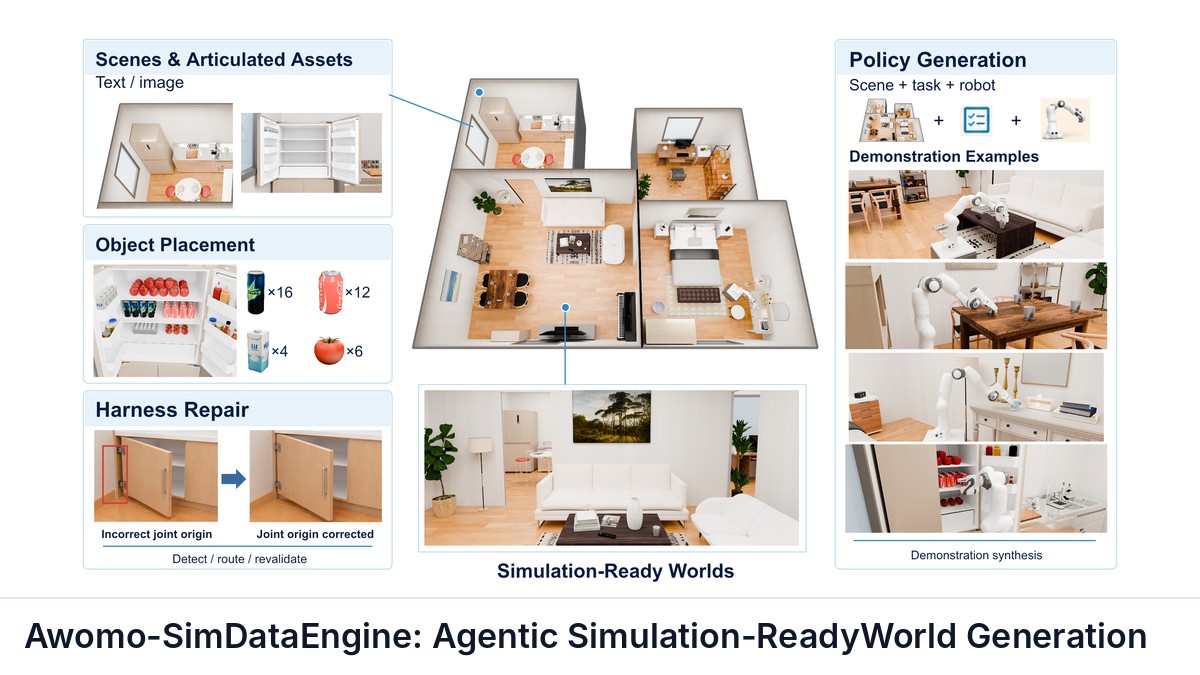
Generating useful robot-training data requires more than visually plausiblescenes: objects must support interaction, placements must remain physicallyvalid, and tasks must admit repeatable execution.
Can People Distinguish Human and AI Agency in Humanoid Teleoperation? A Preliminary Study of Agency Perception
Xiang Li, Koya Dendo, Keigo Minamida et al.
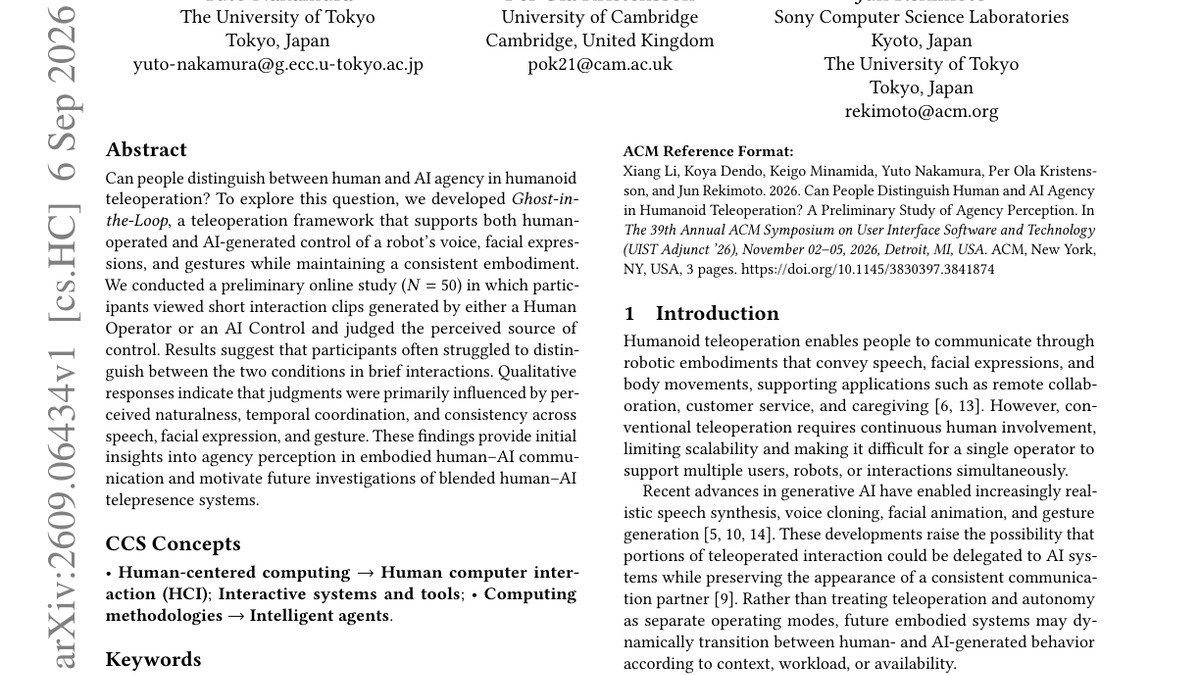
Can people distinguish between human and AI agency in humanoid teleoperation?