
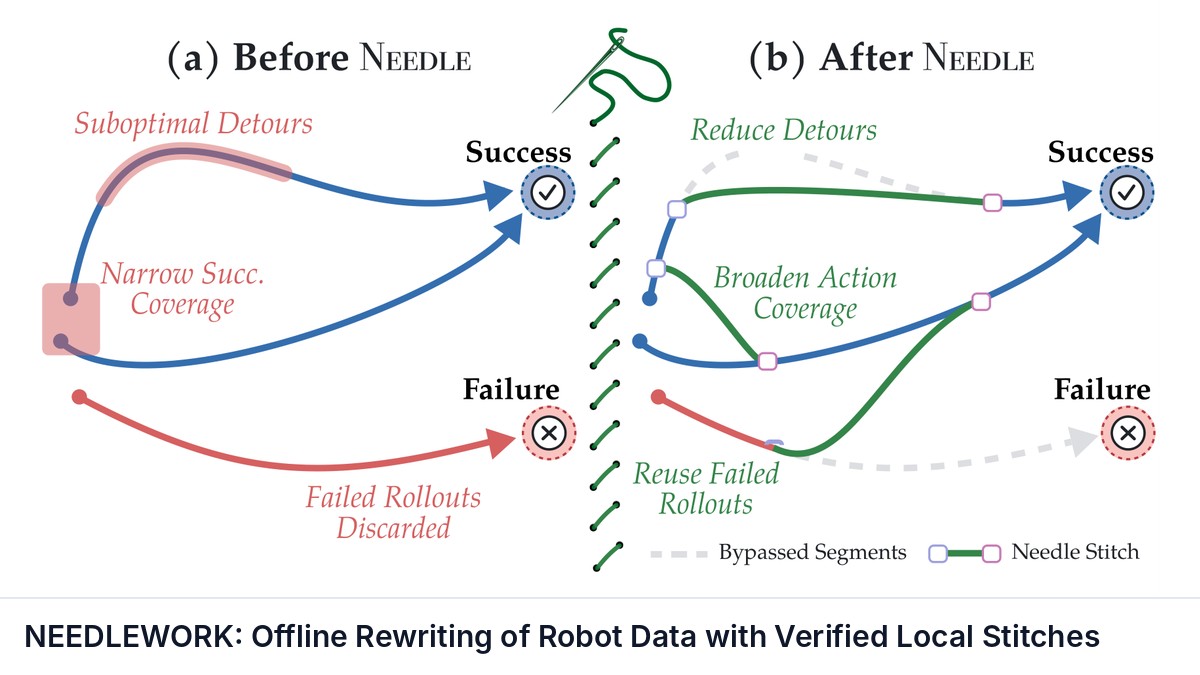
NEEDLEWORK: Offline Rewriting of Robot Data with Verified Local Stitches
Juntao Ren, Yifan Hou, Shuran Song · N/A · 2026
Framework
N/A
License
N/A
Stars
N/A
Summary
Robot demonstrations may contain useful behavior even when individual episodes are inefficient or unsuccessful.
Abstract Summary
Key Points
- Robot demonstrations may contain useful behavior even when individual episodes are inefficient or unsuccessful.
- Trajectory stitching offers a way to compose these behaviors into improved training data, but identifying useful connections and verifying their feasibility is difficult in high-dimensional robot data, where many prior methods rely on low-dimensional state representations.
- We introduce NEEDLE, an offline dataset-augmentation algorithm that addresses these challenges by adding short, verified action bridges between recorded observations in high-dimensional robot demonstrations.
- First, NEEDLE identifies and creates connections that bypass suboptimal detours, broaden action coverage, and augment the original dataset with failed trajectories, using only RGB images, proprioception, and episode-level outcomes, without new environment interaction or privileged object state.
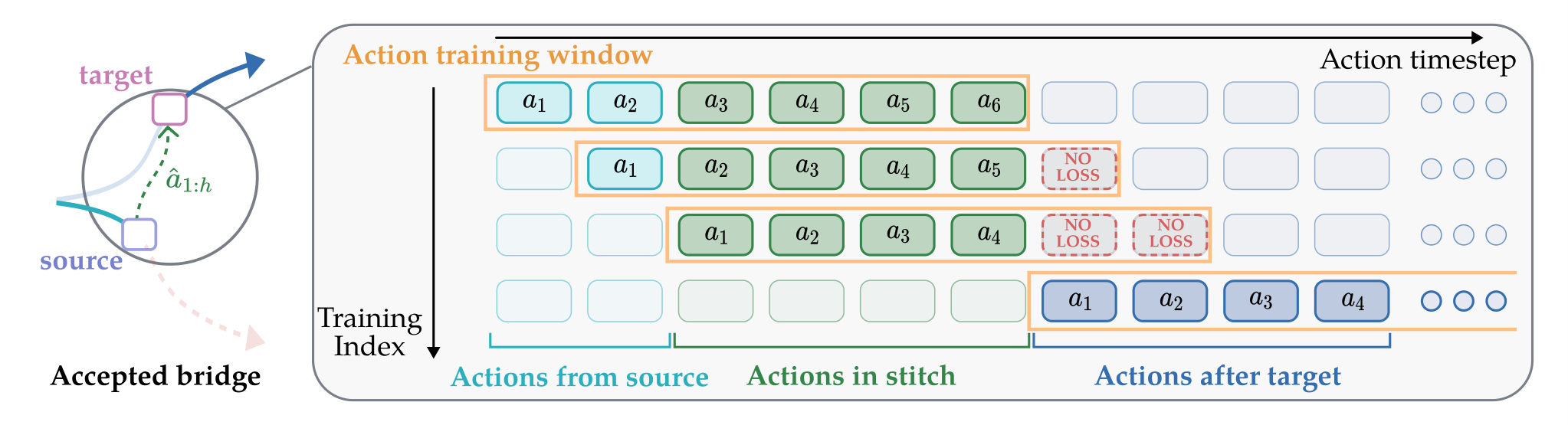
- Next, we present a sampling technique that incorporates accepted bridges into policy training without synthesizing intermediate images or discarding the original demonstrations, allowing policies to learn alternative actions while retaining the original dataset's coverage.
How Needle work Works
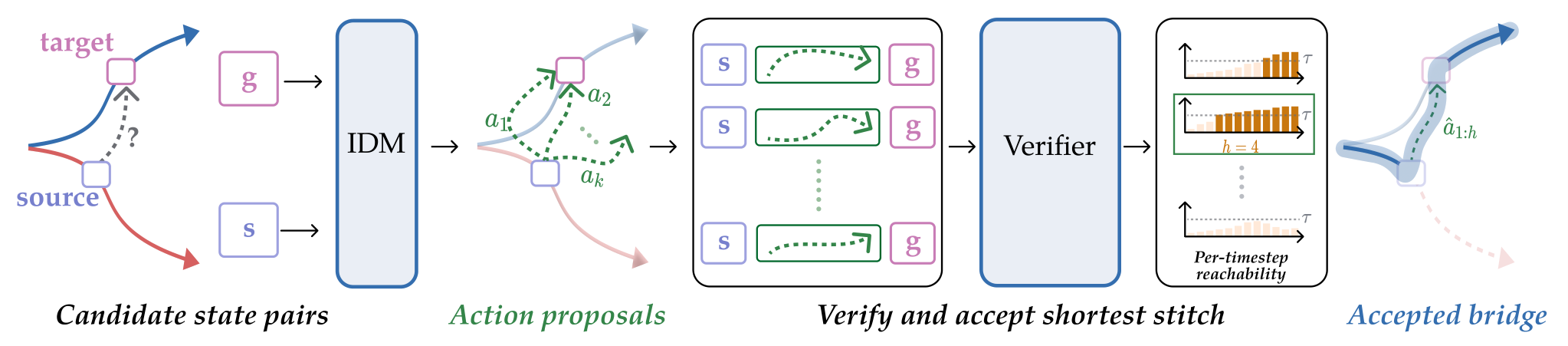
Needle answers two separate questions when rewriting a dataset: whether a stitch is useful , and whether a stitch is feasible . Candidate selection addresses the first question. An Inverse Dynamics Model (IDM) and an action-conditioned verifier address the second.
We formalize the notation in § 3.1 , the selection of useful connections in § 3.2 , action generation and verification in § 3.3 , and policy training on the rewritten dataset in § 3.4 . Additional details in Appendix D .
Experiments
We evaluate whether rewriting an offline robot dataset with Needle improves downstream policy performance, and, more importantly, how the rewritten data changes the behavior learned by the policy. After describing the experimental setup (§ 4.1 ), we first measure task success on real-robot and simulated manipulation tasks (§ 4.2 ).
Sources and Demonstrations
Figures are reproduced from Ren et al. See the full paper for experimental details and the project page, when the paper links one, for demonstrations and videos.
Related Papers

A Sim-to-Real Integration Pipeline for Training and Deployment of Chunk-Based VLA Manipulation Policies
Mathilde Kappel, Clémence Grislain, Mohamed Chetouani et al.
Vision-Language-Action (VLA) models have become a prominent paradigm for mapping multimodal inputs, including semantic instructions, visual observations of the scene, and proprioceptive observations, to robot actions.
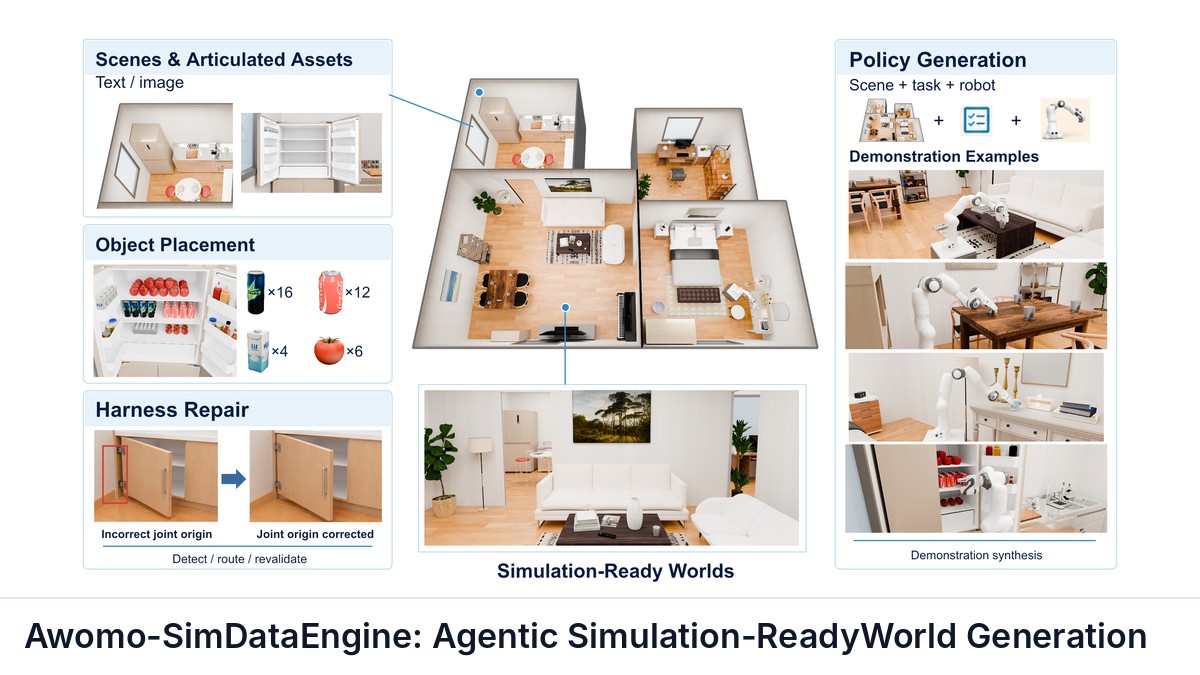
Awomo-SimDataEngine: Agentic Simulation-ReadyWorld Generation
PhysicalRSI Team, Danjiao Ma, Enhui Ma et al.
Generating useful robot-training data requires more than visually plausiblescenes: objects must support interaction, placements must remain physicallyvalid, and tasks must admit repeatable execution.

Capability-Aware Arbitration for Semantic Intent-Based Shared Control
Zhaoda Du, Michael Bowman, Xiaoli Zhang
Shared control often allocates robot authority based on confidence in inferred human intent, assuming reliable autonomous execution. When this assumption fails, high intent confidence can cause over-helping.
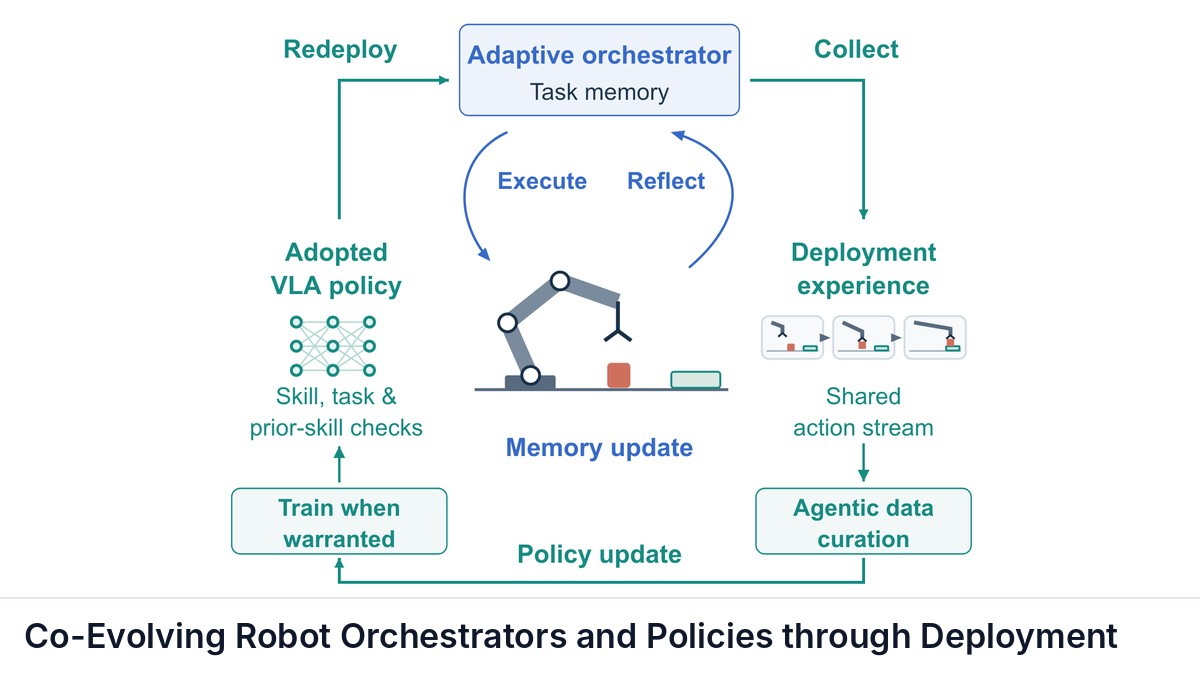
Co-Evolving Robot Orchestrators and Policies through Deployment
Xilun Zhang, Maggie Wang, Erik Bauer et al.
Vision-language-action (VLA) policies trained on large datasets are capable within their training domains, yet they still fail to generalize to the variety of situations a robot meets in real-world deployment.