
Timed Rule-Based Supervision of an End-to-End Autonomous Parking Policy
Kejia Gao, Liguo Zhou, Lei Yu, Alois Knoll · N/A · 2026
Framework
N/A
License
N/A
Stars
N/A
Summary
We study whether a manually specified runtime supervisor can correct recurring failures of an existing end-to-end parking policy in a fixed CARLA parking lot.
Abstract Summary
Key Points
- We study whether a manually specified runtime supervisor can correct recurring failures of an existing end-to-end parking policy in a fixed CARLA parking lot.
- The vision-based Transformer architecture is inherited from Yang et al.; our contribution is a timed, rule-based Parametric Safety Shield (PSS) applied to its control outputs.
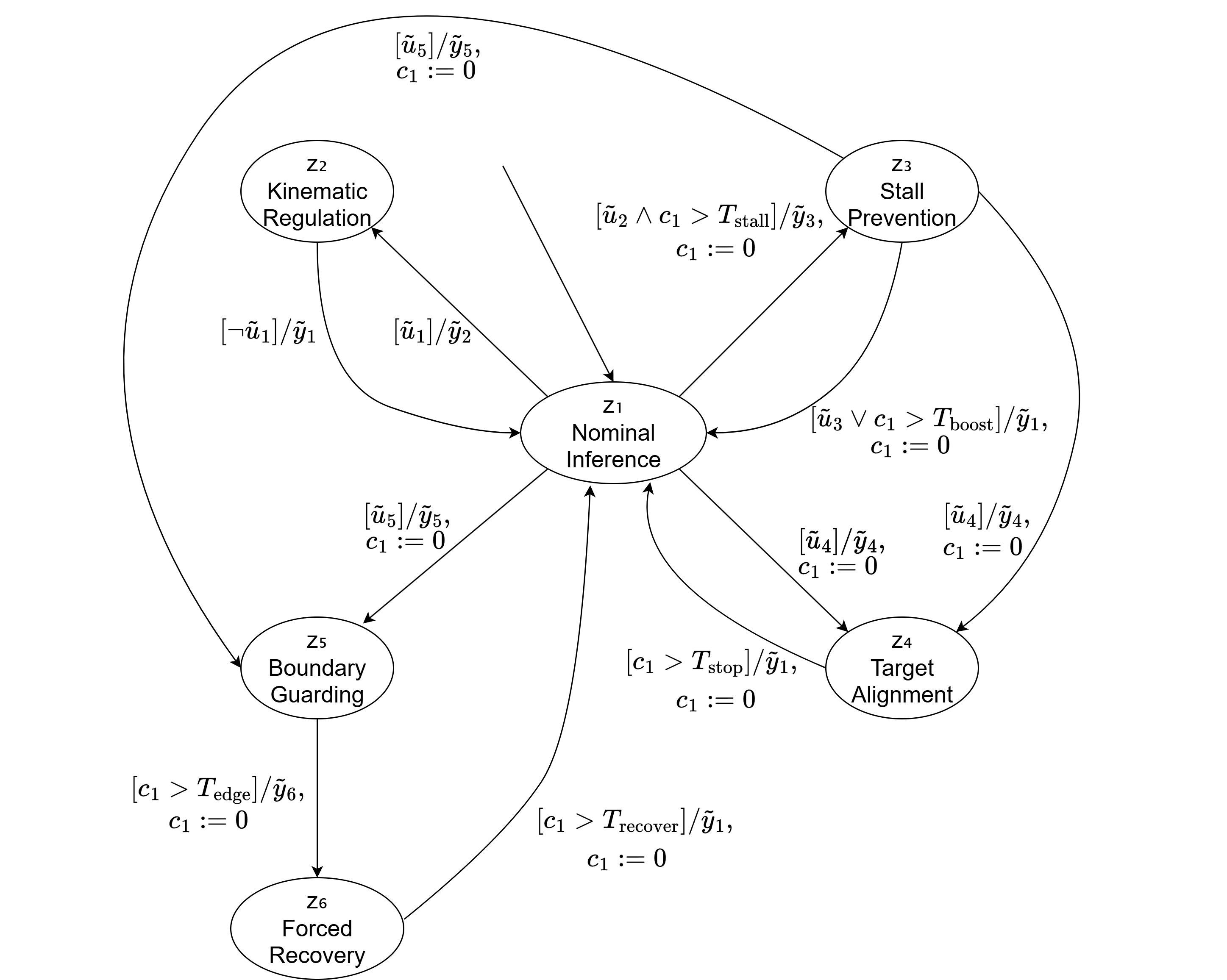
- The PSS uses hand-calibrated speed, position, and duration thresholds to intervene in observed failure modes, including boundary exits, delayed braking, and stalled or oscillatory control.
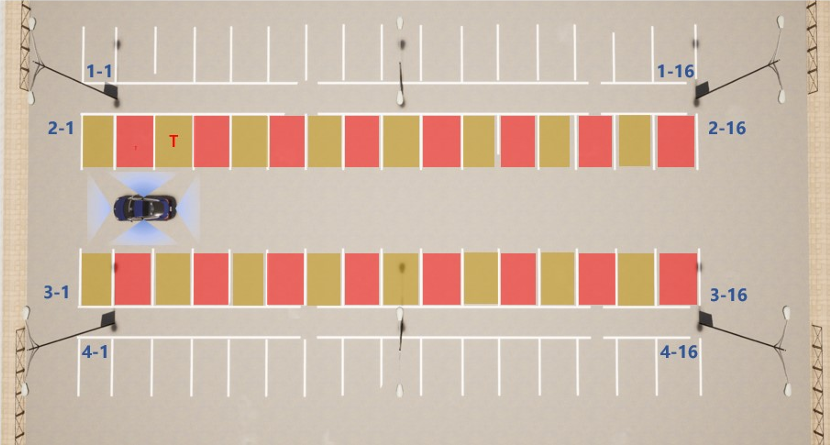
- In the reported closed-loop evaluation, 16 held-out target slots and six initial poses are each evaluated in four rounds (384 attempts per configuration).
- Target success increases from 327/384 (85.16%) for the retrained policy to 375/384 (97.66%) with the PSS; mean position and orientation errors among successful attempts are 0.21m and 0.33 degrees.
Method
We retain the network architecture of Yang et al. [ 2 ] as the nominal controller. The new component in this paper is the post-inference PSS. Figure 1 shows the complete signal path and separates inherited and added components.
Cameras, vehicle state, target slot Inherited E2E Parking Transformer Proposed timed PSS guards and overrides Vehicle in CARLA executed command next observation and simulator position/velocity for PSS Fig. 1: Complete closed-loop architecture.
Experiments
The network architecture keeps the same as the original one and hyperparameters are slightly different. The network was trained on 4 NVIDIA RTX 4090 (total VRAM: 96 GB) with a batch size of 16. Adam optimizer is utilized with an initial learning rate of $7.5\times 10^{-5}$ and a weight decay of $1\times 10^{-4}$, while the beta values are 0.9 and 0.999 as default.
The training dataset, Gen 2B of the E2E Parking Dataset [ 1 ] , comprises 248 training and 104 validation trajectories. As illustrated in Fig.
Sources and Demonstrations
Figures are reproduced from Gao et al. See the full paper for experimental details and the project page, when the paper links one, for demonstrations and videos.
Related Papers

A Sim-to-Real Integration Pipeline for Training and Deployment of Chunk-Based VLA Manipulation Policies
Mathilde Kappel, Clémence Grislain, Mohamed Chetouani et al.
Vision-Language-Action (VLA) models have become a prominent paradigm for mapping multimodal inputs, including semantic instructions, visual observations of the scene, and proprioceptive observations, to robot actions.
Aim Short to Reach Far: Your Frozen World Model Can Plan Better Than You Think
Xvyuan Liu, Jianjie Fang, Chen Gao et al.
Planners built on visual world models commonly score each predicted outcome by its distance to the encoded goal image. We show that this target can limit control even with exact dynamics and globally optimal short-horizon search: reaching a goal may require actions that initially move away from it.
Beyond Reconstruction: What Matters in Action Tokenization for Robot Policies?
Haoran Chen, Jingtian Ji, Samuel Wheeler et al.
Autoregressive action-token policies such as vision-language-action models require action tokenizers to translate discrete token sequences into precise control actions in continuous space. Many action tokenizers learn the mapping between tokens and actions via a reconstruction objective.

Capability-Aware Arbitration for Semantic Intent-Based Shared Control
Zhaoda Du, Michael Bowman, Xiaoli Zhang
Shared control often allocates robot authority based on confidence in inferred human intent, assuming reliable autonomous execution. When this assumption fails, high intent confidence can cause over-helping.