

CougarTail & CUB: A General-Purpose Mast and Central Utility Board for Cylindrical Underwater Enclosures
Ben Washburn, Clayton Smith, Eli Gaskin, Brighton Anderson, Braden Meyers, Brady Moon, Joshua Mangelson · N/A · 2026
Framework
N/A
License
N/A
Stars
N/A
Summary
Cylindrical watertight enclosures are widely used across various underwater systems, from unmanned underwater vehicles (UUVs), to remotely operated vehicles (ROVs), to various sensor platforms.
Abstract Summary
Key Points
- Cylindrical watertight enclosures are widely used across various underwater systems, from unmanned underwater vehicles (UUVs), to remotely operated vehicles (ROVs), to various sensor platforms.
- However, electronics are typically built on rectangular PCBs arranged in horizontal stacks, which inefficiently occupy the circular cross-section volume that is critical for both payload capacity and buoyancy management.
- This paper presents CUB (Central Utility Board) and CougarTail, a general-purpose system designed to address this gap.
- CUB is a circular PCB sized for 4-inch-diameter enclosures that consolidates a Raspberry Pi Compute Module 5 (CM5) and an STM32 microcontroller, while also providing power management features and auxiliary connections.
- Mounted coaxially, CUB reduces the electronics stack of our CougUV from 200 mm of tube length and 709 g to 25 mm and 156 g, returning that length and mass budget to payload and buoyancy trim.
Custom PCB Design
The CUB mainboard was designed to consolidate bulky and wiring-intensive power and data systems onto a single easy-to-use board. A cut-circular geometry was chosen to minimize the size footprint and pass-through inconvenience while maximizing board area. The CUB mounts coaxially within commonly-used 4-inch-diameter Blue Robotics acrylic tubes.
By integrating previously separate systems onto a single board, CUB achieves a significant reduction in footprint and wiring complexity which increases reliability.
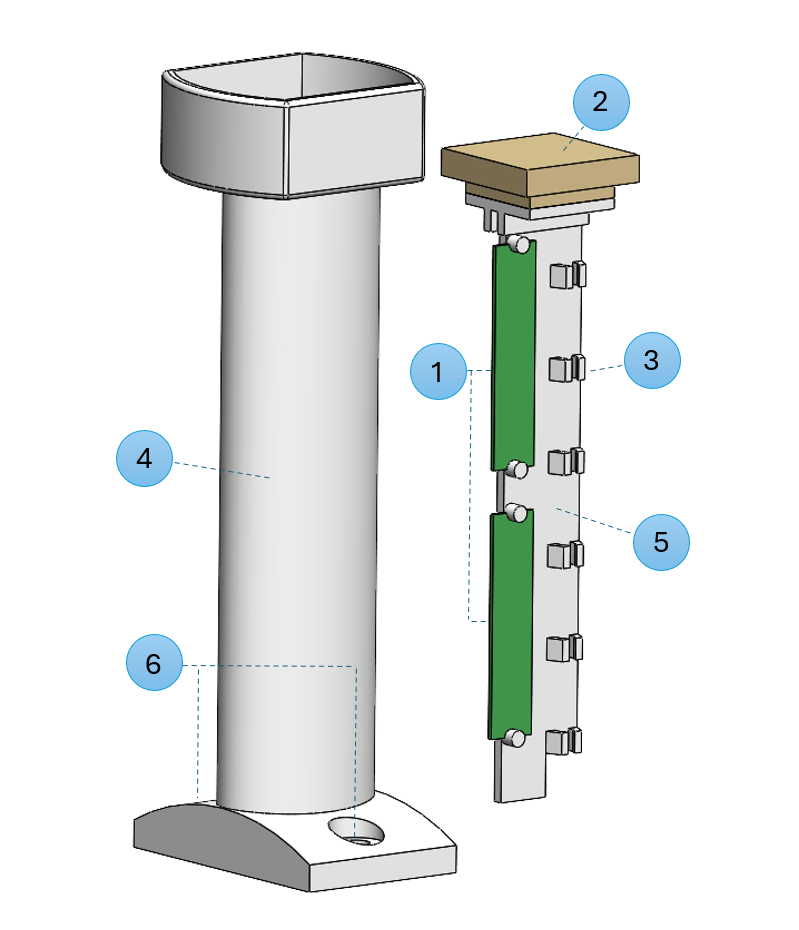
Integrated Sensor Mast
Surface operations with our CougUV platform [ 1 ] previously relied on GPS and radio antennas housed within the main enclosure. Even shallow submersion attenuated these signals enough to render them unreliable, forcing the vehicle to fully surface and orient itself favorably before acquiring a GPS fix or establishing a communication link.
To address this, we designed a custom 100 mm-tall mast that extends above the waterline whenever the vehicle is surfaced (see Fig. 3 ).
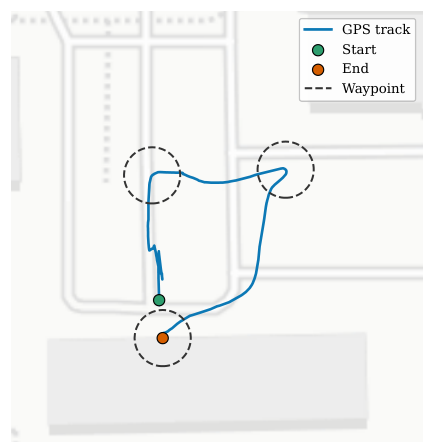
Testing and Results
The CUB and CougarTail were thoroughly bench tested, with deployment onto the CougUV platform in progress. The results below detail the performance of both systems and the improvements they provide to the CougUV platform. The electronics system CUB replaces occupied 200 mm of longitudinal space within the body tube and weighed 709 g. CUB occupies 25 mm and weighs 156 g, reductions of 87.5% and 78% respectively.
Sources and Demonstrations
Figures are reproduced from Washburn et al. See the full paper for experimental details and the project page, when the paper links one, for demonstrations and videos.
Related Papers

3D Euler-Angle Orientation Control for Two-Ray Fading Mitigation in Maritime Air-to-Sea Communications
Mohammed Bajja, Abdoul Karim A. H. Saliah, Hajar El Hammouti et al.
Maritime Air-to-Sea links are dominated by a line-of-sight ray and a sea-surface reflected ray whose destructive combination produces deep fades. Existing mitigation strategies optimize Unmanned Aerial Vehicle position or trajectory but leave attitude unexploited.
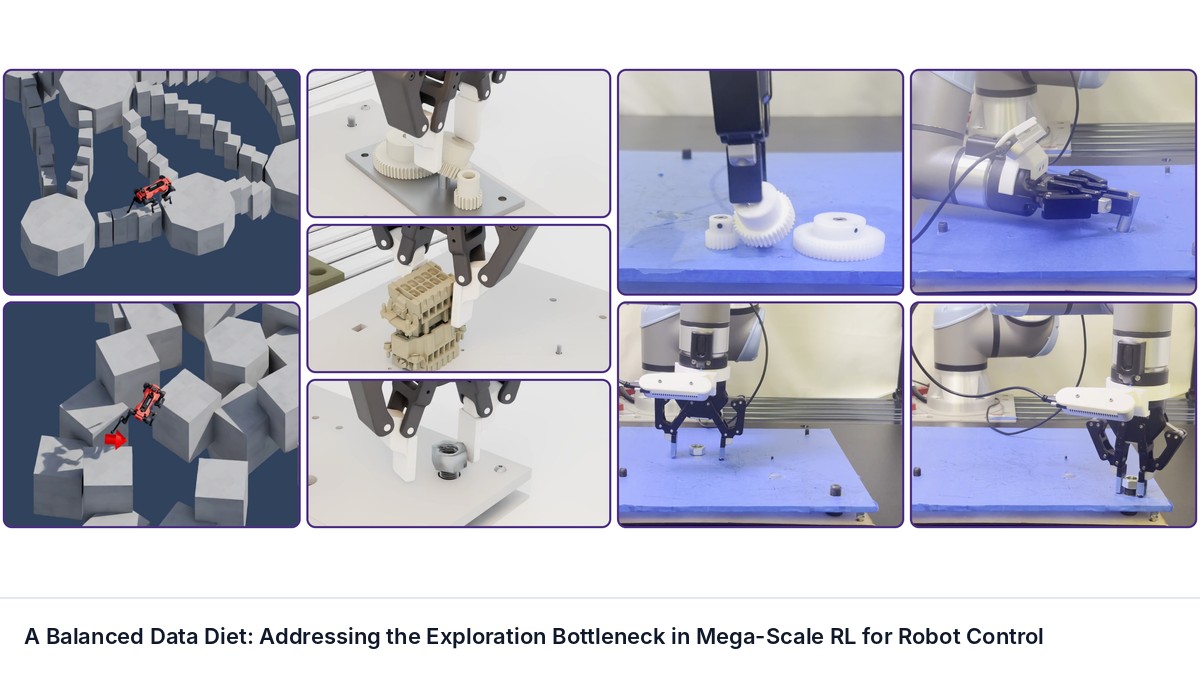
A Balanced Data Diet: Addressing the Exploration Bottleneck in Mega-Scale RL for Robot Control
Octi Zhang, Mateo Guaman Castro, Patrick Yin et al.
General-purpose robots must perform a wide range of tasks from agile locomotion to dexterous manipulation.
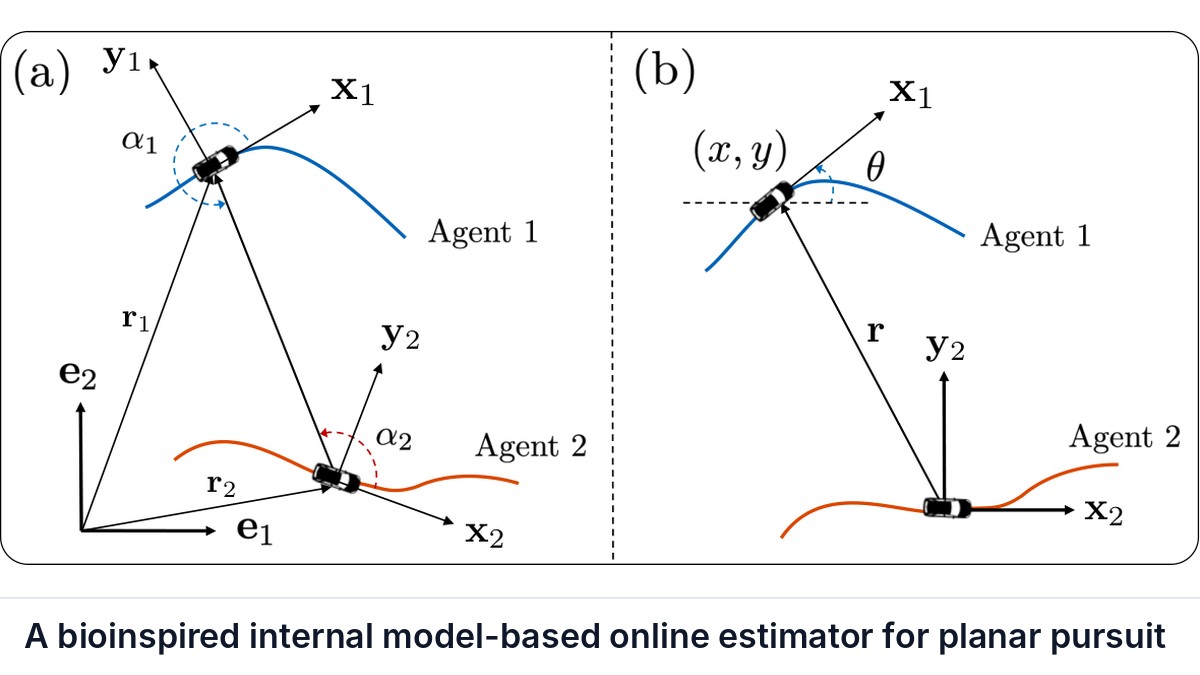
A bioinspired internal model-based online estimator for planar pursuit
Tengyue Liu, Xincheng Li, Sofia Morales Ferreira et al.
Bioinspired feedback controls for pursuit, tracking, and collective motion are often expressed in terms of the relative configuration between interacting agents.
A Biomimetic Gaze Control to Restore Head-Neck Movements
Colin Rubow, Haohan Zhang
Powered neck exoskeletons are developed to restore head-neck motions for those with neck muscle weakness. Current methods using hand-held input devices to control these robotic systems are unintuitive or non-viable for these populations.