
Full-Order Safety for Nonlinear Reduced-Order MPC
Luis Pabon, Johannes K\"{o}hler, Revant Kasichainula, Marco Pavone · N/A · 2026
Framework
N/A
License
N/A
Stars
N/A
Summary
Reduced-order models (ROMs) make model predictive control (MPC) of high-dimensional nonlinear systems tractable, but the resulting modeling error can lead to constraint violations on the real system.
Abstract Summary
Key Points
- Reduced-order models (ROMs) make model predictive control (MPC) of high-dimensional nonlinear systems tractable, but the resulting modeling error can lead to constraint violations on the real system.
- We introduce CoRE-MPC, a robust MPC formulation that plans with a nonlinear ROM and guarantees recursive feasibility and constraint satisfaction for the full-order system.
- It can be applied with a broad class of nonlinear model reduction techniques and the resulting MPC does not require evaluating the full-order model online, thus ensuring computational efficiency.
- The key insight is in how the ROM affects the dynamics of the prediction error
- We account for this with two error radii that are propagated alongside the ROM and provide a guaranteed bound on the prediction error.
Problem Formulation
Consider the full-order model (FOM) with state $x\in\mathbb{R}^{N}$, input $u\in\mathbb{R}^{m}$, $C^{1}$ dynamics $F$, and an unknown piecewise continuous disturbance $d$ with $\/d(t)\/\leq\bar{d}$. We impose the input and state constraints at all times, with a compact set $\mathcal{U}\subset\mathbb{R}^{m}$ and a $C^{1}$ constraint function $h=(h_{1},\ldots,h_{n_{h}})$.
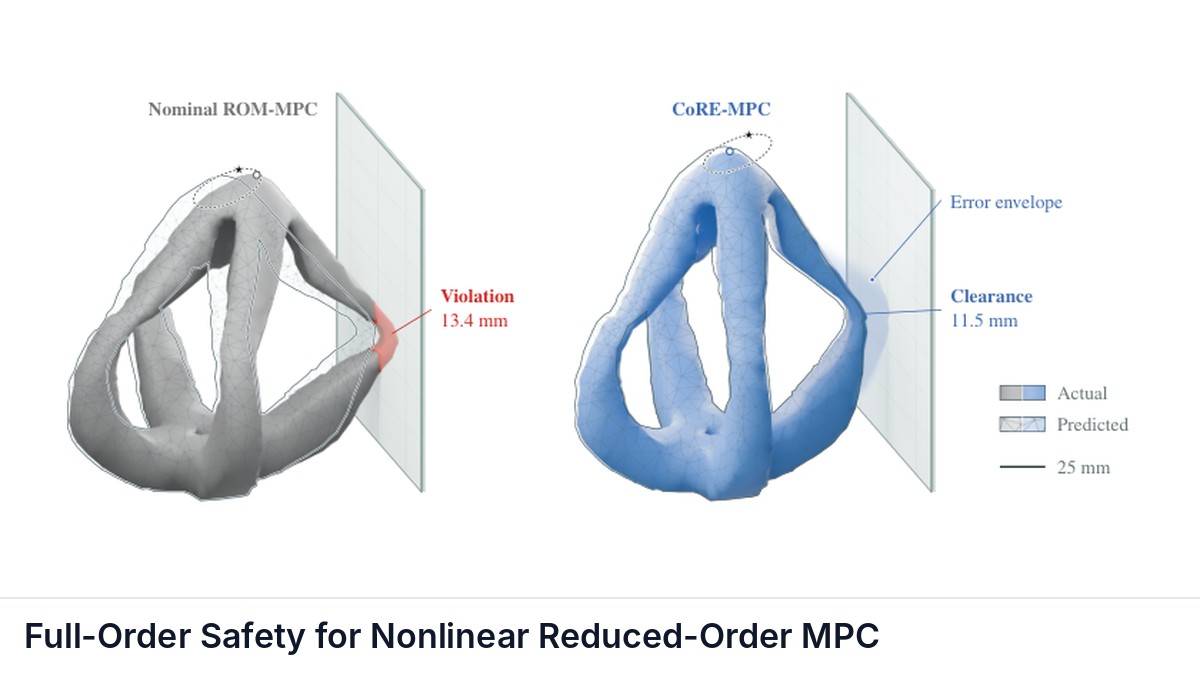
The input constraints encode, for instance, actuator limits, and the state constraints collision avoidance and workspace bounds over the entire body of a soft robot (Fig. 1 ).
Coupled Reduction-Error Certificates
Guaranteeing ( 2 ) for the FOM requires bounding the prediction error $x-\widehat{x}=x-\Phi(z)$ of the ROM. We do so with radii $\rho=(\rho_{\parallel},\rho_{\perp})$ for its two components ( 5 ). Section III-A derives the exact error dynamics, and Section III-B bounds their growth and coupling rates and constructs the bounds offline.
CoRE-MPC: Predictive Control with Coupled Error Certificates
We now use the radii of Theorem 1 to tighten the FOM constraints inside a reduced-order MPC and establish its closed-loop guarantees (Theorem 5 ). Constraint tightening: By ( 6 ), $x=\Phi(z+e_{\parallel})+e_{\perp}$ with $(e_{\parallel},e_{\perp})\in\mathcal{E}_{\rho}$ whenever the errors lie within the radii $\rho$.
Experiments
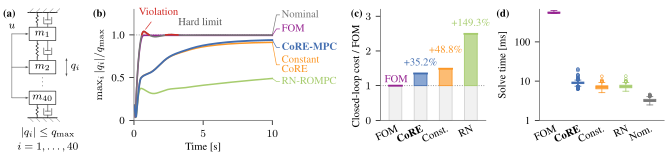
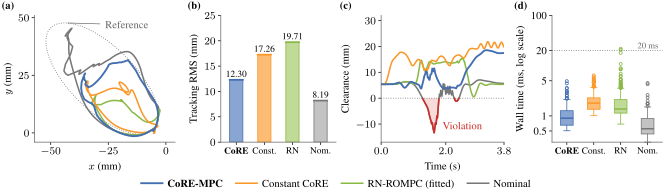
We evaluate CoRE-MPC on three systems of increasing dimension: the oscillator chain (Section V-A ) quantifies the trade-off between full-order safety, closed-loop cost, and computation on a reduction where the invariant-manifold assumption of RN-ROMPC [ 15 ] holds (Remark 3 ).
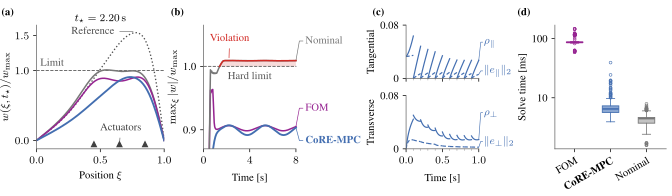
the Burgers equation (Section V-B ) tests the certificate on a POD reduction whose manifold is not invariant, with closed-form bounds that hold for every state and radius.
Sources and Demonstrations
Figures are reproduced from Pabon et al. See the full paper for experimental details and the project page, when the paper links one, for demonstrations and videos.
Related Papers

3D Euler-Angle Orientation Control for Two-Ray Fading Mitigation in Maritime Air-to-Sea Communications
Mohammed Bajja, Abdoul Karim A. H. Saliah, Hajar El Hammouti et al.
Maritime Air-to-Sea links are dominated by a line-of-sight ray and a sea-surface reflected ray whose destructive combination produces deep fades. Existing mitigation strategies optimize Unmanned Aerial Vehicle position or trajectory but leave attitude unexploited.
A Balanced Data Diet: Addressing the Exploration Bottleneck in Mega-Scale RL for Robot Control
Octi Zhang, Mateo Guaman Castro, Patrick Yin et al.
General-purpose robots must perform a wide range of tasks from agile locomotion to dexterous manipulation.
A bioinspired internal model-based online estimator for planar pursuit
Tengyue Liu, Xincheng Li, Sofia Morales Ferreira et al.
Bioinspired feedback controls for pursuit, tracking, and collective motion are often expressed in terms of the relative configuration between interacting agents.
A Biomimetic Gaze Control to Restore Head-Neck Movements
Colin Rubow, Haohan Zhang
Powered neck exoskeletons are developed to restore head-neck motions for those with neck muscle weakness. Current methods using hand-held input devices to control these robotic systems are unintuitive or non-viable for these populations.