
Reduced Cartesian Kinetostatics for Tendon-Driven Continuum Robots: Residual-Stabilized Full-Shape Propagation
Ke Wu, Fangju Yang, Xiaohui Zhang, Zhengqiang Zhang, Jingang Yi, Jian S. Dai · N/A · 2026
Framework
N/A
License
N/A
Stars
N/A
Summary
Many planning and control tasks for tendon-driven continuum robots (TDCRs) require the complete Cartesian backbone geometry.
Abstract Summary
Key Points
- Many planning and control tasks for tendon-driven continuum robots (TDCRs) require the complete Cartesian backbone geometry.
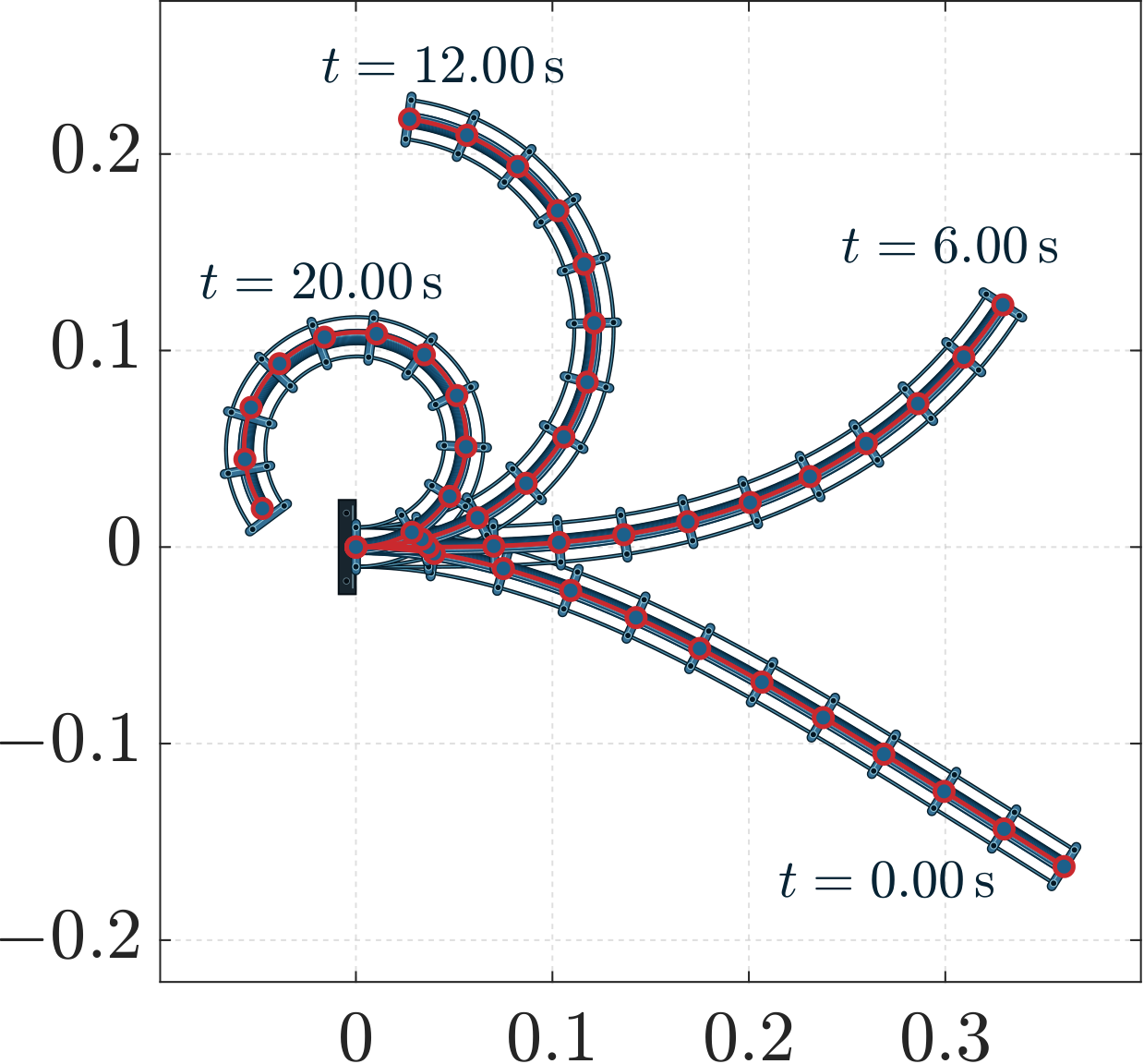
- We present a reduced Cartesian framework for planar, axially compressible TDCRs that propagates equilibrium configurations along prescribed tendon-force and tendon-displacement trajectories.
- The backbone is represented by two global position fields
- Following exact variation, a Taylor-Galerkin reduction condenses prescribed spatial properties and distributed loads into offline moment vectors, yielding analytic reduced residuals and Jacobians without online spatial quadrature or numerical differentiation.
- Analytical differentiation and residual correction yield first-order rate systems requiring one fixed-dimensional linear solve per rate evaluation after initial equilibrium alignment on a regular branch.
Problem Statement
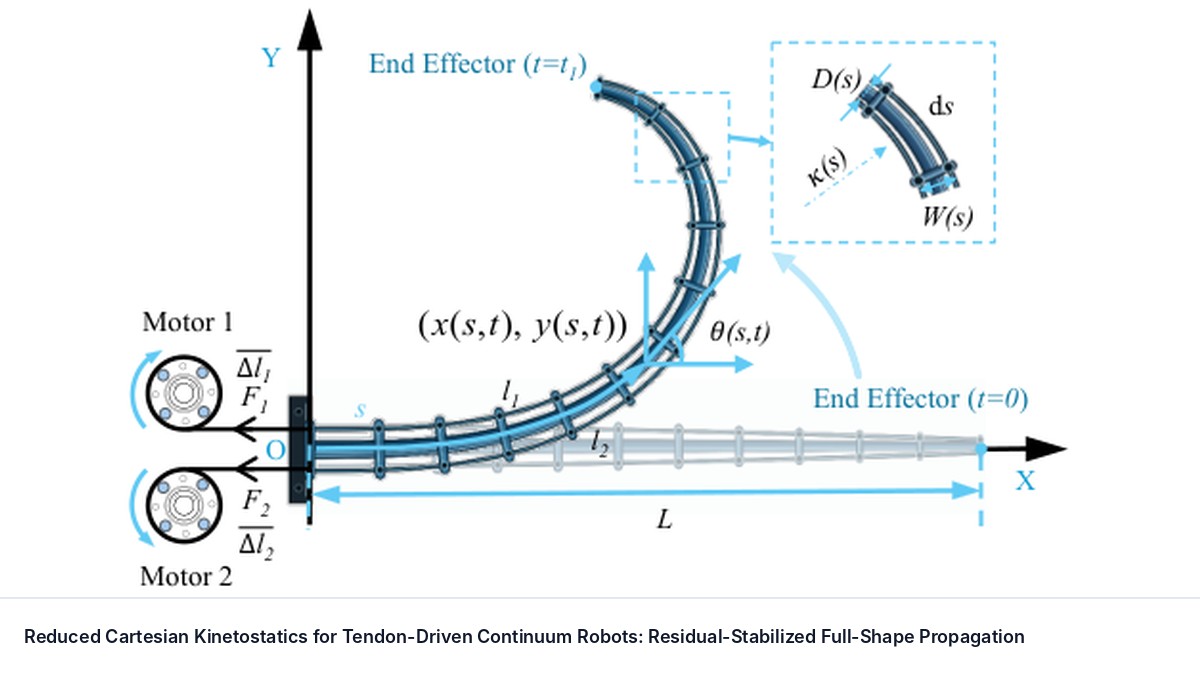
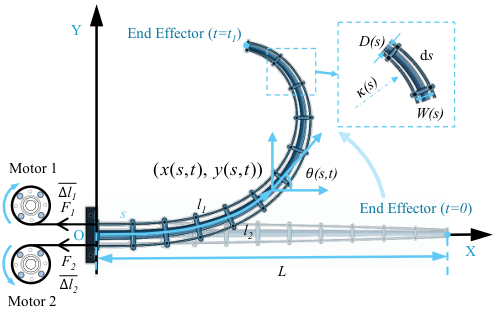
As shown in Fig. 1 , we consider a planar, axially compressible tendon-driven continuum robot with a straight and stress-free reference configuration. Let $s\in[0,L]$ denote the reference arc-length coordinate of the backbone. Two tendons are routed longitudinally on opposite sides of the backbone.
With tendon friction neglected, the prescribed actuation inputs are either the spatially uniform tendon tensions $F_{1}(t),F_{2}(t)\geq 0$ or the tendon displacements $\overline{\Delta l}_{1}(t),\overline{\Delta l}_{2}(t)$.
Methodology
Let $\mathcal{F}=\{O;\hat{\mathbf{x}},\hat{\mathbf{y}}\}$ denote a fixed global Cartesian frame. The origin $O$ is placed at the robot base, $\hat{\mathbf{x}}$ is aligned with the stress-free backbone, and $\hat{\mathbf{y}}$ defines the transverse direction. The backbone centerline expressed in $\mathcal{F}$ is $[x(s),y(s)]^{\mathbf{T}}$.
The clamped-base conditions are A subscript $s$ denotes differentiation with respect to $s$. Admissible configurations satisfy $x_{s}^{2}+y_{s}^{2}>0$ over $s\in[0,L]$, with $x_{s}(0)>0$.
Numerical Simulation and Model Validation
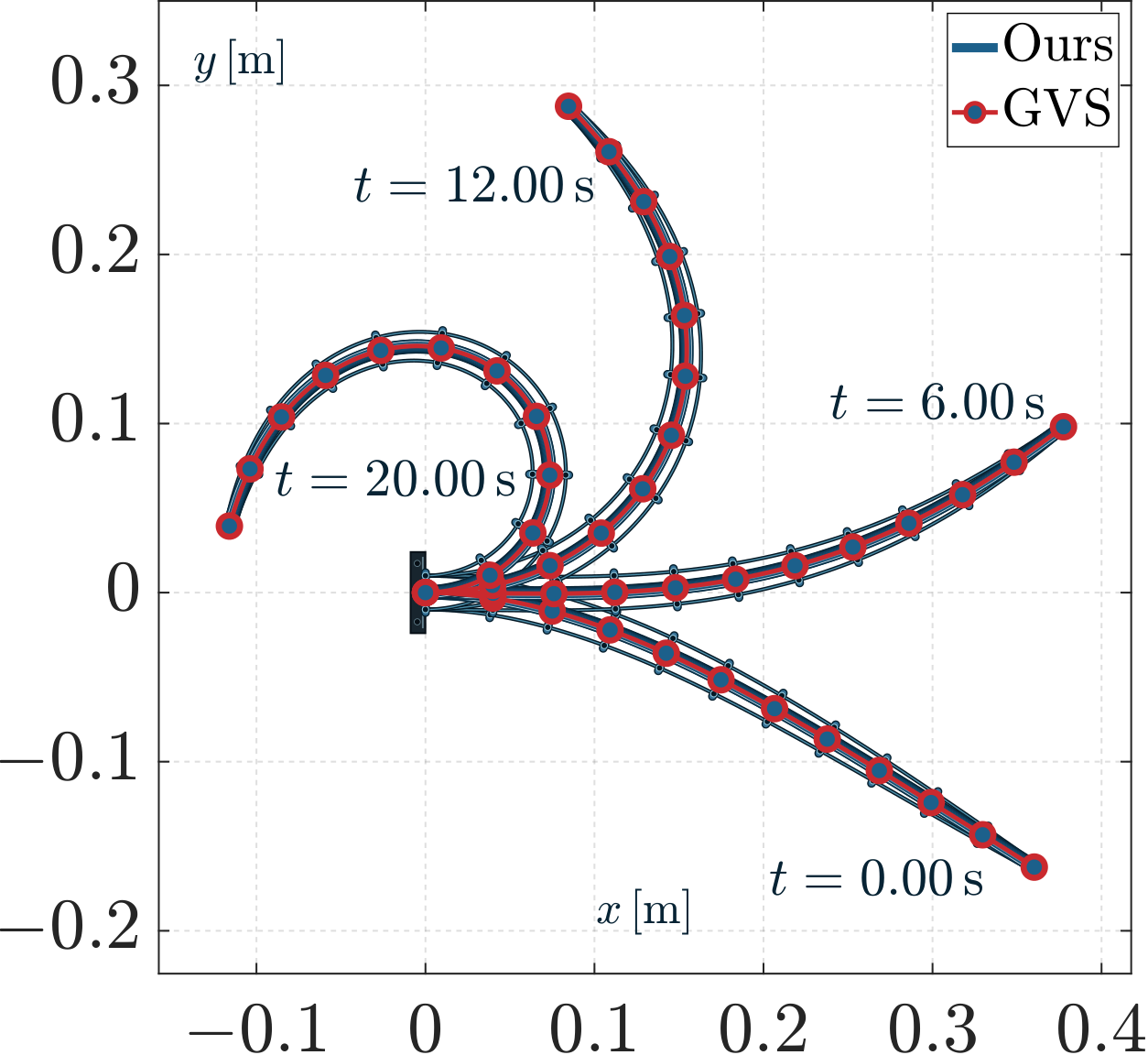
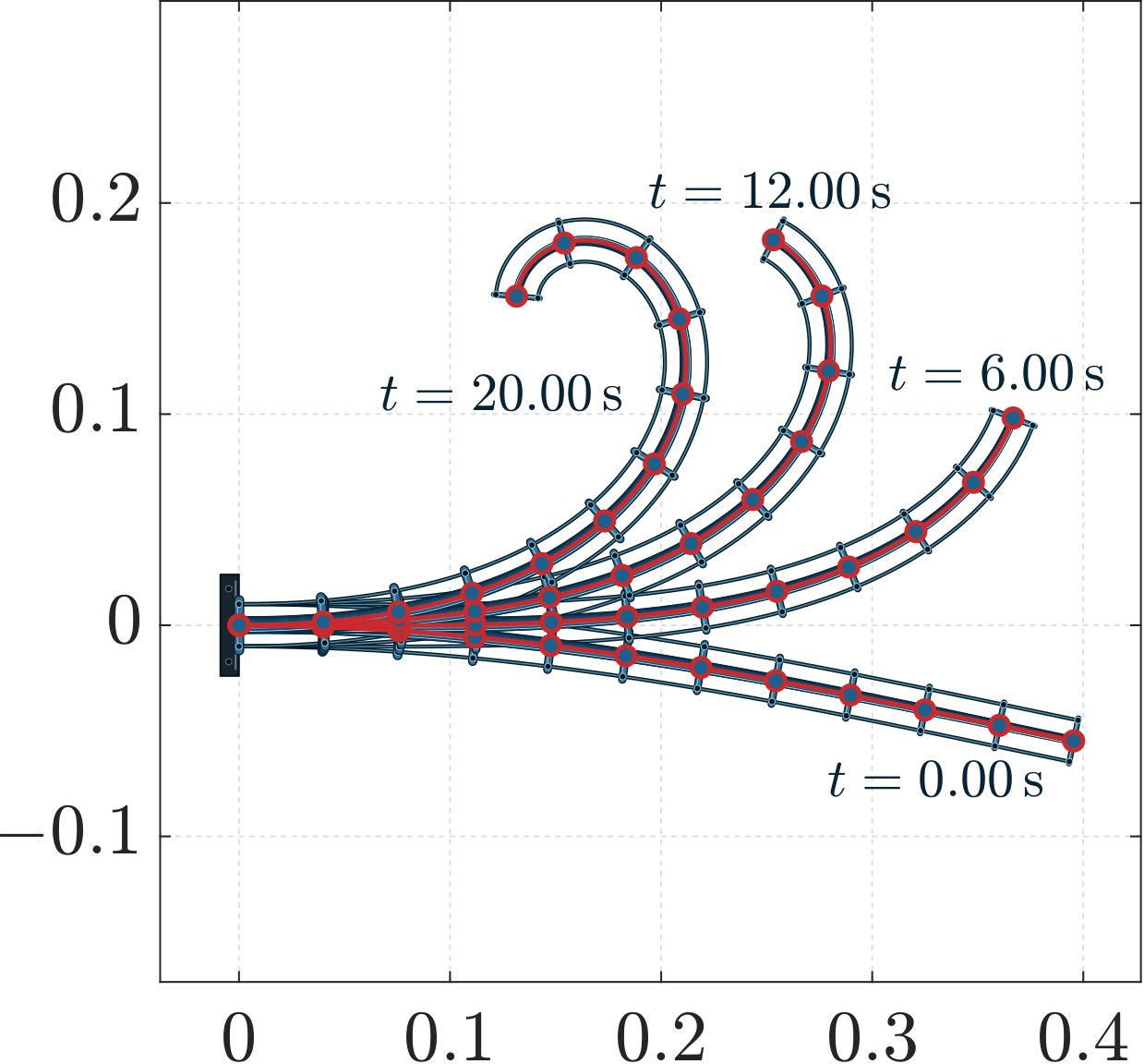
The numerical study evaluates the Cartesian equilibrium-shape accuracy, distributed strain accuracy along the propagation path, residual control, and online computational performance of the proposed formulation against pointwise geometric variable-strain method (GVS) equilibrium solves [ 21 ] . Table I lists the four cases, numerical settings, and tendon-force profiles over $0\leq t\leq T$.
Both models use identical physical parameters, gravitational loading $q_{y}(s)=-\rho gA(s)$, force samples, and initial equilibria.
Experimental Validation
The experiment validates displacement-driven prediction of the backbone shape and end-effector motion along a linear tendon-displacement path, considering the complete backbone-shape trajectory, its distributed Cartesian error, and the corresponding end-effector trajectory. The platform in Fig. 3 uses two antagonistic motor-driven tendons and an RGB-D camera tracking seven backbone markers.
Table III lists the robot parameters and linear input profile.
Sources and Demonstrations
Figures are reproduced from Wu et al. See the full paper for experimental details and the project page, when the paper links one, for demonstrations and videos.
Related Papers
A Browser-Native Digital Test Range for Benchmarking 4D Ocean-Glider Planning Algorithms
Edward Holmberg, Elias Ioup, Mahdi Abdelguerfi
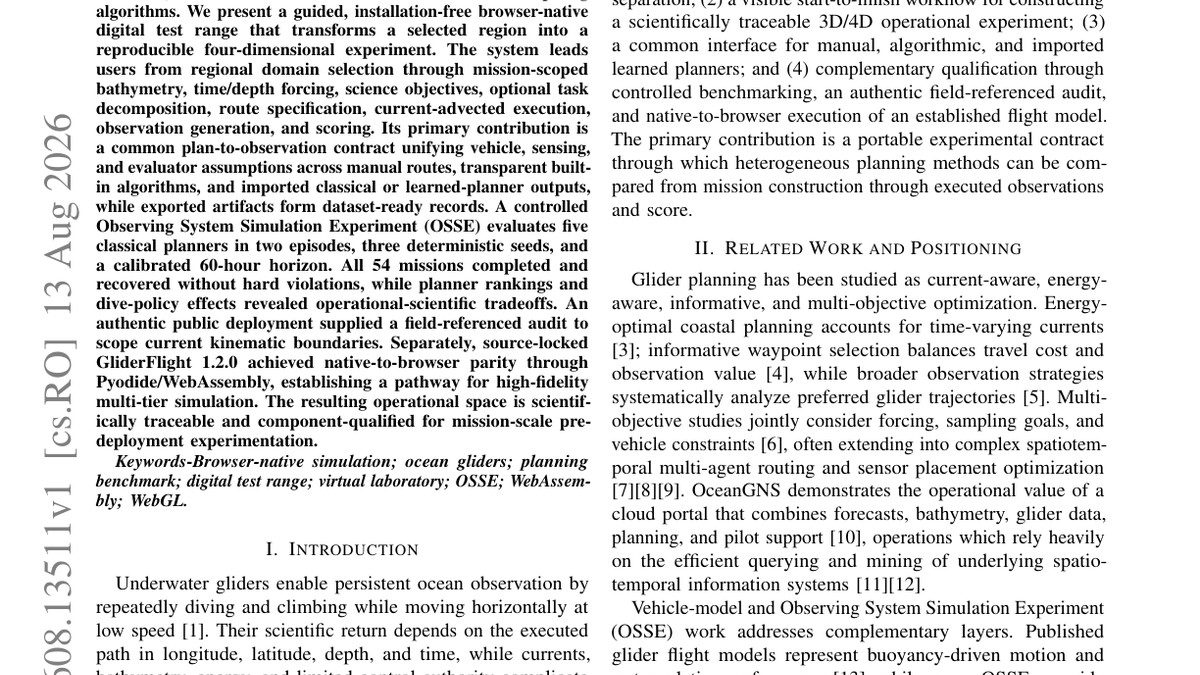
Repeated in-situ evaluation of ocean-glider planners requires scarce vehicles, operators, deployment and recovery resources, and ocean conditions that cannot be reset for competing algorithms.
Aim Short to Reach Far: Your Frozen World Model Can Plan Better Than You Think
Xvyuan Liu, Jianjie Fang, Chen Gao et al.
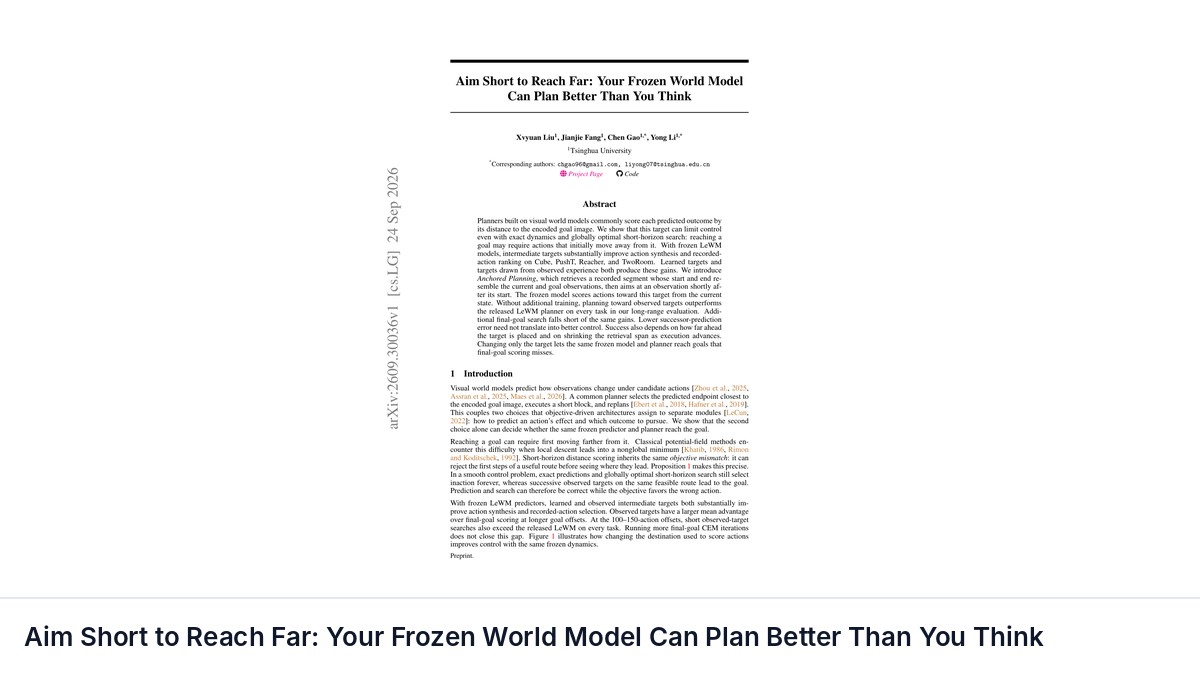
Planners built on visual world models commonly score each predicted outcome by its distance to the encoded goal image. We show that this target can limit control even with exact dynamics and globally optimal short-horizon search: reaching a goal may require actions that initially move away from it.
Compact Latent Coordination for Autonomous Vehicles at Unsignalized Intersections
Gil Lifshits, Igal Bilik, Gilad Katz
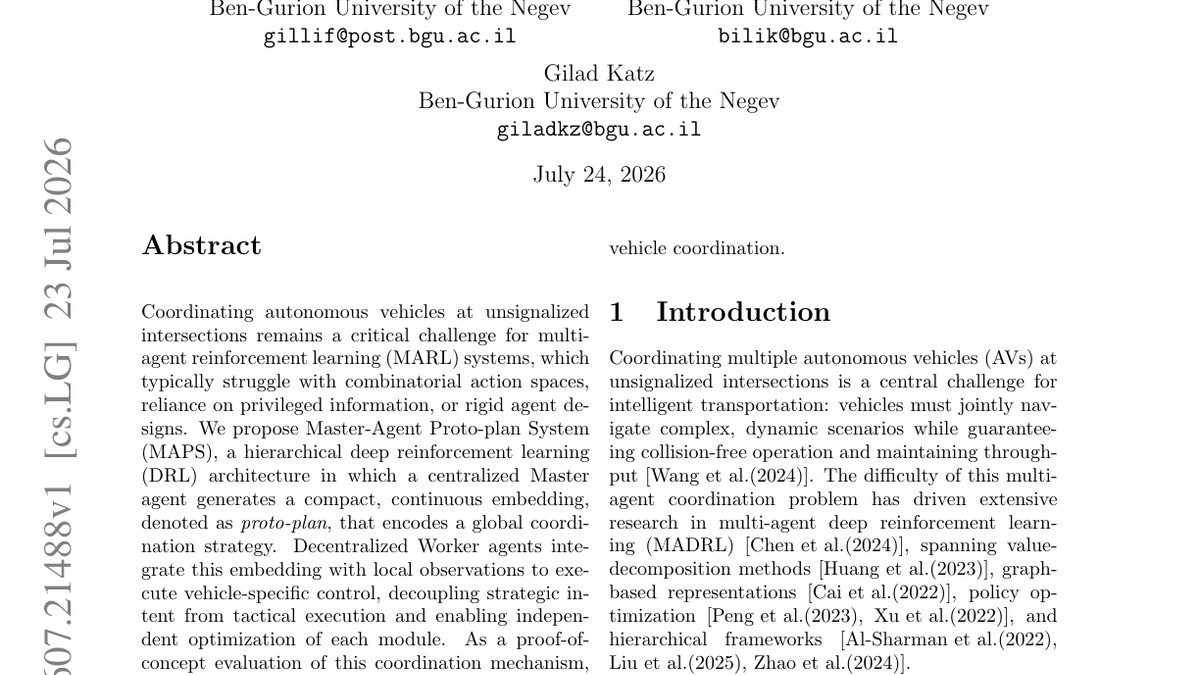
Coordinating autonomous vehicles at unsignalized intersections remains a critical challenge for multi-agent reinforcement learning (MARL) systems, which typically struggle with combinatorial action spaces, reliance on privileged information, or rigid agent designs.
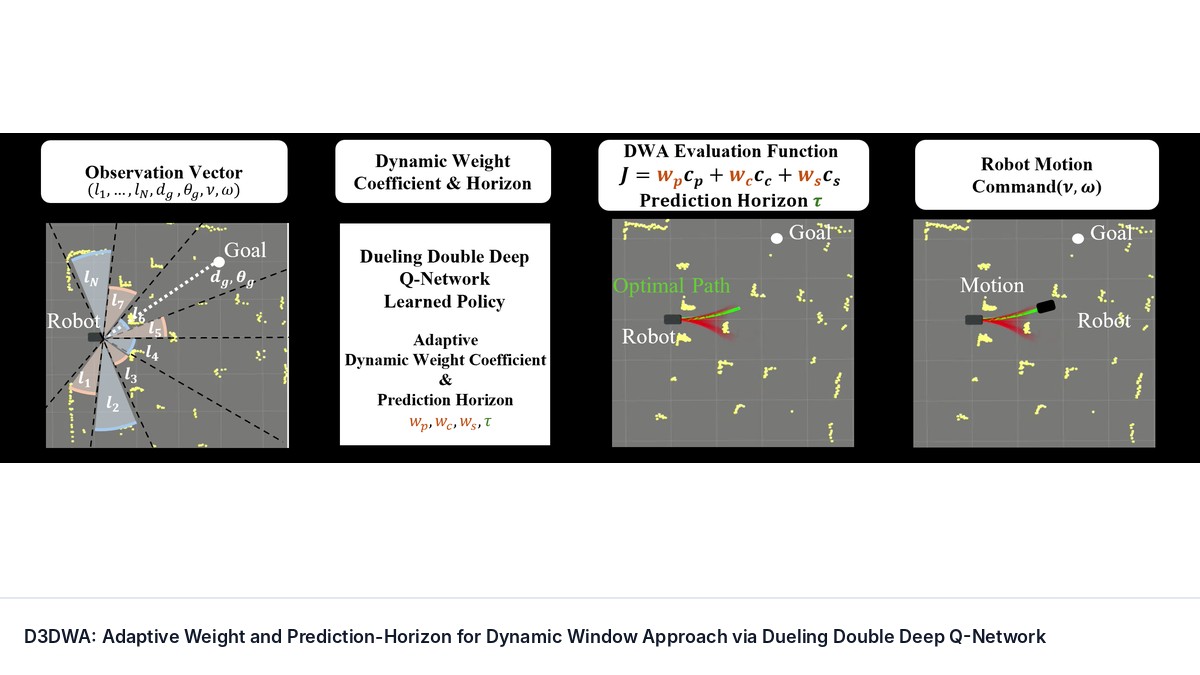
D3DWA: Adaptive Weight and Prediction-Horizon for Dynamic Window Approach via Dueling Double Deep Q-Network
Zahra Jooyandeh, Masato Kobayashi, Yuki Uranishi
The Dynamic Window Approach (DWA) is widely used for local navigation, but its performance depends strongly on parameters that are typically fixed before navigation.