
RTISSLAM-3D: Full 6-DoF SLAM With an In-Air 3D Imaging Sonar
Jan Steckel, Vincent Katter, Wouter Jansen · N/A · 2026
Framework
N/A
License
N/A
Stars
N/A
Summary
Echolocating bats navigate dense forests using sonar alone, and in-air 3D imaging sonars now capture the entire frontal hemisphere with every pulse.
Abstract Summary
Key Points
- Echolocating bats navigate dense forests using sonar alone, and in-air 3D imaging sonars now capture the entire frontal hemisphere with every pulse.
- Sonar SLAM, however, has so far been planar: current systems estimate a 2D trajectory and discard the elevation information in the sonar images, an assumption that does not hold on rough and sloped terrain such as a forest floor.
- In this paper, we introduce RTISSLAM-3D, a novel 6-DoF SLAM system for a wheeled robot that carries an in-air 3D imaging sonar, an IMU and wheel encoders.
- A CFAR detector on the sphere reduces every sonar image to a sparse set of 3D detections, which we use for a 3D acoustic odometry that models the shape of the sonar beam, for place recognition with polar submap descriptors, and for the verification of loop closures by 3D registration, all combined in a 6-DoF pose graph with attitude factors.
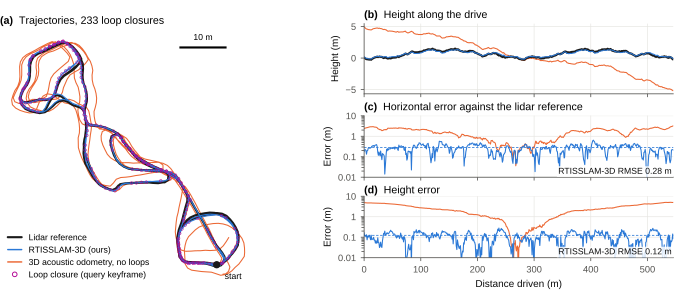
- We evaluated RTISSLAM-3D on a 545m drive through a forest, with a 3D lidar SLAM as reference
Overview of RTISSLAM-3D
Figure 1 shows the processing flow of RTISSLAM-3D. For every pulse, the eRTIS records the echoes with its $N=32$ microphones, which are beamformed with fifth-order DMAS with coherence factor (CF) into an energy volume $P(r,\psi)$ over $M=2293$ directions $\psi$ that sample the frontal hemisphere uniformly (section III-A ).
Method
In this section, we detail the components of RTISSLAM-3D in the order of figure 1 . We use the notation of RTISSLAM [ 13 ] , extended to 3D: the eRTIS has $N$ microphones at positions $p_{y}(i)$, $p_{z}(i)$ in its $YZ$-plane, and a direction $\psi$ has azimuth $\theta$ and elevation $\varphi$, with unit vector $\vec{u}(\psi)$ in the sensor frame ($x$ forward, $y$ left, $z$ up).
The planar array of the eRTIS cannot distinguish echoes arriving front from back, so the frontal hemisphere holds all the directional information of a pulse.
Experimental Setup
In this section, we describe the robot and the recording, the reference trajectory and map against which we evaluate RTISSLAM-3D, and the metrics we use.
The data were recorded with a Clearpath Husky A200 that carried an eRTIS 3D imaging sonar [ 5 , 6 ] at the front, about $0.32\text{\,}\mathrm{m}$ above the ground, together with an Ouster OS1 64 beam 3D lidar with a built-in 6-axis IMU ($100\text{\,}\mathrm{Hz}$), the wheel encoders ($11.5\text{\,}\mathrm{Hz}$), and a GoPro HERO13 camera (which we only use for illustration).
Results
In this section, we will first look at the 3D detections of single captures. Next, we evaluate the 3D acoustic odometry and the 3D place recognition on their own, after which we present the trajectory of the complete system together with an ablation of its components and a sensitivity analysis of its thresholds. We conclude with the 3D map and the computation times.
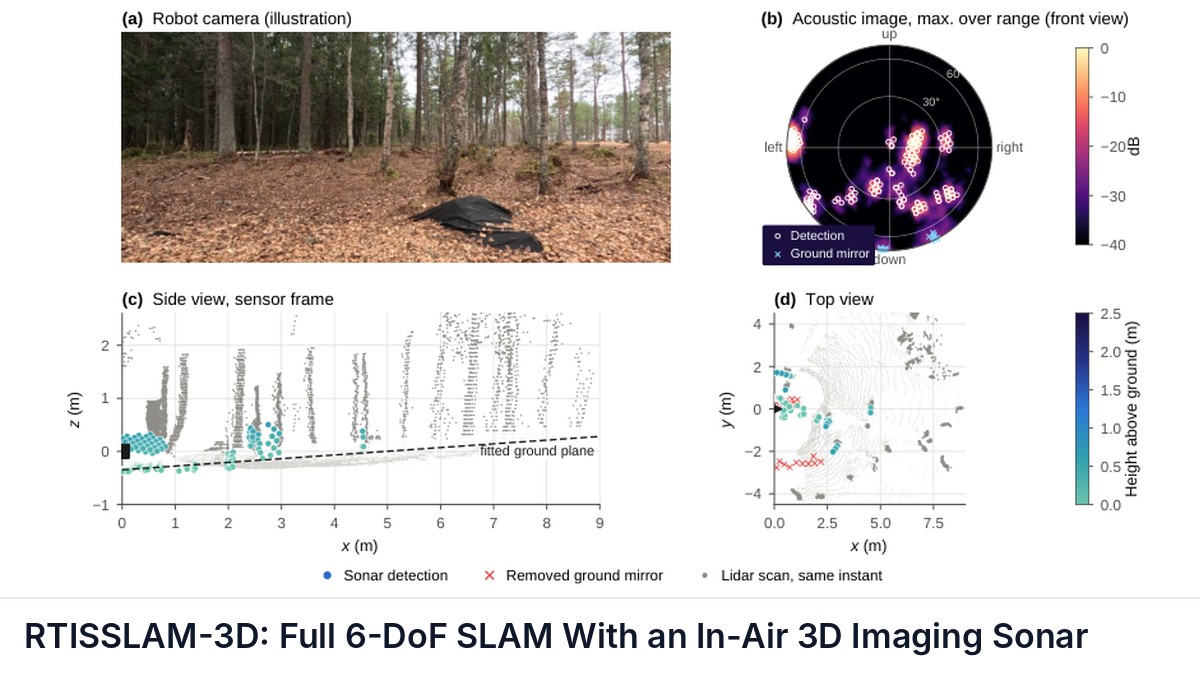
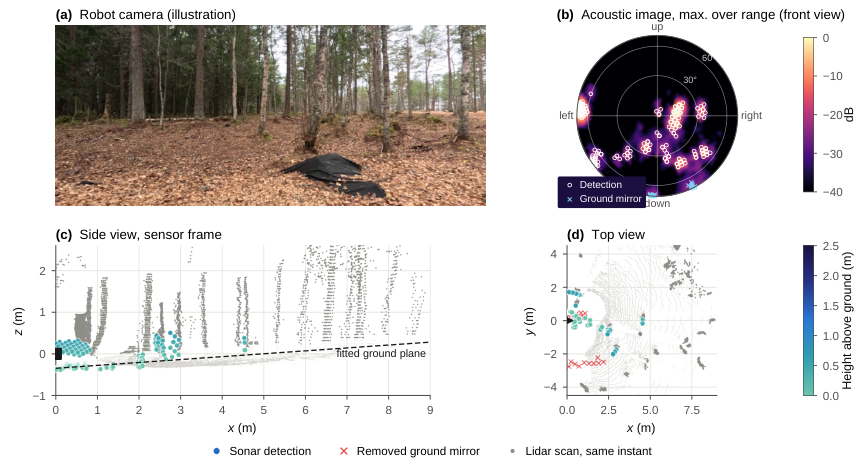
Figure 2 shows a typical capture, taken on a forest path with trunks at 2 to $5\text{\,}\mathrm{m}$, next to the lidar scan of the same moment.
Sources and Demonstrations
Figures are reproduced from Steckel et al. See the full paper for experimental details and the project page, when the paper links one, for demonstrations and videos.
Related Papers
A Low-Cost, Open Platform for End-to-End Autonomous Driving on a Miniature Ackermann Vehicle
Gustavo Claudio Karl Couto, Eric Aislan Antonelo, Gabriel George Zipperer
This paper presents a low-cost, open experimental platform for research in end-to-end autonomous driving with miniature Ackermann vehicles.
AcousticDiffusion: Semantically Conditioned Audio-Guided Diffusion Policy for Search-and-Rescue Assistance
Iana Zhura, Didar Seyidov, Dmitrii Plotnikov et al.
Navigating toward human callers is an important capability for rescue robots operating where visual contact is degraded or occluded. We present AcousticDiffusion, a semantically conditioned, audio-guided diffusion policy for human-directed navigation.
Adaptation Needs in Robotic Systems: Assessing Behavior Trees and Their Enhancement
Mehran Rostamnia, Gianluca Filippone, Ricardo Caldas et al.
Robotic systems increasingly operate in dynamic, uncertain, and open-ended environments, where design-time assumptions may no longer hold, and adaptation becomes necessary to maintain effective and safe operation.
AeRove: A Compact Bimodal Aerial-Terrestrial Drone with Rapid Bistable Reconfiguration for Close-Range Pipeline Inspection
Caleb Polillio, Petras Swissler
Close-proximity pipeline inspection is challenging for standard drones due to high hovering power consumption, airflow sensitivity, and propeller wash interference with gas sensing. To address this, we present AeRove, a compact bimodal aerial-terrestrial robot.