VoxPoser: Composable 3D Value Maps for Robotic Manipulation with Language Models

VoxPoser: Composable 3D Value Maps for Robotic Manipulation with Language Models

Featured

Wenlong Huang, Chen Wang, Ruohan Zhang, Yunzhu Li, Jiajun Wu, Li Fei-Fei · Stanford University · 2023

Framework

PyTorch

License

MIT

Stars

803

Summary

VoxPoser uses LLMs to compose 3D value maps from free-form language instructions, enabling zero-shot closed-loop manipulation planning with model-based trajectory synthesis over dynamic environments.

Abstract Summary

VoxPoser tackles the long-standing bottleneck in LLM-driven robotics: while language models can reason and plan, most existing systems still rely on hard-coded motion primitives to execute physical actions. The authors propose a framework where an LLM grounds free-form language instructions directly into the robot’s observation space by composing *3D value maps*. These maps encode spatial constraints and affordances inferred from the language prompt, effectively acting as a cost landscape that guides trajectory optimization without any pre-programmed skills. The key insight is to leverage the LLM’s code-writing capability to call a vision-language model (VLM), generating programs that produce composable 3D value functions. For example, given the instruction "place the apple inside the bowl on the left," the LLM generates code that queries object segmentation, computes spatial relationships, and assembles an attraction field toward the target region and a repulsion field around obstacles. The resulting dense value map is then passed to an LQR-style model-based planner that synthesizes a closed-loop sequence of 6-DoF end-effector waypoints. Because the maps are recomputed online, the policy is robust to dynamic perturbations such as objects moving mid-trajectory. Beyond zero-shot synthesis, VoxPoser also demonstrates efficient online adaptation for contact-rich interactions. In scenes where precise force profiles matter—such as opening a drawer or inserting a peg—the authors learn a local dynamics model from online rollouts, which refines the value map and improves success rates with only a handful of real-world interactions. This hybrid approach marries the high-level semantic reasoning of LLMs with low-level physics modeling, yielding a system that handles both coarse reaching and fine-grained contact without switching controllers. Evaluation spans both simulated environments and real robotic hardware. The system performs over 30 everyday manipulation tasks specified in free-form language, often succeeding from entirely unseen initial configurations. Importantly, VoxPoser operates zero-shot: no task-specific pre-training or demonstration data is required. The authors release code, pretrained perception modules, and a simulated benchmark, providing a valuable resource for researchers exploring the intersection of foundation models and embodied control.

Key Points

  • LLM composes 3D value maps from open-vocabulary language instructions via VLM-generated code.
  • Model-based LQR planner synthesizes closed-loop 6-DoF trajectories from value maps in real time.
  • Zero-shot manipulation across a large variety of tasks without task-specific demonstrations.
  • Online dynamics learning improves contact-rich performance with minimal real-world rollouts.
  • Demonstrated on real robot hardware with robustness to dynamic perturbations.

Method

We first provide the formulation of VoxPoser as an optimization problem (Sec. 3.1 ). Then we describe how VoxPoser can be used as a general zero-shot framework to map language instructions to 3D value maps (Sec. 3.2 ). We subsequently demonstrate how trajectories can be synthesized in closed-loop for robotic manipulation (Sec. 3.3 ).

While zero-shot in nature, we demonstrate how VoxPoser can learn from online interactions to efficiently solve contact-rich tasks (Sec. 3.4 ).
Method — VoxPoser: Composable 3D Value Maps for Robotic Manipulation with Language Models
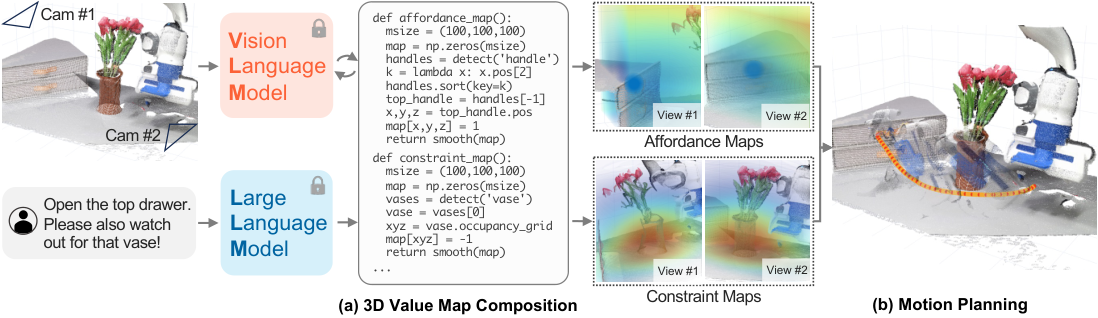
Figure 2: Overview of VoxPoser . Given the RGB-D observation of the environment and a language instruction, LLMs generate code, which interacts with VLMs, to produce a sequence of 3D affordance maps and constraint maps (collectively referred to as value maps) grounded in the observation space of the robot (a) . The composed value maps then serve as objective functions for motion planners to synthesize trajectories for robot manipulation (b) . The entire process does not involve any additional training.

Experiments and Analysis

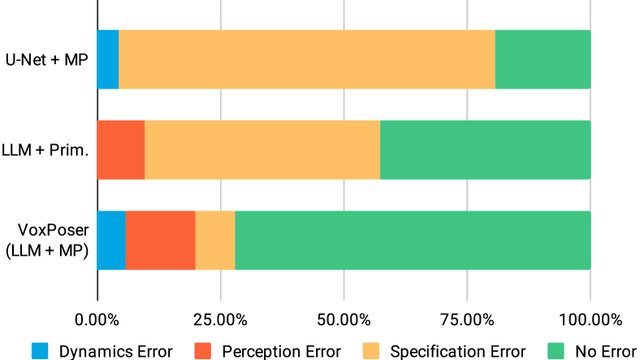
We first discuss our implementation details. Then we validate VoxPoser for real-world everyday manipulation (Sec. 4.1 ). We also study its generalization in simulation (Sec. 4.2 ). We further demonstrate how VoxPoser enables efficient learning of more challenging tasks (Sec. 4.3 ). Finally, we analyze its source of errors and discuss how improvement can be made (Sec. 4.4 ). LLMs and Prompting.
Experiments and Analysis — VoxPoser: Composable 3D Value Maps for Robotic Manipulation with Language Models
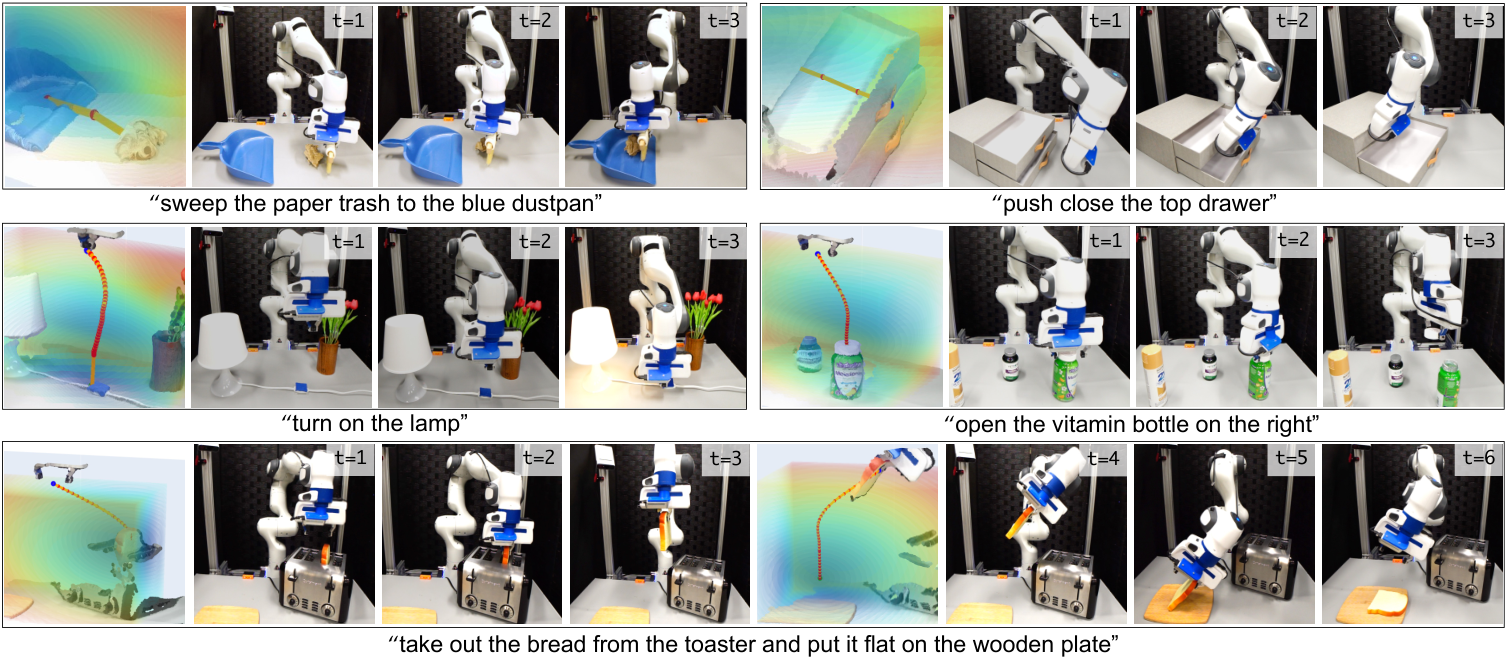
Figure 3: Visualization of composed 3D value maps and rollouts in real-world environments. The top row demonstrates where “entity of interest” is an object or part, and the value maps guide them toward target positions. The bottom two rows showcase tasks where “entity of interest” is the robot end-effector. The bottom-most task involves two phases, which are also orchestrated by LLMs.

Sources and Demonstrations

Figures are reproduced from Huang et al. See the full paper for experimental details and the project page, when the paper links one, for demonstrations and videos.

Share

Related Papers

AD-WM: Action-Discriminative World Models for Counterfactual Model Predictive Control
arXiv preprint

AD-WM: Action-Discriminative World Models for Counterfactual Model Predictive Control

Jiabin Qiu, Zixuan Chen, Hongye Cao et al.

Latent world models are typically trained to predict factual transitions, whereas model predictive control (MPC) must compare alternative actions from the same state. A model can therefore achieve low factual prediction error yet poorly distinguish candidate actions.
manipulation reinforcement-learning planning control
Code PDF Intermediate
GitHub ★ —
AHEAD: Anticipatory Hand-Driven Teleoperation via Human Intent Prediction
arXiv preprint

AHEAD: Anticipatory Hand-Driven Teleoperation via Human Intent Prediction

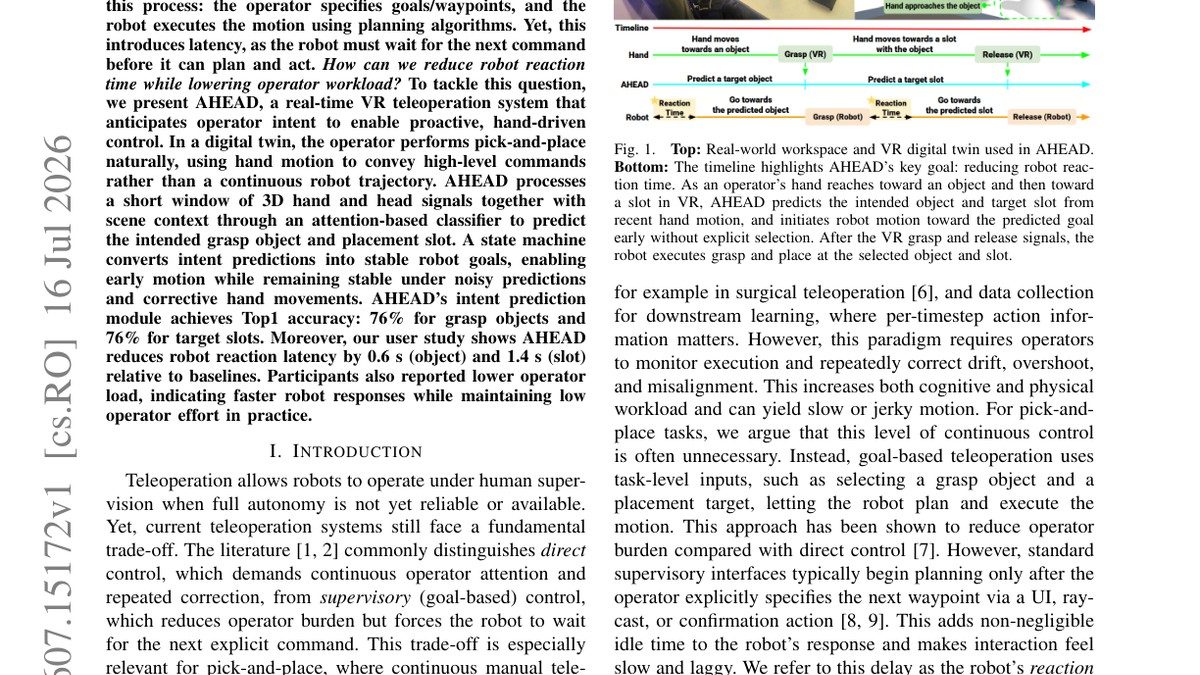
Seok Joon Kim, Junho Lee, Federica Spinola et al.

Direct hand-driven teleoperation maps an operator's hand motion to robot end-effector commands at every frame, enabling precise control, but it requires constant monitoring and correction during approach, grasp, and placement, which can be slow and fatiguing.
manipulation reinforcement-learning planning control learning-from-demonstration
PDF Intermediate
Autonomous Droplet Navigation via Model-Based Reinforcement Learning: Zero-Shot Transfer and Emergent Dynamics
arXiv preprint

Autonomous Droplet Navigation via Model-Based Reinforcement Learning: Zero-Shot Transfer and Emergent Dynamics

Rajneesh Anand, Mayuresh V. Kothare

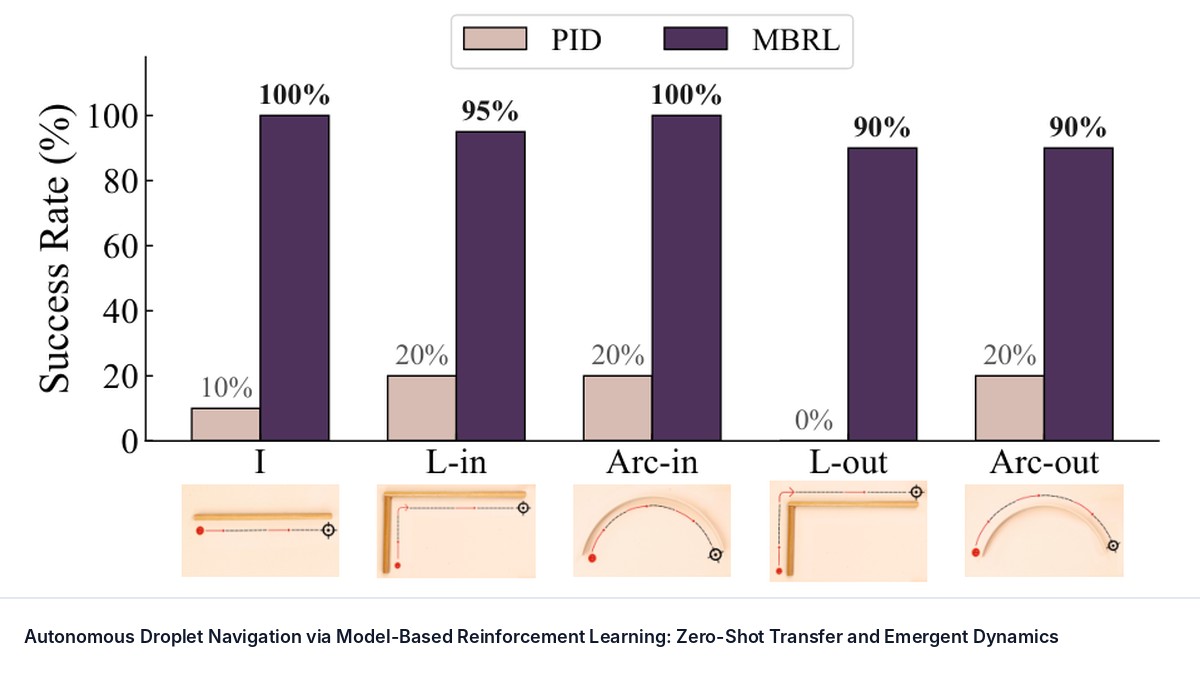
Self-driving laboratories (SDLs) are transforming chemical and materials discovery through closed-loop automation, yet automated infrastructure for physical manipulation of soft, deformable matter remains beyond current robotic platforms.

manipulation vision reinforcement-learning planning control
Code PDF Intermediate
GitHub ★ —