
WT-UMI: Tactile-based Whole-Body Manipulation via Force-Supervised Contact-Aware Planning
Jaehwi Jang, Zhaoyuan Gu, Alfred Cueva, Zimeng Chai, Junjie Sheng, Thong Nguyen, Himank Galundia, Yifan Wu, Huishu Xue, Isaac Legene, Ojas Mediratta, Davin Doan, Andrew Collins, Sarah Sadegh, KyoungMok Kim, Rishita Dhalbisoi, Zun Chen, Ye Zhao · N/A · 2026
Framework
N/A
License
N/A
Stars
N/A
Summary
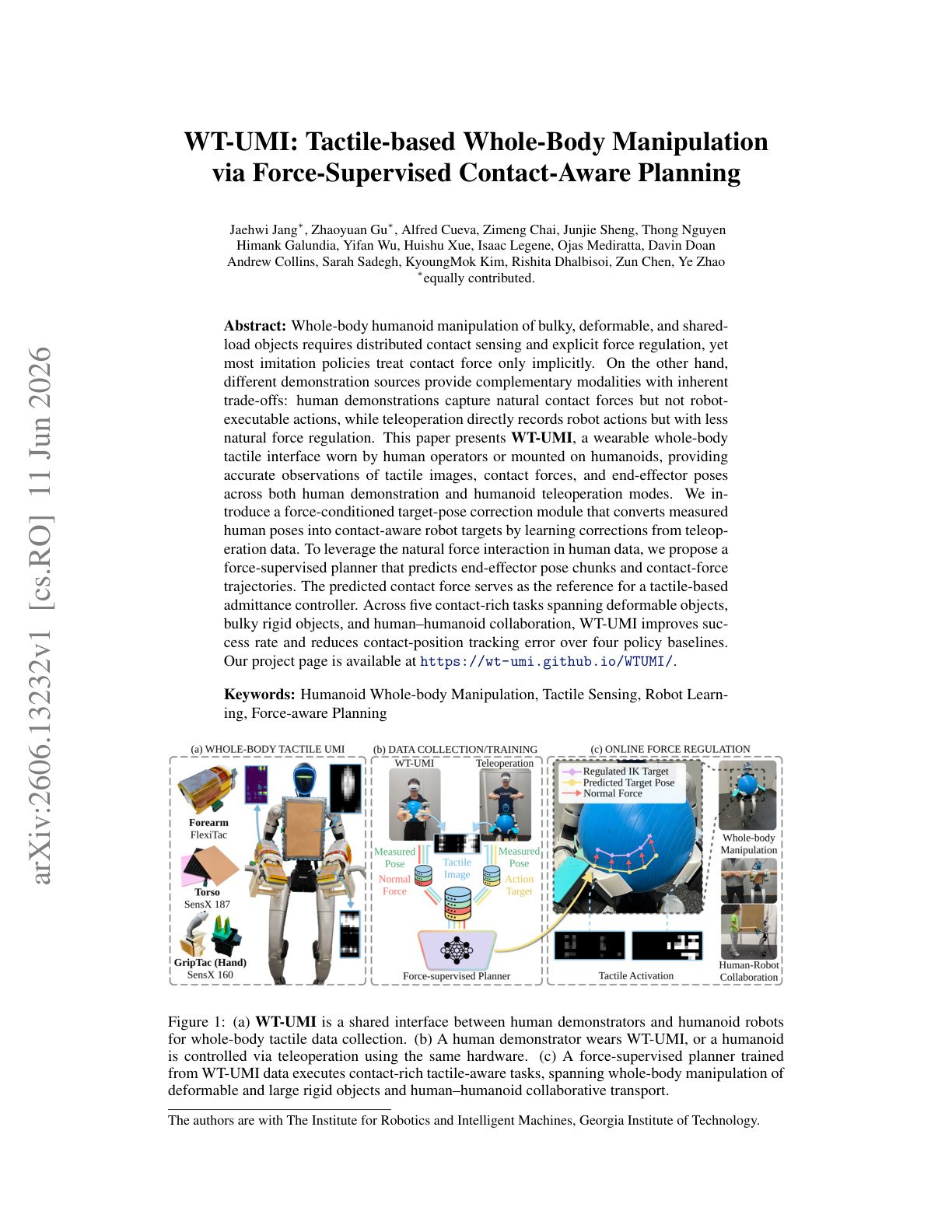
Whole-body humanoid manipulation of bulky, deformable, and shared-load objects requires distributed contact sensing and explicit force regulation, yet most imitation policies treat contact force only implicitly. On the other hand, different demonstration sources provide complementary modalities with...
Abstract Summary
Key Points
- Introduces WT-UMI, a wearable whole-body tactile interface for humanoid manipulation.
- Proposes a force-conditioned target-pose correction module to convert human poses into contact-aware robot targets.
- Achieves superior performance on contact-rich tasks including deformable objects and human-humanoid collaboration.
- Demonstrates the importance of explicit force regulation in whole-body manipulation policies.
Related Papers
SI-Diff: A Framework for Learning Search and High-Precision Insertion with a Force-Domain Diffusion Policy
Yibo Liu, Stanko Oparnica, Simon Shewchun-Jakaitis et al. · arXiv · May 2026
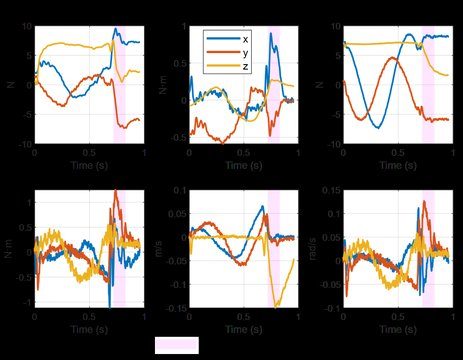
Contact-rich manipulation is fundamental in robotics but poses significant challenges due to uncertainties in relative poses, such as misalignments and small clearances in peg-in-hole tasks. Existing approaches typically address search and...
Accelerating and Scaling MPC-Guided Reinforcement Learning for Humanoid Locomotion and Manipulation
Junheng Li, Liang Wu, Sergio A. Esteban et al. · arXiv preprint · Jun 2026
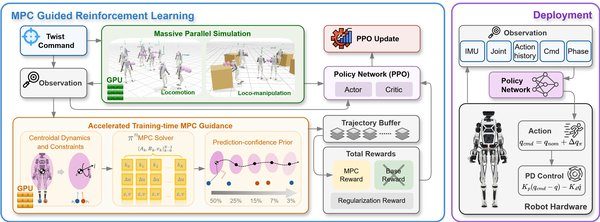
In humanoid motion control, model predictive control (MPC) offers physically grounded prediction and constraint handling, while reinforcement learning (RL) enables robust whole-body skills through large-scale simulation. However, using MPC inside RL often requires time-consuming problem construction or excessive training overhead, making such frameworks difficult to justify in practice. This work studies efficient training-time MPC guidance for humanoid locomotion and manipulation, termed MPC-RL. We introduce a centroidal-dynamics MPC reward formulation that leverages guidance from MPC trajectories in training time. To make this practical in massively parallel RL, we develop π^nMPC, a parallel-in-horizon and construction-free batched GPU MPC solver that operates directly on time-varying dynamics to avoid high memory usage and pre-compilation. Through a variety of comparative studies and hardware validations, we have found that MPC-RL achieves superior performance in locomotion and manipulation skills.
Beyond Binary: Sim-to-Real Dexterous Manipulation with Physics-Grounded Contact Representation
Jiahe Pan, Stelian Coros, Jitendra Malik et al. · arXiv preprint · May 2026
A primary bottleneck in contact-rich manipulation is the difficulty of collecting real-world data. Sim-to-real reinforcement learning offers a scalable alternative, but the simulation-reality gap prev
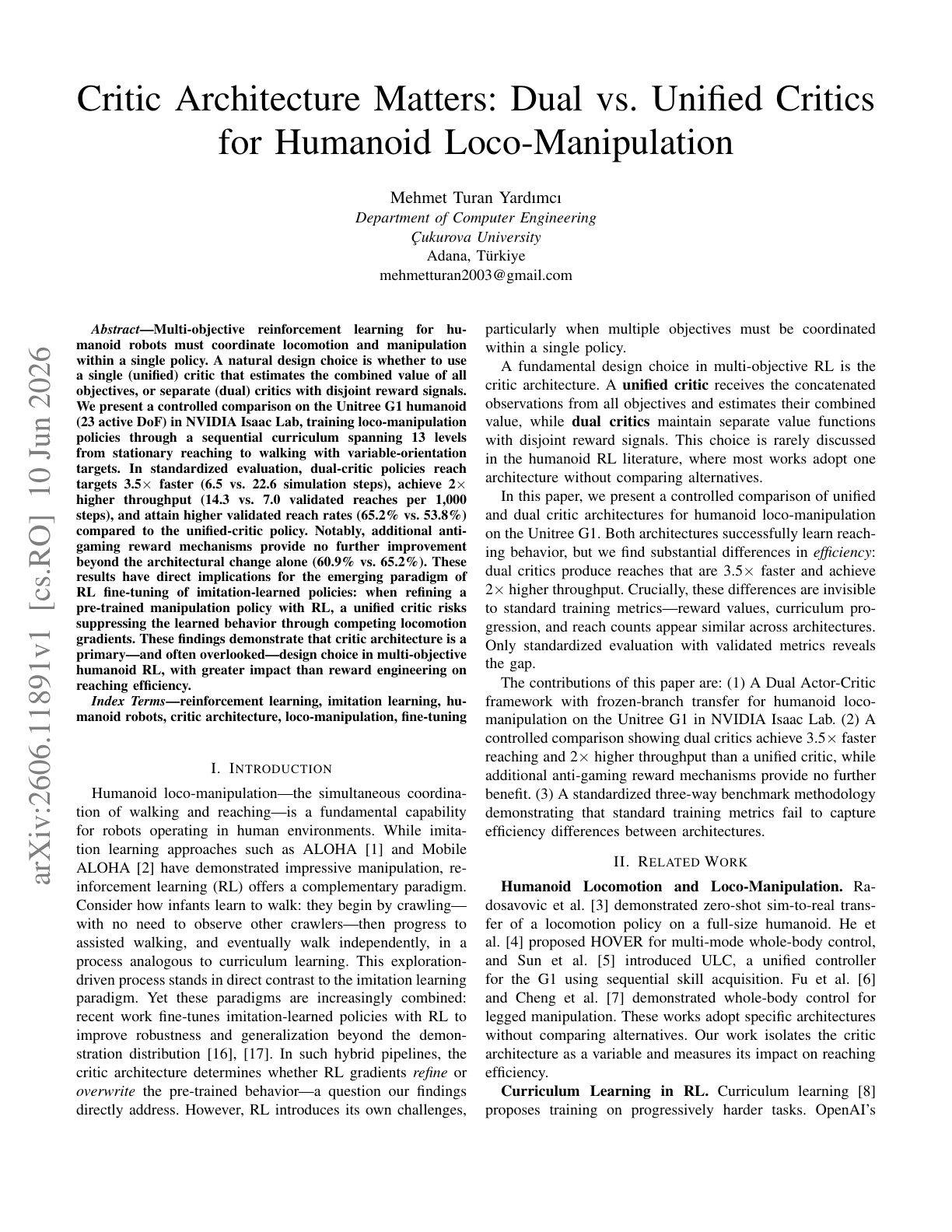
Critic Architecture Matters: Dual vs. Unified Critics for Humanoid Loco-Manipulation
Mehmet Turan Yardımcı · arXiv preprint · Jun 2026
Multi-objective reinforcement learning for humanoid robots must coordinate locomotion and manipulation within a single policy. A natural design choice is whether to use a single (unified) critic that estimates the combined value of all objectives, or separate (dual) critics with disjoint reward sign...