
Critic Architecture Matters: Dual vs. Unified Critics for Humanoid Loco-Manipulation
Mehmet Turan Yardımcı · N/A · 2026
Framework
N/A
License
N/A
Stars
N/A
Summary
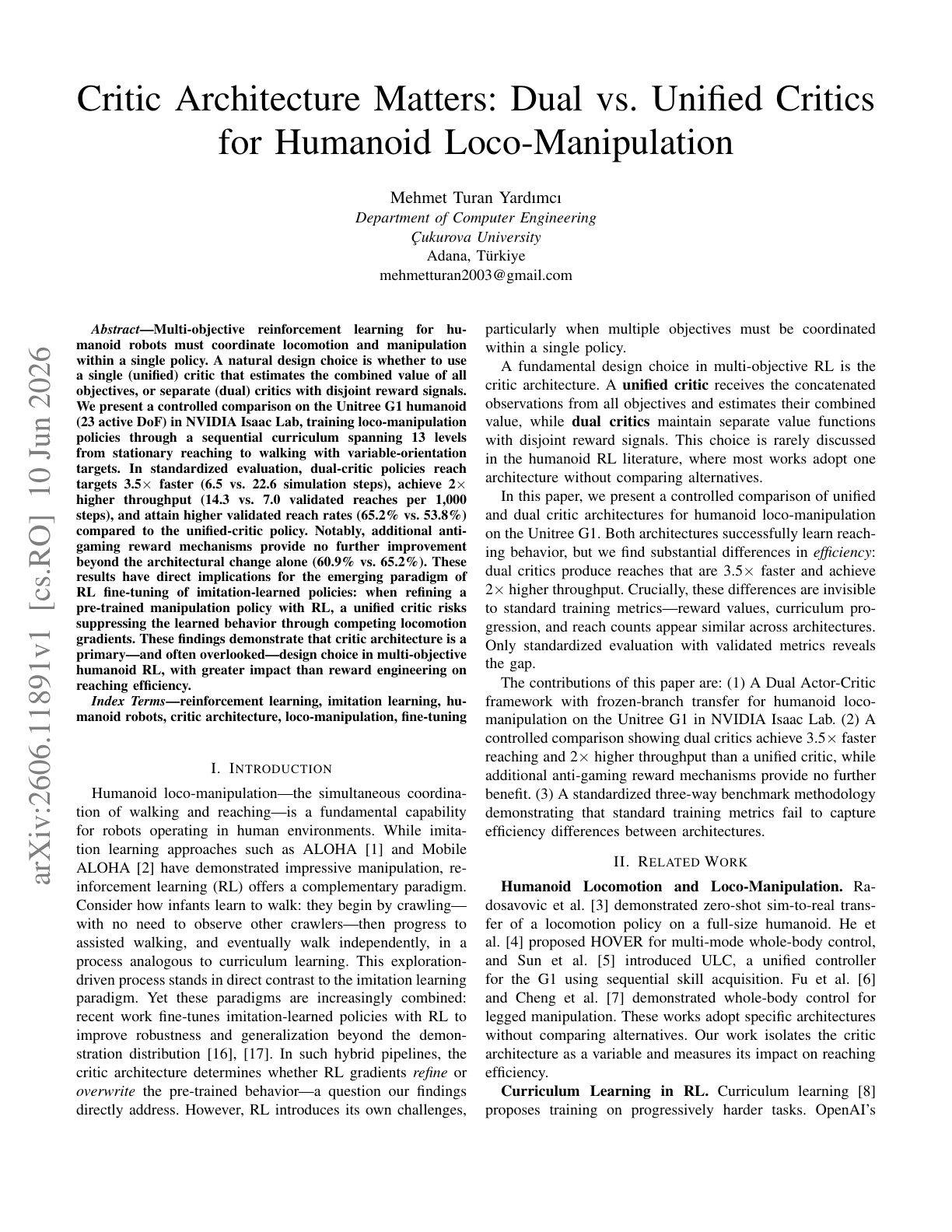
Multi-objective reinforcement learning for humanoid robots must coordinate locomotion and manipulation within a single policy. A natural design choice is whether to use a single (unified) critic that estimates the combined value of all objectives, or separate (dual) critics with disjoint reward sign...
Abstract Summary
Key Points
- Controlled comparison of dual vs. unified critic architectures for humanoid loco-manipulation.
- Dual-critic policies reach targets 3.5x faster and achieve 2x higher throughput than unified critics.
- Critic architecture has greater impact on performance than reward engineering or anti-gaming mechanisms.
- Findings are directly relevant to RL fine-tuning of pre-trained manipulation policies.
Related Papers
Accelerating and Scaling MPC-Guided Reinforcement Learning for Humanoid Locomotion and Manipulation
Junheng Li, Liang Wu, Sergio A. Esteban et al. · arXiv preprint · Jun 2026
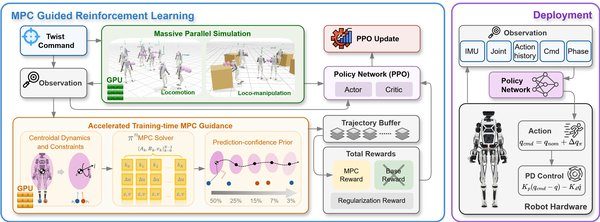
In humanoid motion control, model predictive control (MPC) offers physically grounded prediction and constraint handling, while reinforcement learning (RL) enables robust whole-body skills through large-scale simulation. However, using MPC inside RL often requires time-consuming problem construction or excessive training overhead, making such frameworks difficult to justify in practice. This work studies efficient training-time MPC guidance for humanoid locomotion and manipulation, termed MPC-RL. We introduce a centroidal-dynamics MPC reward formulation that leverages guidance from MPC trajectories in training time. To make this practical in massively parallel RL, we develop π^nMPC, a parallel-in-horizon and construction-free batched GPU MPC solver that operates directly on time-varying dynamics to avoid high memory usage and pre-compilation. Through a variety of comparative studies and hardware validations, we have found that MPC-RL achieves superior performance in locomotion and manipulation skills.
Flash-WAM: Modality-Aware Distillation for World Action Models
Arman Akbari, Ci Zhang, Arash Akbari et al. · arXiv preprint · Jun 2026
World-action models (WAMs) jointly generate future video and robot actions through iterative diffusion, achieving strong performance on manipulation benchmarks but requiring tens of denoising steps, a cost that precludes real-time control. Step distillation has emerged as the natural remedy, but off...
GRAIL: Generating Humanoid Loco-Manipulation from 3D Assets and Video Priors
Tianyi Xie, Haotian Zhang, Jinhyung Park et al. · arXiv preprint · Jun 2026
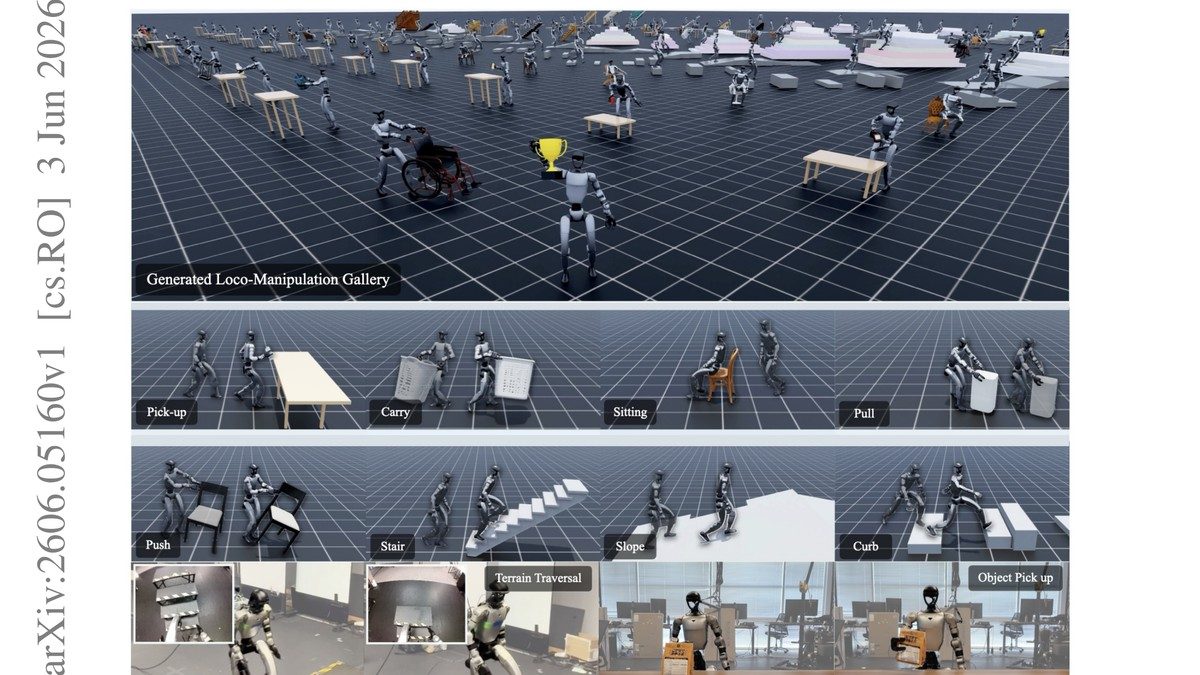
Scaling humanoid loco-manipulation requires robot-compatible demonstrations across diverse objects, whole-body motions, and scene geometries, but teleoperation and motion capture are difficult to scale because each collection depends on physical setups, instrumented actors, and robot operation. We p...
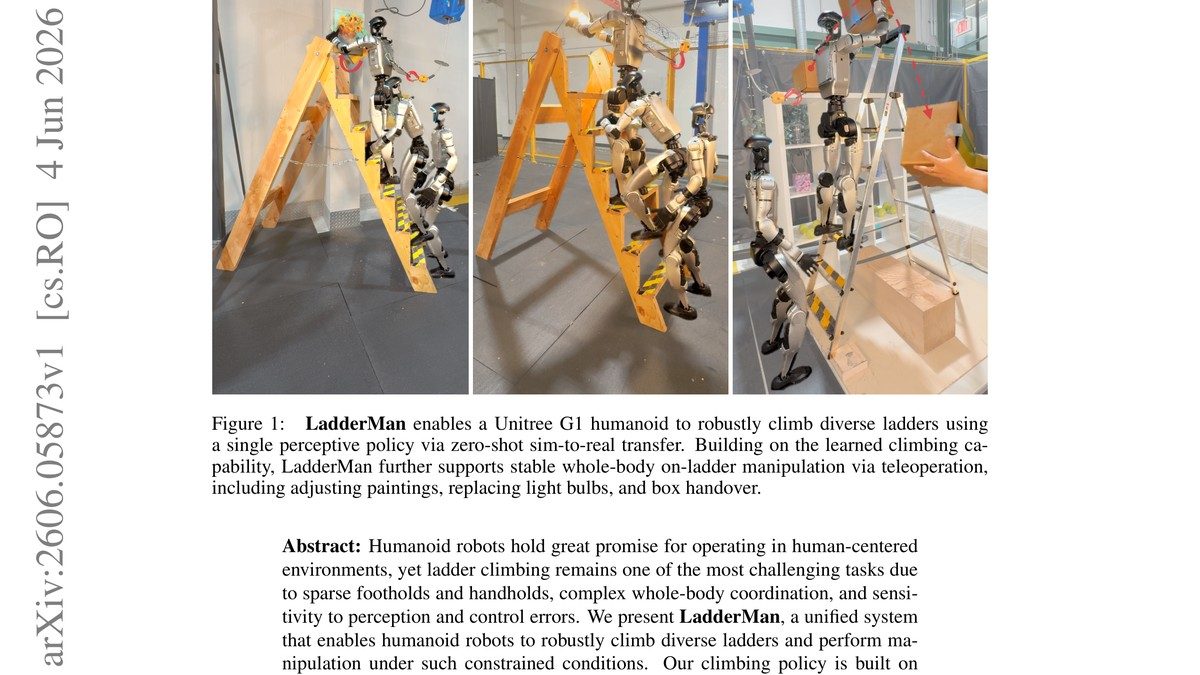
LadderMan: Learning Humanoid Perceptive Ladder Climbing
Siheng Zhao, Yuanhang Zhang, Ziqi Lu et al. · arXiv preprint · Jun 2026
Humanoid robots hold great promise for operating in human-centered environments, yet ladder climbing remains one of the most challenging tasks due to sparse footholds and handholds, complex whole-body coordination, and sensitivity to perception and control errors. We present extbf{LadderMan}, a un...