
Accelerating and Scaling MPC-Guided Reinforcement Learning for Humanoid Locomotion and Manipulation
FeaturedJunheng Li, Liang Wu, Sergio A. Esteban, Lizhi Yang, Ján Drgoňa, Aaron D. Ames · Caltech · 2026
Framework
PyTorch / JAX
License
N/A
Stars
N/A
Summary
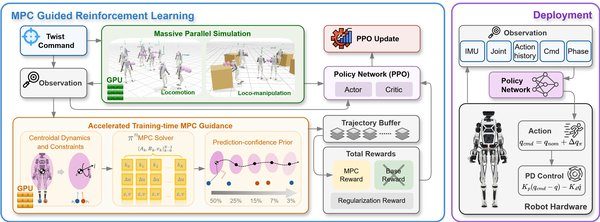
In humanoid motion control, model predictive control (MPC) offers physically grounded prediction and constraint handling, while reinforcement learning (RL) enables robust whole-body skills through large-scale simulation. However, using MPC inside RL often requires time-consuming problem construction or excessive training overhead, making such frameworks difficult to justify in practice. This work studies efficient training-time MPC guidance for humanoid locomotion and manipulation, termed MPC-RL. We introduce a centroidal-dynamics MPC reward formulation that leverages guidance from MPC trajectories in training time. To make this practical in massively parallel RL, we develop π^nMPC, a parallel-in-horizon and construction-free batched GPU MPC solver that operates directly on time-varying dynamics to avoid high memory usage and pre-compilation. Through a variety of comparative studies and hardware validations, we have found that MPC-RL achieves superior performance in locomotion and manipulation skills.
Abstract Summary
Key Points
- Proposes MPC-RL: MPC-guided reinforcement learning for humanoid control
- Introduces centroidal-dynamics MPC reward formulation for RL training
- Develops π^nMPC: parallel-in-horizon batched GPU MPC solver
- Achieves superior locomotion and manipulation on real hardware
- Combines physical structure of MPC with simple deployment of RL
- Provides open-source implementation in PyTorch and JAX
Abstract
In humanoid motion control, model predictive control (MPC) offers physically grounded prediction and constraint handling, while reinforcement learning (RL) enables robust whole-body skills through large-scale simulation. However, using MPC inside RL often requires time-consuming problem construction or excessive training overhead, making such frameworks difficult to justify in practice. This work studies efficient training-time MPC guidance for humanoid locomotion and manipulation, termed MPC-RL. We introduce a centroidal-dynamics MPC reward formulation that leverages guidance from MPC trajectories in training time. To make this practical in massively parallel RL, we develop π^nMPC, a parallel-in-horizon and construction-free batched GPU MPC solver that operates directly on time-varying dynamics to avoid high memory usage and pre-compilation. Through a variety of comparative studies and hardware validations, we have found that MPC-RL achieves superior performance in locomotion and manipulation skills. The code base is available at this https URL.
Links
- Paper (PDF): 2606.05687
- arXiv: 2606.05687
- Project Website: caltech-amber.github.io/mpc-guided-rl
- Code: github.com/junhengl/mpc-rl
BibTeX
@article{Li2026_260605687,
  title={Accelerating and Scaling MPC-Guided Reinforcement Learning for Humanoid Locomotion and Manipulation},
  author={Junheng Li and Liang Wu and Sergio A. Esteban and Lizhi Yang and J{\'a}n Drgo{\v n}a and Aaron D. Ames},
  year={2026},
  eprint={2606.05687},
  archivePrefix={arXiv},
  primaryClass={cs.RO},
  url={https://arxiv.org/abs/2606.05687}
}
Related Papers
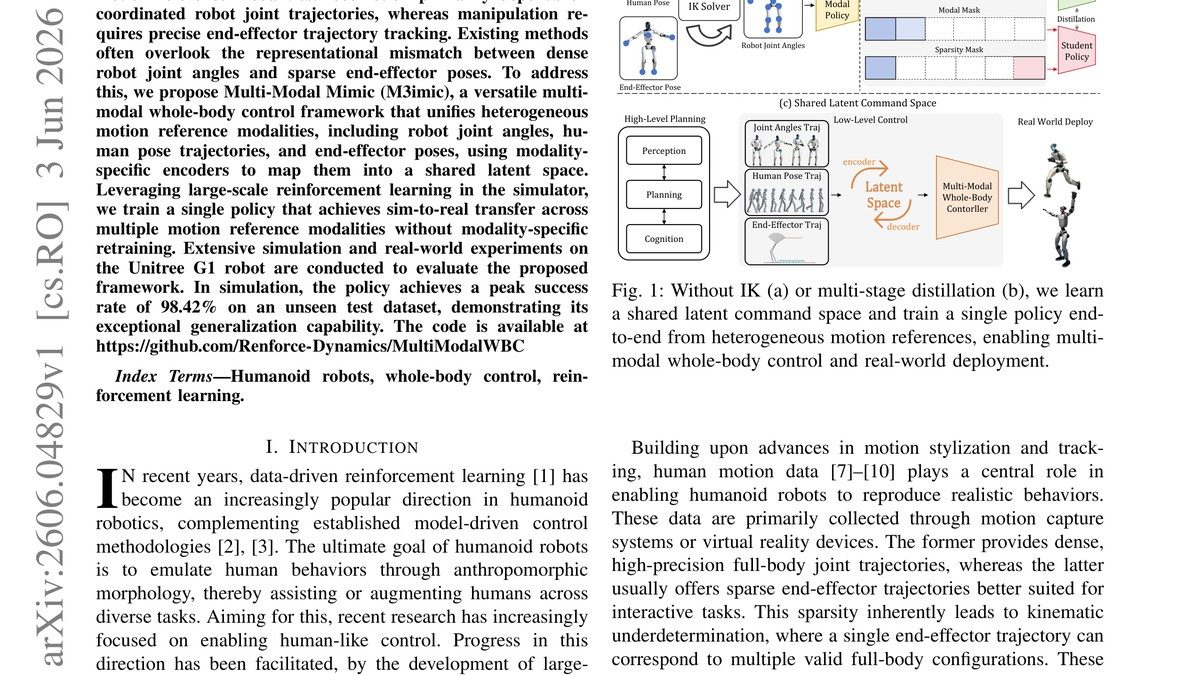
M3imic: Learning a Versatile Whole-Body Controller for Multimodal Motion Mimicking
Zuxing Lu, Ziang Zheng, Yao Lyu et al. · arXiv preprint · Jun 2026
Building a general-purpose whole-body controller is essential for enabling diverse motion capabilities in humanoid robots across a wide range of downstream tasks, including locomotion and loco-manipulation. Different tasks rely on distinct motion reference modalities: locomotion primarily depends on...
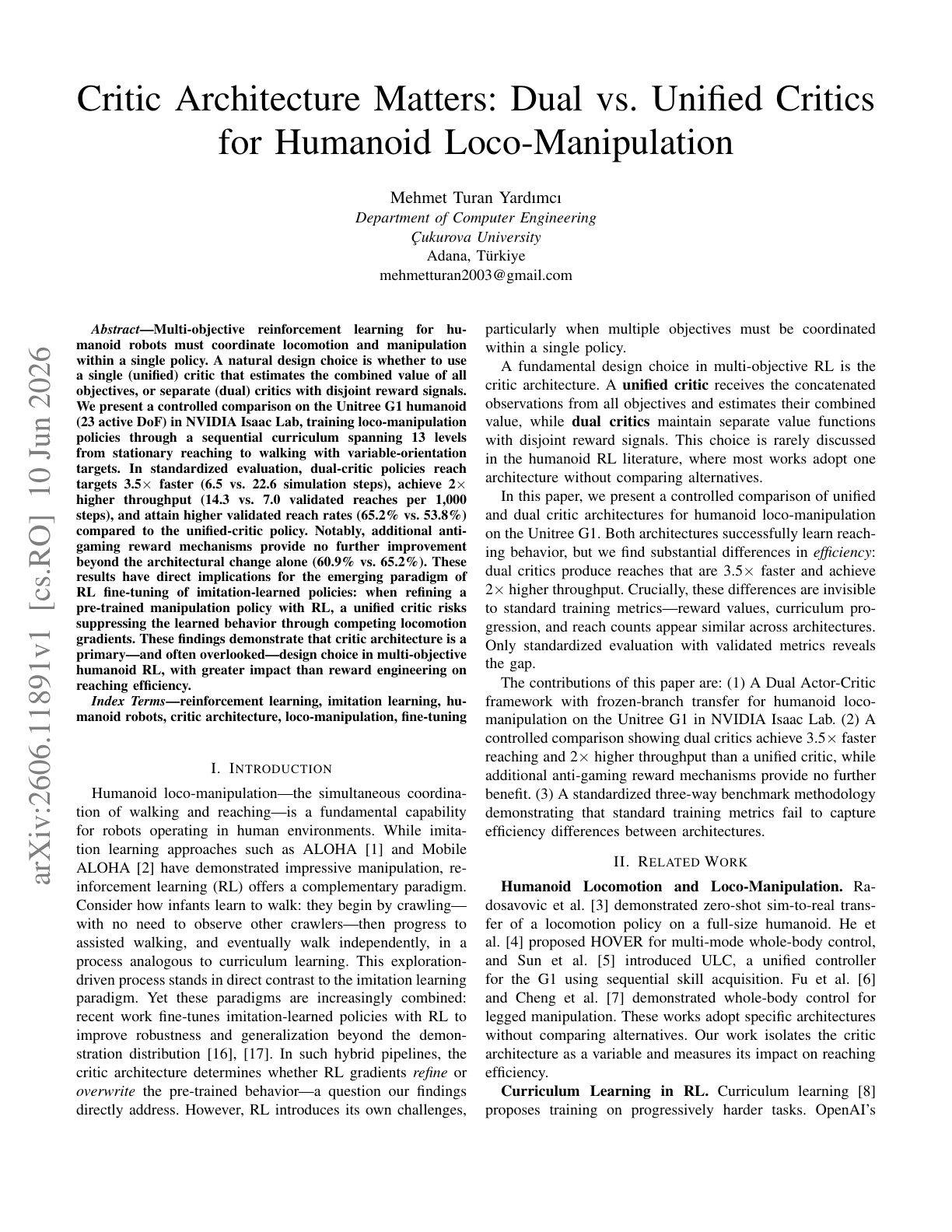
Critic Architecture Matters: Dual vs. Unified Critics for Humanoid Loco-Manipulation
Mehmet Turan Yardımcı · arXiv preprint · Jun 2026
Multi-objective reinforcement learning for humanoid robots must coordinate locomotion and manipulation within a single policy. A natural design choice is whether to use a single (unified) critic that estimates the combined value of all objectives, or separate (dual) critics with disjoint reward sign...
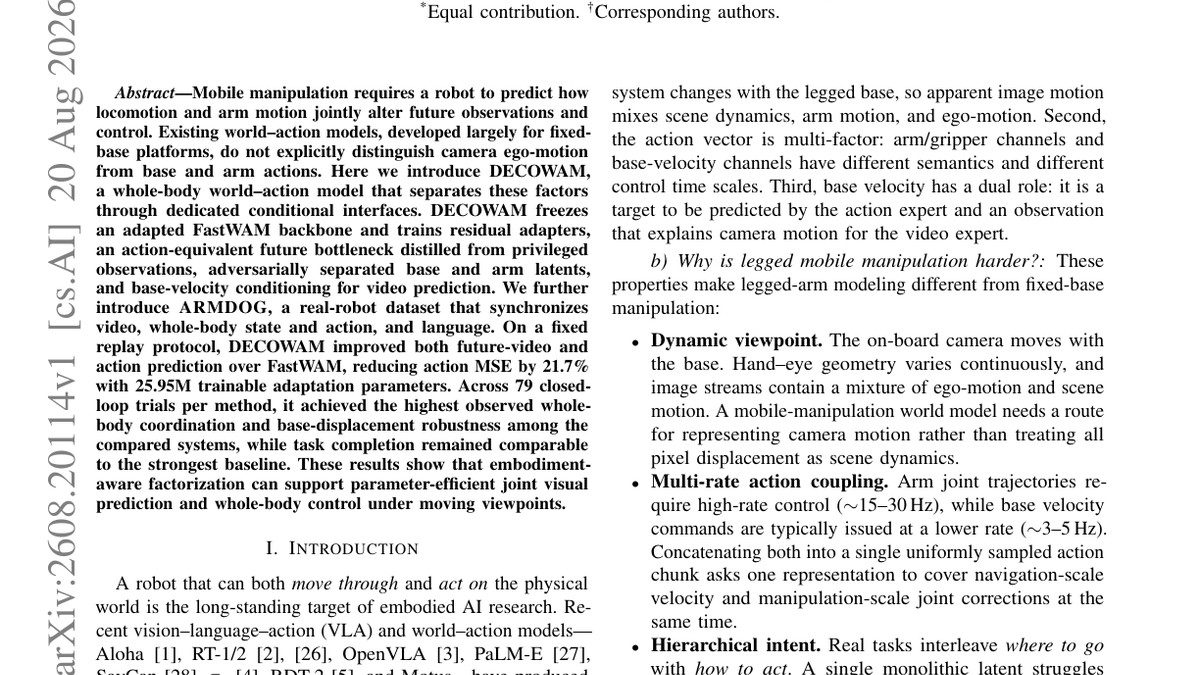
DECOWAM: Decoupled Whole-Body World-Action Model for Legged Mobile Manipulation
Siyuan Ma, Boshi Zhang, Yutian Zhang et al. · arXiv preprint · Aug 2026
Mobile manipulation requires a robot to predict how locomotion and arm motion jointly alter future observations and control. Existing world-action models, developed largely for fixed-base platforms, do not explicitly distinguish camera ego-motion from base and arm actions. Here we introduce DECOW...
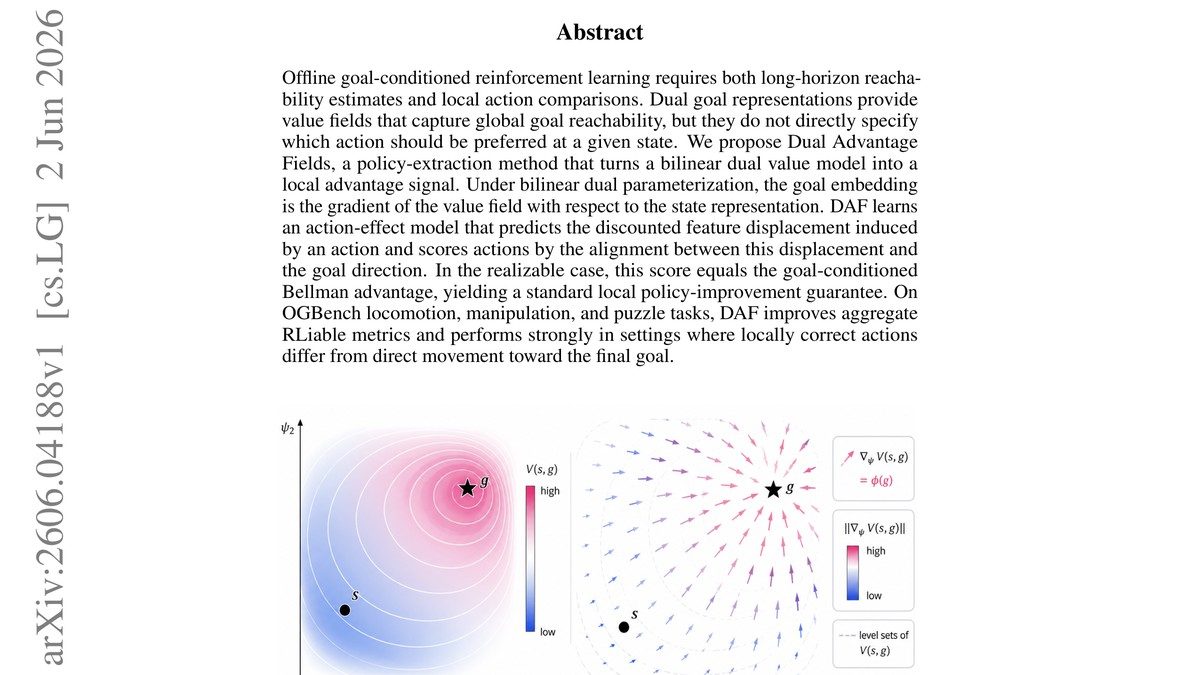
Dual Advantage Fields
Alexey Zemtsov, Maxim Bobrin, Alexander Nikulin et al. · ICML 2026 · Jun 2026
Offline goal-conditioned reinforcement learning requires both long-horizon reachability estimates and local action comparisons. Dual goal representations provide value fields that capture global goal reachability, but they do not directly specify which action should be preferred at a given state. We...