
Flash-WAM: Modality-Aware Distillation for World Action Models
Arman Akbari, Ci Zhang, Arash Akbari, Lin Zhao, Yixiao Chen, Weiwei Chen, Xuan Zhang, Geng Yuan, Yanzhi Wang · N/A · 2026
Framework
N/A
License
N/A
Stars
N/A
Summary
World-action models (WAMs) jointly generate future video and robot actions through iterative diffusion, achieving strong performance on manipulation benchmarks but requiring tens of denoising steps, a cost that precludes real-time control. Step distillation has emerged as the natural remedy, but off...
Abstract Summary
Key Points
- Demonstrates humanoid robot control on real hardware
- Addresses dexterous manipulation challenges
- Uses simulation or synthetic data for training
- Uses knowledge distillation to compress models
Flash-WAM: Modality-Aware Distillation for World Action Models
Authors: Arman Akbari, Ci Zhang, Arash Akbari, Lin Zhao, Yixiao Chen, Weiwei Chen, Xuan Zhang, Geng Yuan, Yanzhi Wang
Venue: arXiv preprint | Year: 2026
arXiv: 2606.05254v1
Abstract
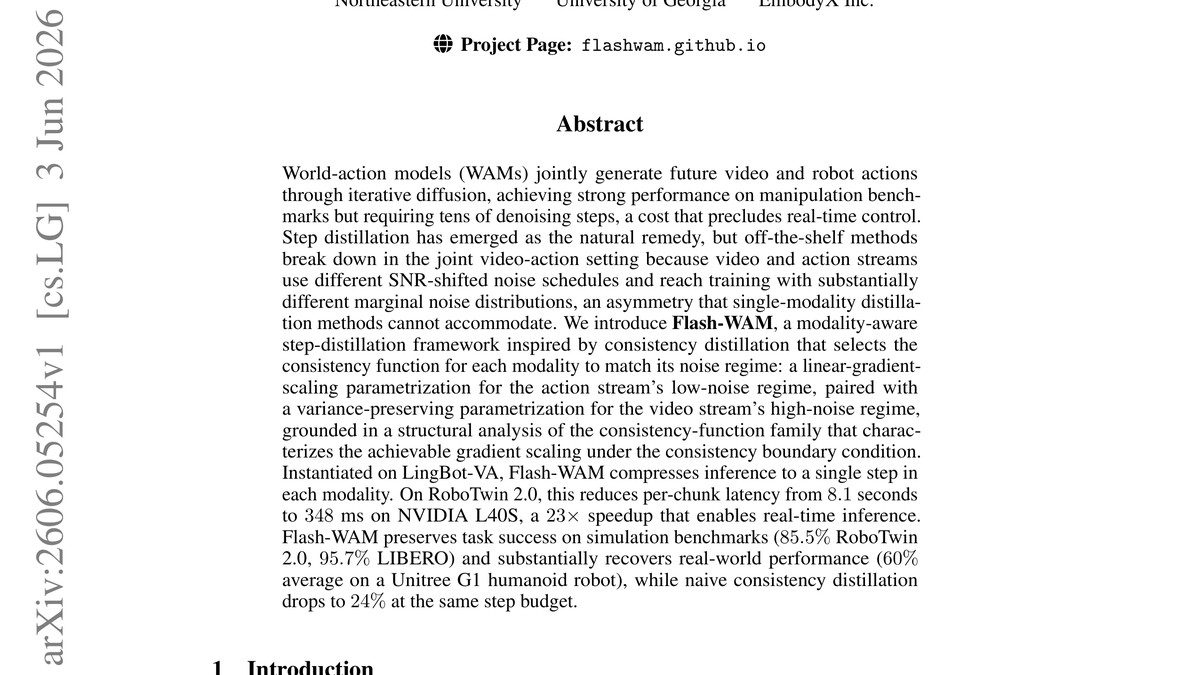
World-action models (WAMs) jointly generate future video and robot actions through iterative diffusion, achieving strong performance on manipulation benchmarks but requiring tens of denoising steps, a cost that precludes real-time control. Step distillation has emerged as the natural remedy, but off-the-shelf methods break down in the joint video-action setting because video and action streams use different SNR-shifted noise schedules and reach training with substantially different marginal noise distributions, an asymmetry that single-modality distillation methods cannot accommodate. We introduce \textbf{Flash-WAM}, a modality-aware step-distillation framework inspired by consistency distillation that selects the consistency function for each modality to match its noise regime: a linear-gradient-scaling parametrization for the action stream’s low-noise regime, paired with a variance-preserving parametrization for the video stream’s high-noise regime, grounded in a structural analysis of the consistency-function family that characterizes the achievable gradient scaling under the consistency boundary condition. Instantiated on LingBot-VA, Flash-WAM compresses inference to a single step in each modality. On RoboTwin 2.0, this reduces per-chunk latency from $8.1$ seconds to $348$ ms on NVIDIA L40S, a $23{\times}$ speedup that enables real-time inference. Flash-WAM preserves task success on simulation benchmarks ($85.5%$ RoboTwin 2.0, $95.7%$ LIBERO) and substantially recovers real-world performance ($60%$ average on a Unitree G1 humanoid robot), while naive consistency distillation drops to $24%$ at the same step budget.
Key Contributions
- Demonstrates humanoid robot control on real hardware
- Addresses dexterous manipulation challenges
- Uses simulation or synthetic data for training
- Uses knowledge distillation to compress models
Topics
- sim-to-real
- reinforcement-learning
- diffusion-policy
- manipulation
- humanoid
Code & Data
No code repository linked in paper metadata.
BibTeX
@article{Akbari2026_260605254v1,
  title={Flash-WAM: Modality-Aware Distillation for World Action Models},
  author={Arman Akbari and Ci Zhang and Arash Akbari and Lin Zhao and Yixiao Chen and Weiwei Chen and Xuan Zhang and Geng Yuan and Yanzhi Wang},
  year={2026},
  eprint={2606.05254v1},
  archivePrefix={arXiv},
  primaryClass={cs.LG},
  url={https://arxiv.org/abs/2606.05254v1}
}
Related Papers
GRAIL: Generating Humanoid Loco-Manipulation from 3D Assets and Video Priors
Tianyi Xie, Haotian Zhang, Jinhyung Park et al. · arXiv preprint · Jun 2026
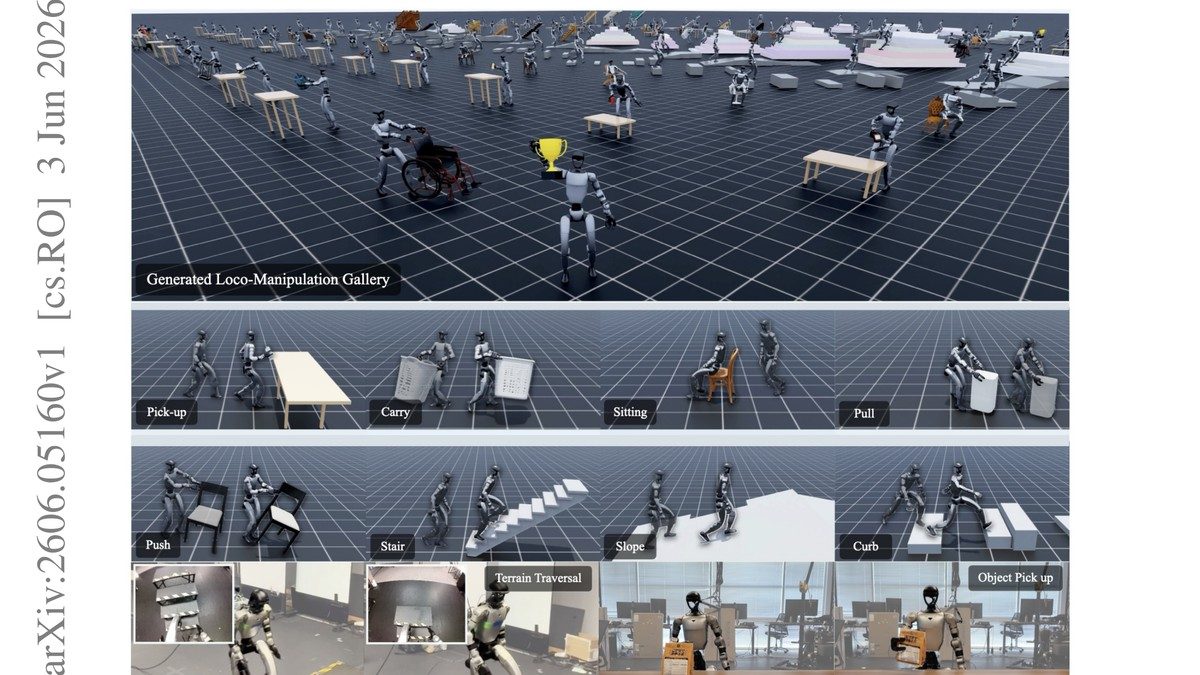
Scaling humanoid loco-manipulation requires robot-compatible demonstrations across diverse objects, whole-body motions, and scene geometries, but teleoperation and motion capture are difficult to scale because each collection depends on physical setups, instrumented actors, and robot operation. We p...
LadderMan: Learning Humanoid Perceptive Ladder Climbing
Siheng Zhao, Yuanhang Zhang, Ziqi Lu et al. · arXiv preprint · Jun 2026
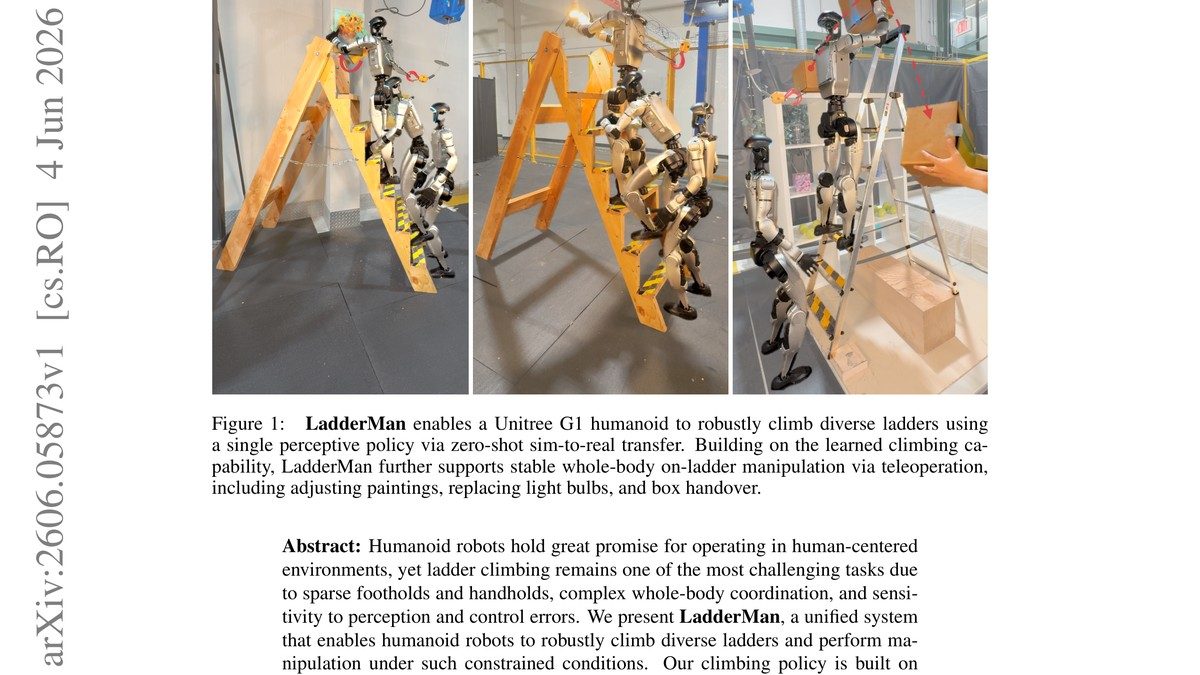
Humanoid robots hold great promise for operating in human-centered environments, yet ladder climbing remains one of the most challenging tasks due to sparse footholds and handholds, complex whole-body coordination, and sensitivity to perception and control errors. We present extbf{LadderMan}, a un...
M3imic: Learning a Versatile Whole-Body Controller for Multimodal Motion Mimicking
Zuxing Lu, Ziang Zheng, Yao Lyu et al. · arXiv preprint · Jun 2026
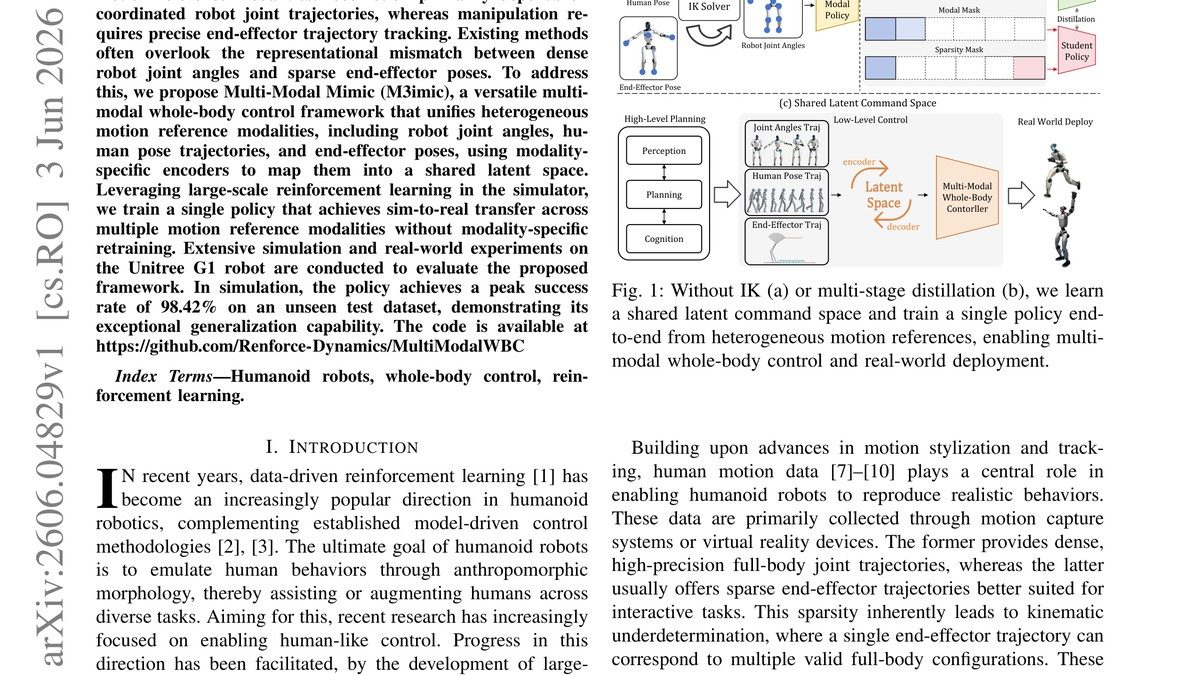
Building a general-purpose whole-body controller is essential for enabling diverse motion capabilities in humanoid robots across a wide range of downstream tasks, including locomotion and loco-manipulation. Different tasks rely on distinct motion reference modalities: locomotion primarily depends on...
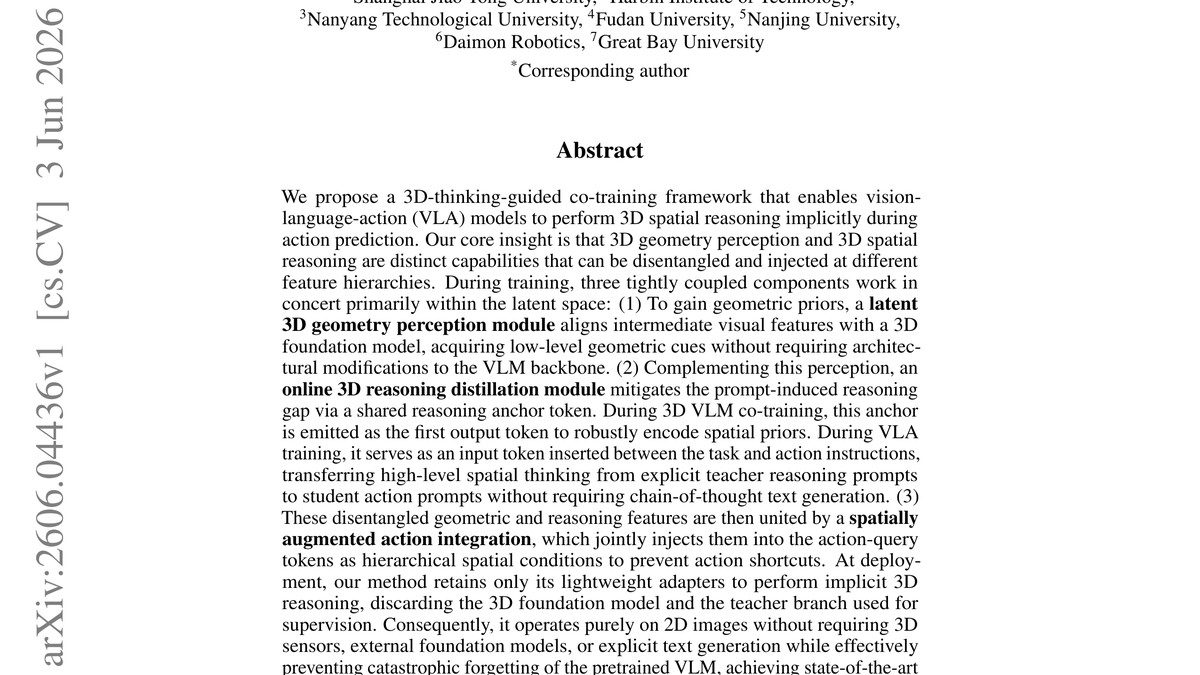
3DThinkVLA: Endowing Vision-Language-Action Models with Latent 3D Priors via 3D-Thinking-Guided Co-training
Jiaxin Shi, Xidong Zhang, Fucai Zhu et al. · arXiv preprint · Jun 2026
We propose a 3D-thinking-guided co-training framework that enables vision-language-action (VLA) models to perform 3D spatial reasoning implicitly during action prediction. Our core insight is that 3D geometry perception and 3D spatial reasoning are distinct capabilities that can be disentangled and ...