
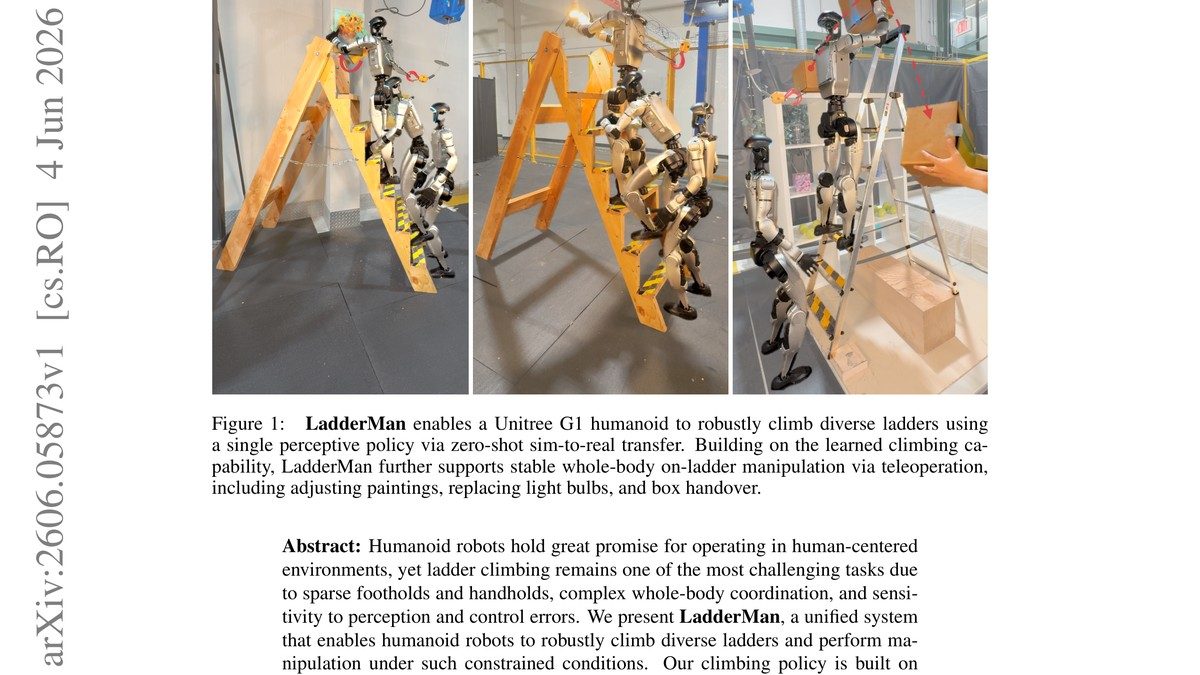
LadderMan: Learning Humanoid Perceptive Ladder Climbing
FeaturedSiheng Zhao, Yuanhang Zhang, Ziqi Lu, Pieter Abbeel, Rocky Duan, Koushil Sreenath, Yue Wang, C. Karen Liu, Guanya Shi · N/A · 2026
Framework
N/A
License
N/A
Stars
N/A
Summary
Humanoid robots hold great promise for operating in human-centered environments, yet ladder climbing remains one of the most challenging tasks due to sparse footholds and handholds, complex whole-body coordination, and sensitivity to perception and control errors. We present extbf{LadderMan}, a un...
Abstract Summary
Key Points
- Demonstrates humanoid robot control on real hardware
- Addresses dexterous manipulation challenges
- Uses simulation or synthetic data for training
- Uses knowledge distillation to compress models
- Leverages 3D geometric reasoning for perception
- Incorporates tactile or force feedback for robust interaction
- Enables complex whole-body climbing behaviors
- Learns multimodal motion skills from human demonstrations
LadderMan: Learning Humanoid Perceptive Ladder Climbing
Authors: Siheng Zhao, Yuanhang Zhang, Ziqi Lu, Pieter Abbeel, Rocky Duan, Koushil Sreenath, Yue Wang, C. Karen Liu, Guanya Shi
Venue: arXiv preprint | Year: 2026
arXiv: 2606.05873v1
Abstract
Humanoid robots hold great promise for operating in human-centered environments, yet ladder climbing remains one of the most challenging tasks due to sparse footholds and handholds, complex whole-body coordination, and sensitivity to perception and control errors. We present \textbf{LadderMan}, a unified system that enables humanoid robots to robustly climb diverse ladders and perform manipulation under such constrained conditions. Our climbing policy is built on a scalable two-stage learning pipeline, where we use hybrid motion tracking to learn multiple climbing experts from a single reference motion, and distill these experts into a unified depth-based visuomotor climbing policy via hybrid imitation and reinforcement learning. To enable real-world deployment, we leverage vision foundation models to bridge the sim-to-real gap in depth perception. Building on the learned climbing policy, we further train a separate manipulation policy using a dual-agent formulation, allowing stable on-ladder manipulation via teleoperation. Experiments demonstrate that LadderMan achieves robust ladder climbing across a wide range of geometries, successfully transfers to real-world hardware in a zero-shot manner, and supports various manipulation tasks under challenging ladder constraints. Video results are available at https://ladderman-robot.github.io .
Key Contributions
- Demonstrates humanoid robot control on real hardware
- Addresses dexterous manipulation challenges
- Uses simulation or synthetic data for training
- Uses knowledge distillation to compress models
- Leverages 3D geometric reasoning for perception
- Incorporates tactile or force feedback for robust interaction
- Enables complex whole-body climbing behaviors
- Learns multimodal motion skills from human demonstrations
Topics
- sim-to-real
- reinforcement-learning
- vision
- manipulation
- humanoid
Code & Data
No code repository linked in paper metadata.
BibTeX
@article{Zhao2026_260605873v1,
  title={LadderMan: Learning Humanoid Perceptive Ladder Climbing},
  author={Siheng Zhao and Yuanhang Zhang and Ziqi Lu and Pieter Abbeel and Rocky Duan and Koushil Sreenath and Yue Wang and C. Karen Liu and Guanya Shi},
  year={2026},
  eprint={2606.05873v1},
  archivePrefix={arXiv},
  primaryClass={cs.RO},
  url={https://arxiv.org/abs/2606.05873v1}
}
Related Papers
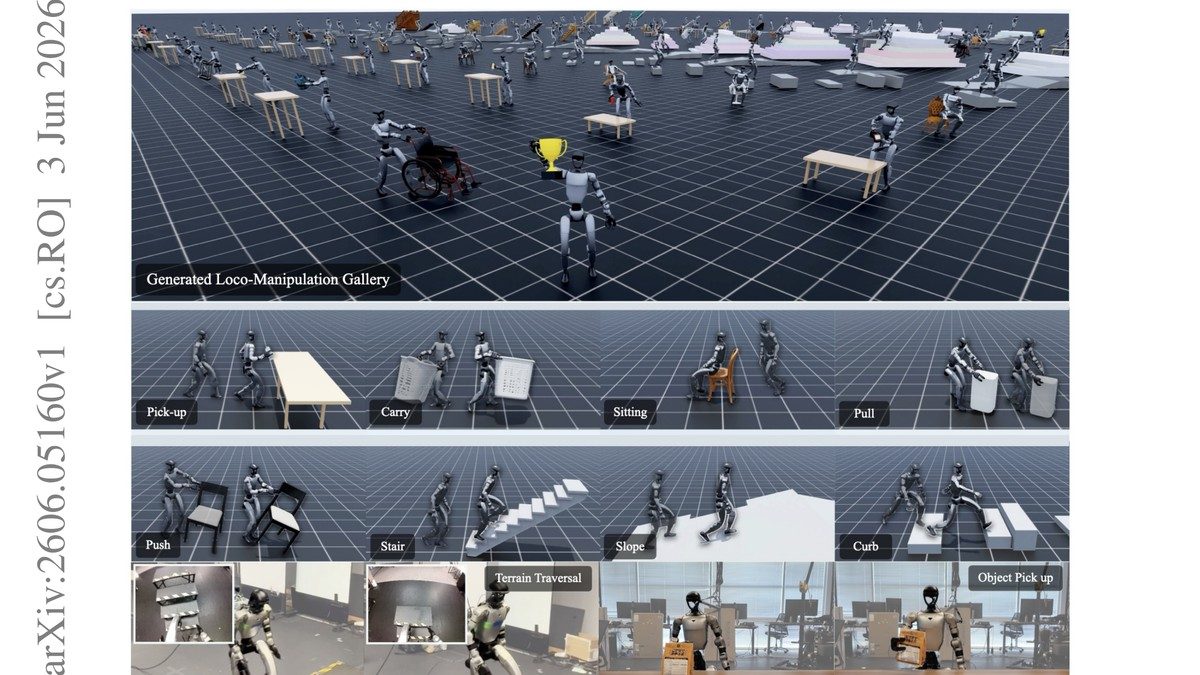
GRAIL: Generating Humanoid Loco-Manipulation from 3D Assets and Video Priors
Tianyi Xie, Haotian Zhang, Jinhyung Park et al. · arXiv preprint · Jun 2026
Scaling humanoid loco-manipulation requires robot-compatible demonstrations across diverse objects, whole-body motions, and scene geometries, but teleoperation and motion capture are difficult to scale because each collection depends on physical setups, instrumented actors, and robot operation. We p...
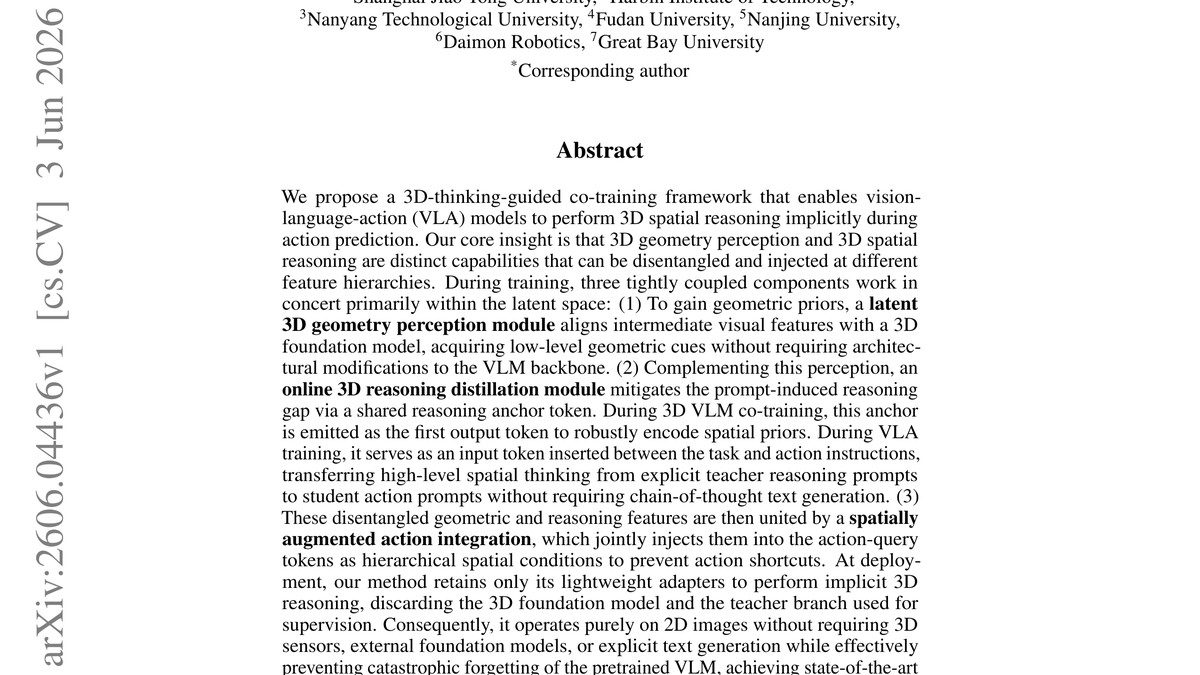
3DThinkVLA: Endowing Vision-Language-Action Models with Latent 3D Priors via 3D-Thinking-Guided Co-training
Jiaxin Shi, Xidong Zhang, Fucai Zhu et al. · arXiv preprint · Jun 2026
We propose a 3D-thinking-guided co-training framework that enables vision-language-action (VLA) models to perform 3D spatial reasoning implicitly during action prediction. Our core insight is that 3D geometry perception and 3D spatial reasoning are distinct capabilities that can be disentangled and ...
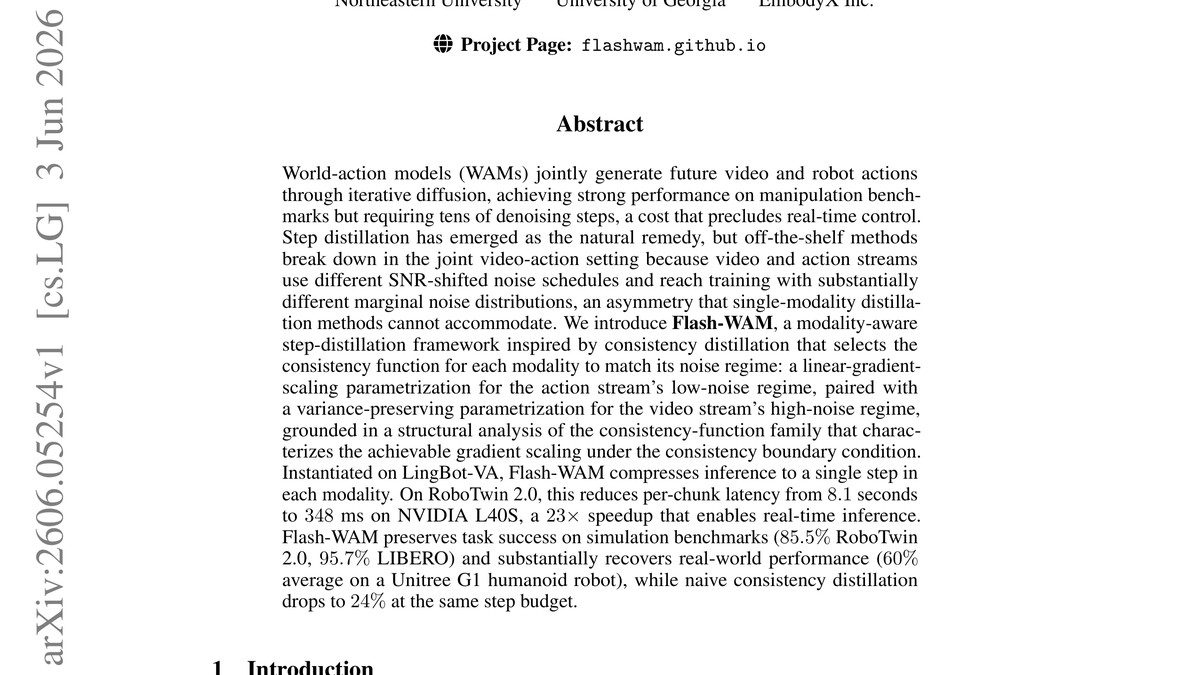
Flash-WAM: Modality-Aware Distillation for World Action Models
Arman Akbari, Ci Zhang, Arash Akbari et al. · arXiv preprint · Jun 2026
World-action models (WAMs) jointly generate future video and robot actions through iterative diffusion, achieving strong performance on manipulation benchmarks but requiring tens of denoising steps, a cost that precludes real-time control. Step distillation has emerged as the natural remedy, but off...
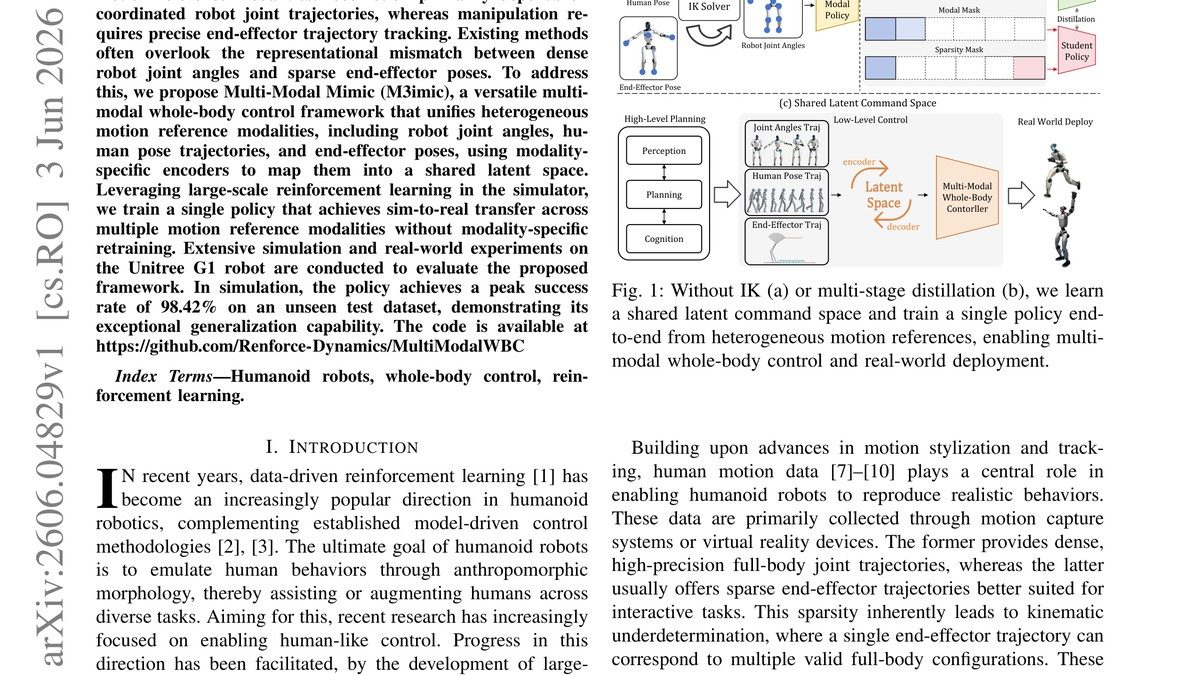
M3imic: Learning a Versatile Whole-Body Controller for Multimodal Motion Mimicking
Zuxing Lu, Ziang Zheng, Yao Lyu et al. · arXiv preprint · Jun 2026
Building a general-purpose whole-body controller is essential for enabling diverse motion capabilities in humanoid robots across a wide range of downstream tasks, including locomotion and loco-manipulation. Different tasks rely on distinct motion reference modalities: locomotion primarily depends on...