
3DThinkVLA: Endowing Vision-Language-Action Models with Latent 3D Priors via 3D-Thinking-Guided Co-training
Jiaxin Shi, Xidong Zhang, Fucai Zhu, Zhe Li, Siyu Zhu, Weihao Yuan · N/A · 2026
Framework
N/A
License
N/A
Stars
N/A
Summary
We propose a 3D-thinking-guided co-training framework that enables vision-language-action (VLA) models to perform 3D spatial reasoning implicitly during action prediction. Our core insight is that 3D geometry perception and 3D spatial reasoning are distinct capabilities that can be disentangled and ...
Abstract Summary
Key Points
- Addresses dexterous manipulation challenges
- Integrates vision-language models for robotic action generation
- Uses simulation or synthetic data for training
- Uses knowledge distillation to compress models
- Leverages 3D geometric reasoning for perception
3DThinkVLA: Endowing Vision-Language-Action Models with Latent 3D Priors via 3D-Thinking-Guided Co-training
Authors: Jiaxin Shi, Xidong Zhang, Fucai Zhu, Zhe Li, Siyu Zhu, Weihao Yuan
Venue: arXiv preprint | Year: 2026
arXiv: 2606.04436v1
Abstract
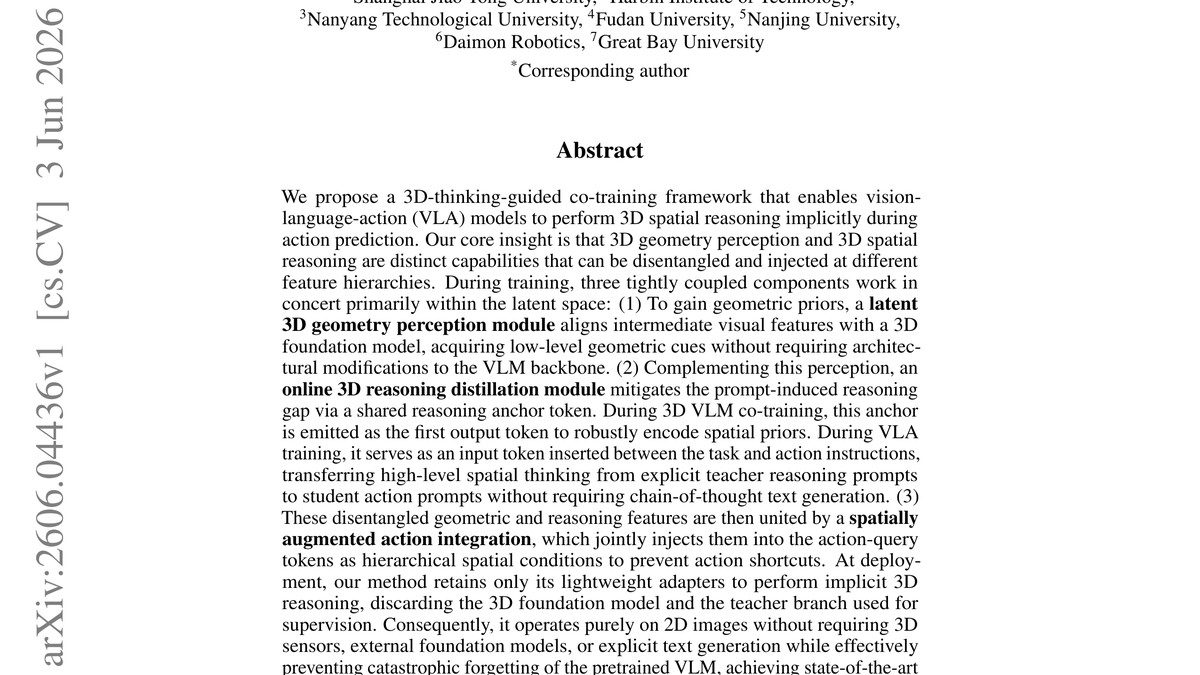
We propose a 3D-thinking-guided co-training framework that enables vision-language-action (VLA) models to perform 3D spatial reasoning implicitly during action prediction. Our core insight is that 3D geometry perception and 3D spatial reasoning are distinct capabilities that can be disentangled and injected at different feature hierarchies. During training, three tightly coupled components work in concert primarily within the latent space: (1) To gain geometric priors, a latent 3D geometry perception module aligns intermediate visual features with a 3D foundation model, acquiring low-level geometric cues without architectural modifications to the VLM backbone. (2) Complementing this, an online 3D reasoning distillation module mitigates the prompt-induced reasoning gap via a shared reasoning anchor token. During 3D VLM co-training, this anchor is emitted as the first output token to robustly encode spatial priors. During VLA training, it serves as an input token inserted between the task and action instructions, transferring high-level spatial thinking from explicit teacher reasoning prompts to student action prompts without chain-of-thought text generation. (3) These disentangled geometric and reasoning features are then united by a spatially augmented action integration, which jointly injects them into the action-query tokens as hierarchical spatial conditions to prevent action shortcuts. At deployment, our method retains only its lightweight adapters to perform implicit 3D reasoning, discarding the 3D foundation model and the teacher branch used for supervision. Consequently, it operates purely on 2D images without 3D sensors, external models, or explicit text generation while preventing catastrophic forgetting of the pretrained VLM, achieving state-of-the-art performance on LIBERO, LIBERO-PLUS, SimplerEnv, and real-world manipulation tasks.
Key Contributions
- Addresses dexterous manipulation challenges
- Integrates vision-language models for robotic action generation
- Uses simulation or synthetic data for training
- Uses knowledge distillation to compress models
- Leverages 3D geometric reasoning for perception
Topics
- sim-to-real
- reinforcement-learning
- vision
- vla
- manipulation
Code & Data
No code repository linked in paper metadata.
BibTeX
@article{Shi2026_260604436v1,
  title={3DThinkVLA: Endowing Vision-Language-Action Models with Latent 3D Priors via 3D-Thinking-Guided Co-training},
  author={Jiaxin Shi and Xidong Zhang and Fucai Zhu and Zhe Li and Siyu Zhu and Weihao Yuan},
  year={2026},
  eprint={2606.04436v1},
  archivePrefix={arXiv},
  primaryClass={cs.CV},
  url={https://arxiv.org/abs/2606.04436v1}
}
Related Papers
Decoding Task Progress from VLA Representations
Atiksh Bhardwaj, Edward Weiyi Duan, Prithwish Dan et al. · arXiv preprint · Aug 2026
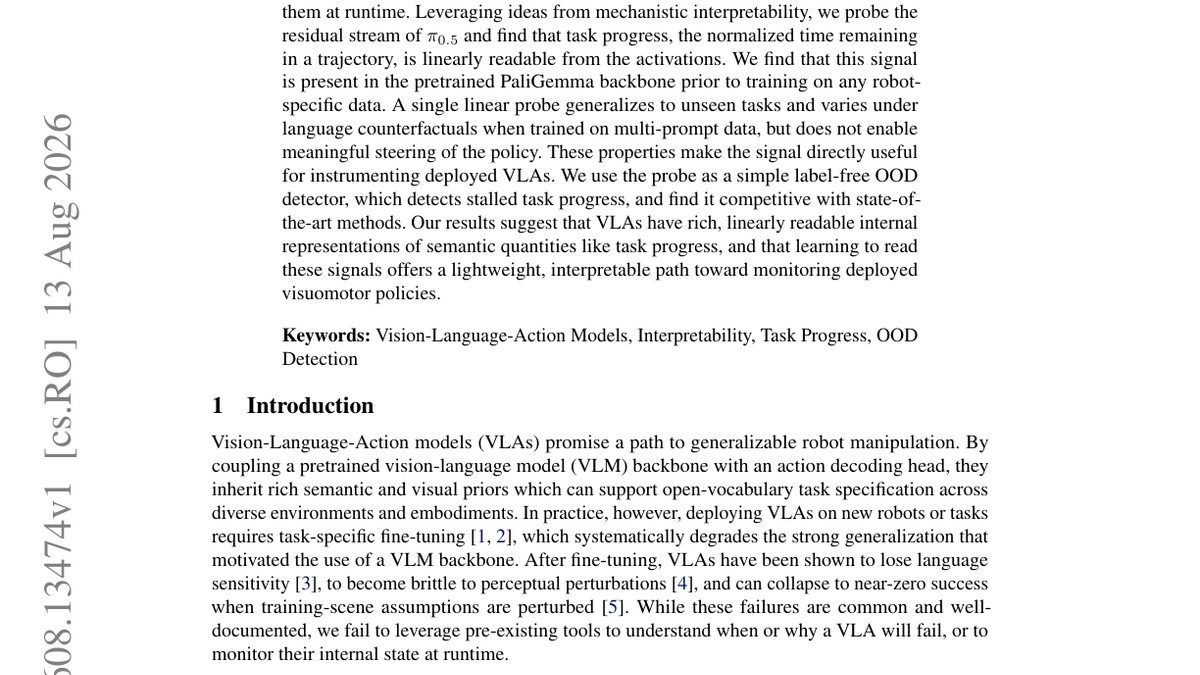
Vision-language-action models (VLAs) are moving rapidly towards deployment as general-purpose manipulation policies, but we currently lack basic tools for understanding what these models represent internally or for monitoring them at runtime. Leveraging ideas from mechanistic interpretability, we...
Development of a Humanoid Robot Prototype for Multimodal Human-Robot Interaction
Thang Tran Viet, Thanh Nguyen Canh, Huy Uong Gia et al. · arXiv preprint · Sep 2026
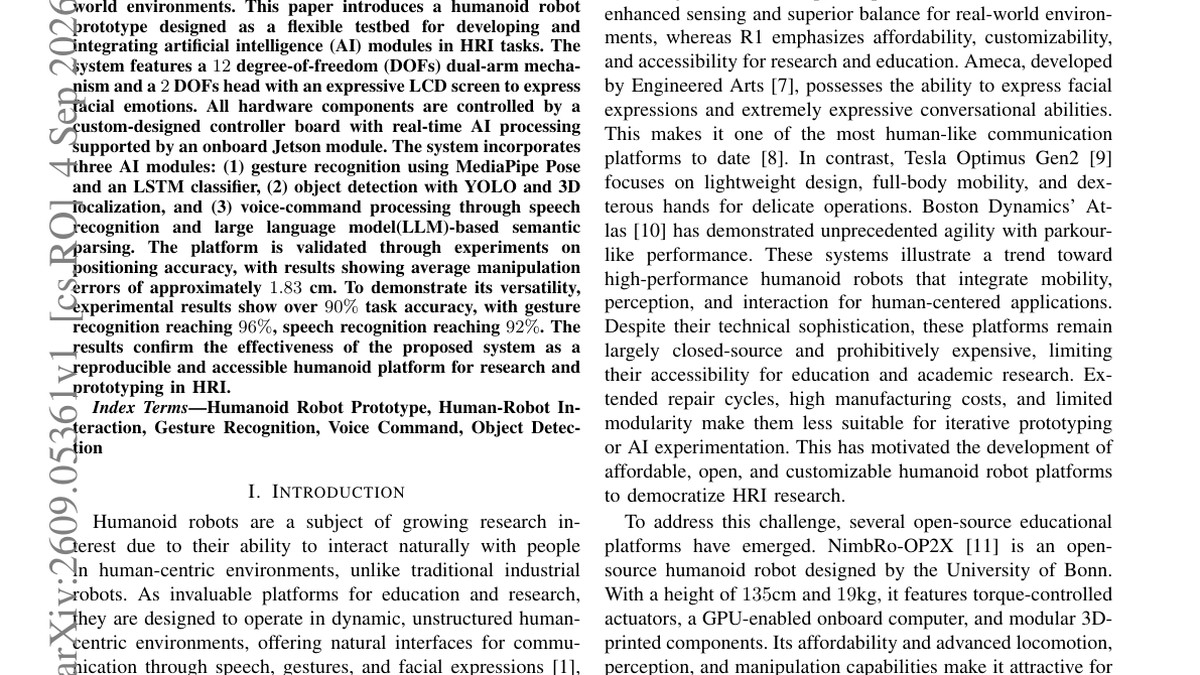
Human-robot interaction (HRI) enables intuitive and intelligent collaboration between humans and robots in real-world environments. This paper introduces a humanoid robot prototype designed as a flexible testbed for developing and integrating artificial intelligence (AI) modules in HRI tasks. The...
DexVerse: A Modular Benchmark for Multi-Task, Multi-Embodiment Dexterous Manipulation
Yunchao Yao, Zhuxiu Xu, Tianqi Zhang et al. · arXiv preprint · Jul 2026
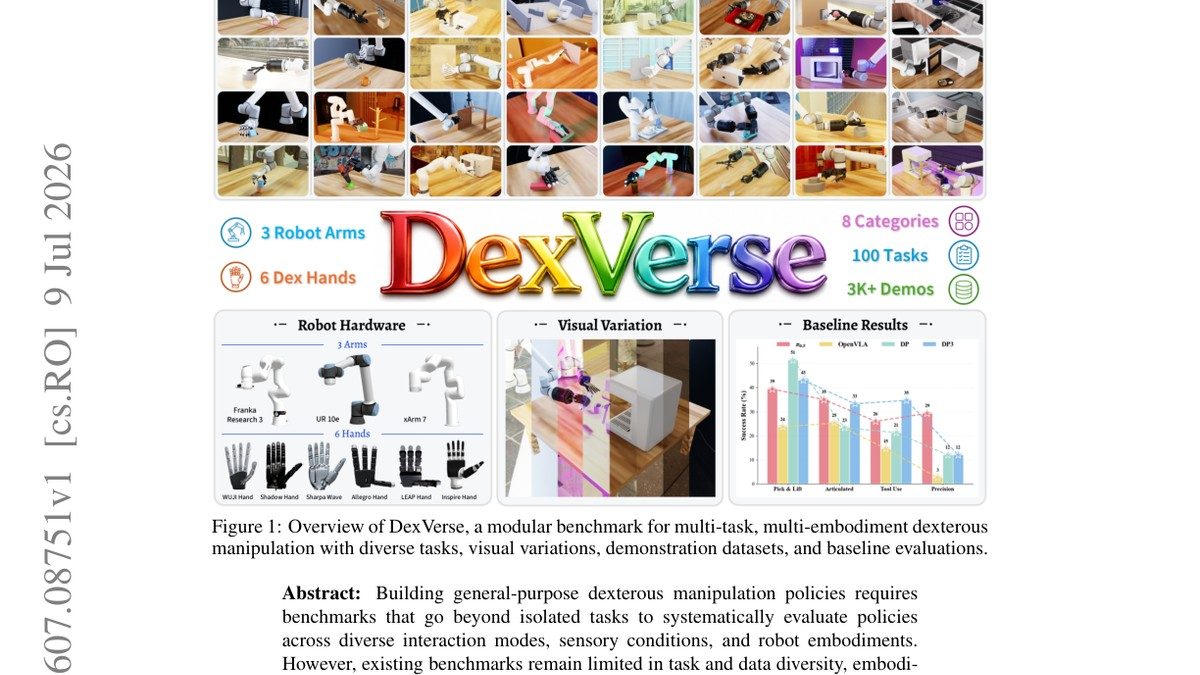
Building general-purpose dexterous manipulation policies requires benchmarks that go beyond isolated tasks to systematically evaluate policies across diverse interaction modes, sensory conditions, and robot embodiments. However, existing benchmarks remain limited in task and data diversity, embod...
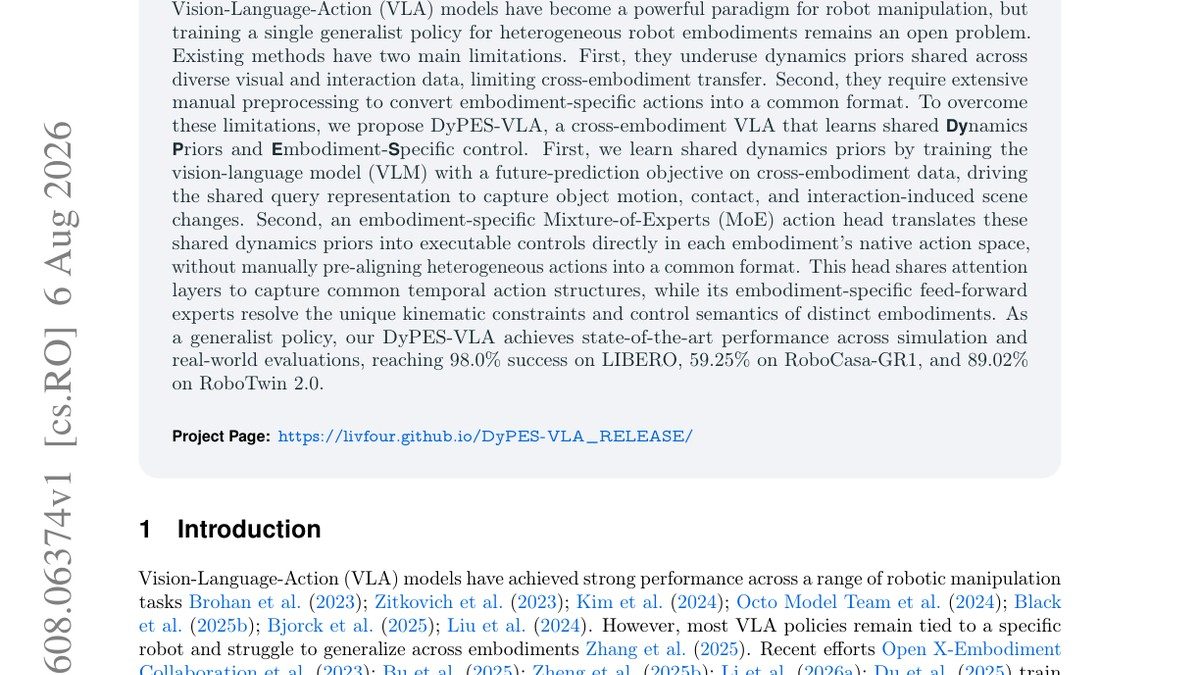
DyPES-VLA: Learning Shared Dynamics Priors and Embodiment-Specific Control for Cross-Embodiment Manipulation
Junfeng Li, Junjie He, Zhide Zhong et al. · arXiv preprint · Aug 2026
Vision-Language-Action (VLA) models have become a powerful paradigm for robot manipulation, but training a single generalist policy for heterogeneous robot embodiments remains an open problem. Existing methods have two main limitations. First, they underuse dynamics priors shared across diverse v...