
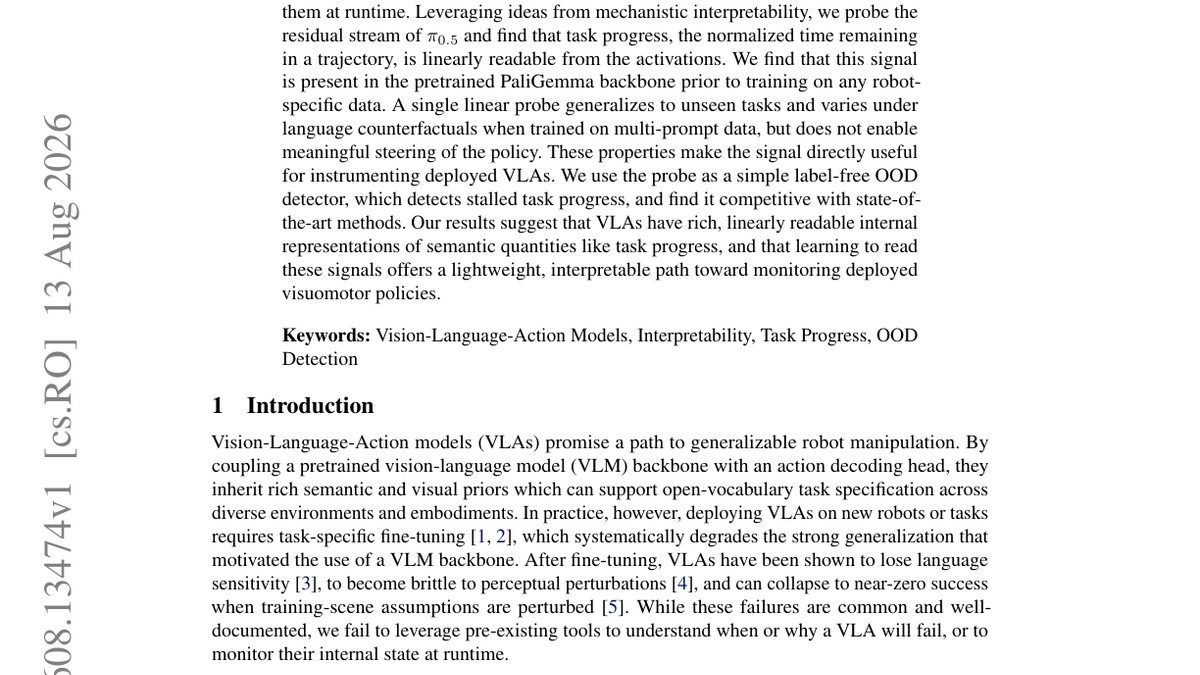
Decoding Task Progress from VLA Representations
Atiksh Bhardwaj, Edward Weiyi Duan, Prithwish Dan, Wei-Chiu Ma, Preston Culbertson · N/A · 2026
Framework
N/A
License
N/A
Stars
N/A
Summary
Vision-language-action models (VLAs) are moving rapidly towards deployment as general-purpose manipulation policies, but we currently lack basic tools for understanding what these models represent internally or for monitoring them at runtime. Leveraging ideas from mechanistic interpretability, we...
Abstract Summary
Key Points
- Vision-language-action models (VLAs) are moving rapidly towards deployment as general-purpose man...
- Leveraging ideas from mechanistic interpretability, we probe the residual stream of $π_{0.5}$ and...
- We find that this signal is present in the pretrained PaliGemma backbone prior to training on any...
- A single linear probe generalizes to unseen tasks and varies under language counterfactuals when ...
- These properties make the signal directly useful for instrumenting deployed VLAs
Decoding Task Progress from VLA Representations
|Authors: Atiksh Bhardwaj, Edward Weiyi Duan, Prithwish Dan, Wei-Chiu Ma, Preston Culbertson
|Venue: arXiv preprint | Year: 2026
|arXiv: 2608.13474v1
Abstract
Vision-language-action models (VLAs) are moving rapidly towards deployment as general-purpose manipulation policies, but we currently lack basic tools for understanding what these models represent internally or for monitoring them at runtime. Leveraging ideas from mechanistic interpretability, we probe the residual stream of $π_{0.5}$ and find that task progress, the normalized time remaining in a trajectory, is linearly readable from the activations. We find that this signal is present in the pretrained PaliGemma backbone prior to training on any robot-specific data. A single linear probe generalizes to unseen tasks and varies under language counterfactuals when trained on multi-prompt data, but does not enable meaningful steering of the policy. These properties make the signal directly useful for instrumenting deployed VLAs. We use the probe as a simple label-free OOD detector, which detects stalled task progress, and find it competitive with state-of-the-art methods. Our results suggest that VLAs have rich, linearly readable internal representations of semantic quantities like task progress, and that learning to read these signals offers a lightweight, interpretable path toward monitoring deployed visuomotor policies.
Key Contributions
- Vision-language-action models (VLAs) are moving rapidly towards deployment as general-purpose man…
- Leveraging ideas from mechanistic interpretability, we probe the residual stream of $π_{0.5}$ and…
- We find that this signal is present in the pretrained PaliGemma backbone prior to training on any…
- A single linear probe generalizes to unseen tasks and varies under language counterfactuals when …
- These properties make the signal directly useful for instrumenting deployed VLAs
Topics
- manipulation
- vision
- vla
- reinforcement-learning
- control
Code & Data
No code repository linked in paper metadata.
BibTeX
@article{Bhardwaj2026_260813474v1,
  title     = {Decoding Task Progress from VLA Representations},
  author    = {Atiksh Bhardwaj and Edward Weiyi Duan and Prithwish Dan and Wei-Chiu Ma and Preston Culbertson},
  year      = {2026},
  eprint    = {2608.13474v1},
  archivePrefix = {arXiv},
  primaryClass  = {cs.RO},
  url       = {https://arxiv.org/abs/2608.13474v1}
}
Related Papers
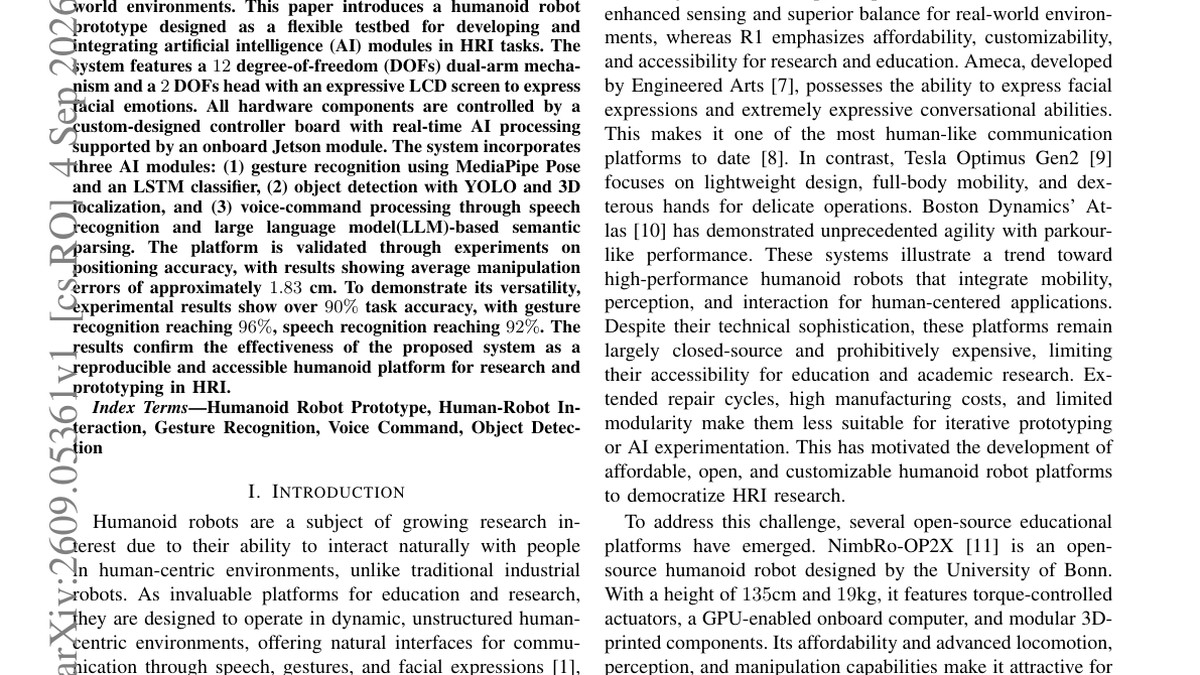
Development of a Humanoid Robot Prototype for Multimodal Human-Robot Interaction
Thang Tran Viet, Thanh Nguyen Canh, Huy Uong Gia et al. · arXiv preprint · Sep 2026
Human-robot interaction (HRI) enables intuitive and intelligent collaboration between humans and robots in real-world environments. This paper introduces a humanoid robot prototype designed as a flexible testbed for developing and integrating artificial intelligence (AI) modules in HRI tasks. The...
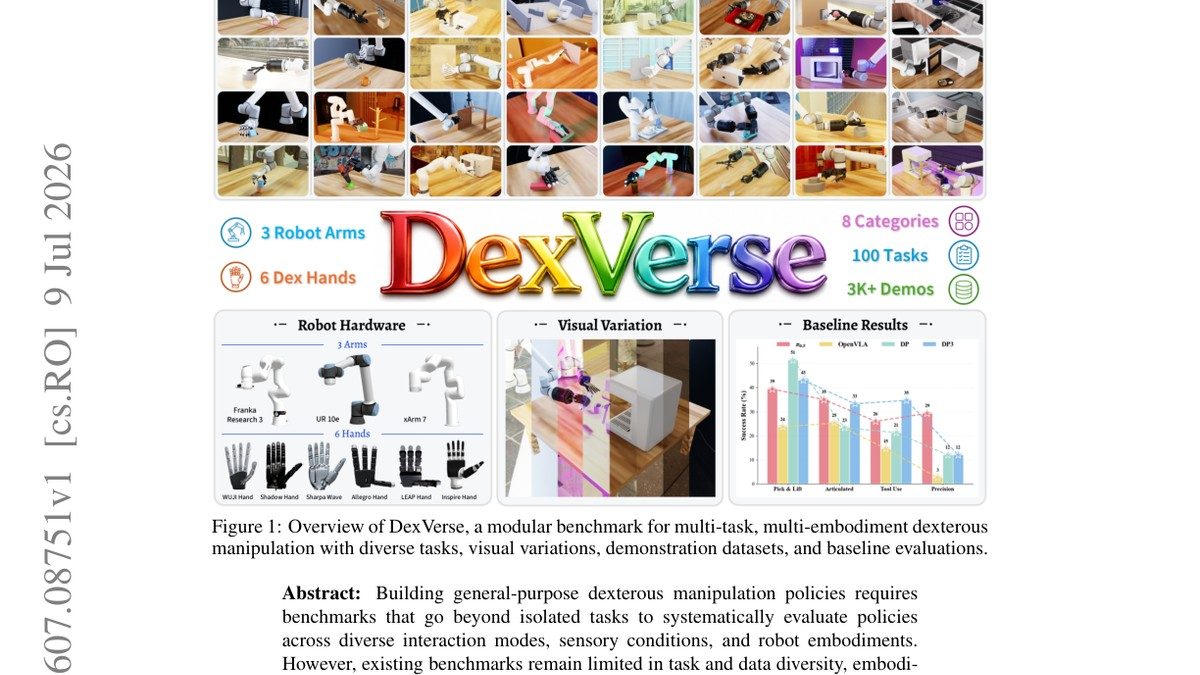
DexVerse: A Modular Benchmark for Multi-Task, Multi-Embodiment Dexterous Manipulation
Yunchao Yao, Zhuxiu Xu, Tianqi Zhang et al. · arXiv preprint · Jul 2026
Building general-purpose dexterous manipulation policies requires benchmarks that go beyond isolated tasks to systematically evaluate policies across diverse interaction modes, sensory conditions, and robot embodiments. However, existing benchmarks remain limited in task and data diversity, embod...
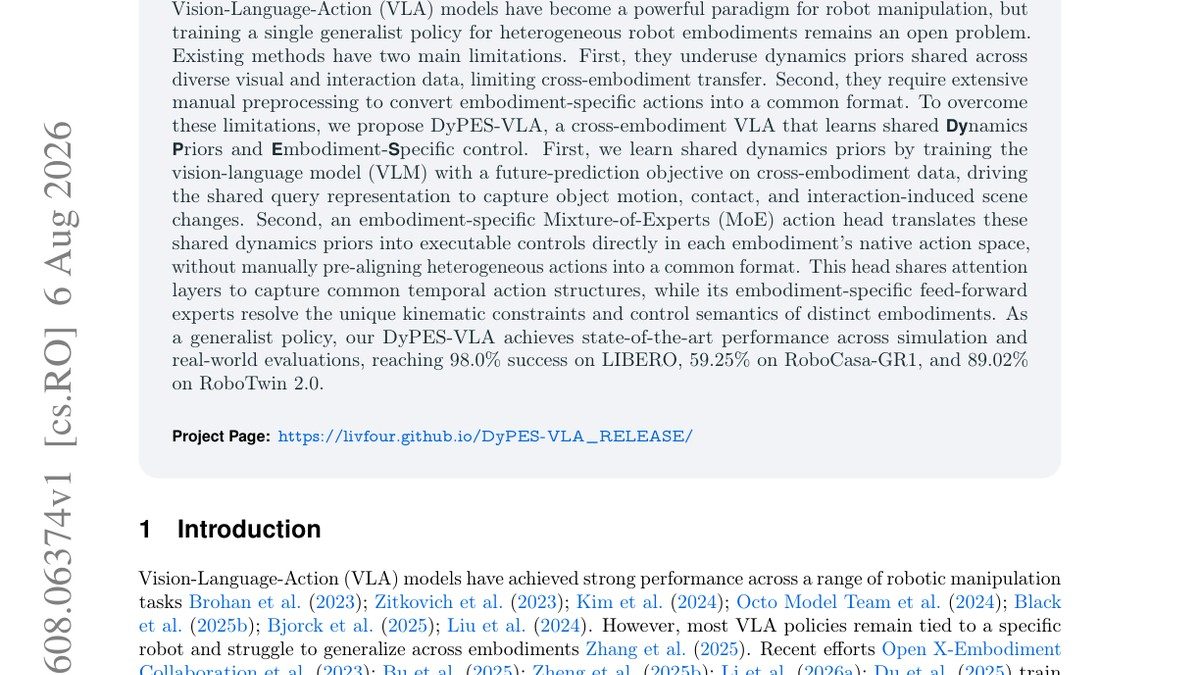
DyPES-VLA: Learning Shared Dynamics Priors and Embodiment-Specific Control for Cross-Embodiment Manipulation
Junfeng Li, Junjie He, Zhide Zhong et al. · arXiv preprint · Aug 2026
Vision-Language-Action (VLA) models have become a powerful paradigm for robot manipulation, but training a single generalist policy for heterogeneous robot embodiments remains an open problem. Existing methods have two main limitations. First, they underuse dynamics priors shared across diverse v...
FlashVLA: Streaming Action Decoding for Fast and Asynchronous VLA Inference
Zekai Li, Jiaming Tang, Zhijian Liu · arXiv preprint · Aug 2026
Vision-Language-Action (VLA) models are increasingly promising for robotic manipulation, yet their real-world deployment remains bottlenecked by high inference latency and unstable asynchronous execution. This challenge is particularly pronounced in flow-matching-based VLA models, where action de...