
SI-Diff: A Framework for Learning Search and High-Precision Insertion with a Force-Domain Diffusion Policy
Yibo Liu, Stanko Oparnica, Simon Shewchun-Jakaitis, Guoyi Fu, Jie Wang, Jun Yang, Anand Jagannathan, Tony Hong-Yau Lo · · 2026
Framework
N/A
License
N/A
Stars
0
Summary
Contact-rich manipulation is fundamental in robotics but poses significant challenges due to uncertainties in relative poses, such as misalignments and small clearances in peg-in-hole tasks. Existing approaches typically address search and...
Abstract Summary
Key Points
- Introduces SI-Diff, advancing manipulation research.
- Detailed evaluation demonstrates effectiveness on benchmarks and real-world scenarios.
- Provides insights into methodology and architectural choices.
Abstract
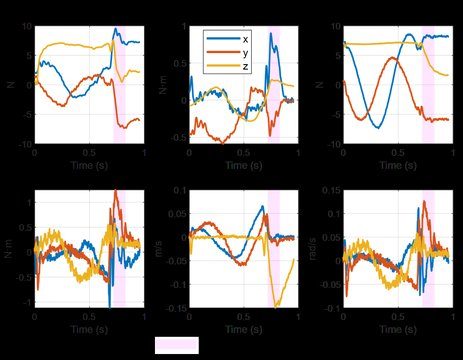
Contact-rich manipulation is fundamental in robotics but poses significant challenges due to uncertainties in relative poses, such as misalignments and small clearances in peg-in-hole tasks. Existing approaches typically address search and high-precision insertion separately, because these tasks involve distinct action patterns. However, supporting both tasks within a single model, without switching models or weights, is desirable for intelligent manipulation systems. In this work, we propose SI-Diff, a framework that learns both search and high-precision insertion through a force-domain diffusion policy. To this end, we introduce a new mode-conditioning mechanism that enables the policy to capture distinct action behaviors under a single framework. Moreover, we develop a new search teacher policy that can generate diverse trajectories. By training on successful and efficient demonstrations provided by the teacher policy, the model learns the mapping from tactile and end-effector velocity observations to effective action behaviors. We conduct thorough experiments to show that SI-Diff extends the tolerance to x-y misalignments from 2 mm to 5 mm compared to the state-of-the-art baseline, TacDiffusion, while also demonstrating strong zero-shot transferability to unseen shapes.
Links
- Paper (PDF): 2605.12247
- arXiv: 2605.12247
Related Papers
Beyond Binary: Sim-to-Real Dexterous Manipulation with Physics-Grounded Contact Representation
Jiahe Pan, Stelian Coros, Jitendra Malik et al. · arXiv preprint · May 2026
A primary bottleneck in contact-rich manipulation is the difficulty of collecting real-world data. Sim-to-real reinforcement learning offers a scalable alternative, but the simulation-reality gap prev
Design and Evaluation of a Touchscreen-Based Teleoperation Interface for Robotic Manipulators
Juan José García Cárdenas, Alperen Kenan, Hamidreza Raei et al. · arXiv preprint · Aug 2026
Intuitive teleoperation interfaces are crucial for the safe and effective operation of robotic manipulators in challenging environments. In the nuclear industry, surface contact tasks such as swab sampling require precise path and force tracking, obstacle avoidance, and sustained operator attenti...
EgoForce: Forearm-Guided Camera-Space 3D Hand Pose from a Monocular Egocentric Camera
Christen Millerdurai, Shaoxiang Wang, Yaxu Xie et al. · SIGGRAPH 2026 · May 2026
Reconstructing the absolute 3D pose and shape of the hands from the user's viewpoint using a single head-mounted camera is crucial for practical egocentric interaction in AR/VR, telepresence, and hand-centric manipulation tasks, where sensing must...
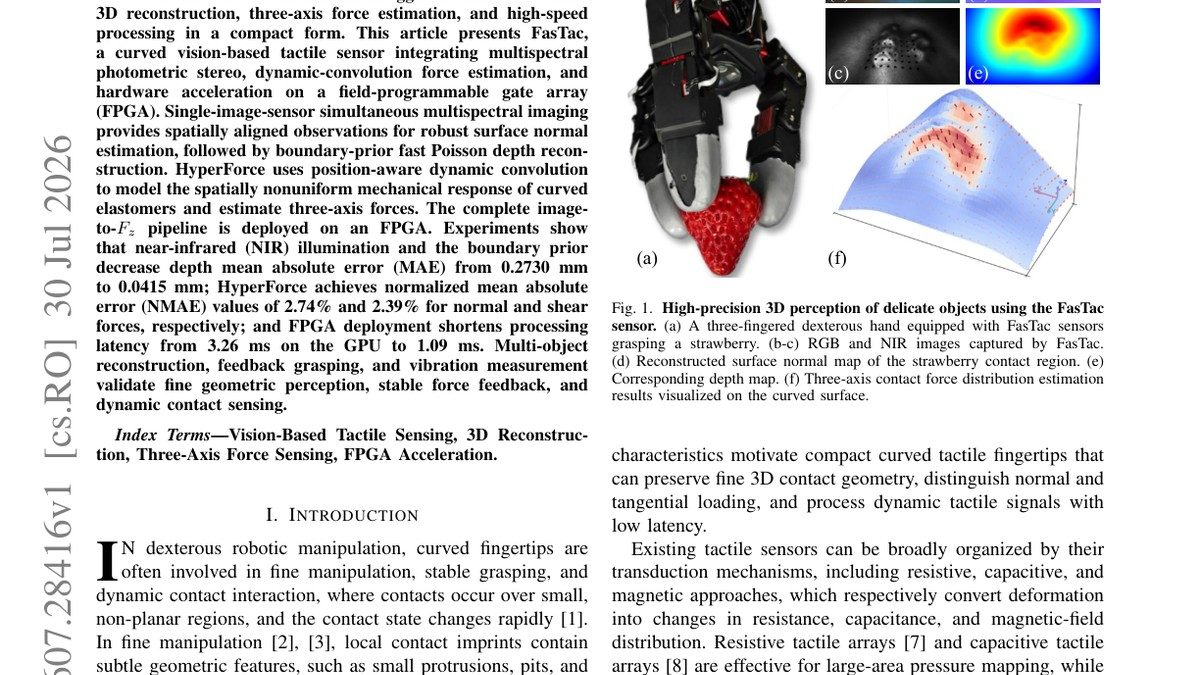
FasTac: A Curved Multispectral Vision-Based Tactile Sensor for High-Speed High-Precision 3D Shape and Force Perception
Xiaofan Lu, Kaiji Huang, Jiahui Chen et al. · arXiv preprint · Jul 2026
Curved tactile fingertips for dexterous manipulation must resolve fine contact geometry, distinguish normal and tangential loads, and capture transient signals. Existing curved vision-based tactile sensors struggle to combine accurate 3D reconstruction, three-axis force estimation, and high-speed...