
EgoForce: Forearm-Guided Camera-Space 3D Hand Pose from a Monocular Egocentric Camera
Christen Millerdurai, Shaoxiang Wang, Yaxu Xie, Vladislav Golyanik, Didier Stricker, Alain Pagani · · 2026
Framework
N/A
License
N/A
Stars
0
Summary
Reconstructing the absolute 3D pose and shape of the hands from the user's viewpoint using a single head-mounted camera is crucial for practical egocentric interaction in AR/VR, telepresence, and hand-centric manipulation tasks, where sensing must...
Abstract Summary
Key Points
- Introduces EgoForce, advancing manipulation research.
- Detailed evaluation demonstrates effectiveness on benchmarks and real-world scenarios.
- Provides insights into methodology and architectural choices.
Abstract
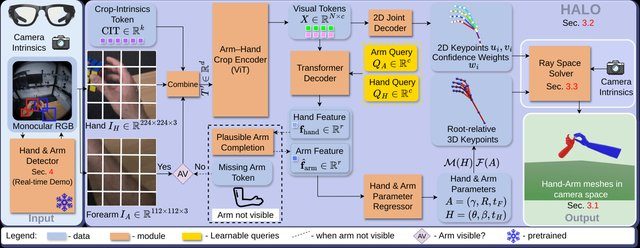
Reconstructing the absolute 3D pose and shape of the hands from the user’s viewpoint using a single head-mounted camera is crucial for practical egocentric interaction in AR/VR, telepresence, and hand-centric manipulation tasks, where sensing must remain compact and unobtrusive. While monocular RGB methods have made progress, they remain constrained by depth-scale ambiguity and struggle to generalize across the diverse optical configurations of head-mounted devices. As a result, models typically require extensive training on device-specific datasets, which are costly and laborious to acquire. This paper addresses these challenges by introducing EgoForce, a monocular 3D hand reconstruction framework that recovers robust, absolute 3D hand pose and its position from the user’s (camera-space) viewpoint. EgoForce operates across fisheye, perspective, and distorted wide-FOV camera models using a single unified network. Our approach combines a differentiable forearm representation that stabilizes hand pose, a unified arm-hand transformer that predicts both hand and forearm geometry from a single egocentric view, mitigating depth-scale ambiguity, and a ray space closed-form solver that enables absolute 3D pose recovery across diverse head-mounted camera models. Experiments on three egocentric benchmarks show that EgoForce achieves state-of-the-art 3D accuracy, reducing camera-space MPJPE by up to 28% on the HOT3D dataset compared to prior methods and maintaining consistent performance across camera configurations. For more details, visit the project page at https://dfki-av.github.io/EgoForce.
Links
- Paper (PDF): 2605.12498
- arXiv: 2605.12498
Related Papers
Human-Centric Transferable Tactile Pre-Training for Dexterous Robotic Manipulation
Chi Zhang, Penglin Cai, Ziheng Xi et al. · arXiv preprint · Jul 2026
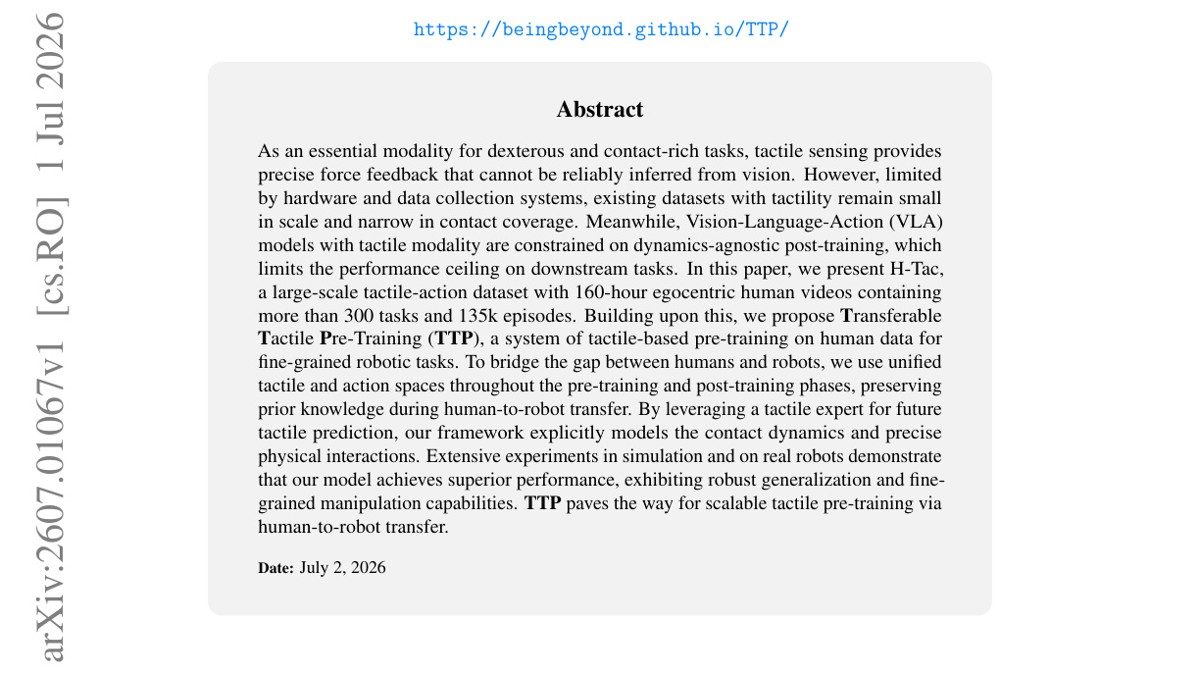
As an essential modality for dexterous and contact-rich tasks, tactile sensing provides precise force feedback that cannot be reliably inferred from vision. However, limited by har...
 Video
Video
MOCHI: Motion Enhancement of Collaborative Human-object Interactions
Jiye Lee, Yonghun Choi, Jungdam Won · SIGGRAPH 2026 (Journal Track) · Jun 2026
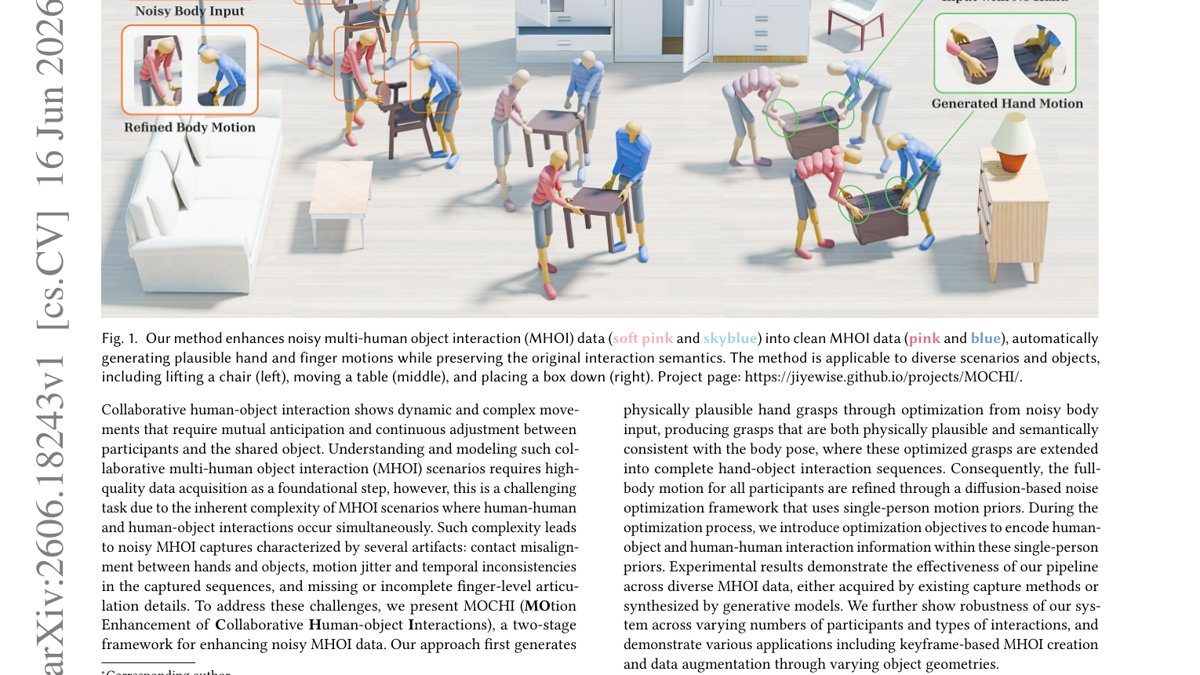
Two-stage framework that enhances noisy multi-human object interaction (MHOI) data by generating plausible hand grasps and refining full-body motion via diffusion-based optimization.
MoSA: Motion-constrained Stress Adaptation for Mitigating Real-to-Sim Gap in Continuum Dynamics
Jiaxu Wang, Junhao He, Jingkai Sun et al. · arXiv preprint · May 2026
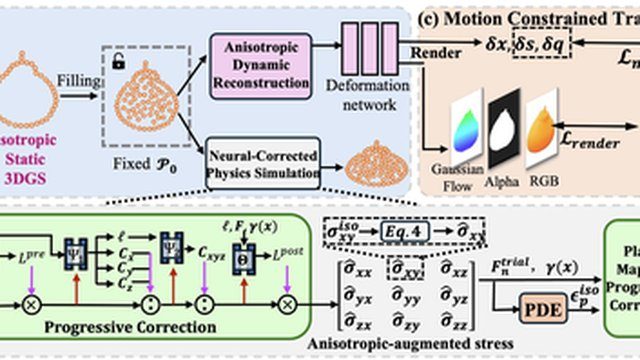
MoSA closes the real-to-sim gap for continuum robots by learning a residual stress field that captures anisotropic material behavior missed by standard simulators.

SafeManip: A Property-Driven Benchmark for Temporal Safety Evaluation in Robotic Manipulation
Chengyue Huang, Khang Vo Huynh, Sebastian Elbaum et al. · arXiv · May 2026
Robotic manipulation is typically evaluated by task success, but successful completion does not guarantee safe execution. Many rl failures are temporal: a robot may touch a clean surface after contamination or release an object before it is...