

SafeManip: A Property-Driven Benchmark for Temporal Safety Evaluation in Robotic Manipulation
Chengyue Huang, Khang Vo Huynh, Sebastian Elbaum, Zsolt Kira, Lu Feng · · 2026
Summary
Robotic manipulation is typically evaluated by task success, but successful completion does not guarantee safe execution. Many rl failures are temporal: a robot may touch a clean surface after contamination or release an object before it is...
Abstract Summary
Key Points
- Introduces SafeManip, advancing simulation research.
- Detailed simulation demonstrates effectiveness on benchmarks and real-world scenarios.
- Provides insights into methodology and architectural choices.
Abstract
Robotic manipulation is typically evaluated by task success, but successful completion does not guarantee safe execution. Many rl failures are temporal: a robot may touch a clean surface after contamination or release an object before it is fully inside an enclosure. We introduce SafeManip, a property-driven benchmark to explicitly evaluate temporal rl properties in robotic manipulation, moving beyond prior simulations that largely focus on task completion or per-state constraint violations. SafeManip defines reusable rl templates over finite executions using Linear Temporal Logic over finite traces (LTLf). It maps observed rollouts to symbolic predicate traces and evaluates them with LTLf-based monitors. Its property suite covers eight manipulation rl categories: collision and contact rl, grasp stability, release stability, cross-contamination, action onset, mechanism recovery, object containment, and enclosure access. Templates can be instantiated with task-specific objects, fixtures, regions, or skills, allowing the same rl specifications to generalize across tasks and environments. We evaluate SafeManip on six vision-language-action policies, including $π_0$, $π_{0.5}$, GR00T, and their training variants, across 50 RoboCasa365 household tasks. Results show that even strong models often behave unsafely. Task-success gains do not reliably translate into safer execution: many successful rollouts remain unsafe, while longer-horizon or more complex tasks expose more violations. SafeManip provides a reusable simulation layer for diagnosing temporal rl failures and measuring safe success beyond task completion.
Links
- Paper (PDF): 2605.12386
- arXiv: 2605.12386
Related Papers
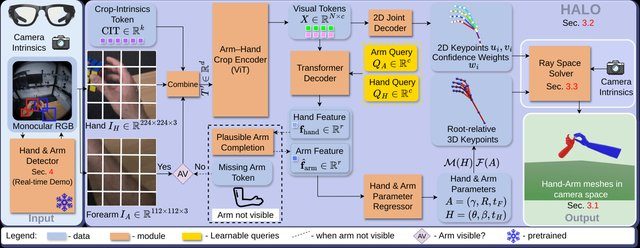
EgoForce: Forearm-Guided Camera-Space 3D Hand Pose from a Monocular Egocentric Camera
Christen Millerdurai, Shaoxiang Wang, Yaxu Xie et al. · SIGGRAPH 2026 · May 2026
Reconstructing the absolute 3D pose and shape of the hands from the user's viewpoint using a single head-mounted camera is crucial for practical egocentric interaction in AR/VR, telepresence, and hand-centric manipulation tasks, where sensing must...
CoRe: Combined Rewards with Vision-Language Model Feedback for Preference-Aligned Reinforcement Learning
Hexian Ni, Tao Lu, Yinghao Cai · ICML 2026 · Jul 2026
Reward design remains a central challenge in reinforcement learning (RL). Hand-crafted rewards are often difficult to specify and may lead to suboptimal policies, while learned rew...

Aligning Flow Map Policies with Optimal Q-Guidance
Christos Ziakas, Alessandra Russo, Avishek Joey Bose · arXiv · May 2026
Generative policies based on expressive model classes, such as diffusion-models and flow matching, are well-suited to complex control problems with highly multimodal action distributions. Their expressivity, however, comes at a significant inference cost:...
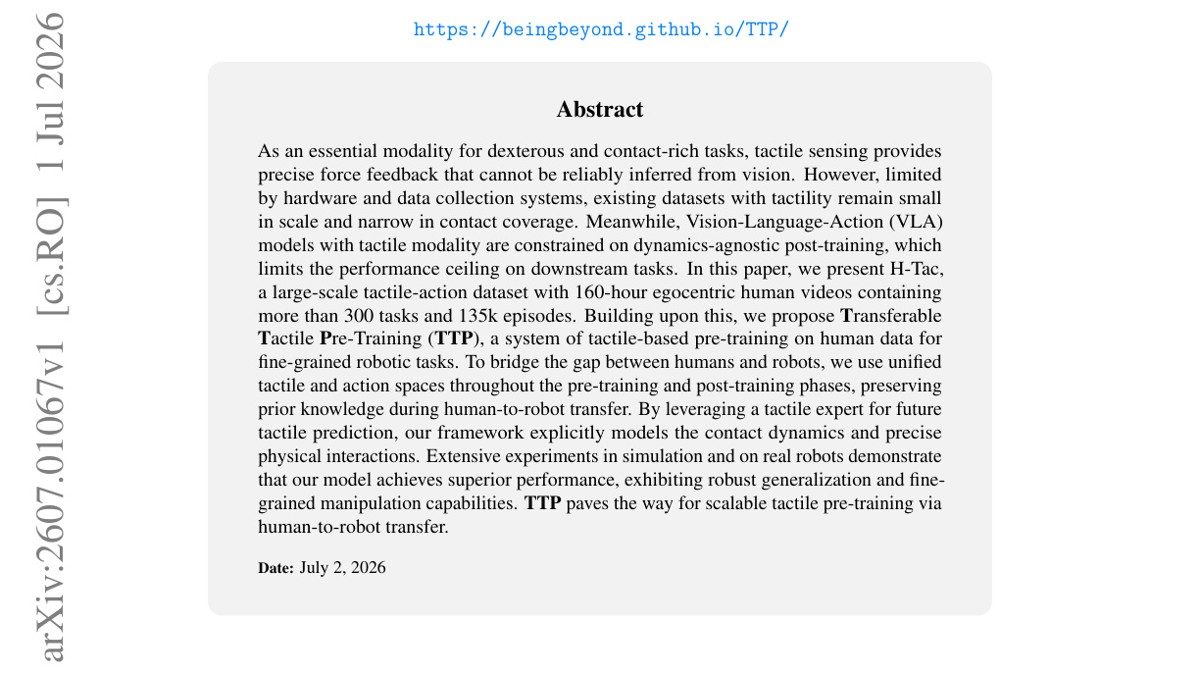
Human-Centric Transferable Tactile Pre-Training for Dexterous Robotic Manipulation
Chi Zhang, Penglin Cai, Ziheng Xi et al. · arXiv preprint · Jul 2026
As an essential modality for dexterous and contact-rich tasks, tactile sensing provides precise force feedback that cannot be reliably inferred from vision. However, limited by har...