
CoRe: Combined Rewards with Vision-Language Model Feedback for Preference-Aligned Reinforcement Learning
FeaturedHexian Ni, Tao Lu, Yinghao Cai · · 2026
Framework
N/A
License
N/A
Stars
N/A
Summary
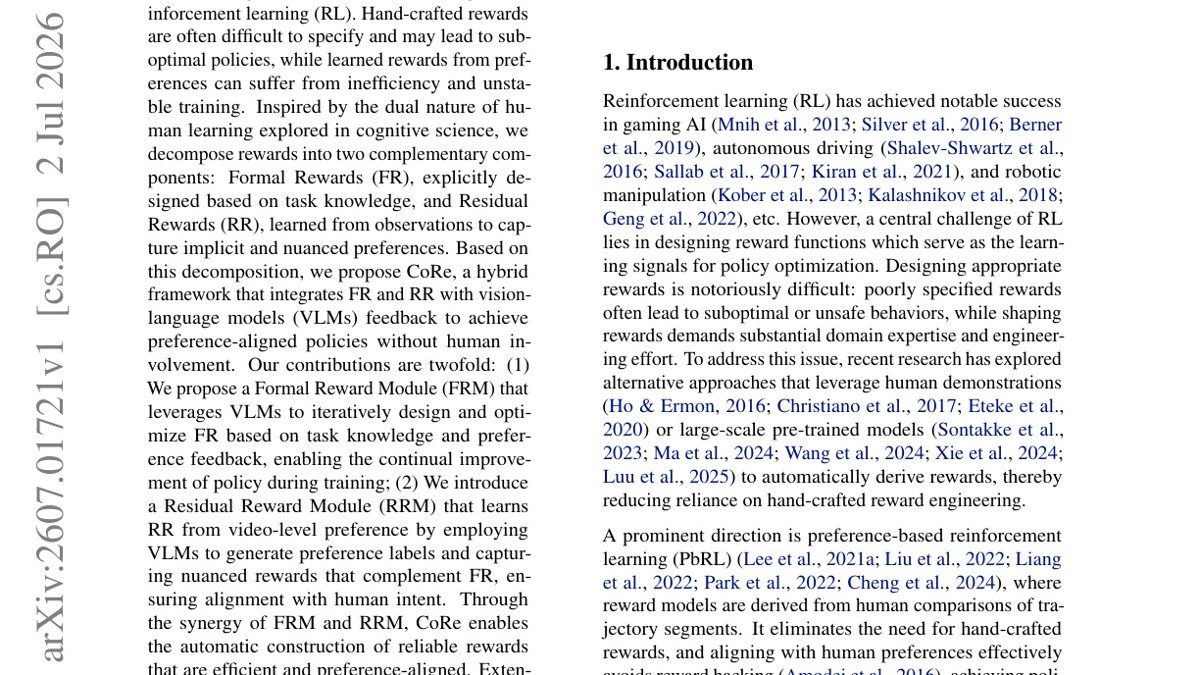
Reward design remains a central challenge in reinforcement learning (RL). Hand-crafted rewards are often difficult to specify and may lead to suboptimal policies, while learned rew...
Abstract Summary
Key Points
- Proposes CoRe for robotics.
- Evaluated on real or simulated robotic tasks.
- Primary contribution in ar-vr.
Related Papers
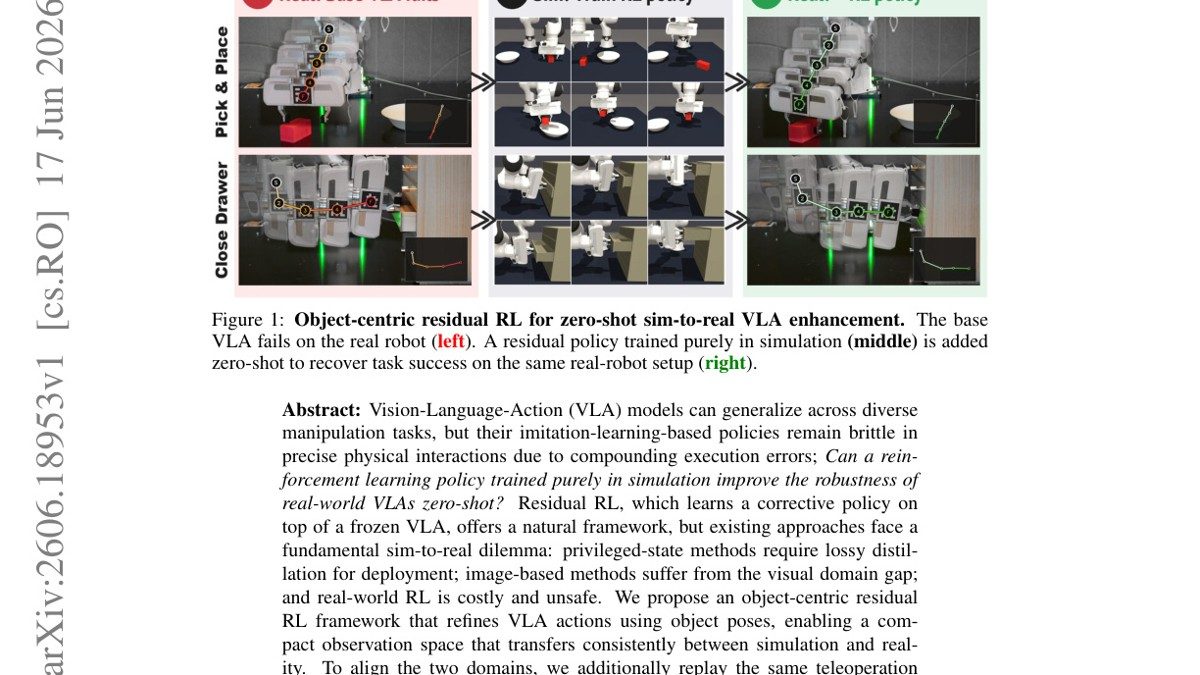
Object-Centric Residual RL for Zero-Shot Sim-to-Real VLA Enhancement
Kinam Kim, Namiko Saito, Heecheol Kim et al. · arXiv preprint · Jun 2026
Vision-Language-Action (VLA) models can generalize across diverse manipulation tasks, but their imitation-learning-based policies remain brittle in precise physical interactions du...
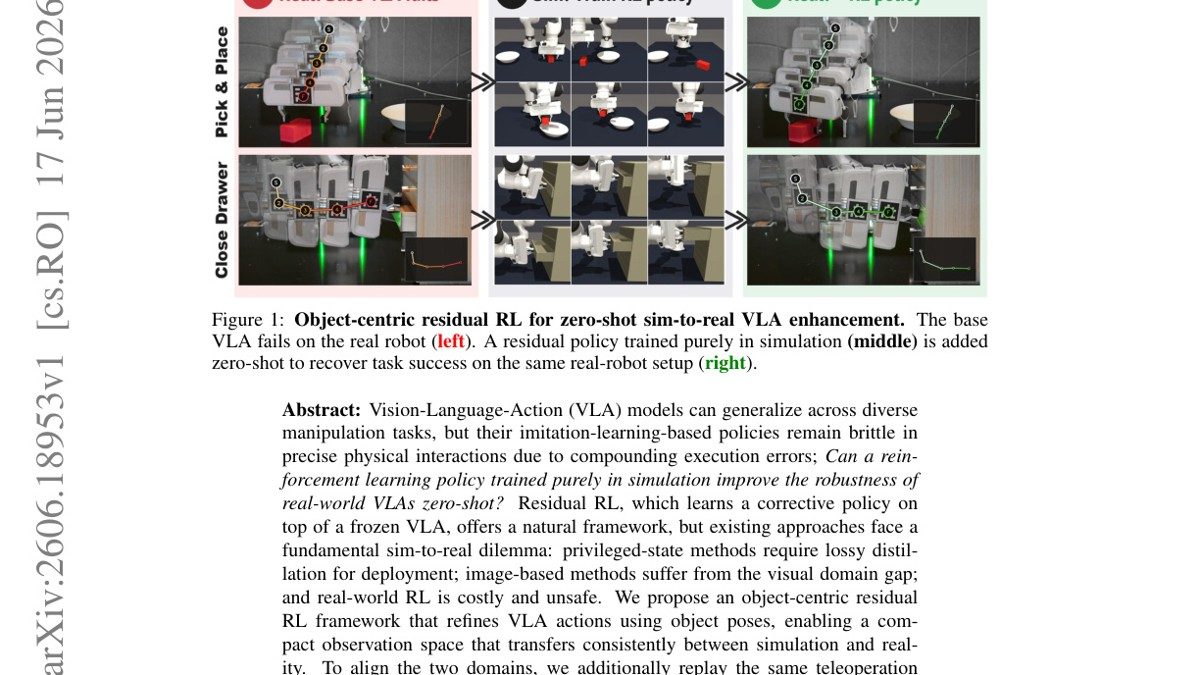
Object-Centric Residual RL for Zero-Shot Sim-to-Real VLA Enhancement
Kinam Kim, Namiko Saito, Heecheol Kim et al. · arXiv preprint · Jun 2026
Vision-Language-Action (VLA) models can generalize across diverse manipulation tasks, but their imitation-learning-based policies remain brittle in precise physical interactions du...

Pose6DAug: Physically Plausible Multi-view Object Swapping for Robot Data Augmentation
Jonghoon Lee, Seong Hyeon Park, Byungwoo Jeon et al. · arXiv preprint · Jun 2026
Vision-language-action (VLA) policies have shown strong potential for general-purpose manipulation, yet they often fail on novel, out-of-distribution objects whose appearance or ge...
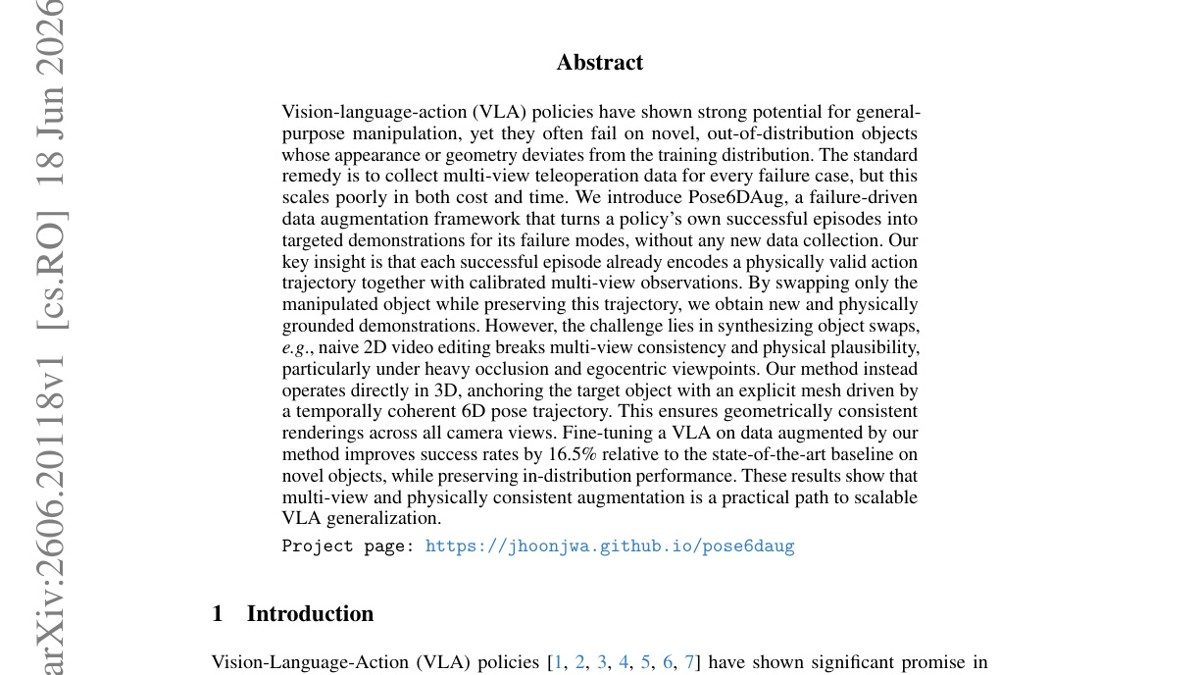
Pose6DAug: Physically Plausible Multi-view Object Swapping for Robot Data Augmentation
Jonghoon Lee, Seong Hyeon Park, Byungwoo Jeon et al. · arXiv preprint · Jun 2026
Vision-language-action (VLA) policies have shown strong potential for general-purpose manipulation, yet they often fail on novel, out-of-distribution objects whose appearance or ge...