

Aligning Flow Map Policies with Optimal Q-Guidance
Christos Ziakas, Alessandra Russo, Avishek Joey Bose · · 2026
Summary
Generative policies based on expressive model classes, such as diffusion-models and flow matching, are well-suited to complex control problems with highly multimodal action distributions. Their expressivity, however, comes at a significant inference cost:...
Abstract Summary
Key Points
- Introduces Aligning Flow Map Policies with Optimal Q-Guidance, advancing rl research.
- Detailed evaluation demonstrates effectiveness on benchmarks and real-world scenarios.
- Provides insights into methodology and architectural choices.
Abstract
Generative policies based on expressive model classes, such as diffusion-models and flow matching, are well-suited to complex control problems with highly multimodal action distributions. Their expressivity, however, comes at a significant inference cost: generating each action typically requires simulating many steps of the generative process, compounding latency across sequential decision-making rollouts. We introduce flow map policies, a novel class of generative policies designed for fast action generation by learning to take arbitrary-size jumps including one-step jumps-across the generative dynamics of existing flow-based policies. We instantiate flow map policies for offline-to-online reinforcement learning (RL) and formulate online adaptation as a trust-region optimization problem that improves the critic’s Q-value while remaining close to the offline policy. We theoretically derive FLOW MAP Q-GUIDANCE (FMQ), a principled closed-form learning target that is optimal for adapting offline flow map policies under a critic-guided trust-region constraint. We further introduce Q-GUIDED BEAM SEARCH (QGBS), a stochastic flow-map sampler that combines renoising with beam search to enable iterative inference-time refinement. Across 12 challenging robotic manipulation and locomotion tasks from OGBench and RoboMimic, FMQ achieves state-of-the-art performance in offline-to-online RL, outperforming the previous one-step policy MVP by a relative improvement of 21.3% on the average success rate.
Links
- Paper (PDF): 2605.12416
- arXiv: 2605.12416
Related Papers
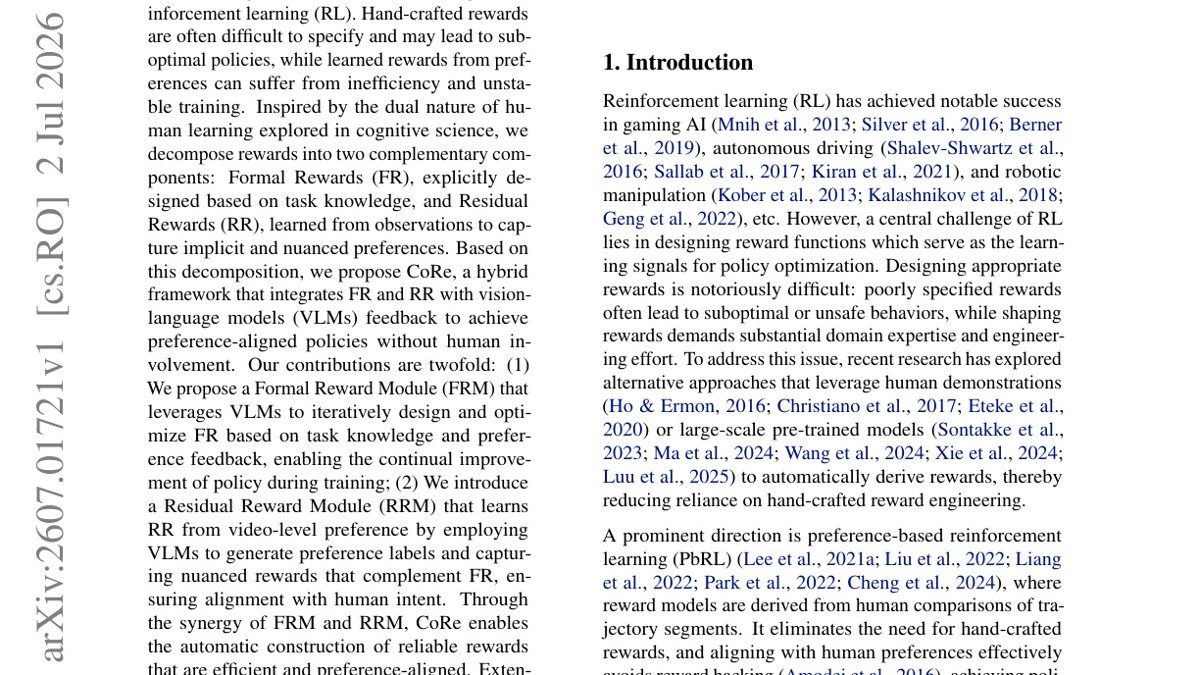
CoRe: Combined Rewards with Vision-Language Model Feedback for Preference-Aligned Reinforcement Learning
Hexian Ni, Tao Lu, Yinghao Cai · ICML 2026 · Jul 2026
Reward design remains a central challenge in reinforcement learning (RL). Hand-crafted rewards are often difficult to specify and may lead to suboptimal policies, while learned rew...
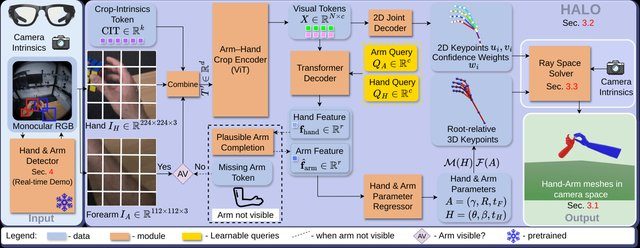
EgoForce: Forearm-Guided Camera-Space 3D Hand Pose from a Monocular Egocentric Camera
Christen Millerdurai, Shaoxiang Wang, Yaxu Xie et al. · SIGGRAPH 2026 · May 2026
Reconstructing the absolute 3D pose and shape of the hands from the user's viewpoint using a single head-mounted camera is crucial for practical egocentric interaction in AR/VR, telepresence, and hand-centric manipulation tasks, where sensing must...
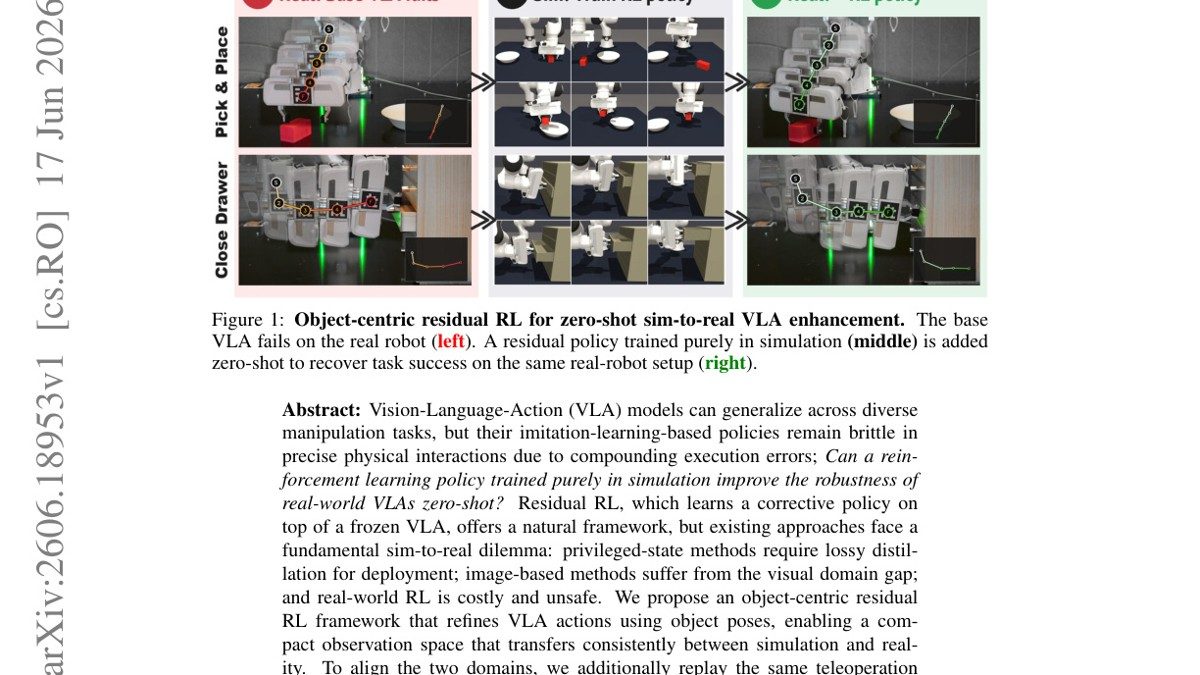
Object-Centric Residual RL for Zero-Shot Sim-to-Real VLA Enhancement
Kinam Kim, Namiko Saito, Heecheol Kim et al. · arXiv preprint · Jun 2026
Vision-Language-Action (VLA) models can generalize across diverse manipulation tasks, but their imitation-learning-based policies remain brittle in precise physical interactions du...
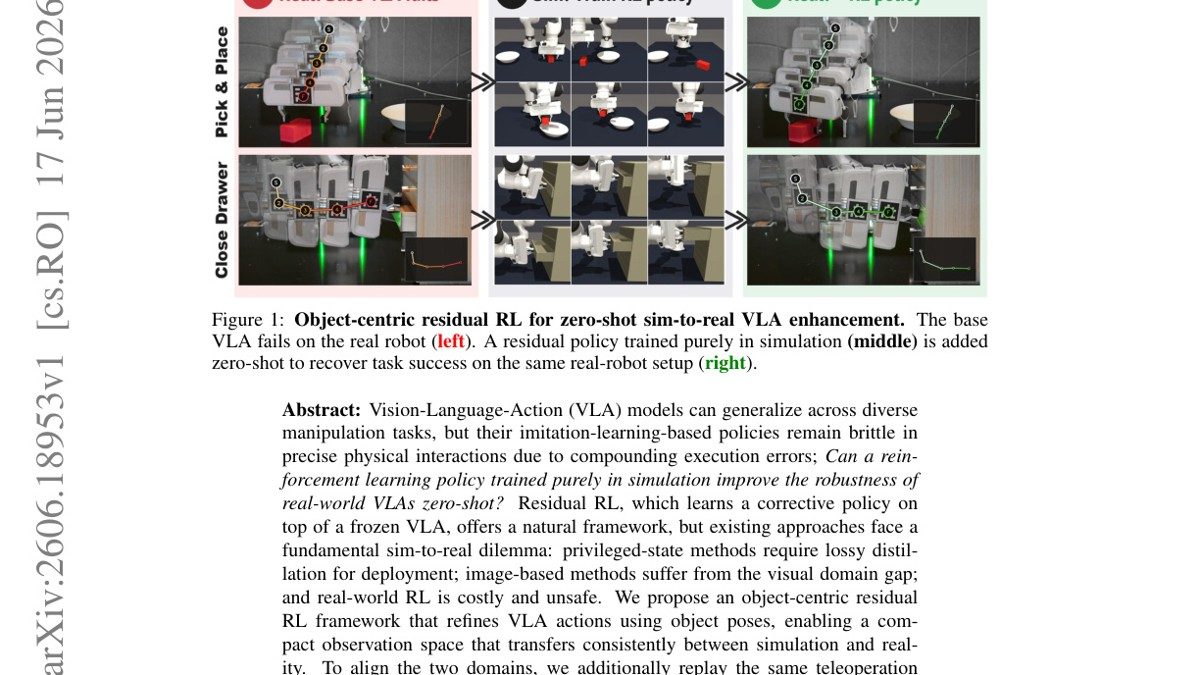
Object-Centric Residual RL for Zero-Shot Sim-to-Real VLA Enhancement
Kinam Kim, Namiko Saito, Heecheol Kim et al. · arXiv preprint · Jun 2026
Vision-Language-Action (VLA) models can generalize across diverse manipulation tasks, but their imitation-learning-based policies remain brittle in precise physical interactions du...