
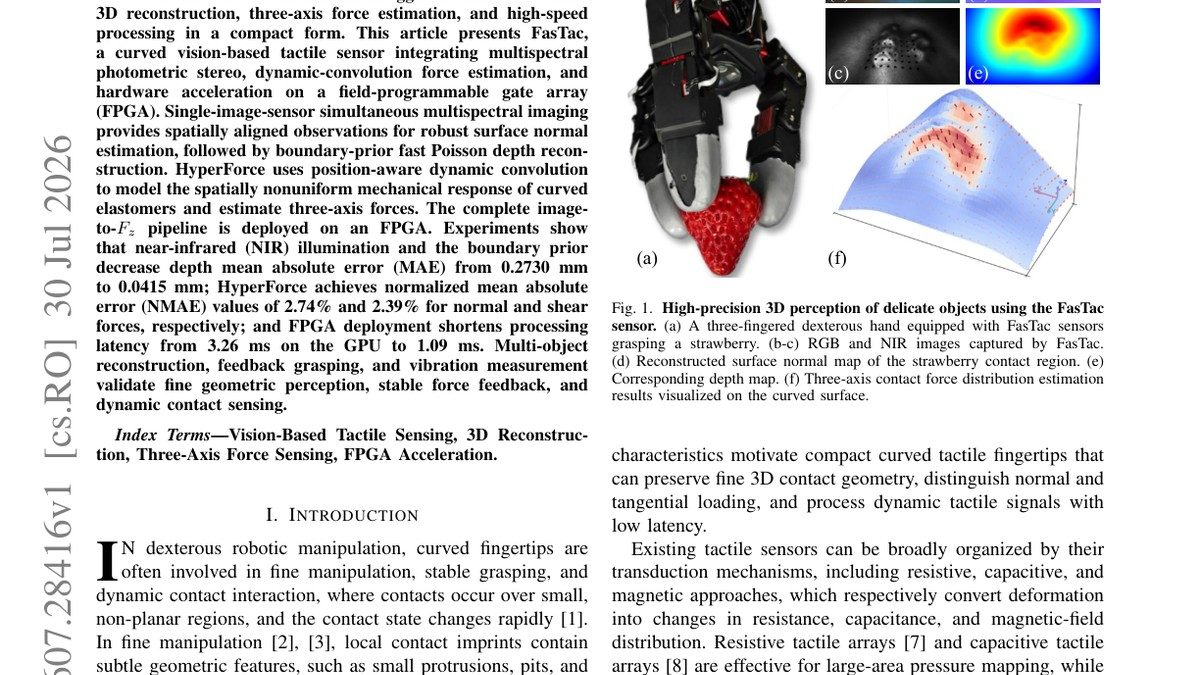
FasTac: A Curved Multispectral Vision-Based Tactile Sensor for High-Speed High-Precision 3D Shape and Force Perception
Xiaofan Lu, Kaiji Huang, Jiahui Chen, Yuankai Lin, Hua Yang, Zhouping Yin · N/A · 2026
Framework
N/A
License
N/A
Stars
N/A
Summary
Curved tactile fingertips for dexterous manipulation must resolve fine contact geometry, distinguish normal and tangential loads, and capture transient signals. Existing curved vision-based tactile sensors struggle to combine accurate 3D reconstruction, three-axis force estimation, and high-speed...
Abstract Summary
Key Points
- Curved tactile fingertips for dexterous manipulation must resolve fine contact geometry, distingu...
- Existing curved vision-based tactile sensors struggle to combine accurate 3D reconstruction, thre...
- This article presents FasTac, a curved vision-based tactile sensor integrating multispectral phot...
- Single-image-sensor simultaneous multispectral imaging provides spatially aligned observations fo...
- HyperForce uses position-aware dynamic convolution to model the spatially nonuniform mechanical r...
FasTac: A Curved Multispectral Vision-Based Tactile Sensor for High-Speed High-Precision 3D Shape and Force Perception
|Authors: Xiaofan Lu, Kaiji Huang, Jiahui Chen, Yuankai Lin, Hua Yang, Zhouping Yin
|Venue: arXiv preprint | Year: 2026
|arXiv: 2607.28416v1
Abstract
Curved tactile fingertips for dexterous manipulation must resolve fine contact geometry, distinguish normal and tangential loads, and capture transient signals. Existing curved vision-based tactile sensors struggle to combine accurate 3D reconstruction, three-axis force estimation, and high-speed processing in a compact form. This article presents FasTac, a curved vision-based tactile sensor integrating multispectral photometric stereo, dynamic-convolution force estimation, and hardware acceleration on a field-programmable gate array (FPGA). Single-image-sensor simultaneous multispectral imaging provides spatially aligned observations for robust surface normal estimation, followed by boundary-prior fast Poisson depth reconstruction. HyperForce uses position-aware dynamic convolution to model the spatially nonuniform mechanical response of curved elastomers and estimate three-axis forces. The complete image-to-normal-force pipeline is deployed on an FPGA. Experiments show that near-infrared (NIR) illumination and the boundary prior decrease depth mean absolute error (MAE) from 0.2730 mm to 0.0415 mm; HyperForce achieves normalized mean absolute error (NMAE) values of 2.74% and 2.39% for normal and shear forces, respectively; and FPGA deployment shortens processing latency from 3.26 ms on the GPU to 1.09 ms. Multi-object reconstruction, feedback grasping, and vibration measurement validate fine geometric perception, stable force feedback, and dynamic contact sensing.
Key Contributions
- Curved tactile fingertips for dexterous manipulation must resolve fine contact geometry, distingu…
- Existing curved vision-based tactile sensors struggle to combine accurate 3D reconstruction, thre…
- This article presents FasTac, a curved vision-based tactile sensor integrating multispectral phot…
- Single-image-sensor simultaneous multispectral imaging provides spatially aligned observations fo…
- HyperForce uses position-aware dynamic convolution to model the spatially nonuniform mechanical r…
Topics
- manipulation
- vision
- tactile
Code & Data
No code repository linked in paper metadata.
BibTeX
@article{Lu2026_260728416v1,
  title     = {FasTac: A Curved Multispectral Vision-Based Tactile Sensor for High-Speed High-Precision 3D Shape and Force Perception},
  author    = {Xiaofan Lu and Kaiji Huang and Jiahui Chen and Yuankai Lin and Hua Yang and Zhouping Yin},
  year      = {2026},
  eprint    = {2607.28416v1},
  archivePrefix = {arXiv},
  primaryClass  = {cs.RO},
  url       = {https://arxiv.org/abs/2607.28416v1}
}
Related Papers
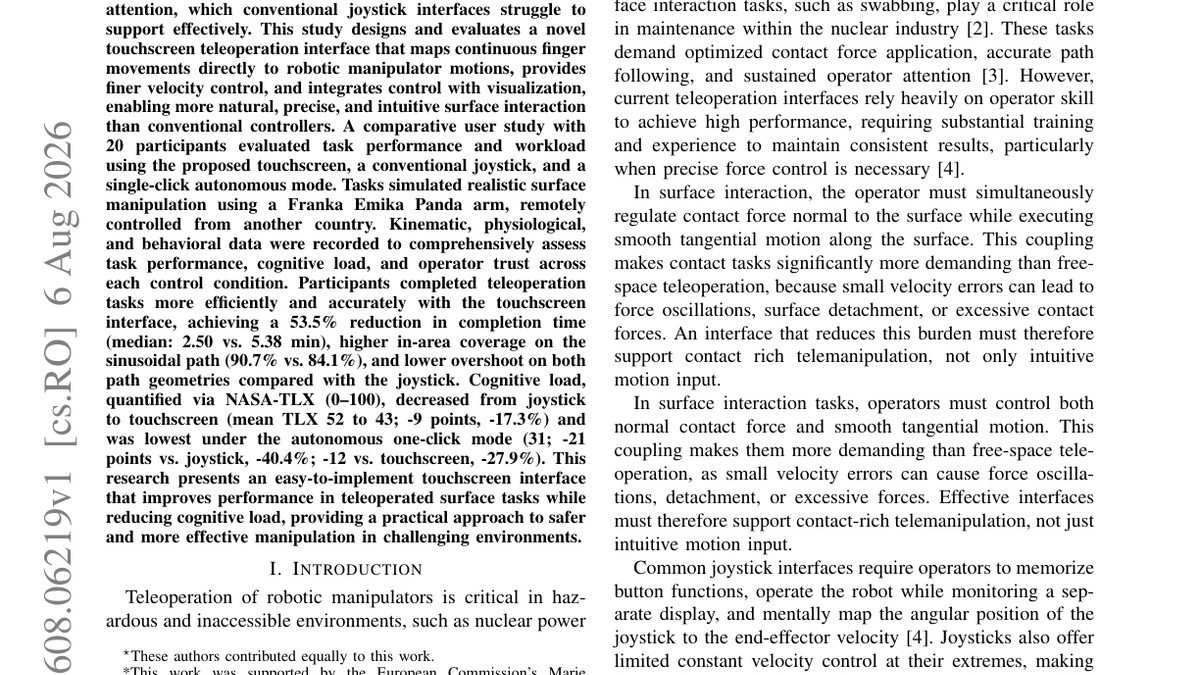
Design and Evaluation of a Touchscreen-Based Teleoperation Interface for Robotic Manipulators
Juan José García Cárdenas, Alperen Kenan, Hamidreza Raei et al. · arXiv preprint · Aug 2026
Intuitive teleoperation interfaces are crucial for the safe and effective operation of robotic manipulators in challenging environments. In the nuclear industry, surface contact tasks such as swab sampling require precise path and force tracking, obstacle avoidance, and sustained operator attenti...
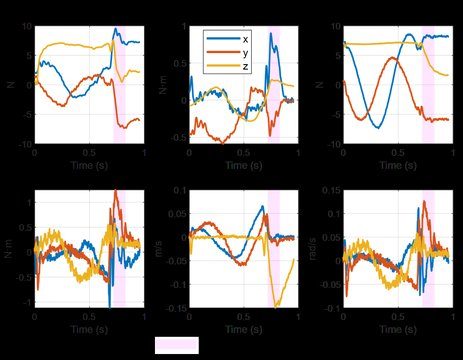
SI-Diff: A Framework for Learning Search and High-Precision Insertion with a Force-Domain Diffusion Policy
Yibo Liu, Stanko Oparnica, Simon Shewchun-Jakaitis et al. · arXiv · May 2026
Contact-rich manipulation is fundamental in robotics but poses significant challenges due to uncertainties in relative poses, such as misalignments and small clearances in peg-in-hole tasks. Existing approaches typically address search and...
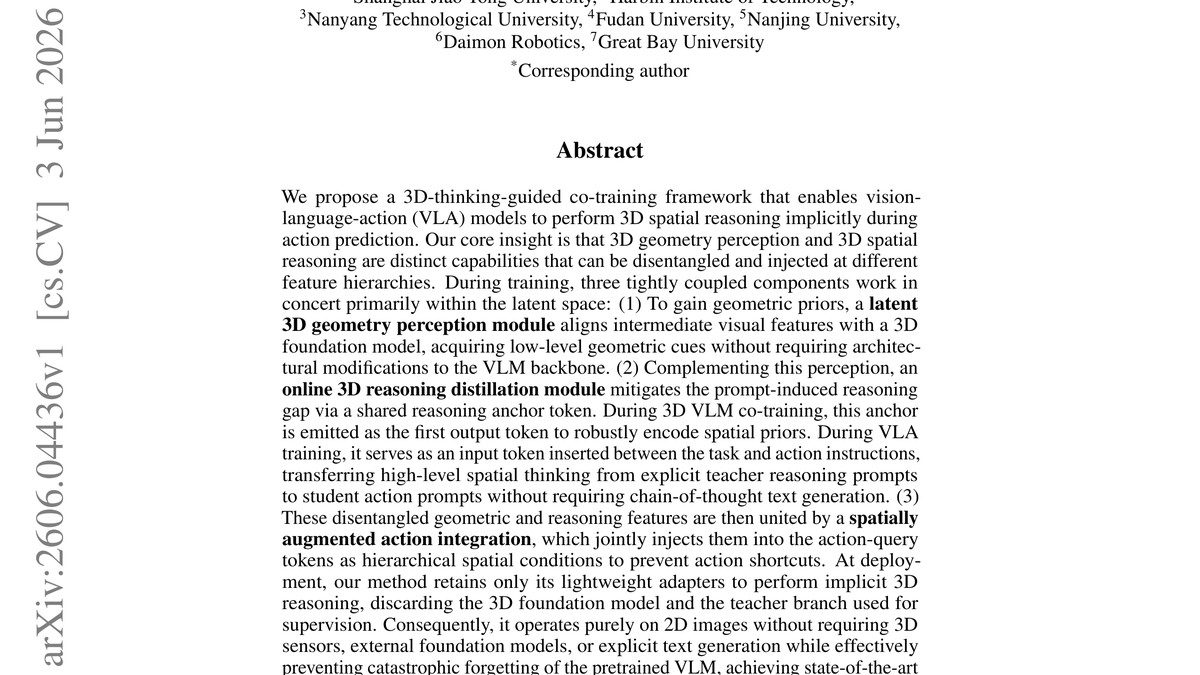
3DThinkVLA: Endowing Vision-Language-Action Models with Latent 3D Priors via 3D-Thinking-Guided Co-training
Jiaxin Shi, Xidong Zhang, Fucai Zhu et al. · arXiv preprint · Jun 2026
We propose a 3D-thinking-guided co-training framework that enables vision-language-action (VLA) models to perform 3D spatial reasoning implicitly during action prediction. Our core insight is that 3D geometry perception and 3D spatial reasoning are distinct capabilities that can be disentangled and ...
Adaptive Vision-Language Grasping via Composable Foundation Priors and Generalizable Grasp Synthesis
Sixu Yan, Shikang Wang, Binhua Huang et al. · arXiv preprint · Sep 2026
This paper proposes AdaRoboVLG, a task-adaptive Vision-Language-Grasp (VLG) framework that supports generalizable grasp synthesis across different robotic hands. Unlike existing VLG methods that tightly couple foundation models with end-to-end grasp policies, AdaRoboVLG learns an efficient genera...