
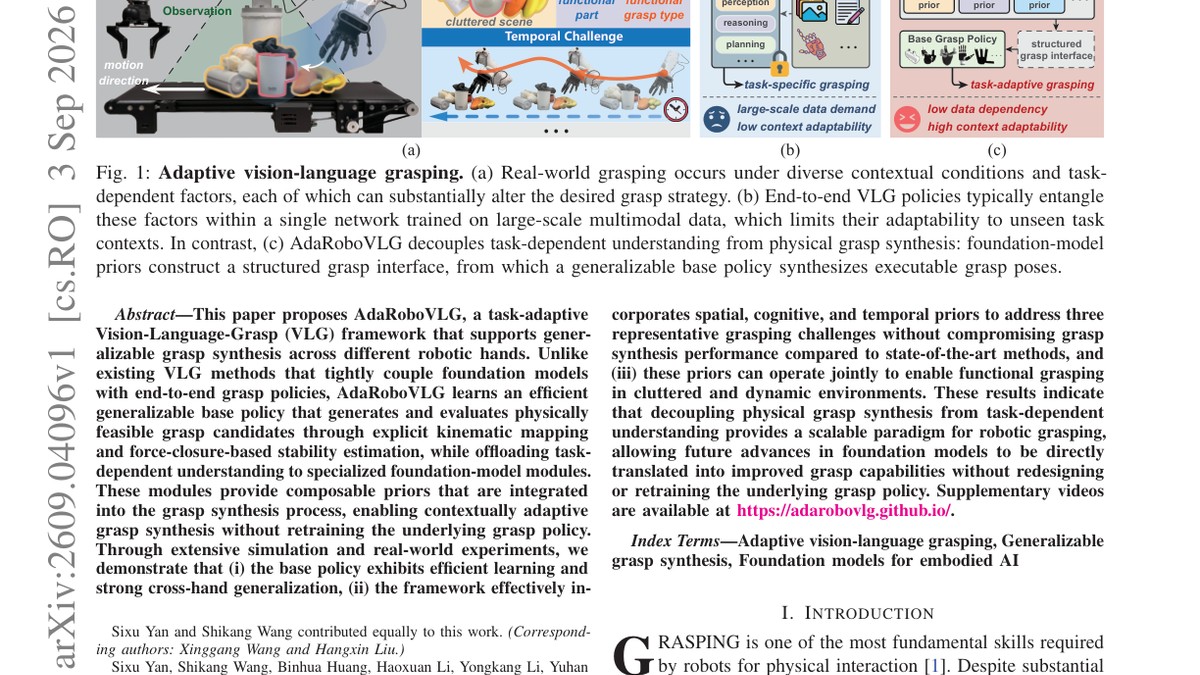
Adaptive Vision-Language Grasping via Composable Foundation Priors and Generalizable Grasp Synthesis
Sixu Yan, Shikang Wang, Binhua Huang, Xuanlai Tang, Guohua Fan, Fan Huang, Haoxuan Li, Yongkang Li, Yuhan Li, Bencheng Liao, Zeyu Zhang, Wenyu Liu, Hangxin Liu, Xinggang Wang · N/A · 2026
Framework
N/A
License
N/A
Stars
N/A
Summary
This paper proposes AdaRoboVLG, a task-adaptive Vision-Language-Grasp (VLG) framework that supports generalizable grasp synthesis across different robotic hands. Unlike existing VLG methods that tightly couple foundation models with end-to-end grasp policies, AdaRoboVLG learns an efficient genera...
Abstract Summary
Key Points
- This paper proposes AdaRoboVLG, a task-adaptive Vision-Language-Grasp (VLG) framework that suppor...
- Unlike existing VLG methods that tightly couple foundation models with end-to-end grasp policies,...
- These modules provide composable priors that are integrated into the grasp synthesis process, ena...
- Through extensive simulation and real-world experiments, we demonstrate that (i) the base policy ...
- These results indicate that decoupling physical grasp synthesis from task-dependent understanding...
Adaptive Vision-Language Grasping via Composable Foundation Priors and Generalizable Grasp Synthesis
|Authors: Sixu Yan, Shikang Wang, Binhua Huang, Xuanlai Tang, Guohua Fan, Fan Huang, Haoxuan Li, Yongkang Li, Yuhan Li, Bencheng Liao, Zeyu Zhang, Wenyu Liu, Hangxin Liu, Xinggang Wang
|Venue: arXiv preprint | Year: 2026
|arXiv: 2609.04096v1
Abstract
This paper proposes AdaRoboVLG, a task-adaptive Vision-Language-Grasp (VLG) framework that supports generalizable grasp synthesis across different robotic hands. Unlike existing VLG methods that tightly couple foundation models with end-to-end grasp policies, AdaRoboVLG learns an efficient generalizable base policy that generates and evaluates physically feasible grasp candidates through explicit kinematic mapping and force-closure-based stability estimation, while offloading task-dependent understanding to specialized foundation-model modules. These modules provide composable priors that are integrated into the grasp synthesis process, enabling contextually adaptive grasp synthesis without retraining the underlying grasp policy. Through extensive simulation and real-world experiments, we demonstrate that (i) the base policy exhibits efficient learning and strong cross-hand generalization, (ii) the framework effectively incorporates spatial, cognitive, and temporal priors to address three representative grasping challenges without compromising grasp synthesis performance compared to state-of-the-art methods, and (iii) these priors can operate jointly to enable functional grasping in cluttered and dynamic environments. These results indicate that decoupling physical grasp synthesis from task-dependent understanding provides a scalable paradigm for robotic grasping, allowing future advances in foundation models to be directly translated into improved grasp capabilities without redesigning or retraining the underlying grasp policy. Supplementary videos are available at https://adarobovlg.github.io/
Key Contributions
- This paper proposes AdaRoboVLG, a task-adaptive Vision-Language-Grasp (VLG) framework that suppor…
- Unlike existing VLG methods that tightly couple foundation models with end-to-end grasp policies,…
- These modules provide composable priors that are integrated into the grasp synthesis process, ena…
- Through extensive simulation and real-world experiments, we demonstrate that (i) the base policy …
- These results indicate that decoupling physical grasp synthesis from task-dependent understanding…
Topics
- manipulation
- vision
- reinforcement-learning
Code & Data
- GitHub repository: https://github.com/ByteDance-Seed/Seed-1.8
BibTeX
@article{Yan2026_260904096v1,
  title     = {Adaptive Vision-Language Grasping via Composable Foundation Priors and Generalizable Grasp Synthesis},
  author    = {Sixu Yan and Shikang Wang and Binhua Huang and Xuanlai Tang and Guohua Fan and Fan Huang and Haoxuan Li and Yongkang Li and Yuhan Li and Bencheng Liao and Zeyu Zhang and Wenyu Liu and Hangxin Liu and Xinggang Wang},
  year      = {2026},
  eprint    = {2609.04096v1},
  archivePrefix = {arXiv},
  primaryClass  = {cs.RO},
  url       = {https://arxiv.org/abs/2609.04096v1}
}
Related Papers
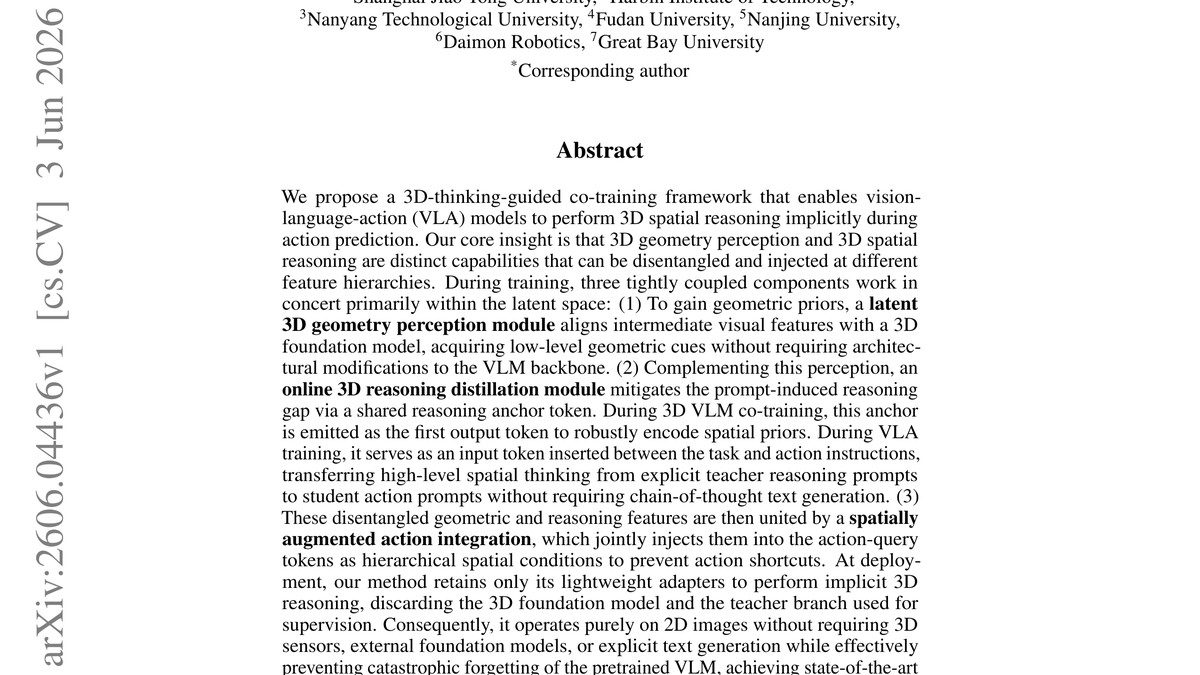
3DThinkVLA: Endowing Vision-Language-Action Models with Latent 3D Priors via 3D-Thinking-Guided Co-training
Jiaxin Shi, Xidong Zhang, Fucai Zhu et al. · arXiv preprint · Jun 2026
We propose a 3D-thinking-guided co-training framework that enables vision-language-action (VLA) models to perform 3D spatial reasoning implicitly during action prediction. Our core insight is that 3D geometry perception and 3D spatial reasoning are distinct capabilities that can be disentangled and ...
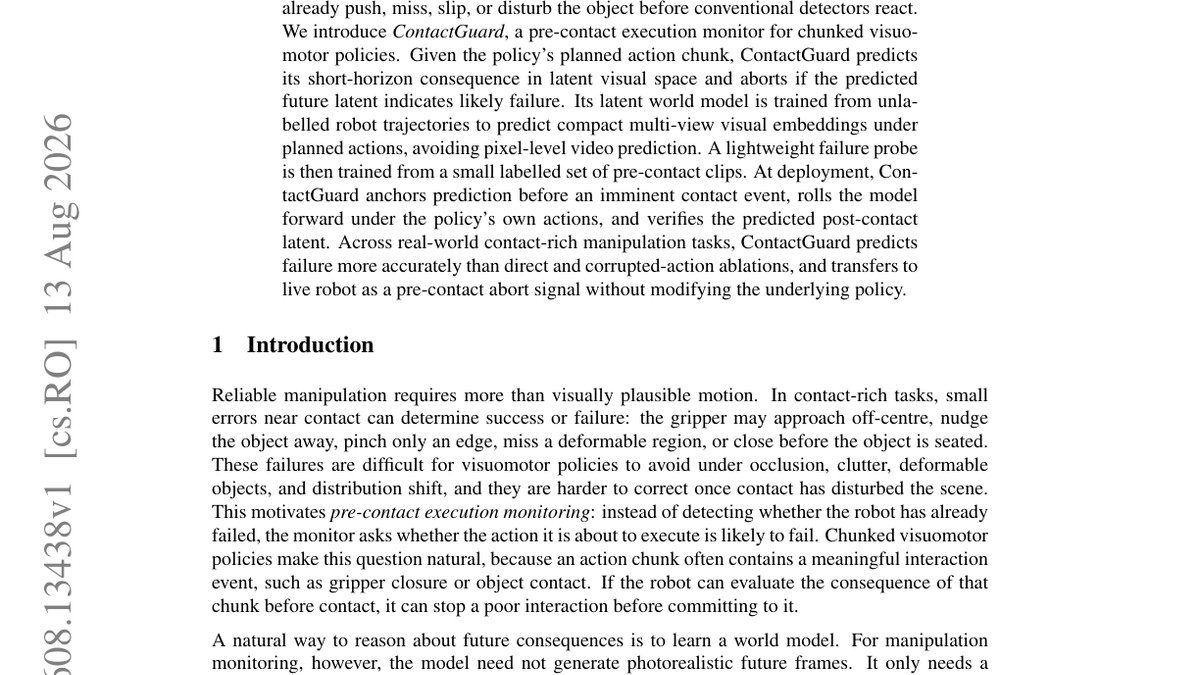
ContactGuard: Pre-Contact Execution Monitoring with Action-Conditioned Latent World Models
Gehan Zheng, Matthew Johnson-Roberson, Weiming Zhi · arXiv preprint · Aug 2026
Contact-rich manipulation failures are often detected only after the robot has committed to contact. This is especially limiting in wrist-camera setups: close gripper--object views help observe contact, but a poor approach may already push, miss, slip, or disturb the object before conventional de...
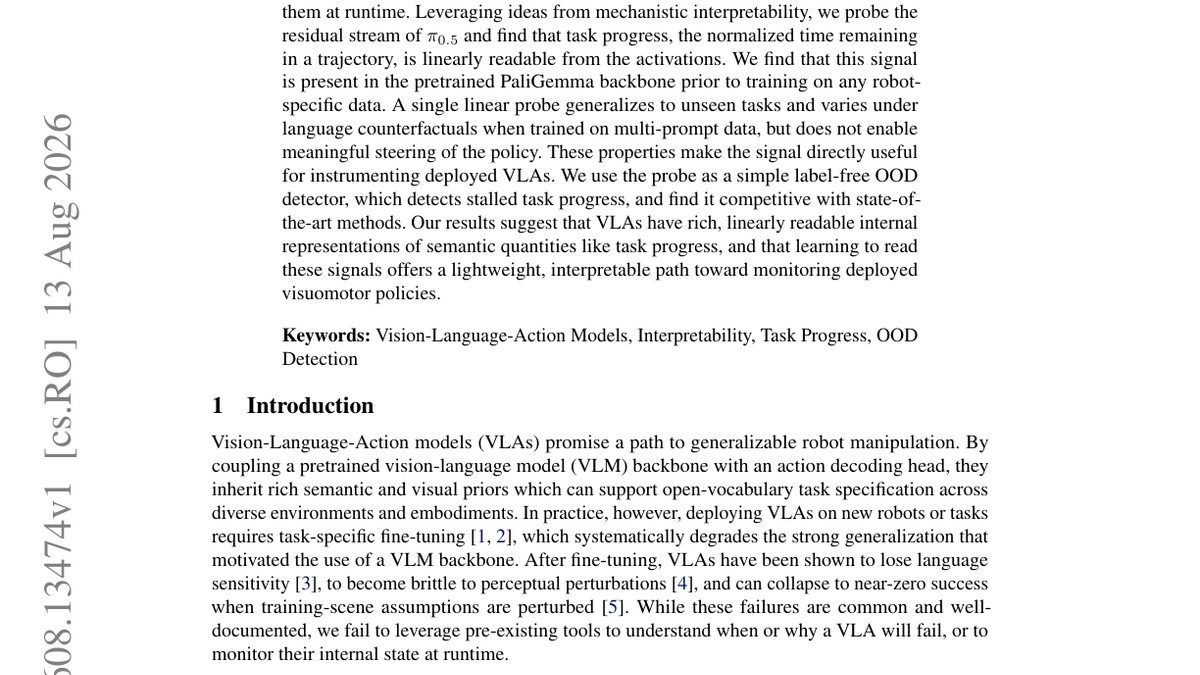
Decoding Task Progress from VLA Representations
Atiksh Bhardwaj, Edward Weiyi Duan, Prithwish Dan et al. · arXiv preprint · Aug 2026
Vision-language-action models (VLAs) are moving rapidly towards deployment as general-purpose manipulation policies, but we currently lack basic tools for understanding what these models represent internally or for monitoring them at runtime. Leveraging ideas from mechanistic interpretability, we...
DECOWAM: Decoupled Whole-Body World-Action Model for Legged Mobile Manipulation
Siyuan Ma, Boshi Zhang, Yutian Zhang et al. · arXiv preprint · Aug 2026
Mobile manipulation requires a robot to predict how locomotion and arm motion jointly alter future observations and control. Existing world-action models, developed largely for fixed-base platforms, do not explicitly distinguish camera ego-motion from base and arm actions. Here we introduce DECOW...