

Using Automated Vehicles Operational Data to Confirm Safety and Anticipate Threats
Riccardo Donà, Espedito Rusciano, Germana Trentadue, Anastasios Tsakalidis, Maria Cristina Galassi · N/A · 2026
Framework
N/A
License
N/A
Stars
N/A
Summary
European Union (EU) policymakers adopted revolutionary data collection provisions for Automated Driving Systems (ADS) in the recently approved regulation that allows driverless vehicles to be operated on public roads. The framework is inspired by best practices developed at the United Nations Eco...
Abstract Summary
Key Points
- European Union (EU) policymakers adopted revolutionary data collection provisions for Automated D...
- The framework is inspired by best practices developed at the United Nations Economic Commission f...
- The collection of real-world data will enable the competent safety authorities to gather the info...
- Safety-relevant driving scenarios discovered during the real-world operation of a given ADS can a...
- Moreover, lessons learnt deriving from the data collected can be shared among original equipment ...
Using Automated Vehicles Operational Data to Confirm Safety and Anticipate Threats
|Authors: Riccardo Donà, Espedito Rusciano, Germana Trentadue, Anastasios Tsakalidis, Maria Cristina Galassi
|Venue: arXiv preprint | Year: 2026
|arXiv: 2609.11549v1
Abstract
European Union (EU) policymakers adopted revolutionary data collection provisions for Automated Driving Systems (ADS) in the recently approved regulation that allows driverless vehicles to be operated on public roads. The framework is inspired by best practices developed at the United Nations Economic Commission for Europe(UNECE) level: the In-Service Monitoring and Reporting (ISMR); and by similar operational data collection regulatory approaches in nuclear energy production and transportation fields. The collection of real-world data will enable the competent safety authorities to gather the information needed to confirm the homologation safety target. Safety-relevant driving scenarios discovered during the real-world operation of a given ADS can also be stored in a scenario catalogue to investigate how other ADS types might have addressed such a traffic conflict. Moreover, lessons learnt deriving from the data collected can be shared among original equipment manufacturers (OEMs) and safety authorities. Ultimately, the ISMR is recognised as a necessary tool to properly tackle the challenges associated with ADS safety assessment given the number of unknowns that might remain undisclosed by leveraging the traditional homologation validation scheme only.
Key Contributions
- European Union (EU) policymakers adopted revolutionary data collection provisions for Automated D…
- The framework is inspired by best practices developed at the United Nations Economic Commission f…
- The collection of real-world data will enable the competent safety authorities to gather the info…
- Safety-relevant driving scenarios discovered during the real-world operation of a given ADS can a…
- Moreover, lessons learnt deriving from the data collected can be shared among original equipment …
Topics
- vision
- reinforcement-learning
Code & Data
No code repository linked in paper metadata.
BibTeX
@article{Donà2026_260911549v1,
  title     = {Using Automated Vehicles Operational Data to Confirm Safety and Anticipate Threats},
  author    = {Riccardo Donà and Espedito Rusciano and Germana Trentadue and Anastasios Tsakalidis and Maria Cristina Galassi},
  year      = {2026},
  eprint    = {2609.11549v1},
  archivePrefix = {arXiv},
  primaryClass  = {cs.RO},
  url       = {https://arxiv.org/abs/2609.11549v1}
}
Related Papers
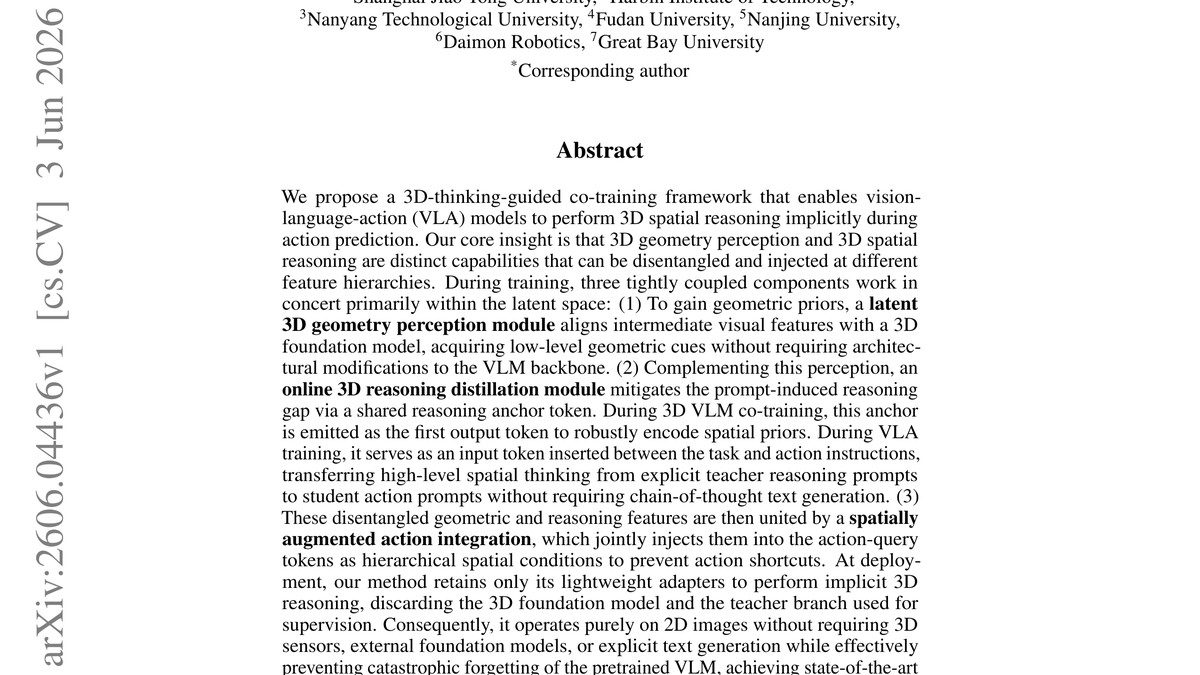
3DThinkVLA: Endowing Vision-Language-Action Models with Latent 3D Priors via 3D-Thinking-Guided Co-training
Jiaxin Shi, Xidong Zhang, Fucai Zhu et al. · arXiv preprint · Jun 2026
We propose a 3D-thinking-guided co-training framework that enables vision-language-action (VLA) models to perform 3D spatial reasoning implicitly during action prediction. Our core insight is that 3D geometry perception and 3D spatial reasoning are distinct capabilities that can be disentangled and ...
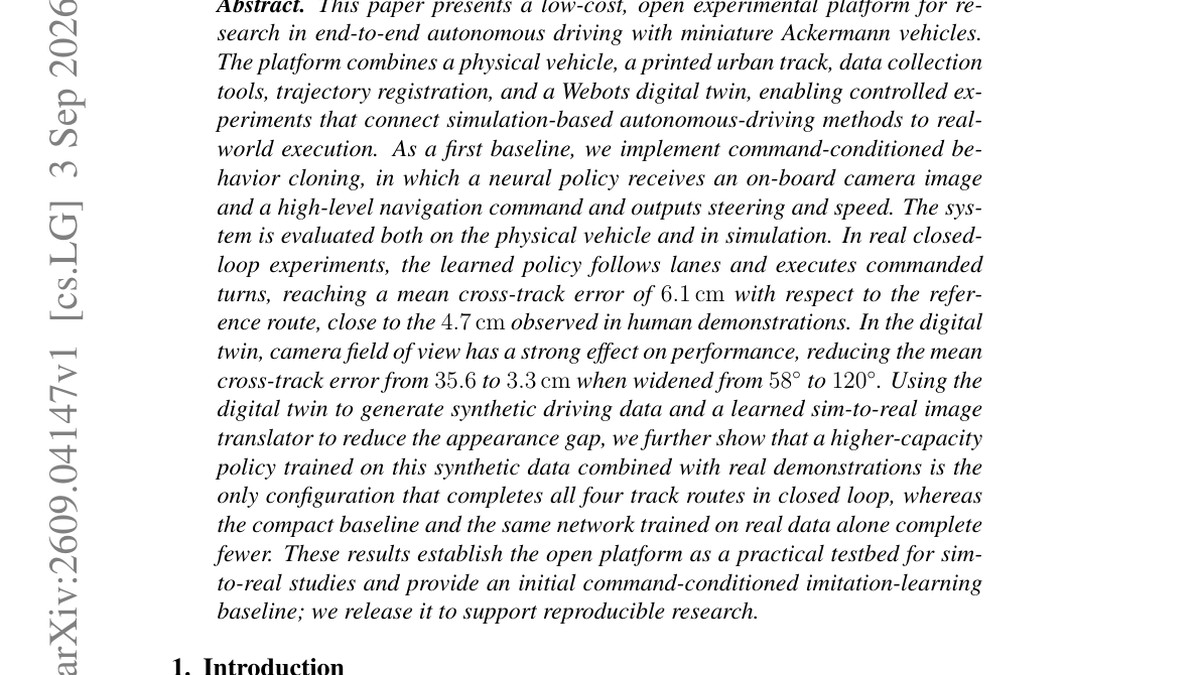
A Low-Cost, Open Platform for End-to-End Autonomous Driving on a Miniature Ackermann Vehicle
Gustavo Claudio Karl Couto, Eric Aislan Antonelo, Gabriel George Zipperer · arXiv preprint · Sep 2026
This paper presents a low-cost, open experimental platform for research in end-to-end autonomous driving with miniature Ackermann vehicles. The platform combines a physical vehicle, a printed urban track, data collection tools, trajectory registration, and a Webots digital twin, enabling controll...
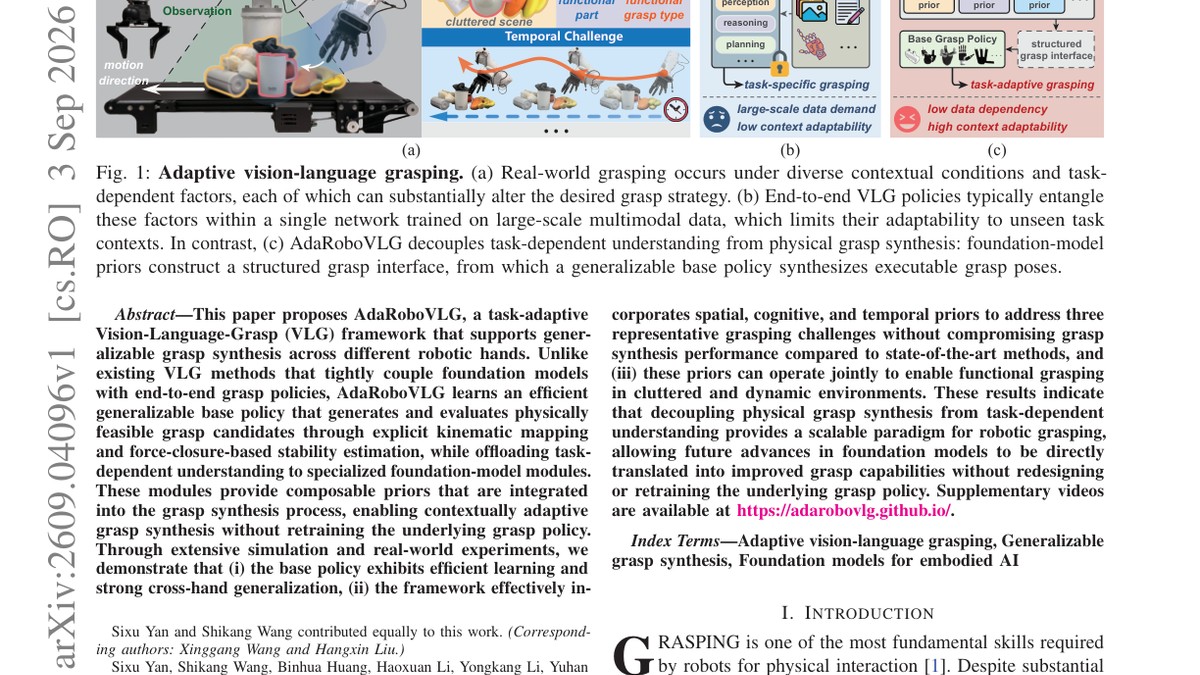
Adaptive Vision-Language Grasping via Composable Foundation Priors and Generalizable Grasp Synthesis
Sixu Yan, Shikang Wang, Binhua Huang et al. · arXiv preprint · Sep 2026
This paper proposes AdaRoboVLG, a task-adaptive Vision-Language-Grasp (VLG) framework that supports generalizable grasp synthesis across different robotic hands. Unlike existing VLG methods that tightly couple foundation models with end-to-end grasp policies, AdaRoboVLG learns an efficient genera...
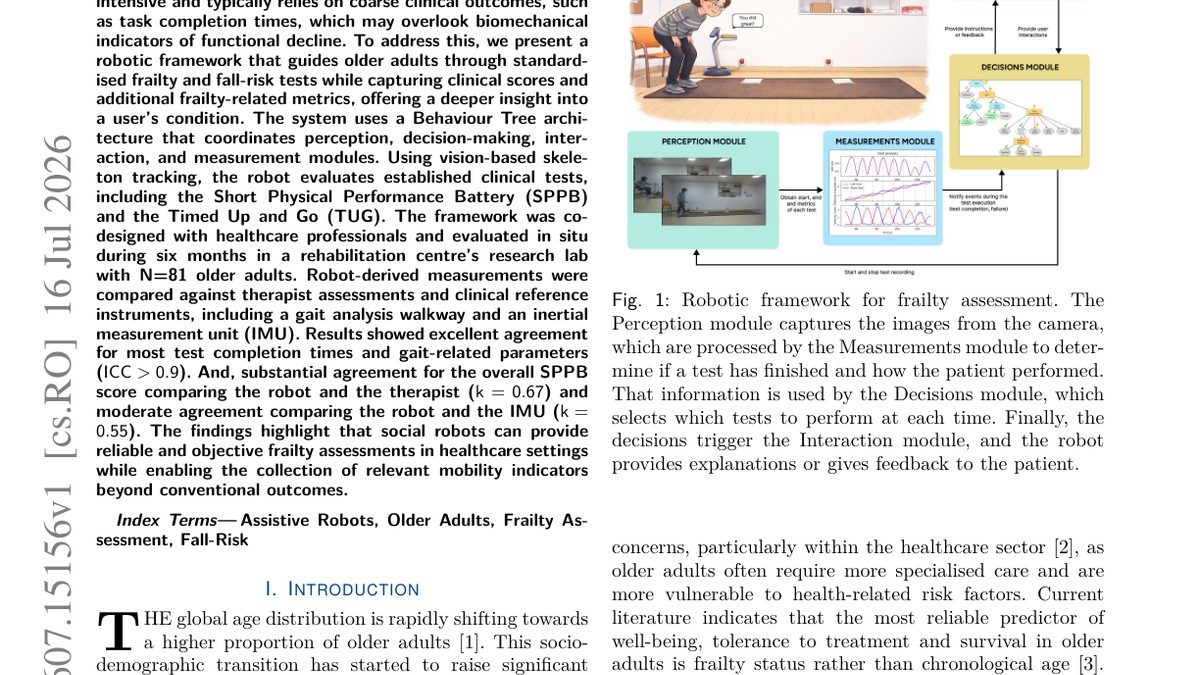
Assessing Physical Frailty and Fall-Risk Indicators with Social Robots: An in situ Evaluation with Older Adults
Aniol Civit, Antonio Andriella, Alba Martínez et al. · arXiv preprint · Jul 2026
Frailty assessments are crucial to evaluate the risk of adverse events and the health and social care needs of older adults, yet their administration remains resource-intensive and typically relies on coarse clinical outcomes, such as task completion times, which may overlook biomechanical indica...