
Assessing Physical Frailty and Fall-Risk Indicators with Social Robots: An in situ Evaluation with Older Adults
Aniol Civit, Antonio Andriella, Alba Martínez, Joan Ars, Aida Ribera, Cristian Barrué, Guillem Alenyà · N/A · 2026
Framework
N/A
License
N/A
Stars
N/A
Summary
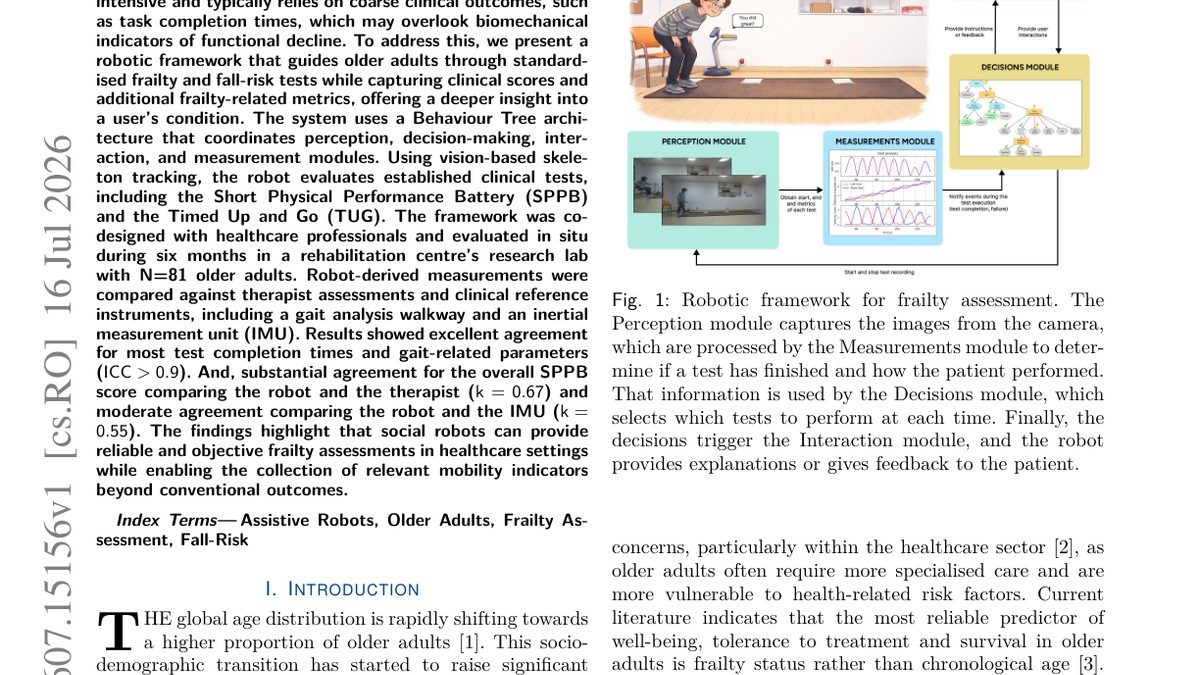
Frailty assessments are crucial to evaluate the risk of adverse events and the health and social care needs of older adults, yet their administration remains resource-intensive and typically relies on coarse clinical outcomes, such as task completion times, which may overlook biomechanical indica...
Abstract Summary
Key Points
- Frailty assessments are crucial to evaluate the risk of adverse events and the health and social ...
- To address this, we present a robotic framework that guides older adults through standardised fra...
- The system uses a Behaviour Tree architecture that coordinates perception, decision-making, inter...
- Using vision-based skeleton tracking, the robot evaluates established clinical tests, including t...
- The framework was co-designed with healthcare professionals and evaluated in situ during six mont...
Assessing Physical Frailty and Fall-Risk Indicators with Social Robots: An in situ Evaluation with Older Adults
|Authors: Aniol Civit, Antonio Andriella, Alba Martínez, Joan Ars, Aida Ribera, Cristian Barrué, Guillem Alenyà
|Venue: arXiv preprint | Year: 2026
|arXiv: 2607.15156v1
Abstract
Frailty assessments are crucial to evaluate the risk of adverse events and the health and social care needs of older adults, yet their administration remains resource-intensive and typically relies on coarse clinical outcomes, such as task completion times, which may overlook biomechanical indicators of functional decline. To address this, we present a robotic framework that guides older adults through standardised frailty and fall-risk tests while capturing clinical scores and additional frailty-related metrics, offering a deeper insight into a user’s condition. The system uses a Behaviour Tree architecture that coordinates perception, decision-making, interaction, and measurement modules. Using vision-based skeleton tracking, the robot evaluates established clinical tests, including the Short Physical Performance Battery (SPPB) and the Timed Up and Go (TUG). The framework was co-designed with healthcare professionals and evaluated in situ during six months in a rehabilitation centre’s research lab with N=81 older adults. Robot-derived measurements were compared against therapist assessments and clinical reference instruments, including a gait analysis walkway and an inertial measurement unit (IMU). Results showed excellent agreement for most test completion times and gait-related parameters ($ICC > 0.9$). And, substantial agreement for the overall SPPB score comparing the robot and the therapist ($k = 0.67$) and moderate agreement comparing the robot and the IMU ($k=0.55$). The findings highlight that social robots can provide reliable and objective frailty assessments in healthcare settings while enabling the collection of relevant mobility indicators beyond conventional outcomes.
Key Contributions
- Frailty assessments are crucial to evaluate the risk of adverse events and the health and social …
- To address this, we present a robotic framework that guides older adults through standardised fra…
- The system uses a Behaviour Tree architecture that coordinates perception, decision-making, inter…
- Using vision-based skeleton tracking, the robot evaluates established clinical tests, including t…
- The framework was co-designed with healthcare professionals and evaluated in situ during six mont…
Topics
- vision
- reinforcement-learning
- human-robot-interaction
- benchmark
Code & Data
No code repository linked in paper metadata.
BibTeX
@article{Civit2026_260715156v1,
  title     = {Assessing Physical Frailty and Fall-Risk Indicators with Social Robots: An in situ Evaluation with Older Adults},
  author    = {Aniol Civit and Antonio Andriella and Alba Martínez and Joan Ars and Aida Ribera and Cristian Barrué and Guillem Alenyà},
  year      = {2026},
  eprint    = {2607.15156v1},
  archivePrefix = {arXiv},
  primaryClass  = {cs.RO},
  url       = {https://arxiv.org/abs/2607.15156v1}
}
Related Papers
Beyond Episodic Evaluation: Memory Architectural Bottlenecks in Sequential Embodied Question Answering
Zikui Cai, Kaushal Janga, Tan Dat Dao et al. · arXiv preprint · Jul 2026
Embodied question answering (EQA) is traditionally evaluated under an episodic formulation, where agents solve each task independently and reset internal state between episodes. However, real-world robots operate continuously and must accumulate, retain, and selectively reuse information acquired...
Catalogue Photography as a Cold Start: Toward Deployable Carbide Burr Recognition
Abilash Philip Madavath, Chandra Yuvesh Aubeeluck, Augustin Raju et al. · arXiv preprint · Sep 2026
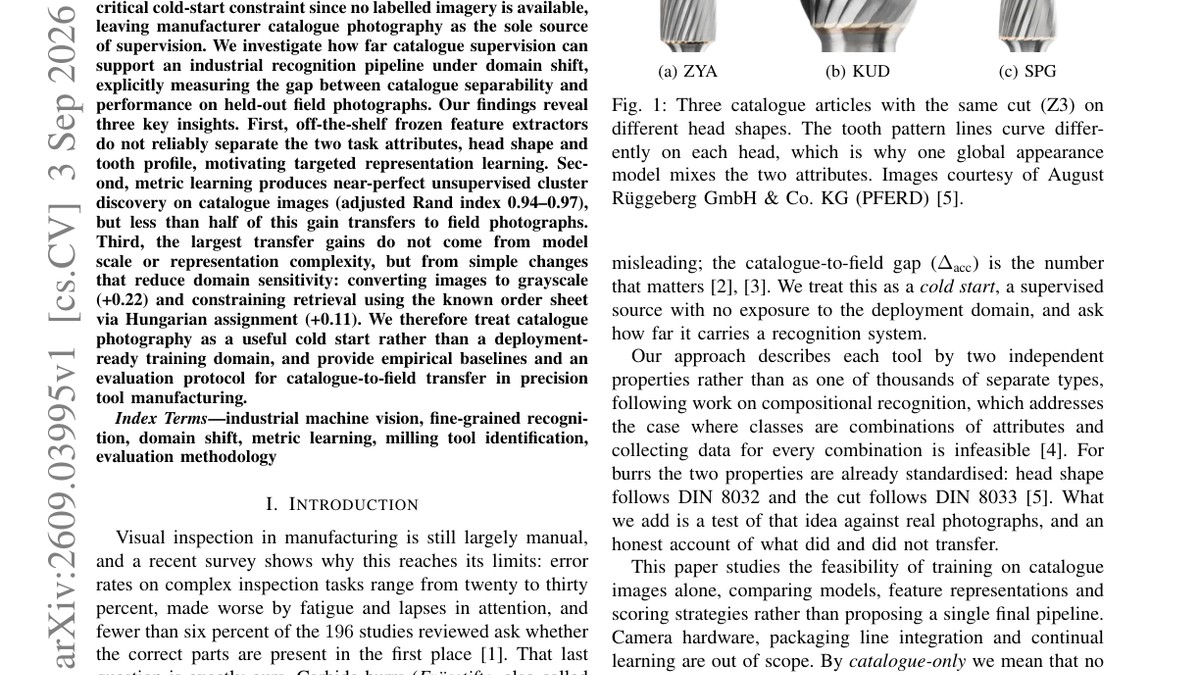
Verifying that manufactured batches of milling tools or carbide rotary burrs conform to production order sheets remains a largely manual and error-prone quality assurance task. Automating this process with computer vision faces a critical cold-start constraint since no labelled imagery is availab...
Catch, Throw, Repeat: Planning for Human-Robot Partner Juggling
Jonathan Rainer Lippert, Kai Ploeger, Abir Chowdhury et al. · arXiv preprint · Jul 2026
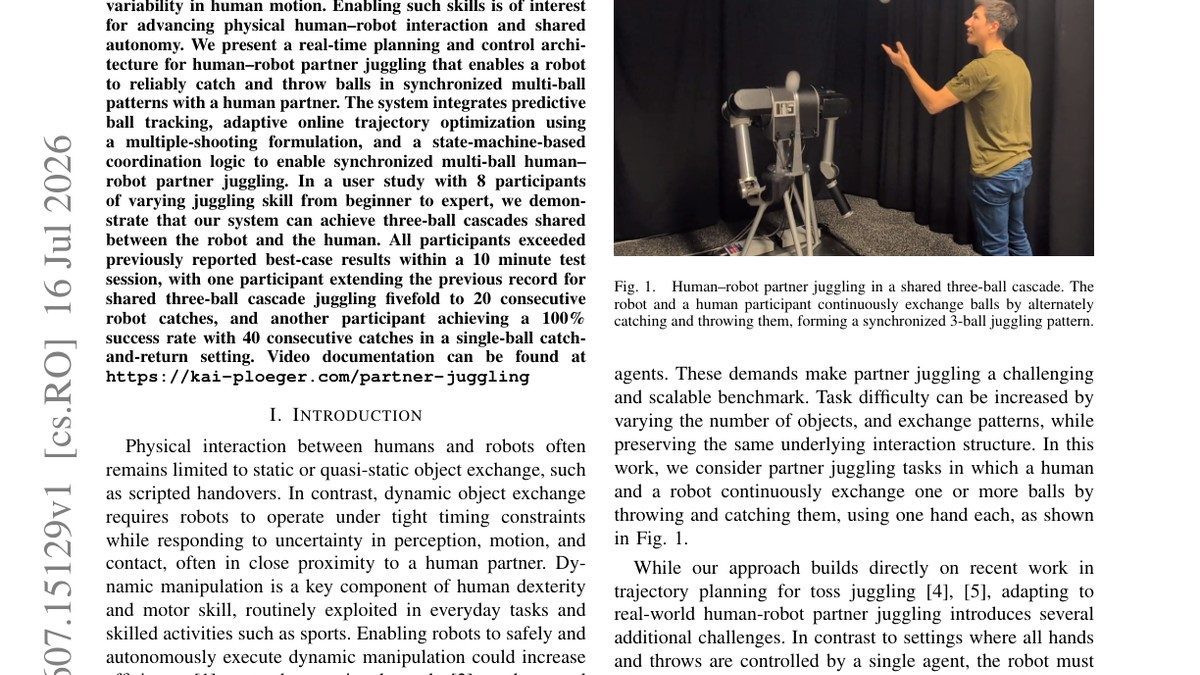
Dynamic object exchange between humans and robots remains a challenging problem due to uncertainty in perception, timing, and contact-rich interaction. Human-robot juggling represents a particularly demanding instance of this problem, requiring precise real-time coordination, predictive motion pl...

CrossDepth: Geometry-Constrained Attention for Generalizable Multi-View Surround Depth Estimation
Samer Abualhanud, Max Mehltretter · arXiv preprint · Sep 2026
Reliable 3D understanding of the surrounding environment is a core requirement for autonomous driving. Multi-view surround camera rigs provide broad scene coverage, but the spatially adjacent images typically overlap only minimally. Consequently, the depth of most pixels must be inferred from mon...