
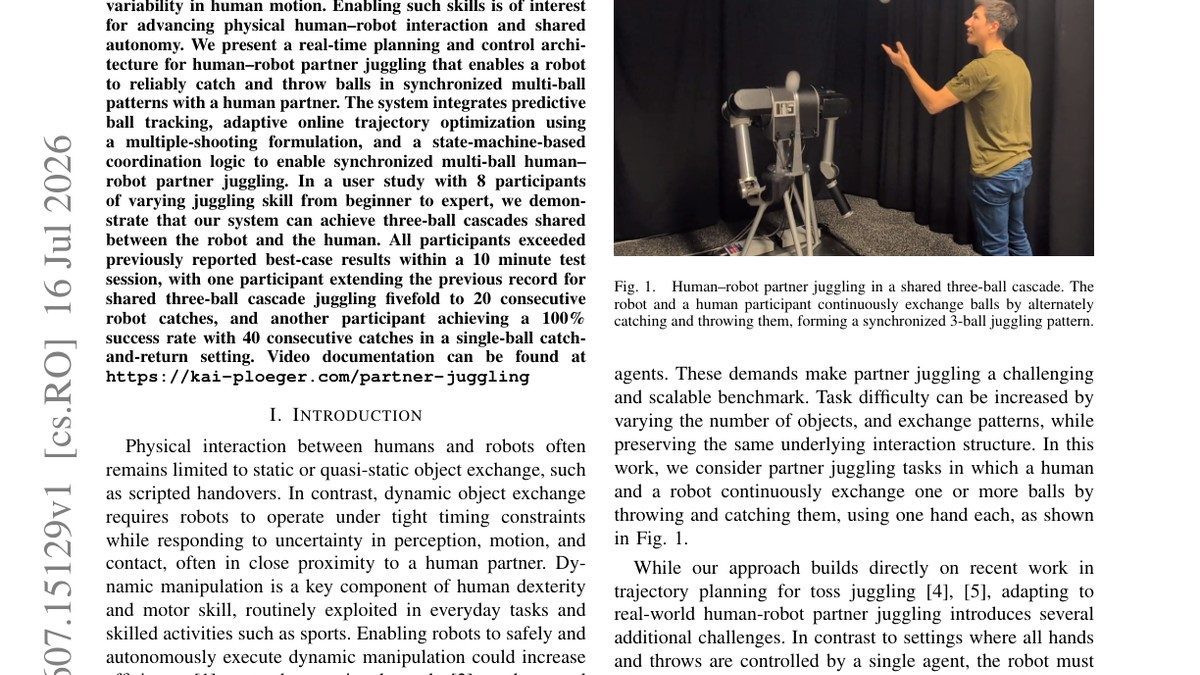
Catch, Throw, Repeat: Planning for Human-Robot Partner Juggling
Jonathan Rainer Lippert, Kai Ploeger, Abir Chowdhury, Hermann Müller, Jan Peters, Alap Kshirsagar · N/A · 2026
Framework
N/A
License
N/A
Stars
N/A
Summary
Dynamic object exchange between humans and robots remains a challenging problem due to uncertainty in perception, timing, and contact-rich interaction. Human-robot juggling represents a particularly demanding instance of this problem, requiring precise real-time coordination, predictive motion pl...
Abstract Summary
Key Points
- Dynamic object exchange between humans and robots remains a challenging problem due to uncertaint...
- Human-robot juggling represents a particularly demanding instance of this problem, requiring prec...
- Enabling such skills is of interest for advancing physical human-robot interaction and shared aut...
- We present a real-time planning and control architecture for human-robot partner juggling that en...
- The system integrates predictive ball tracking, adaptive online trajectory optimization using a m...
Catch, Throw, Repeat: Planning for Human-Robot Partner Juggling
|Authors: Jonathan Rainer Lippert, Kai Ploeger, Abir Chowdhury, Hermann Müller, Jan Peters, Alap Kshirsagar
|Venue: arXiv preprint | Year: 2026
|arXiv: 2607.15129v1
Abstract
Dynamic object exchange between humans and robots remains a challenging problem due to uncertainty in perception, timing, and contact-rich interaction. Human-robot juggling represents a particularly demanding instance of this problem, requiring precise real-time coordination, predictive motion planning with feedback control, and robustness to variability in human motion. Enabling such skills is of interest for advancing physical human-robot interaction and shared autonomy. We present a real-time planning and control architecture for human-robot partner juggling that enables a robot to reliably catch and throw balls in synchronized multi-ball patterns with a human partner. The system integrates predictive ball tracking, adaptive online trajectory optimization using a multiple-shooting formulation, and a state-machine-based coordination logic to enable synchronized multi-ball human-robot partner juggling. In a user study with 8 participants of varying juggling skill from beginner to expert, we demonstrate that our system can achieve three-ball cascades shared between the robot and the human. All participants exceeded previously reported best-case results within a 10-minute test session, with one participant extending the previous record for shared three-ball cascade juggling fivefold to 20 consecutive robot catches, and another participant achieving a 100% success rate with 40 consecutive catches in a single-ball catch-and-return setting. Video documentation can be found at https://kai-ploeger.com/partner-juggling
Key Contributions
- Dynamic object exchange between humans and robots remains a challenging problem due to uncertaint…
- Human-robot juggling represents a particularly demanding instance of this problem, requiring prec…
- Enabling such skills is of interest for advancing physical human-robot interaction and shared aut…
- We present a real-time planning and control architecture for human-robot partner juggling that en…
- The system integrates predictive ball tracking, adaptive online trajectory optimization using a m…
Topics
- vision
- reinforcement-learning
- planning
- control
- human-robot-interaction
Code & Data
No code repository linked in paper metadata.
BibTeX
@article{Lippert2026_260715129v1,
  title     = {Catch, Throw, Repeat: Planning for Human-Robot Partner Juggling},
  author    = {Jonathan Rainer Lippert and Kai Ploeger and Abir Chowdhury and Hermann Müller and Jan Peters and Alap Kshirsagar},
  year      = {2026},
  eprint    = {2607.15129v1},
  archivePrefix = {arXiv},
  primaryClass  = {cs.RO},
  url       = {https://arxiv.org/abs/2607.15129v1}
}
Related Papers
A Low-Cost, Open Platform for End-to-End Autonomous Driving on a Miniature Ackermann Vehicle
Gustavo Claudio Karl Couto, Eric Aislan Antonelo, Gabriel George Zipperer · arXiv preprint · Sep 2026
This paper presents a low-cost, open experimental platform for research in end-to-end autonomous driving with miniature Ackermann vehicles. The platform combines a physical vehicle, a printed urban track, data collection tools, trajectory registration, and a Webots digital twin, enabling controll...
Development of a Humanoid Robot Prototype for Multimodal Human-Robot Interaction
Thang Tran Viet, Thanh Nguyen Canh, Huy Uong Gia et al. · arXiv preprint · Sep 2026
Human-robot interaction (HRI) enables intuitive and intelligent collaboration between humans and robots in real-world environments. This paper introduces a humanoid robot prototype designed as a flexible testbed for developing and integrating artificial intelligence (AI) modules in HRI tasks. The...
ErgoSurf: Ergodic Control for the Coverage of Unknown Surfaces
Stefan Schneyer, Timo Bachmann, Maged Iskandar et al. · arXiv preprint · Aug 2026
Contact-centric tasks on surfaces, ranging from inspection and cleaning to sanding and polishing, require robots to systematically cover the surface while maintaining stable contact. Ergodic control generates trajectories that spend time at a location proportional to a desired, task-specific spat...
EVPeriscope: Extended Perception across Aerial and Ground Vehicles with Event-based Propeller Tracking
Dexter Ong, Vijay Kumar, Pratik Chaudhari · arXiv preprint · Sep 2026
Reliable relative localization between aerial and ground robots is a key requirement for tightly coordinated heterogeneous teams. This can be difficult to do using conventional frame-based cameras and fiducial markers because they are sensitive to motion blur, lighting variations, and payload con...